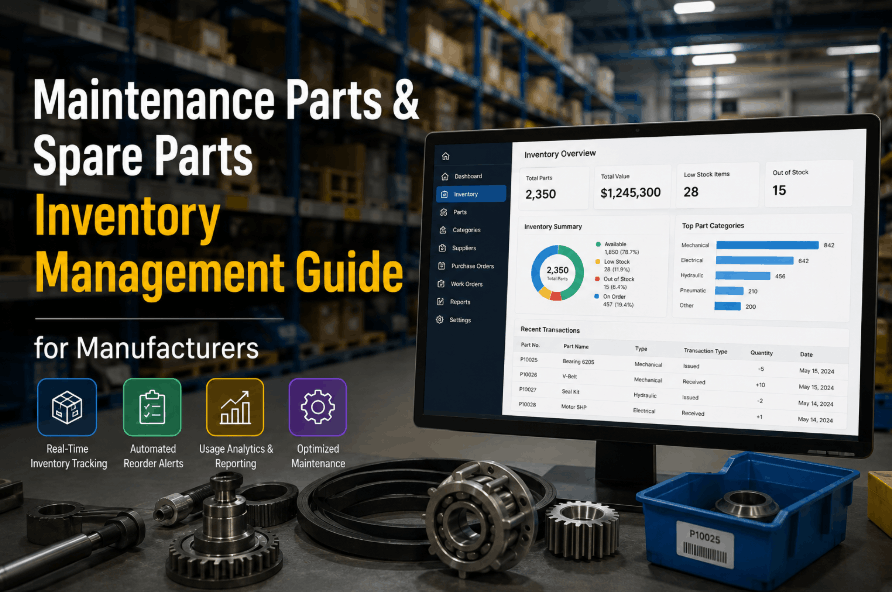
Manufacturing Plant Spare Parts Inventory Management: Optimization Guide
By oxmaint on February 10, 2026
Every manufacturing plant relies on a storeroom full of spare parts to keep production lines running. Yet most facilities manage this critical asset with outdated spreadsheets, guesswork, and reactive purchasing that leads to expensive emergency orders and unnecessary downtime. With unplanned equipment failures costing manufacturers between $10,000 and $50,000 per hour in lost production, the difference between a well-managed inventory and a chaotic one directly impacts your bottom line. A structured approach to spare parts optimization — powered by the right CMMS tools — can reduce carrying costs by up to 30% while virtually eliminating stockout-driven downtime. Schedule a free consultation to see how Oxmaint can transform your storeroom operations.
The Hidden Price Tag of Inventory Mismanagement
When a production line stops because a $12 bearing is missing from the storeroom, the real cost is not the bearing — it is the cascade of idle workers, missed shipments, and emergency freight charges that follow. Poor spare parts management creates a cycle of reactive spending that most plants never fully quantify.
$260K
Average hourly cost of unplanned downtime across manufacturing sectors
29%
Of manufacturers cite missing spare parts as the primary cause of extended downtime
27 hrs
Monthly machine downtime at large facilities — much of it preventable with proper parts stocking
Stop bleeding money from stockouts and emergency orders. Oxmaint gives your maintenance team real-time visibility into every part across every storeroom location.
Not every part in your storeroom deserves the same attention. ABC analysis segments inventory by annual consumption value, while XYZ analysis layers on demand predictability. Together, they tell you exactly where to invest management effort and where to apply lighter controls — ensuring your team focuses on the parts that truly move the needle on uptime and cost.
The goal of inventory optimization is simple: have every part available when needed without tying up excess capital in your storeroom. Three core formulas drive this balance — reorder points that trigger purchases at the right moment, safety stock that buffers against uncertainty, and economic order quantities that minimize total procurement and holding costs.
Reorder Point
ROP = (Daily Usage x Lead Time) + Safety Stock
Triggers a purchase order automatically when stock drops to this level. A bearing used 3/day with 7-day lead and 10-unit safety stock = ROP of 31 units.
Safety Stock
SS = Z x σd x √LT
Z = service level factor (1.65 for 95%, 2.33 for 99%). Higher service levels for production-critical equipment. Accounts for demand variability and lead time uncertainty.
Economic Order Quantity
EOQ = √(2DS / H)
D = annual demand, S = order cost, H = annual holding cost per unit. Minimizes the total of ordering and carrying costs for predictable-demand items.
Let Oxmaint calculate reorder points and safety stock automatically. Book a demo to see how smart alerts prevent stockouts before they happen.
A well-organized storeroom is the physical foundation of every reliable maintenance operation. When technicians can locate the exact part they need in under two minutes — even during a night shift emergency — mean time to repair drops dramatically and production recovers faster. These six disciplines turn a cluttered stockroom into a precision parts operation that Oxmaint helps you manage digitally from day one.
Six Pillars of Storeroom Excellence
1
One SKU, One Part
Eliminate duplicates by creating a single SKU per component with standardized naming. Capture manufacturer part number, unit of measure, cost, lead time, and criticality. Attach photos and spec sheets for fast identification.
2
Location Precision
Map every bin using Aisle-Bay-Shelf-Bin codes. Print large, legible labels and maintain a digital storeroom layout so any technician — including new hires — can pick the right part without help.
3
Controlled Access
Restrict entry to authorized personnel using badge readers and service counters. Log every issue and return digitally. Uncontrolled access is the single fastest path to inventory inaccuracy.
4
BOM-Linked Kitting
Tie complete Bills of Materials to each asset and preventive maintenance task. Pre-assemble PM kits so technicians grab one package instead of hunting for individual items across multiple shelves.
5
Rolling Cycle Counts
Replace painful annual audits with continuous counting. Count Category A items monthly, B quarterly, C annually. Investigate every discrepancy immediately to maintain 97%+ accuracy year-round.
6
Obsolescence Purge
Flag items with zero consumption for 18+ months. Cross-check against active equipment lists quarterly. Dispose, return, or transfer dead stock to free shelf space and reclaim tied-up capital.
What Changes When You Move from Spreadsheets to a CMMS
The leap from manual tracking to a CMMS-powered inventory system is not incremental — it is transformational. Every process that used to depend on memory, paper logs, or tribal knowledge becomes automated, auditable, and visible in real time.
The Inventory Transformation
Before: Manual Tracking
Handwritten logs and spreadsheet counts
Parts discovered missing only after equipment fails
No connection between work orders and parts consumed
Duplicate SKUs across different naming conventions
Annual physical counts that disrupt operations for days
below 80%typical inventory accuracy in manually-managed storerooms
After: Oxmaint CMMS
Barcode and QR scanning with real-time stock updates
Automated alerts trigger reorders at min thresholds
Every part auto-linked to work orders, assets, and BOMs
Centralized master catalog with de-duplication tools
97%+inventory accuracy with CMMS-driven cycle counting programs
Replace Guesswork with Real-Time Inventory Intelligence
Oxmaint connects your storeroom to your maintenance workflow — linking every spare part to the assets it supports, the work orders that consume it, and the purchase orders that replenish it. One platform for complete parts visibility.
Measuring What Matters: Inventory KPIs That Drive Results
Optimizing spare parts inventory is not a one-time project — it is a continuous discipline. These key performance indicators help maintenance leaders monitor storeroom health, justify improvement investments, and benchmark performance against industry standards.
97%+
Inventory Accuracy
System count vs. physical count. The foundation of every planning decision — inaccurate data causes false stockouts and over-ordering.
<2%
Stockout Rate
Percentage of requisitions unfilled due to zero stock. Directly correlates with downtime duration and emergency purchase costs.
2-4x
Inventory Turnover
Annual usage value divided by average inventory value. Shows whether capital is cycling efficiently or trapped in slow-moving stock.
90%+
First-Time Fix Rate
Work orders completed on first visit with parts available. Measures whether stocking decisions actually support maintenance speed.
<5%
Dead Stock Ratio
Inventory with no movement in 18+ months. Highlights obsolete items consuming shelf space and capital that should be freed up.
15-25%
Carrying Cost Rate
Annual holding cost as percentage of inventory value. Includes storage, insurance, depreciation, and opportunity cost of tied-up capital.
Track all these KPIs from a single dashboard.Create your free Oxmaint account and start measuring storeroom performance from day one.
Spare parts challenges vary dramatically across industries. An automotive plant running just-in-time production has zero tolerance for stockouts, while a pharmaceutical facility must track validated components with full audit trails. Understanding your sector's unique requirements is the first step toward building a parts program that actually fits your operation.
Parts Strategy by Industry
Sector
Critical Components
Primary Challenge
Recommended Approach
Automotive
Robot arms, servo drives, PLCs, welding tips
JIT production = zero tolerance for missing parts
Vendor-managed inventory, consignment stocking for top 50 SKUs
Food & Beverage
Seals, gaskets, conveyor belts, temperature sensors
FDA traceability requirements for food-grade materials
Lot tracking, shelf-life alerts, automated expiration management
Pharmaceutical
Cleanroom filters, pumps, calibration instruments
Validated parts with strict change control documentation
Transforming a disorganized storeroom does not require a massive capital project. A phased approach delivers measurable wins within the first month while building the systems and disciplines for long-term optimization. Book a consultation with Oxmaint to get a roadmap customized for your facility.
Implementation Journey
Week 1-2
Audit & Baseline
Full physical count. Identify duplicate SKUs. Document current stockout frequency, carrying costs, and emergency order spend.
Week 3-4
Classify & Organize
Run ABC-XYZ analysis. Assign bin locations. Label all storage. Set initial min/max levels based on consumption history and lead times.
Week 5-6
Go Live with Oxmaint
Import master data. Link parts to assets and BOMs. Configure automated reorder alerts. Train technicians on barcode scanning and digital issue/return.
Ongoing
Optimize & Expand
Launch cycle counting. Refine reorder points with actual usage data. Roll out multi-site visibility. Review dead stock quarterly.
Your Storeroom Should Work as Hard as Your Team
Oxmaint brings together real-time inventory tracking, automated reorder alerts, work order integration, and ABC classification into one intuitive platform. Stop losing production hours to missing parts — start running a lean, high-performing spare parts operation that supports uptime and cuts costs across every facility.
How much can we realistically save by optimizing spare parts inventory?
Plants that implement structured ABC classification, calculated safety stock levels, and automated reorder points typically reduce total carrying costs by 20-30% within the first year. The savings come from eliminating overstocked items, clearing dead stock, and stopping emergency purchases that carry premium pricing and expedited freight charges. Schedule a consultation to estimate savings for your specific operation.
What is the difference between spare parts inventory and MRO inventory?
Spare parts are replacement components for equipment — motors, bearings, pumps, seals, and similar items used to repair or replace failed machine parts. MRO (Maintenance, Repair, and Operations) is the broader category that includes spare parts plus consumables like lubricants, cleaning supplies, safety gear, and hand tools. Both should be tracked within your CMMS for complete visibility into maintenance spending.
How do we decide which critical spares to keep in stock?
Run a criticality analysis that weighs four factors: how important the equipment is to production, how often the part fails, how long the supplier takes to deliver it, and what downtime costs if the part is unavailable. Parts for production-critical equipment with long lead times and high downtime impact should always be stocked. Sign up for Oxmaint to use built-in criticality tools that guide every stocking decision.
Can Oxmaint manage inventory across multiple plant locations?
Yes. Oxmaint provides centralized visibility across all storerooms and facilities, enabling inter-site part transfers, consolidated purchasing, and standardized SKU catalogs. A maintenance manager can view stock levels at every location from one dashboard, and the system can recommend transferring a nearby part instead of placing an expensive rush order.
How long does it take to implement a CMMS for spare parts management?
Most manufacturing plants complete core Oxmaint implementation for inventory management in 4-6 weeks, including data migration, user training, and configuration of automated alerts and reorder rules. Quick wins from improved visibility and automated reordering are typically visible within the first 30 days. Book a demo to get a detailed timeline for your facility.