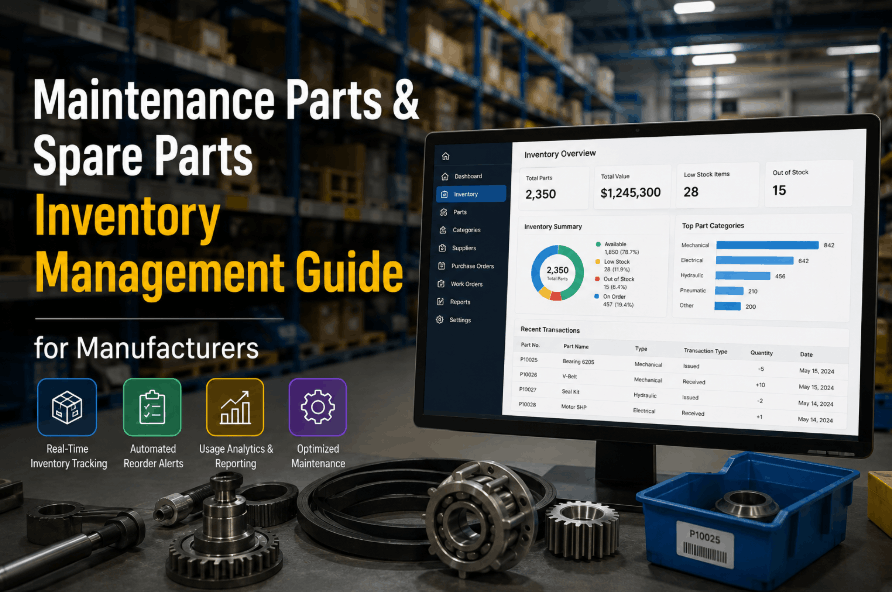
Maintenance spare parts inventory management is the operational foundation that determines whether your facility runs or fails. When the right MRO part is unavailable at the moment of a breakdown, every minute of unplanned downtime compounds into lost production, emergency sourcing costs, and strained technician schedules. Oxmaint gives maintenance planners a Sign Up Free path to replace reactive, spreadsheet-driven parts management with a fully integrated CMMS storeroom system — one that tracks stock levels, automates reorder triggers, manages vendor lead times, and links every part directly to the assets and work orders that consume it. Whether you manage a single storeroom or a multi-site MRO warehouse network, the right spare parts management system eliminates stockouts, cuts excess inventory carrying costs, and keeps your maintenance team working without interruption. Book a Demo to see how leading manufacturers manage their full parts inventory lifecycle inside Oxmaint.
MRO INVENTORY · SPARE PARTS MANAGEMENT · CMMS
Manage Your Entire Spare Parts Inventory Inside Oxmaint
Automate reorder points, link parts to assets and work orders, track storeroom consumption, and eliminate stockouts — all from one live CMMS dashboard.
Why Spare Parts Inventory Management Fails in Manufacturing Facilities
Most manufacturing storerooms operate on tribal knowledge — senior technicians who remember where parts are kept, informal reorder habits, and spreadsheets that are weeks out of date. When those systems break down, maintenance teams face stockouts on critical components, overstocked slow-movers consuming budget, and zero visibility into actual parts consumption rates. Sign Up Free to build a CMMS-connected parts inventory that updates in real time with every work order closed.
COMMON SPARE PARTS INVENTORY FAILURES IN MANUFACTURING
01
Stockouts During Critical Failures
Critical spare parts are unavailable at breakdown, forcing emergency procurement at premium freight costs and extending downtime by hours or days.
02
No Reorder Point Automation
Without automated min/max triggers, reorders depend on technician memory — leading to both stockouts and excess inventory buildup on slow-moving parts.
03
Parts Not Linked to Assets
Disconnected storeroom and asset records make it impossible to know which parts are consumed by which equipment — preventing accurate demand forecasting.
04
No Consumption Visibility
Paper-based or spreadsheet storerooms provide zero real-time visibility into parts usage, making it impossible to identify high-consumption items or cost drivers.
05
Duplicate and Obsolete Parts
Without a centralized parts catalog, the same component is purchased under multiple part numbers — inflating inventory counts and wasting storeroom space.
06
Vendor Lead Time Blind Spots
Long-lead critical parts are ordered without accounting for supplier lead times, leaving the facility exposed during supply chain disruptions or seasonal demand peaks.
MRO Spare Parts Classification: The ABC-XYZ Framework for Manufacturing
Effective maintenance parts management starts with proper classification. The ABC-XYZ matrix segments your MRO inventory by consumption value and demand variability — ensuring the right stocking strategy is applied to each part class. Book a Demo to see how Oxmaint's parts catalog supports multi-tier classification and automated stocking policy assignment.
ABC-XYZ MRO CLASSIFICATION MATRIX
A-X
High value, top 70–80% of spend
Predictable, steady consumption
Tight min/max, lean buffer stock
Automated reorder point trigger
A-Y
High value spend
Variable, seasonal demand
Safety stock with demand review
Periodic review + forecast input
B-X
Medium value spend
Predictable consumption
Standard min/max policy
Automated min/max reorder
B-Z
Medium value spend
Irregular, unpredictable
Higher safety stock buffer
Manual review with alerts
C-X/Y
Low value, bottom 5–10% of spend
Predictable to variable
Bulk stocking, low review frequency
Periodic bulk reorder
C-Z
Low value, slow movers
Rare, sporadic demand
Consignment or on-demand only
Vendor-managed or eliminate
Setting Spare Parts Reorder Points and Safety Stock Levels
Reorder point calculation is the mathematical core of spare parts inventory optimization. Without accurate reorder triggers, facilities either run out of critical stock or tie up working capital in excess inventory. Oxmaint automates reorder point management per part — Book a Demo to see how the inventory engine handles multi-location stock levels and supplier lead time inputs.
Storeroom Layout and Parts Locator Best Practices for Manufacturing
A well-organized maintenance storeroom reduces technician search time, prevents unauthorized parts withdrawal, and improves inventory accuracy. Physical organization and digital parts locator systems inside your CMMS work together to eliminate the "storeroom as black box" problem. Sign Up Free to configure your parts catalog with bin locations, shelf codes, and asset linkages inside Oxmaint.
STOREROOM ORGANIZATION PRINCIPLES
01
Zone by Criticality
Position critical and high-turnover parts closest to the storeroom counter. Place slow-movers and safety stock reserves in deeper storage zones.
02
Bin-Level Location Coding
Assign alphanumeric bin codes (Row-Shelf-Bin) to every SKU. Record bin locations in the CMMS parts catalog so technicians can locate parts via mobile search.
03
Controlled Access Zones
Restrict direct storeroom access. Issue parts only through work order-linked transactions to maintain accurate on-hand counts and reduce shrinkage.
04
FIFO Rotation for Consumables
Apply first-in, first-out rotation for filters, seals, gaskets, and lubricants to prevent shelf-life expiration of maintenance consumables.
05
Shadow Boards for Shop Floor Kits
Use shadow boards near production lines for frequently accessed consumables. Link each shadow board kit to a recurring work order for automated restocking triggers.
06
Cycle Count Schedule
Replace annual physical inventory with continuous cycle counting — count A-class parts monthly, B-class quarterly, C-class semi-annually — using CMMS count worksheets.
Spare Parts Kitting for Planned Maintenance Work Orders
Parts kitting is the practice of pre-assembling all required components for a planned maintenance task before the work order is released to the technician. Kitting eliminates mid-job storeroom trips, reduces wrench time loss, and ensures planned shutdowns start with all materials staged and ready. Sign Up Free and link your Oxmaint work order templates to bill-of-materials kits for every recurring PM task.
PARTS KITTING BY MAINTENANCE WORK ORDER TYPE
Weekly PM — Conveyor
Lubricant, grease gun, filter, rags, belt tension gauge
1 day prior to WO date
Auto BOM link on WO creation
Monthly PM — Motor
Bearing, seal kit, electrical tape, torque specs sheet
2–3 days prior
Storeroom pick list generation
Quarterly — HVAC Overhaul
Filter sets, belts, coil cleaner, refrigerant, drain treatment
1 week prior
Parts reservation + pick staging
Annual Shutdown — Boiler
Refractory materials, valves, gasket sets, insulation, test kits
4–6 weeks prior (long-lead)
Lead-time aware procurement alerts
Corrective — Pump Repair
Seal kit, impeller, coupling, gaskets, alignment tools
Same-day from storeroom stock
Asset-linked parts lookup on WO
How Oxmaint Integrates Spare Parts Inventory with Your CMMS Workflow
Parts management isolated from your CMMS is just a stockroom ledger. When spare parts inventory is fully integrated with work orders, asset records, and PM schedules, every part transaction is traced, every consumption trend is visible, and every reorder is triggered before a stockout occurs. Book a Demo to see the full Oxmaint parts-to-work-order integration in a live manufacturing environment.
HOW OXMAINT POWERS SPARE PARTS INVENTORY MANAGEMENT
01
Parts Catalog with Asset Linkage
Every part in the Oxmaint catalog is linked to the assets and equipment it services — enabling asset-specific BOM lookups directly from the work order screen.
02
Automated Reorder Point Triggers
Set min/max thresholds per part and per location. When stock falls below the reorder point, Oxmaint automatically creates a purchase request and notifies the storeroom manager.
03
Work Order Parts Consumption Tracking
When a technician closes a work order, parts consumed are automatically deducted from on-hand inventory — keeping stock counts accurate without manual data entry.
04
Vendor and Lead Time Management
Record preferred vendors, unit costs, and lead times per part. Oxmaint uses lead time data to advance reorder triggers for long-lead critical spares before stockout risk appears.
05
Multi-Location Inventory Control
Track the same part across multiple storerooms, warehouses, or plant sites. Transfer parts between locations inside Oxmaint with full transaction audit trail.
06
Parts Cost and Spend Reporting
Generate parts spend reports by asset, cost center, or time period. Identify high-consumption parts, cost per asset, and MRO budget trends from the live Oxmaint dashboard.
Spare Parts Inventory KPIs Every Maintenance Manager Should Track
Storeroom performance measurement turns parts management from a cost center into a strategic function. The following KPIs give maintenance managers and operations leadership the visibility needed to continuously optimize their MRO inventory investment. Book a Demo to see Oxmaint's live parts inventory dashboards and KPI reporting capabilities.
MRO INVENTORY PERFORMANCE METRICS
Parts Fill Rate
Parts Issued on First Request / Total Parts Requested × 100
Target: ≥ 95%
Measures storeroom service level — the percentage of parts requests fulfilled from stock without backorder or emergency sourcing.
Inventory Turnover
Annual Parts Consumption Value / Average Inventory Value
Target: 2–4× for MRO
Low turnover signals overstocking and excessive carrying costs. High turnover with frequent stockouts signals under-stocking and poor reorder discipline.
Stockout Rate
Parts Requests Unfulfilled / Total Parts Requests × 100
Target: < 2%
The single most impactful KPI for maintenance operations. Every stockout event represents potential unplanned downtime and emergency procurement cost.
Obsolete Stock Ratio
Value of Zero-Movement Parts (12 mo.) / Total Inventory Value × 100
Target: < 5%
Tracks dead inventory — parts that have not been consumed in 12 months — which represent wasted capital and should be reviewed for disposal or return to vendor.
Inventory Accuracy
Accurate Bin Count / Total Bins Counted × 100 (Cycle Count)
Target: ≥ 98%
Measures the gap between system on-hand counts and physical bin quantities. Low accuracy undermines reorder triggers and creates false stockout or overstock signals.
MRO Spend per Work Order
Total MRO Parts Cost / Total Work Orders Closed
Benchmark vs. prior period
Tracks materials cost efficiency across the maintenance program. Rising cost per work order indicates reactive repair trends — a signal to strengthen the PM program.
SPARE PARTS OPTIMIZATION · STOREROOM CONTROL · MRO CMMS
Replace Your Spreadsheet Storeroom with Oxmaint's Live Parts Inventory
Automated reorder points, asset-linked BOM kits, work order consumption tracking, and real-time MRO spend dashboards — go live in days, not months.
Frequently Asked Questions
Q1 What is maintenance spare parts inventory management?
It is the process of stocking, tracking, and replenishing the MRO components required to maintain production assets — ensuring parts are available at the point of need without tying up excess capital in idle inventory.
Q2 How do I calculate the reorder point for a spare part?
Reorder Point = (Average Daily Usage × Supplier Lead Time) + Safety Stock. Oxmaint allows you to input these values per part and automates the reorder trigger when on-hand stock reaches the calculated threshold.
Q3 What is the difference between MRO and spare parts inventory?
MRO (Maintenance, Repair, and Operations) inventory includes all consumables, tools, and indirect materials used to keep facilities running. Spare parts are a subset — specifically the replacement components tied to maintainable assets.
Q4 Can Oxmaint track spare parts across multiple storeroom locations?
Yes. Oxmaint supports multi-location inventory management, allowing maintenance teams to track on-hand quantities per location, initiate inter-site transfers, and view consolidated stock levels across all facilities from one dashboard.
Q5 How does parts kitting improve maintenance efficiency?
Kitting pre-stages all required parts for a planned work order before the technician begins — eliminating mid-job storeroom trips and reducing total job time by 20–35% on complex PM tasks.
Q6 What parts inventory KPIs should a maintenance manager track?
The most important MRO KPIs are Parts Fill Rate (target ≥ 95%), Stockout Rate (target < 2%), Inventory Accuracy (target ≥ 98%), Inventory Turnover, Obsolete Stock Ratio, and MRO Spend per Work Order.
Q7 Is a spreadsheet sufficient for managing spare parts inventory in a manufacturing facility?
Spreadsheets lack auto-reorder triggers, real-time consumption tracking, work order integration, and multi-user accuracy controls. A CMMS like Oxmaint replaces spreadsheets with a live, connected parts inventory that updates automatically with every work order transaction.
MRO INVENTORY MANAGEMENT · PARTS CONTROL · MANUFACTURING CMMS
Start Managing Your Spare Parts Inventory in Oxmaint Today
Parts catalog, automated reorder points, BOM kitting, multi-site inventory control, and real-time MRO spend reporting — built for manufacturing maintenance teams.