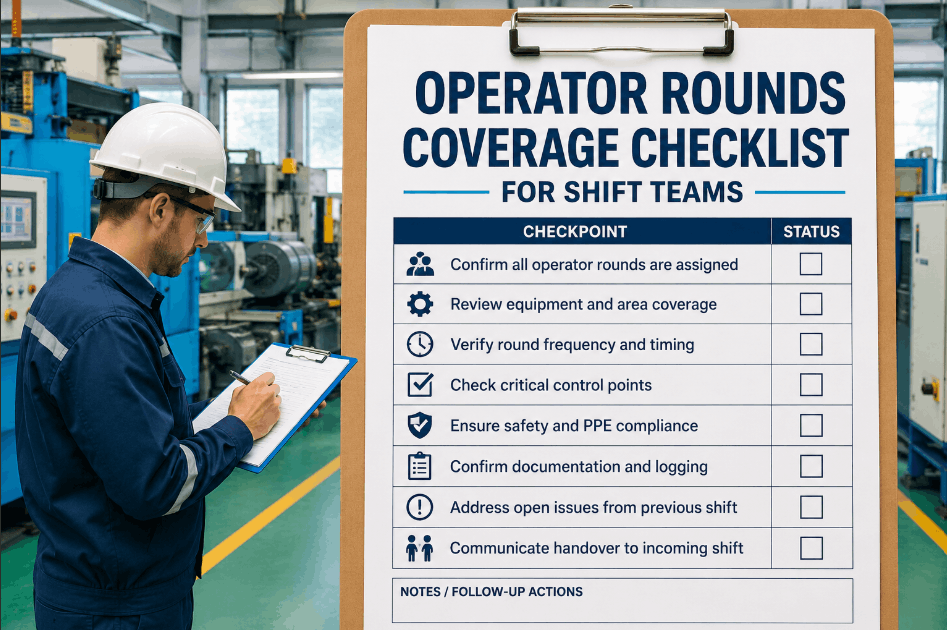
Operator rounds coverage is one of the most direct levers shift teams have for maintaining equipment visibility and preventing unplanned breakdowns — yet it is one of the first disciplines to erode when shift handovers are rushed, coverage is assumed rather than confirmed, and round completion goes unverified between supervisory reviews. When operator rounds are skipped or compressed, early equipment deterioration signals go undetected, minor issues escalate into stoppages, and the shift team loses the situational awareness that routine checks are designed to maintain. The root cause is almost always structural: no formal coverage confirmation at shift start, no digital record of which assets were checked and when, and no visibility into gaps until an incident has already occurred. This checklist helps shift supervisors, plant engineers, and operations managers confirm that operator rounds coverage is structured, assigned, and tracked before each shift begins — not reviewed after a miss has already cost production time. Oxmaint's Sign Up Free platform gives shift teams digital round routes, mobile check-in confirmation, and real-time round completion visibility — so coverage gaps are caught at shift start, not discovered during incident review. From route assignment to handover confirmation, unstructured operator rounds coverage is one of the most correctable sources of recurring plant stoppages. Book a Demo to see how Oxmaint connects operator round routes to asset records, shift schedules, and maintenance work orders — ensuring every check point is covered, recorded, and visible to the team responsible for acting on what operators find. Use this checklist before each shift begins to confirm that rounds coverage is assigned, understood, and structured for execution — not left to informal team awareness and assumed completion.
1. Round Route Assignment & Shift Coverage Confirmation
Operator rounds that are not formally assigned before shift start are completed based on habit and individual judgment — not against a structured coverage plan. Confirm that every round route has a named operator assigned before the shift begins.
2. Round Frequency & Timing Compliance
Round routes completed at the wrong frequency or compressed into a single check per shift do not deliver the equipment visibility they are designed to provide. Confirm that round timing requirements are understood and are being met before accepting shift coverage as adequate.
3. Shift Handover Coverage Continuity
Operator rounds coverage gaps most commonly occur at shift changeover — when outgoing operators consider rounds complete and incoming operators have not yet confirmed their own assignments. Confirm that handover transfers coverage responsibility explicitly, not by assumption.
4. Observation Capture & Escalation Discipline
Operator rounds that produce observations with no structured capture or escalation path deliver detection without action. Confirm that operators have a clear process for logging what they find and that observations are reviewed before they become unreported developing failures.
5. Round Coverage Visibility & Supervisor Review Cadence
Round coverage that is not actively monitored during the shift cannot be corrected until after a gap has already occurred. Confirm that supervisors have real-time visibility into round completion status and a defined cadence for reviewing coverage during the shift — not only at its end.