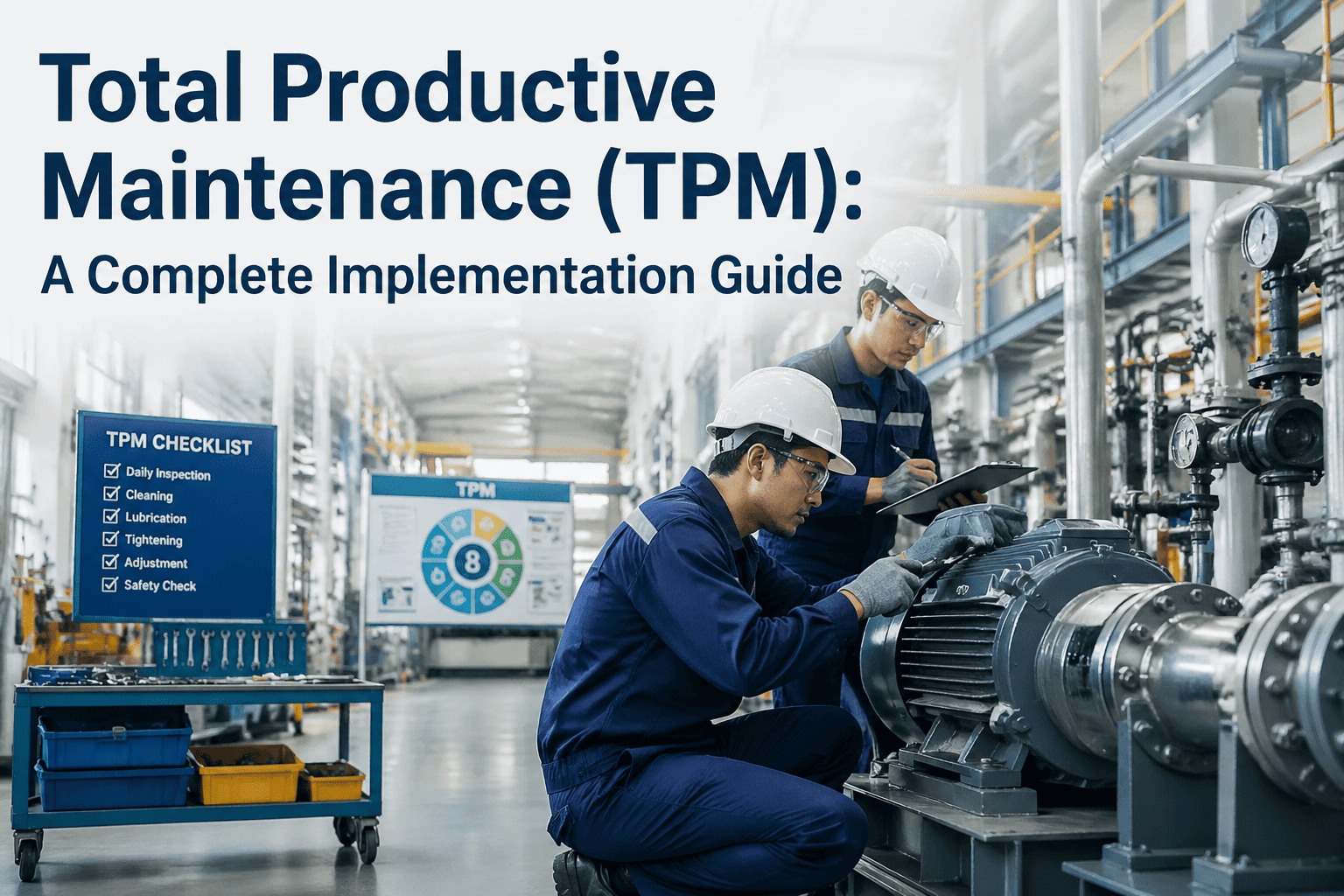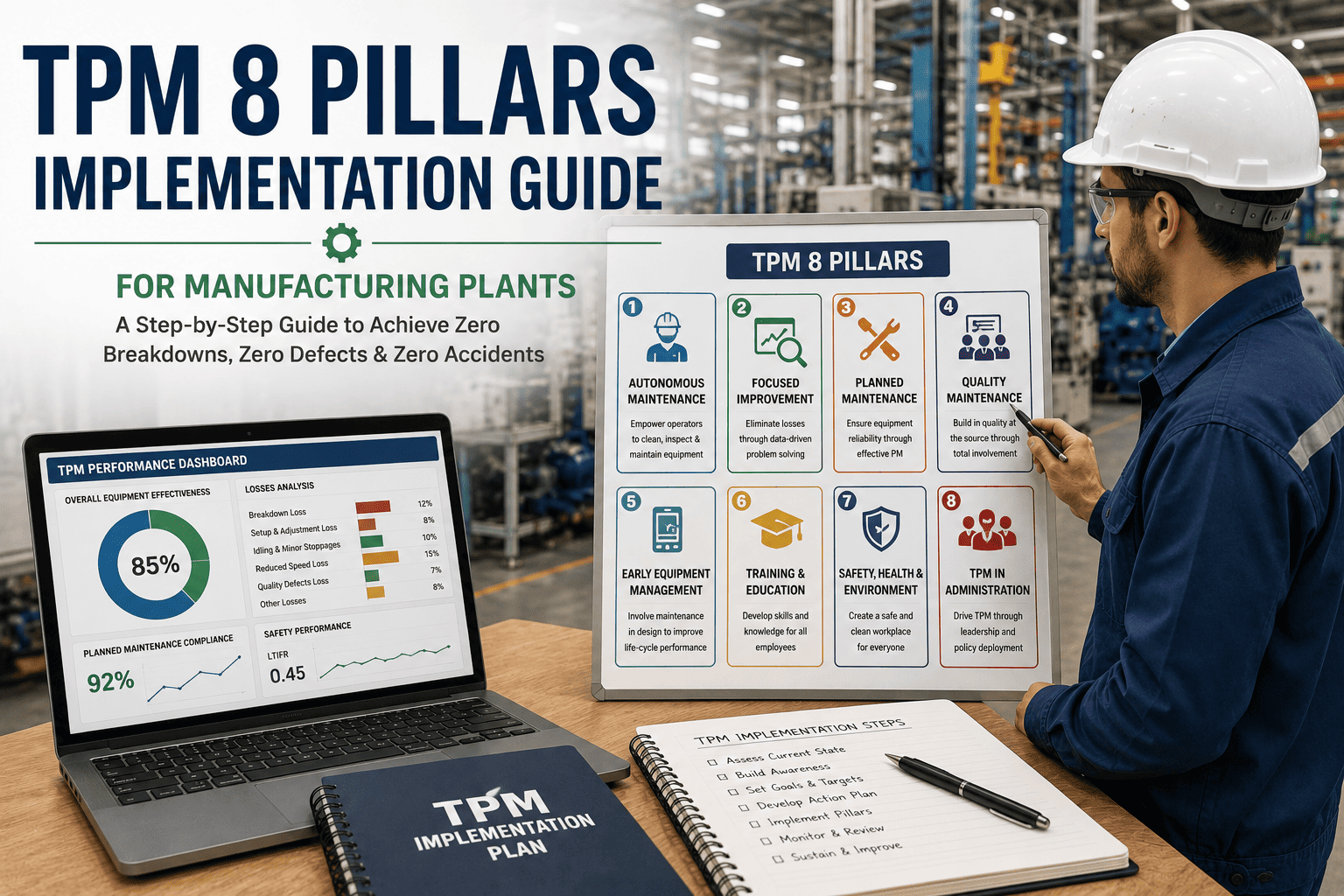
Total Productive Maintenance shifts the maintenance burden from a reactive repair crew to every operator on the floor, turning eight disciplined pillars into a single engine for asset availability. Plants that implement TPM correctly routinely push Overall Equipment Effectiveness (OEE) above 85%, slashing unplanned downtime by 30–50% within the first 18 months. This guide walks you through each of the 8 TPM pillars, the phased rollout sequence that avoids the common 70% failure rate, and the metrics that prove ROI to your CFO. When you are ready to digitize autonomous maintenance checklists and planned-maintenance schedules in one system, you can Start Free Trial and configure pillars in under an hour.
Can an 8-pillar TPM program push your OEE past 85% within 18 months?
The World Class Manufacturing benchmark is not theoretical. Toyota, the JIPM Prize winners, and over 2,000 mid-tier plants globally have used the same eight-pillar framework to drive availability above 90%, performance above 95%, and quality above 99%. The gap between plants that hit 85% and those stuck at 55% is execution — not methodology.
Target across all 8 pillars within 18–24 months
The Six Big Losses every TPM pillar must eliminate
Before assigning pillars, plants must name their losses. The TPM framework targets six root causes that together cap typical manufacturing OEE at 60%. Each pillar maps directly to one or more of these losses.
Equipment Failure
Unplanned breakdowns and downtime. Targeted by Autonomous + Planned Maintenance pillars.
Setup & Adjustment
Time lost changing over tooling. Driven down by Focused Improvement and Quick Changeover kaizens.
Idling & Minor Stops
Jams, sensors, brief halts under 5 minutes. Addressed by Autonomous Maintenance routines.
Reduced Speed
Running below nameplate capacity. Root-caused by Focused Improvement teams using OEE data.
Process Defects
Scrap and rework from machine drift. The Quality Maintenance pillar conditions machines to hold tolerance.
Reduced Yield
Startup scrap until steady-state. Early Management and Planned Maintenance cut ramp-up loss.
A structured walkthrough of every TPM pillar
Each pillar owns a slice of the asset lifecycle. Sequencing matters — Autonomous and Planned Maintenance must stabilize the base before Quality and Early Management can sustain gains.
Autonomous Maintenance
Operators perform daily cleaning, lubrication, tightening, and inspection (CLTI) — restoring equipment to its ideal state and catching micro-failures before breakdown. Target: 40–60% reduction in minor stops, with operators owning the first 15 minutes of every shift.
Planned Maintenance
Maintenance teams move from firefighting to predictive and preventive scheduling. MTBF rises, MTTR falls, and condition-based monitoring replaces calendar-based PMs. Mature plants cut unplanned downtime 30–50% within 18 months.
Focused Improvement
Cross-functional teams use OEE loss trees, 5-Why, and Why-Why analysis to eliminate the top recurring losses. Every kaizen is tied to a dollar figure — a 180-asset plant typically frees $180K–$420K/yr in recovered capacity.
Quality Maintenance
Sets the conditions under which defects cannot occur — 4M (Man, Machine, Material, Method) analysis stabilizes the process. Drives first-pass yield above 98% and links every defect code to a specific equipment condition.
Early Management
Applies TPM lessons to new equipment design and commissioning. Maintainability is engineered in before purchase — cutting startup losses and first-year breakdowns by up to 60% versus a non-TPM baseline.
Education & Training
Builds a skill matrix for every operator and technician — from single-skill to multi-skill mastery. Plants that certify 80%+ of operators on autonomous tasks sustain OEE gains 3× longer than those that skip this pillar.
Safety, Health & Environment
Identifies and eliminates hazard sources permanently — no guards, no labels, just inherently safe equipment. The goal is zero accidents, zero occupational illness, and zero environmental incidents across the plant.
Office TPM
Extends loss elimination into purchasing, scheduling, logistics, and admin functions — cutting order-to-ship lead times by 20–40% and reducing transaction errors that ripple onto the production floor.
A 4-phase, 18-month TPM implementation timeline
TPM is not a launch event — it is a phased build. Skipping the foundation phase is why 70% of programs stall within 12 months. Follow this cadence to reach a self-sustaining 85% OEE.
Phase 1 · Foundation & Assessment
Train steering committee, baseline OEE on pilot line, map the Six Big Losses, and select a model machine. Appoint a full-time TPM coordinator. Deliverable: current-state OEE report and 12-month roadmap.
Phase 2 · Autonomous & Planned Launch
Begin CLTI routines on the pilot asset. Build the equipment cleaning and inspection standard. Launch the planned-maintenance PM calendar in your CMMS. Expect initial OEE dip, then a 5–10 point rise by month 9.
Phase 3 · Focused Improvement & Quality
Run weekly kaizen events against the top 3 loss categories. Stand up Quality Maintenance 4M analysis. Roll autonomous routines to 60% of plant assets. OEE typically crosses 75% by month 15.
Phase 4 · Sustain & Expand
Activate Early Management, Training, SHE, and Office TPM. Audit each pillar against JIPM criteria. Sustain above 85% OEE for 3 consecutive months, then expand the framework plant-wide.
The payback math: a 180-asset automotive components plant
Consider a tier-2 supplier running 180 assets across three shifts, spending $42K/yr on unplanned repairs and losing $310K/yr to downtime-related lost capacity. Here is how TPM changes the math in plain dollars.
Baseline: 68% × 82% × 96% = 53.5% OEE. Target after 18 months: 92% × 95% × 99% = 86.5% OEE.
| Metric | Before TPM | Month 9 | Month 18 |
|---|---|---|---|
| OEE | 53.5% | 71% | 86.5% |
| Unplanned Downtime (hrs/mo) | 148 | 92 | 51 |
| MTBF (hours) | 62 | 118 | 240 |
| First-Pass Yield | 96.0% | 97.6% | 99.1% |
| Operator Autonomous Tasks (%) | 0% | 45% | 80% |
Ready to launch your first TPM pilot line this quarter?
Configure autonomous checklists, PM schedules, and OEE dashboards in Oxmaint — live in under one hour, with a guided 8-pillar setup.
TPM rollout questions, answered directly
The five questions plant managers ask most before committing to an 8-pillar TPM program.
How long does a full 8-pillar TPM implementation take?
A realistic rollout takes 18–24 months to reach a sustained 85% OEE on the pilot line, with plant-wide expansion in years 2–3. Plants that compress the foundation phase below 3 months typically fail to sustain gains. Sequencing Autonomous and Planned Maintenance first, then layering Quality and Early Management, is the proven path — Start Free Trial to scaffold that sequence with prebuilt pillar templates.
Which pillar should we launch first?
Always begin with Autonomous Maintenance on a single model machine. It builds operator ownership, surfaces hidden defects, and gives the maintenance team breathing room to design the Planned Maintenance calendar in parallel. Launching Focused Improvement before stability exists leads to recurring losses that erode operator trust in the program.
What is the typical ROI and payback period?
Most mid-sized manufacturing plants recover $180K–$420K/yr in lost capacity and reduced repair spend, with a payback period of 6–12 months on TPM software, training, and dedicated coordinator time. The fastest payback comes from Focused Improvement kaizens that eliminate the top three downtime causes within the first 90 days.
Do operators really take over maintenance tasks?
Yes — but only routine CLTI tasks: clean, lubricate, tighten, inspect. Operators do not perform corrective repairs or disassembly. The goal is to move roughly 40% of routine tasks to operators so skilled technicians focus on predictive work, root-cause analysis, and reliability engineering. A certified skill matrix makes the boundary explicit.
Can TPM coexist with ISO 55000 and lean manufacturing?
TPM is fully complementary. ISO 55000 provides the asset-management governance layer, lean supplies the kaizen and waste-elimination toolkit, and TPM delivers the shop-floor execution mechanics. Many JIPM Prize plants hold ISO 55001 certification simultaneously — book a walkthrough via Book a Demo to see how Oxmaint maps to both frameworks.
Turn 8 pillars into one digital TPM system
Autonomous checklists, PM scheduling, OEE dashboards, and kaizen tracking — configured for your plant in under an hour.
Free 14-day trial · No credit card

.png)