Every manufacturing plant loses money to unplanned downtime — on average $25,000 for every hour a critical machine sits idle. Total Productive Maintenance (TPM) is the proven methodology that turns this around by making equipment reliability a shared responsibility across your entire workforce. From shop floor operators performing daily inspections to leadership tracking Overall Equipment Effectiveness (OEE), TPM creates a culture where breakdowns, defects, and accidents are systematically driven to zero. This 2026 guide breaks down exactly how to implement TPM in your plant — the foundation, the pillars, the rollout phases, and the metrics that prove it is working. Sign up for Oxmaint to give your TPM program a digital command center from day one.
What Makes TPM Different from Regular Maintenance
Most plants already do some form of maintenance — reactive fixes, scheduled PMs, maybe even some condition monitoring. So why adopt TPM? Because TPM is not just another maintenance strategy. It is an organization-wide operating philosophy that fundamentally changes who is responsible for equipment, how losses are measured, and what "good" looks like. Here is how TPM redefines maintenance at every level.
Traditional Approach
Maintenance team owns all equipment repairs
Operators run machines until something breaks
Success measured by how fast you fix problems
Downtime accepted as cost of doing business
No visibility into where production hours are lost
40–60%Typical OEE
TPM Approach
Everyone shares responsibility for equipment health
Operators perform daily care, inspections, and early detection
Success measured by preventing problems entirely
Zero breakdowns, zero defects, zero accidents as targets
OEE tracked in real time to expose every source of loss
85%+World-Class OEE
Stop Reacting. Start Preventing.
Oxmaint gives you the CMMS backbone for TPM — automated PM schedules, mobile operator checklists, and live OEE tracking in one platform.
Laying the Groundwork: The 5S System
TPM cannot survive in a disorganized workplace. The 5S methodology creates the clean, visual environment where equipment problems become impossible to ignore and good habits become routine. Think of 5S as clearing the fog before you can see the road ahead.
01
Sort — Eliminate What You Do Not Need
Red-tag every item in the work area. If it is not needed for current production, remove it. Clearing away unused tools, obsolete parts, and accumulated debris reveals hidden problems like oil leaks, cracked housings, and metal shavings that signal abnormal wear.
02
Set in Order — A Place for Everything
Every tool, gauge, and spare part gets a labeled home. Shadow boards, color-coded zones, and floor markings make it instantly obvious when something is missing or misplaced. Operators save minutes per shift that compound into hours of recovered productivity.
03
Shine — Clean as Inspection
Daily cleaning routines double as equipment inspections. When operators wipe down machines, they feel loose bolts, spot hairline cracks, and notice temperature changes. This transforms cleaning from a chore into the earliest layer of predictive maintenance.
04
Standardize — Define What Normal Looks Like
Create visual checklists and reference photos that show the correct state of each workstation and machine. When everyone shares the same definition of "clean" and "organized," deviations become immediately visible to any person on any shift.
05
Sustain — Build the Discipline to Keep Going
Regular audits, leadership walkthroughs, and recognition programs prevent backsliding. This is where most plants struggle — sustaining 5S requires ongoing management commitment and accountability systems.
Sign up for Oxmaint to digitize your 5S audits with mobile checklists and automatic scoring.
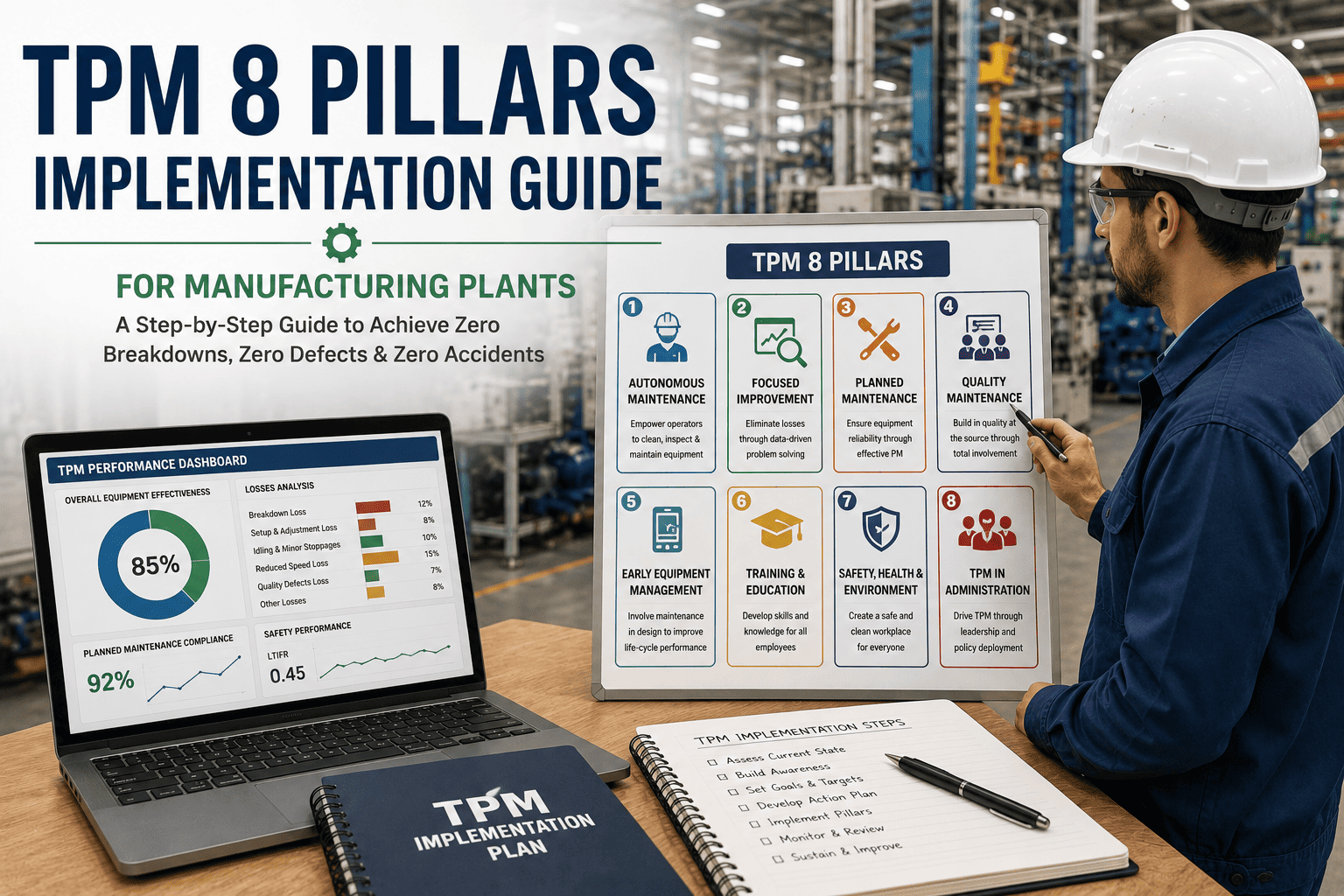
The Eight Pillars That Hold Up Your TPM Program
Once the 5S foundation is solid, the eight pillars of TPM provide the structure for sustained improvement. Each pillar tackles a different dimension of equipment reliability and organizational capability. You do not need to launch all eight at once — most successful plants start with pillars 1 through 3 and add the rest as the program matures. Book a demo to see how Oxmaint supports each pillar digitally.
01
Autonomous Maintenance
Operators own daily equipment care — cleaning, lubricating, tightening, and inspecting. They become the first line of defense against deterioration and develop deep knowledge of how their machines should look, sound, and feel.
02
Focused Improvement (Kaizen)
Cross-functional teams target the biggest OEE losses using root cause analysis. Small, data-driven improvements — applied consistently — eliminate chronic equipment problems and compound into major productivity gains.
03
Planned Maintenance
Replace reactive firefighting with scheduled preventive and predictive maintenance. Prioritize tasks by equipment criticality and failure history so the maintenance team spends time on high-value planned work rather than emergency breakdowns.
04
Quality Maintenance
Identify the equipment conditions that cause product defects and eliminate them at the source. Statistical monitoring and root cause analysis ensure that machines produce within specification consistently, reducing scrap and rework.
05
Early Equipment Management
Feed lessons from existing equipment failures and maintenance history into the design and procurement of new machines. This reduces commissioning time, improves maintainability, and prevents known failure modes from recurring on new assets.
06
Training and Skill Development
Close the knowledge gap between what operators need to know and what they currently know. Structured training in basic equipment mechanics, inspection techniques, and problem-solving tools turns operators into capable maintenance partners.
07
Office and Administrative TPM
Extend lean principles to support functions. Faster purchase orders, streamlined spare parts management, and better production scheduling directly impact how quickly the shop floor can respond to equipment needs.
08
Safety, Health, and Environment
Well-maintained equipment is inherently safer. This pillar ensures that every TPM activity also reduces workplace hazards, protects operators, and supports environmental compliance. Zero accidents is not just an aspiration — it is a measurable TPM target.
Digitize Every Pillar with Oxmaint
From autonomous maintenance mobile checklists to planned maintenance scheduling and OEE dashboards — Oxmaint provides the digital infrastructure that makes each TPM pillar actionable, trackable, and sustainable.
Sign Up
Your TPM Rollout: A Phased Game Plan
Trying to implement all eight pillars across an entire plant on day one is the fastest way to kill a TPM program. The most successful implementations follow a phased approach — prove value on a single line, build momentum with visible wins, and expand only when the foundation is strong.
Weeks 1–4
Commit and Measure
Secure executive sponsorship and assign a TPM champion. Conduct a baseline OEE assessment on target equipment. Select a pilot line — ideally one with high losses, high visibility, or a willing team. Document current maintenance practices and loss data so you have a clear "before" picture.
Weeks 5–10
Foundation and First Pillars
Deploy 5S on the pilot line with before-and-after photos posted on a project board. Launch autonomous maintenance training — start with simple cleaning, inspection, and lubrication tasks. Create standardized checklists operators can complete in under 10 minutes per shift.
Weeks 11–18
Attack the Biggest Losses
Use OEE data to identify top loss categories. Form kaizen teams to conduct root cause analysis on the biggest availability and performance losses. Simultaneously, build a planned maintenance schedule for pilot equipment using criticality and failure data. Track improvements weekly.
Weeks 19+
Scale Across the Plant
Document pilot results and share wins plant-wide. Replicate the proven process on additional lines. Progressively introduce remaining pillars — quality maintenance, training programs, administrative improvements, and safety integration. Establish monthly TPM review meetings to sustain momentum.
Tracking Success: OEE and the Six Big Losses
You cannot improve what you do not measure. OEE (Overall Equipment Effectiveness) is the scorecard for every TPM program — a single percentage that reveals exactly how much of your planned production time is truly productive. OEE combines three factors, and each one maps directly to specific losses that TPM systematically eliminates.
Availability
Actual run time divided by planned production time. Reduced by equipment breakdowns and changeover/setup time. TPM pillars 1 and 3 — autonomous and planned maintenance — directly improve this factor.
Performance
Actual throughput versus maximum designed speed. Impacted by small stops, slow cycles, and idling. Focused improvement (kaizen) teams investigate and resolve these often-invisible speed losses.
Quality
Good units produced divided by total units started. Startup rejects and in-process defects pull this down. Quality maintenance and early equipment management ensure machines produce within spec consistently.
OEE Formula
Availability x Performance x Quality = OEE%
World-class target: 85% | Typical without TPM: 40–60%
Know Your OEE Before You Start
Oxmaint calculates OEE automatically from your work orders and downtime logs — giving you an honest baseline before your first TPM initiative launches.
Sign Up
Where TPM Programs Get Stuck — And How to Push Through
Knowing the common failure points ahead of time is your best defense. Most TPM programs do not fail because of bad methodology — they fail because of people, politics, and poor sustainability practices. Here is what to watch for and how to keep your program on track. Using a CMMS like Oxmaint addresses many of these roadblocks by building structure and accountability into every step.
The Roadblock
Operators See TPM as Extra Work
The Fix
Start with 5-minute tasks, not 30-minute routines. Let operators choose their first autonomous maintenance tasks. Show quick wins — when their input leads to a visible fix, buy-in accelerates fast. Recognition matters more than mandates.
The Roadblock
Leadership Treats TPM as a Maintenance Project
The Fix
TPM is an operations strategy, not a maintenance initiative. The TPM champion must report to plant leadership, not the maintenance manager. Executive floor walks and monthly OEE reviews signal that TPM is a business priority, not a department task.
The Roadblock
No Baseline Data to Prove Progress
The Fix
Measure OEE on pilot equipment for at least two weeks before launching any TPM activities. Even manual calculations using pen and paper provide the critical "before" number. Without a baseline, you cannot demonstrate ROI — and without ROI, funding disappears.
The Roadblock
Early Gains Fade After Six Months
The Fix
Sustainability requires systems, not willpower. CMMS-enforced schedules, visual management boards updated weekly, and quarterly TPM audits with scoring prevent backsliding. Build the discipline into your processes so it does not depend on any single person staying motivated.
TPM is not a maintenance program — it is a cultural transformation. The plants that succeed are the ones where leadership walks the floor, operators take pride in their machines, and every team member understands that equipment reliability belongs to everyone.
— Manufacturing Excellence Director
Results You Can Expect in the First 12 Months
TPM is a multi-year journey to full maturity, but meaningful results show up quickly when the program is implemented with discipline. Here is what plants typically achieve within the first year of a well-executed TPM rollout.
60%
Less unplanned downtime on pilot equipment
50%
Reduction in emergency repair spending
70%
Fewer equipment-related safety incidents
40%
Improvement in first-pass product quality
Give Your TPM Program a Digital Backbone
Clipboards and spreadsheets cannot sustain a TPM program at scale. Oxmaint automates preventive maintenance scheduling, puts autonomous maintenance checklists on operators' phones, calculates OEE in real time, and tracks root causes across every work order — so your team can focus on eliminating losses instead of chasing paperwork.
Frequently Asked Questions
How long does a full TPM implementation take?
Full maturity across an entire facility typically takes 2–3 years. However, measurable OEE improvements on pilot equipment often appear within the first 3–6 months. The key is starting with a focused pilot area, proving results, and expanding systematically.
Book a demo to discuss a phased timeline for your plant.
Is TPM the same thing as preventive maintenance?
Preventive maintenance is just one of the eight pillars within TPM. TPM goes far beyond scheduled servicing — it includes autonomous maintenance by operators, continuous improvement (kaizen), quality defect elimination, workforce training, safety integration, and administrative efficiency. TPM is a company-wide philosophy; preventive maintenance is one tool inside it.
Can we implement TPM without a CMMS?
You can start with paper-based systems, but sustaining and scaling TPM without a CMMS is extremely difficult. Digital tools automate PM scheduling, deliver mobile checklists to operators, calculate OEE automatically, and create an audit trail that prevents backsliding. Plants that digitize TPM with a CMMS consistently achieve faster and more durable results.
Sign up for Oxmaint to see the difference.
What OEE target is realistic for year one?
If your plant currently operates without a structured TPM program, baseline OEE is likely between 40–60%. A realistic first-year target for pilot equipment is 65–75%. World-class status at 85%+ OEE generally requires 2–3 years of sustained effort. The most important step is measuring your current state accurately before setting any targets.
How do we get operator buy-in for autonomous maintenance?
Start small — 5-minute cleaning and inspection tasks, not hour-long routines. Involve operators in choosing which tasks to take on first. When their observations lead to real fixes, ownership grows naturally. Public recognition, visible results boards, and leadership presence on the floor all reinforce that TPM is not a passing initiative.
Schedule a consultation for proven change management strategies.