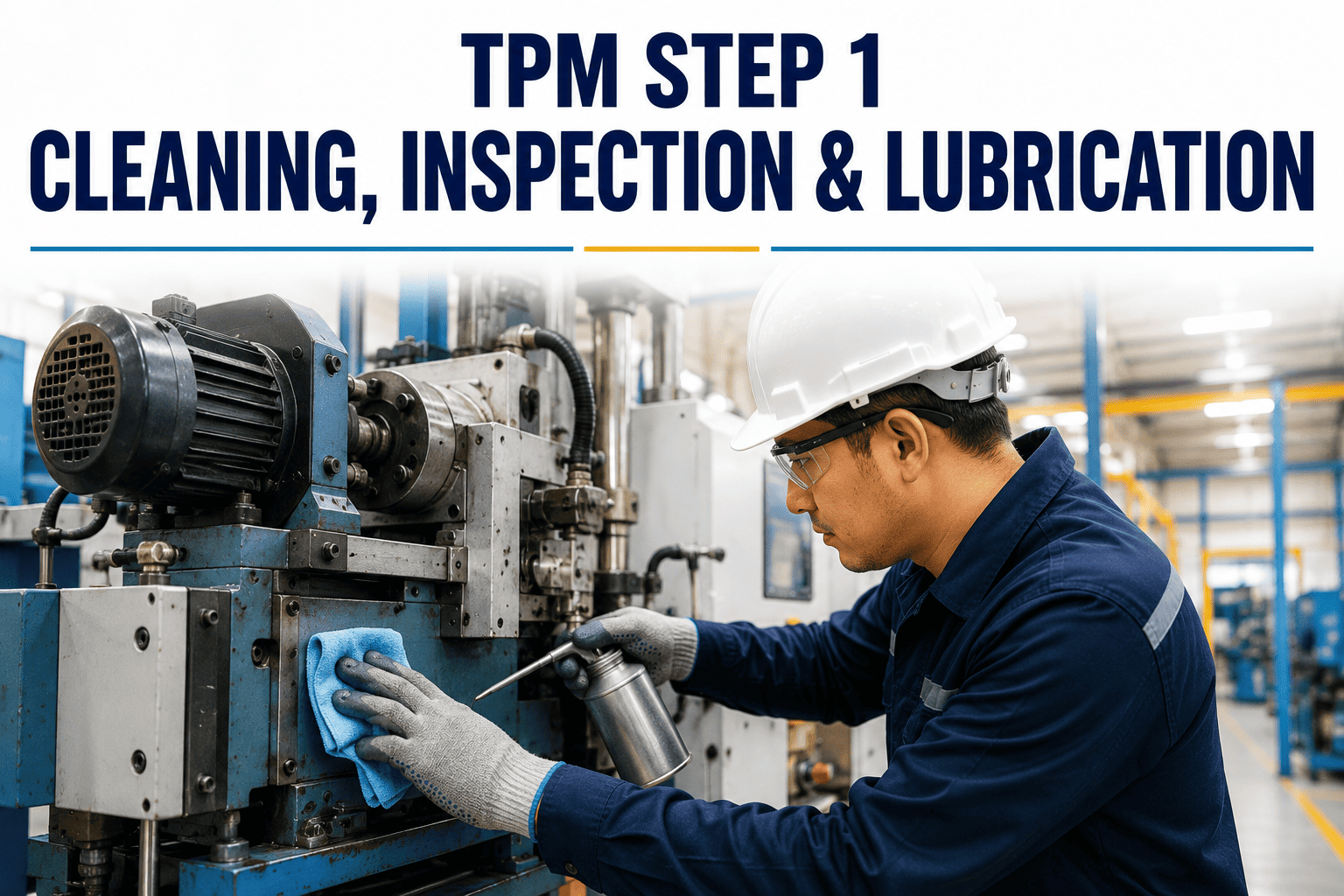
Total Productive Maintenance promises a lot — double-digit OEE gains, 30–50% fewer breakdowns, operators who own their equipment. But nearly every TPM program that stalls does so at the same place: Step 1, Initial Cleaning, Inspection, and Lubrication. It sounds trivial, yet it is the moment autonomous maintenance either takes root or quietly collapses into a one-time spring-cleaning event. This guide breaks down how manufacturing plants can run TPM Step 1 as a repeatable system — contamination-source mapping, abnormality tagging, CILT checklists, lubrication standards, and operator-led inspection routines wired into your CMMS. If you want to skip the theory and deploy it this quarter, you can Start Free Trial and configure the workflow today.
Why do 70% of TPM programs stall before autonomous maintenance ever takes hold?
Because Step 1 — Initial Cleaning, Inspection, and Lubrication — is treated as a cleaning event, not an inspection system. When operators discover hidden defects, tag abnormalities, and own lubrication standards, breakdowns drop 30–50% within the first 12 months. Skip the rigor, and you've held a broom, not built a culture.
CILT is not a checklist — it is a discovery protocol
A correctly executed Step 1 surfaces the contamination sources, lubrication gaps, and micro-defects that cause 60–80% of unplanned downtime. The work is organized around seven focal points that every operator walks through on every assigned asset.
Initial Cleaning
Top-down, full-surface cleaning that turns dirt removal into defect discovery. Every wiped surface is an inspection touchpoint — cracks, leaks, play, and heat signatures reveal themselves once contamination is gone.
Containment of Sources
Map where contamination originates — coolant mist, dust ingress, lubricant weep, product spill — and engineer physical containment at the source rather than cleaning the symptom forever.
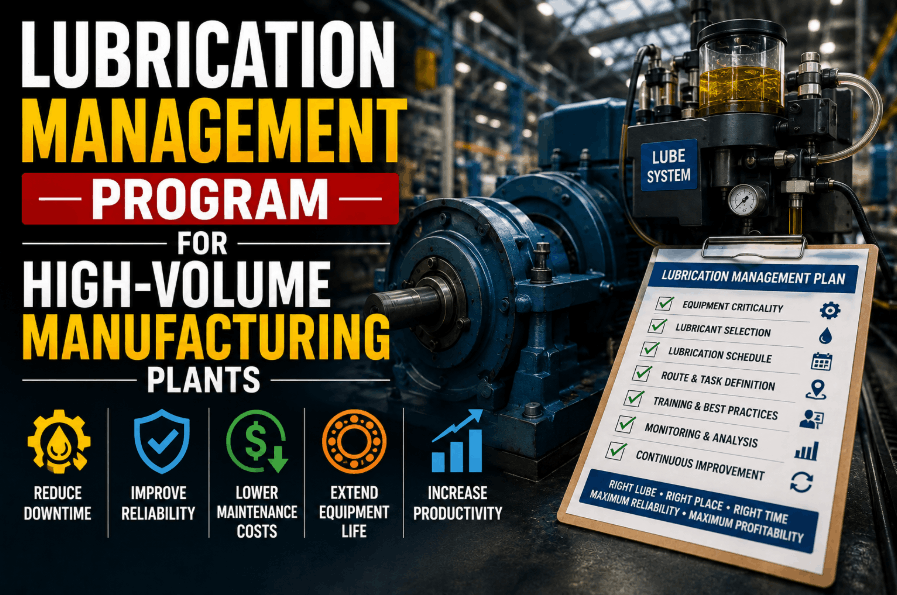
Cleaning & Lubrication Standards
Convert tribal knowledge into visual, time-bound standards: what to clean, what to lubricate, with which product, at what frequency, and what "good" looks like — photographed and posted at the asset.
General Inspection Training
Operators learn the anatomy of their machines — drive systems, hydraulics, pneumatics, electrics — so they can distinguish normal from abnormal and act before a failure cascades.
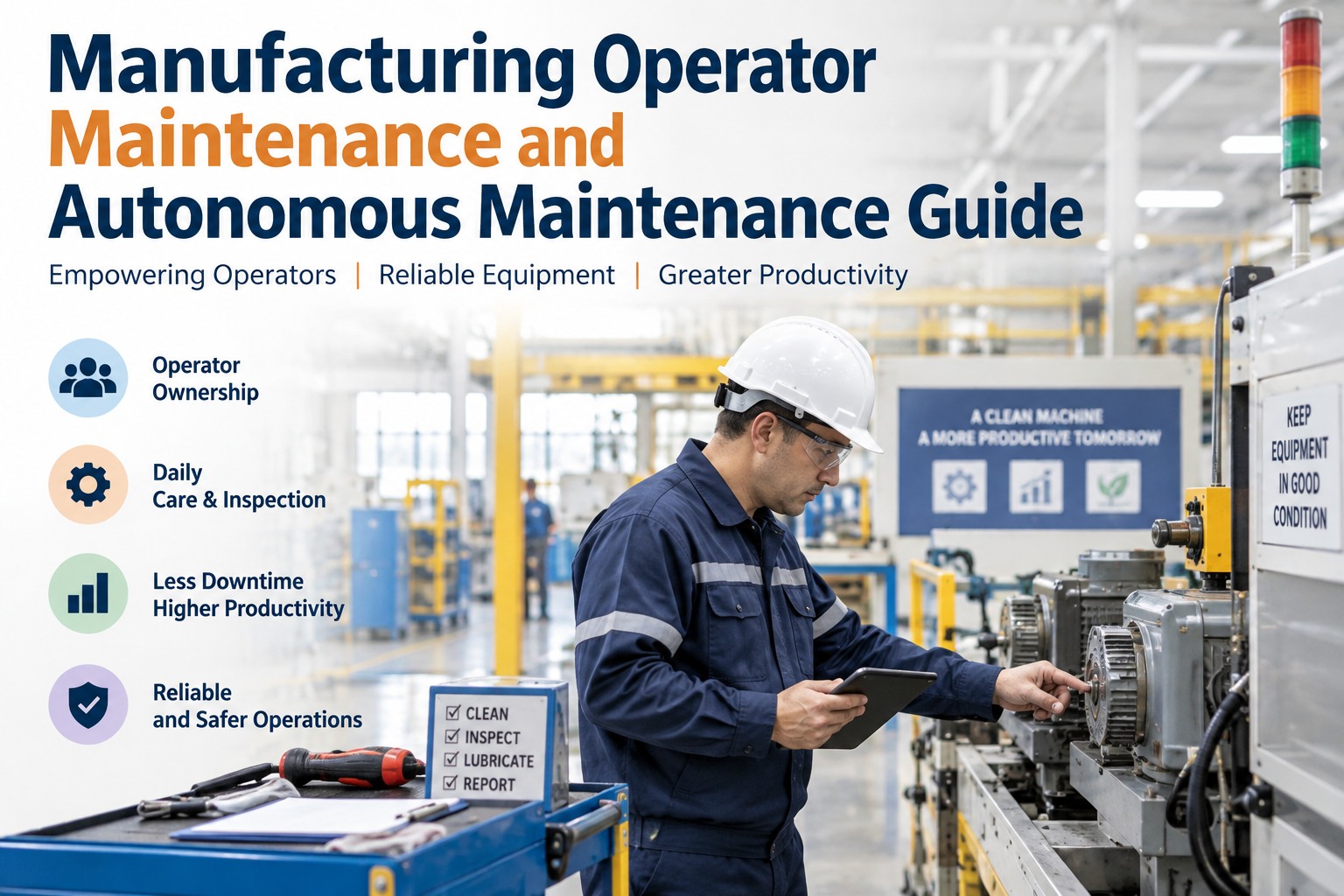
Autonomous Inspection
Daily and shift-start inspection tasks transfer from maintenance to operators, documented in a CMMS with pass/fail criteria, photo evidence, and automatic escalation on deviation.
Standardization & Visual Control
Color-coded lubrication points, sight-glass markers, torque labels, and shadow boards make the correct state visible at a glance — so deviation is obvious in under five seconds.
Sustained Autonomous Maintenance
Step 1 becomes routine: CILT cycles run on cadence, abnormalities are logged and closed in the CMMS, and one-point lessons continuously raise the skill floor of the team.
One-Point Lessons
Every defect found generates a 5-minute visual lesson — one symptom, one cause, one fix — so the next operator catches it earlier. A mature plant produces 200+ OPLs per year from Step 1 alone.
From a dirty machine to a tagged defect in four moves
CILT is the operating system of Step 1. Each cycle is short, measurable, and designed to generate findings — not just a clean machine. A well-run CILT pass on a mid-size asset takes 20–35 minutes and typically surfaces 3–8 latent abnormalities.
Clean — contamination removal as inspection
Wipe down every surface in sequence, top to bottom. Dirt masks defects; the moment it lifts, the operator's eyes become the first sensor. Log anything that looks wrong — a wet patch, a hairline crack, a discolored fitting — with a photo and a red tag.
Inspect — sense-based abnormality detection
Look, listen, touch, smell. Vibration, temperature, noise, and odor deviations precede 70% of mechanical failures. Operators trained in general inspection catch these signals hours or days before a sensor trips or a breakdown stops the line.
Lubricate — the right product, the right amount, the right time
Follow the posted lubrication standard: product grade, quantity, frequency, and application point. Over-greasing destroys bearings as fast as under-greasing. A single mis-lubricated bearing can cost $2,400 and 8 hours of unplanned downtime.
Tighten — restore mechanical integrity
Check fasteners at known torque values, re-torque to spec, and confirm guards, couplings, and seals are seated. Loosening from vibration is a leading contributor to misalignment, leaks, and safety incidents — and it is invisible without a deliberate check.
A scannable breakdown of the daily autonomous inspection routine
The handoff from maintenance to operator only works when the standard is unambiguous. Below is the inspection scope a competent operator carries on a typical production asset during Step 1 — every row is a CMMS task with a pass/fail field and a photo requirement.
| Inspection Domain | What the Operator Checks | Frequency | Pass / Fail Criteria | Escalation |
|---|---|---|---|---|
| Lubrication | Oil level, grease points, sight glass color, leak weep | Shift-start | Level in band, no active drips, correct product at point | Auto WO if level below min or leak detected |
| Pneumatics | Air pressure at regulator, filter bowl, audible leak | Shift-start | Pressure within ±0.2 bar of spec, bowl clear | Maintenance call if pressure deviates >0.3 bar |
| Drive System | Belt tension, guard integrity, coupling alignment, vibration | Daily | No visible slack, guard bolted, no abnormal vibration by feel | Vibration analysis request if deviation reported |
| Electrical / Control | Panel seal, E-stop function, indicator lamps, cabinet temp | Daily | Seal intact, E-stop resets clean, no fault lamps, temp <40°C | Immediate maintenance + lockout if E-stop fails |
| Cleanliness | Machine surfaces, guards, sensors, floor area | End-of-shift | No product buildup, sensors clear, floor dry and swept | Logged as 5S finding if standard not met |
| Safety Devices | Light curtains, interlocks, guards, emergency stops | Shift-start | All devices function on test, no bypasses present | Production hold + maintenance if any device fails |
The payback math of a disciplined first step
Industry TPM benchmarks are consistent: plants that complete and sustain Step 1 see 25–40% reductions in unplanned downtime within 12 months, with a typical payback window of 4–7 months on the program investment. The figures below are drawn from consolidated JIPM-aligned and SMRP benchmark data.
Most plants recover the full Step 1 investment within the first quarter of sustained execution.
Within 12 months of sustained Step 1 deployment across surveyed plants.
Operators touch the asset every shift; maintenance walks it weekly at best.
Parts, labor, and 8 hours of unplanned line stoppage — preventable with a posted standard.
Training, visual standards, and CMMS configuration — recovered through avoided breakdowns.
A 180-asset food processing plant was spending roughly $42,000 per year on reactive bearing failures and lubricant-related downtime across its packaging line. After a 6-week Step 1 rollout — initial cleaning on all 180 assets, lubrication standards posted at every point, operator inspection tasks configured in their CMMS, and 47 one-point lessons generated from abnormalities found during cleaning — lubricant-related failures dropped 61% in the first year. The plant avoided an estimated $25,600 in repair and downtime costs, recovered the $9,800 program investment in under 5 months, and freed 120 maintenance hours per quarter for preventive work.
Five practices that separate a program from a project
The single most common failure mode is treating Step 1 as a launch event — a heroic cleaning weekend, a stack of red tags, a round of applause, and then drift. Sustained autonomous maintenance is built on cadence, visibility, and accountability wired into the CMMS, not a poster on the wall.
Lock the CILT cycle into the shift schedule
A 20-minute CILT pass at shift-start is non-negotiable. If production pressure eats it, the program is already dying. Block the time in the CMMS, mark it as a priority task, and measure completion rate weekly — target 95%+ sustained.
Every abnormality becomes a tracked work order
A red tag that stays on the machine for three weeks teaches operators that findings are ignored. Tags must convert to CMMS work orders within 24 hours, with an owner, a priority, and a closure date visible at the asset.
Post standards where the work happens
Lubrication maps, inspection checklists, and "good vs. abnormal" photos live at the machine — not in a binder in the supervisor's office. If an operator cannot see the standard from the asset, the standard does not exist.
Turn every defect into a five-minute lesson
A one-point lesson is a single symptom, a single root cause, and a single corrective action on one page. Plants that generate 15+ OPLs per month from Step 1 build a continuously rising skill floor — and a library that survives staff turnover.
Make the CMMS the single source of truth
Paper checklists vanish. Mobile CMMS tasks with photo evidence, pass/fail fields, and automatic escalation are what make Step 1 auditable and sustainable. If it is not in the system, it did not happen.
Ready to turn Step 1 into a system, not a spring-cleaning?
Deploy CILT checklists, lubrication standards, abnormality tagging, and operator inspection workflows in your CMMS — configured for your assets in days, not quarters.
Answers to the five questions that decide whether Step 1 sticks
How long should a proper TPM Step 1 rollout take?
A focused Step 1 rollout on a pilot line of 15–25 assets typically takes 4–8 weeks: one week for initial cleaning and abnormality discovery, two to three weeks for source containment and standard development, and one to two weeks for operator training and CMMS configuration. Plant-wide scaling then proceeds line by line. Rushing it in under three weeks almost always means the cleaning was done but the inspection system was never built — which is why the program stalls within a quarter.
What is the difference between cleaning and inspection in Step 1?
Cleaning is the method; inspection is the purpose. When an operator wipes a hydraulic cylinder clean, the goal is not a shiny cylinder — it is to expose the weep at the seal, the scoring on the rod, the loose fitting at the base. Every cleaning touchpoint is an inspection touchpoint. If your Step 1 produces a clean machine but zero tagged abnormalities, you cleaned but you did not inspect, and the cycle has to be re-run with a different mindset.
How do we stop abnormalities from sitting on the machine for weeks?
Every red tag must convert to a CMMS work order within 24 hours, with an assigned owner, a priority level, and a target closure date. The closure status should be visible at the asset — a tag board or a QR-coded status check — so operators see that their findings are acted on. When findings linger ignored for weeks, operators stop reporting them, and the inspection system collapses. You can Book a Demo to see how automated escalation rules keep closure rates above 90%.
Should lubrication standards really be owned by operators?
Yes — for the routine, visual, frequency-based lubrication tasks that fall within the operator's daily and weekly scope: checking sight glasses, topping up to a marked level, greasing clearly identified points with a posted product and quantity. Maintenance engineering still owns the lubrication route design, product selection, and analysis. The split is: operators execute the standard, maintenance owns the standard itself. Plants that keep all lubrication with maintenance lose the frequency advantage of having an operator at the machine every shift.
How does a CMMS support autonomous maintenance specifically?
A CMMS turns Step 1 from paper into a system. It assigns CILT tasks to operators by shift and asset, captures pass/fail responses and photo evidence, auto-escalates deviations to maintenance, tracks abnormality closure rates, and generates the audit trail that proves the program is running. Without a CMMS, Step 1 relies on binders and bulletin boards — which is why it drifts. You can configure the full workflow yourself when you Start Free Trial and be live on a pilot line within a week.
Build your TPM Step 1 system this quarter
CILT checklists, lubrication standards, abnormality tagging, operator inspection workflows, and one-point lesson capture — all in one CMMS, ready for your assets.
Free 14-day trial · No credit card