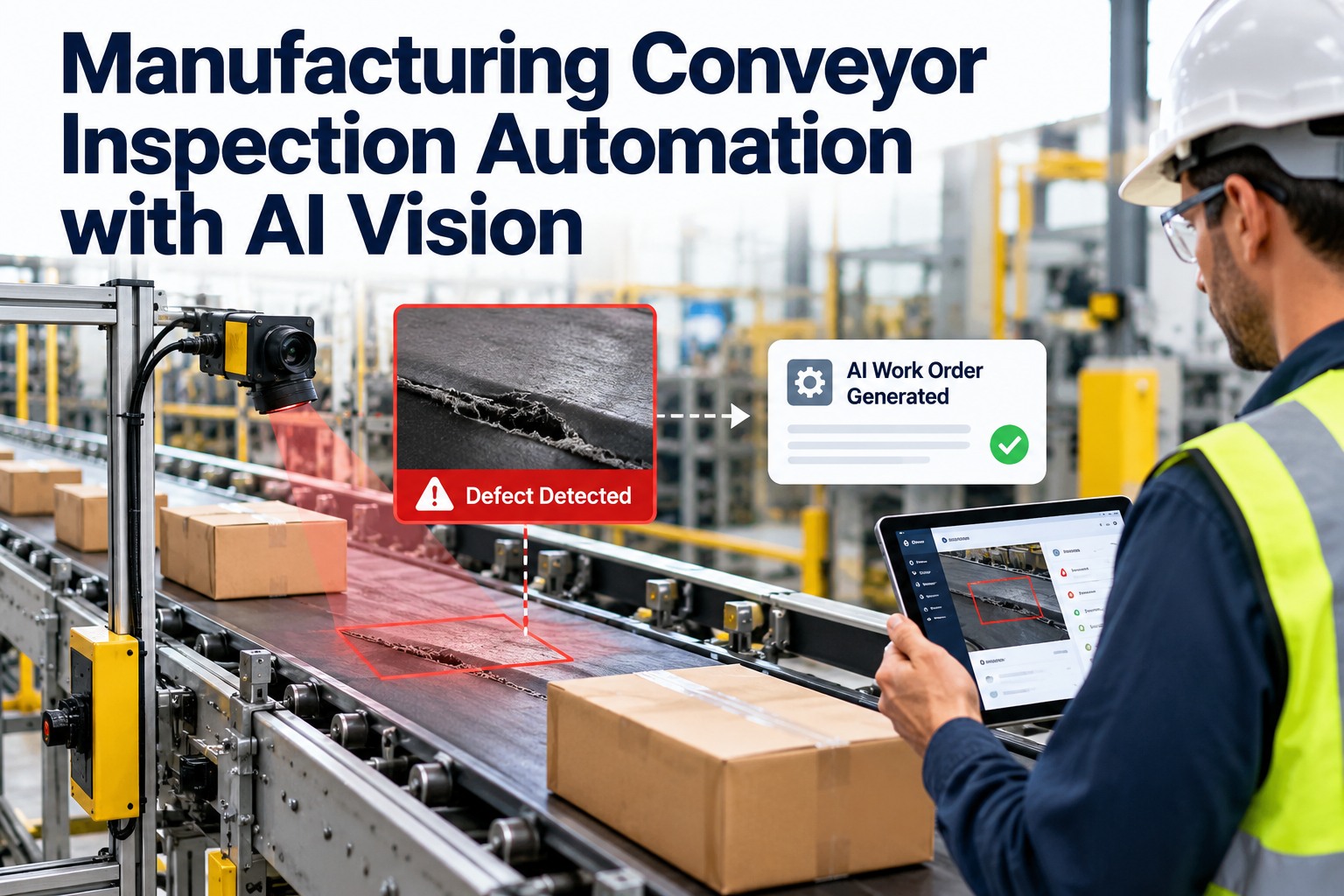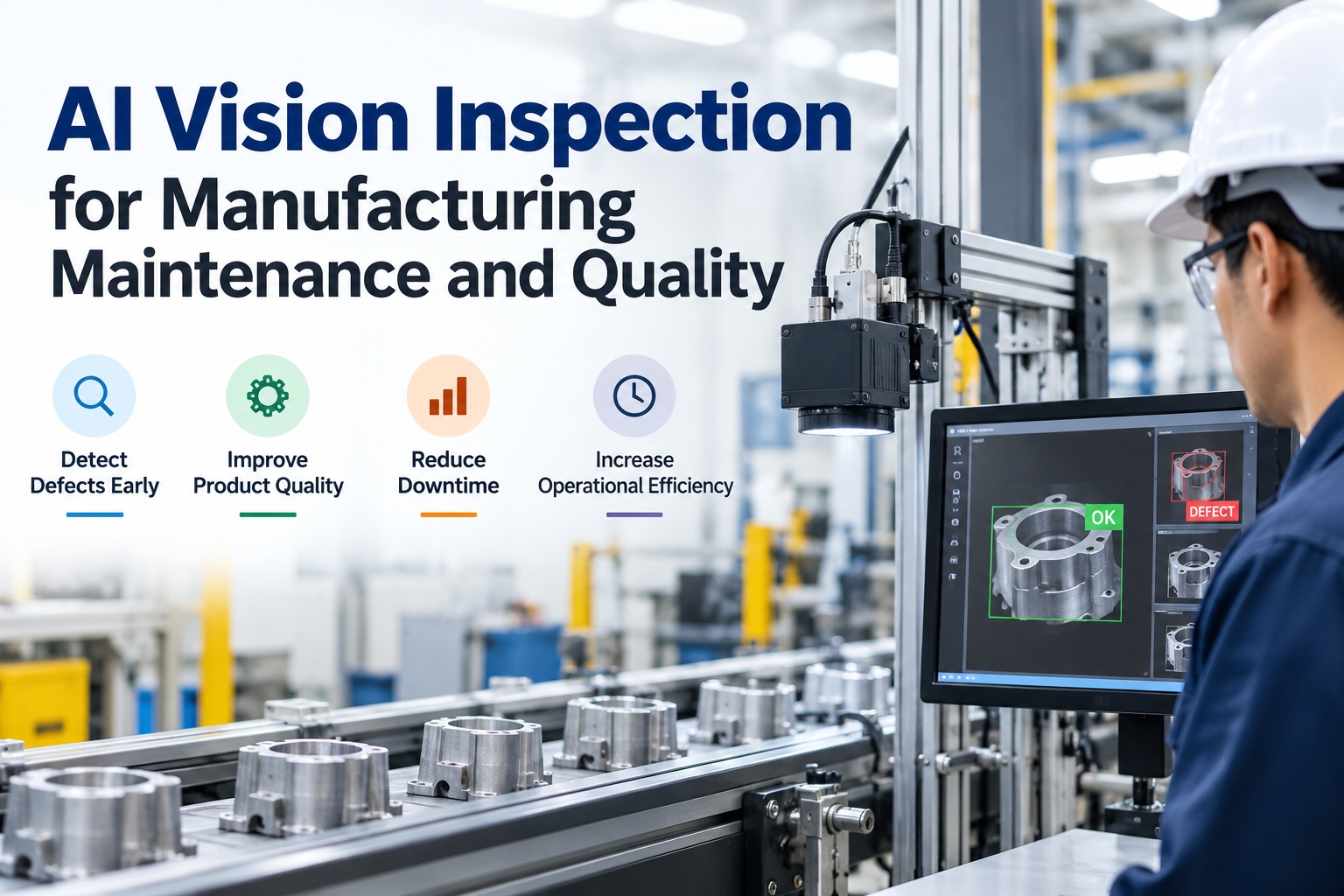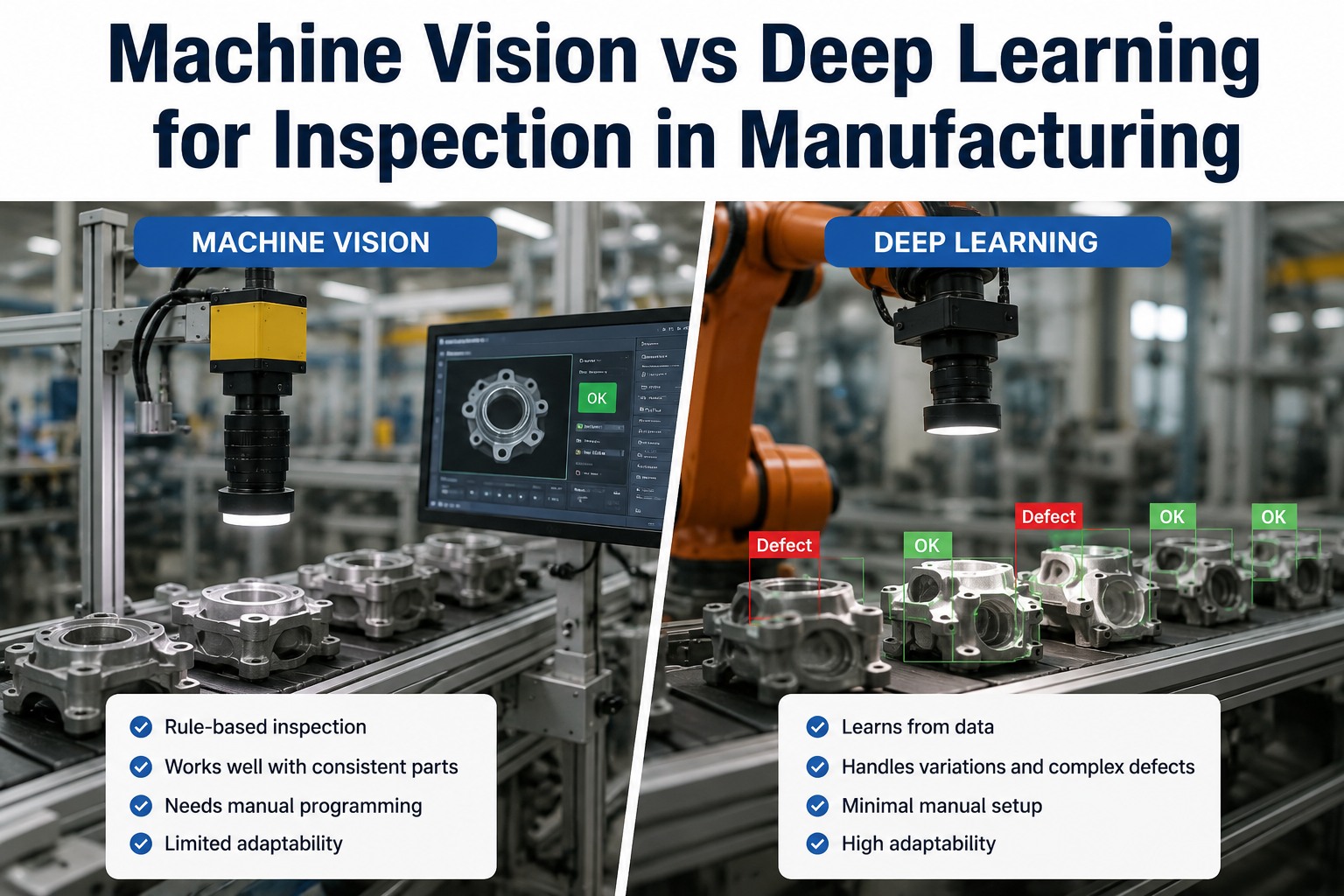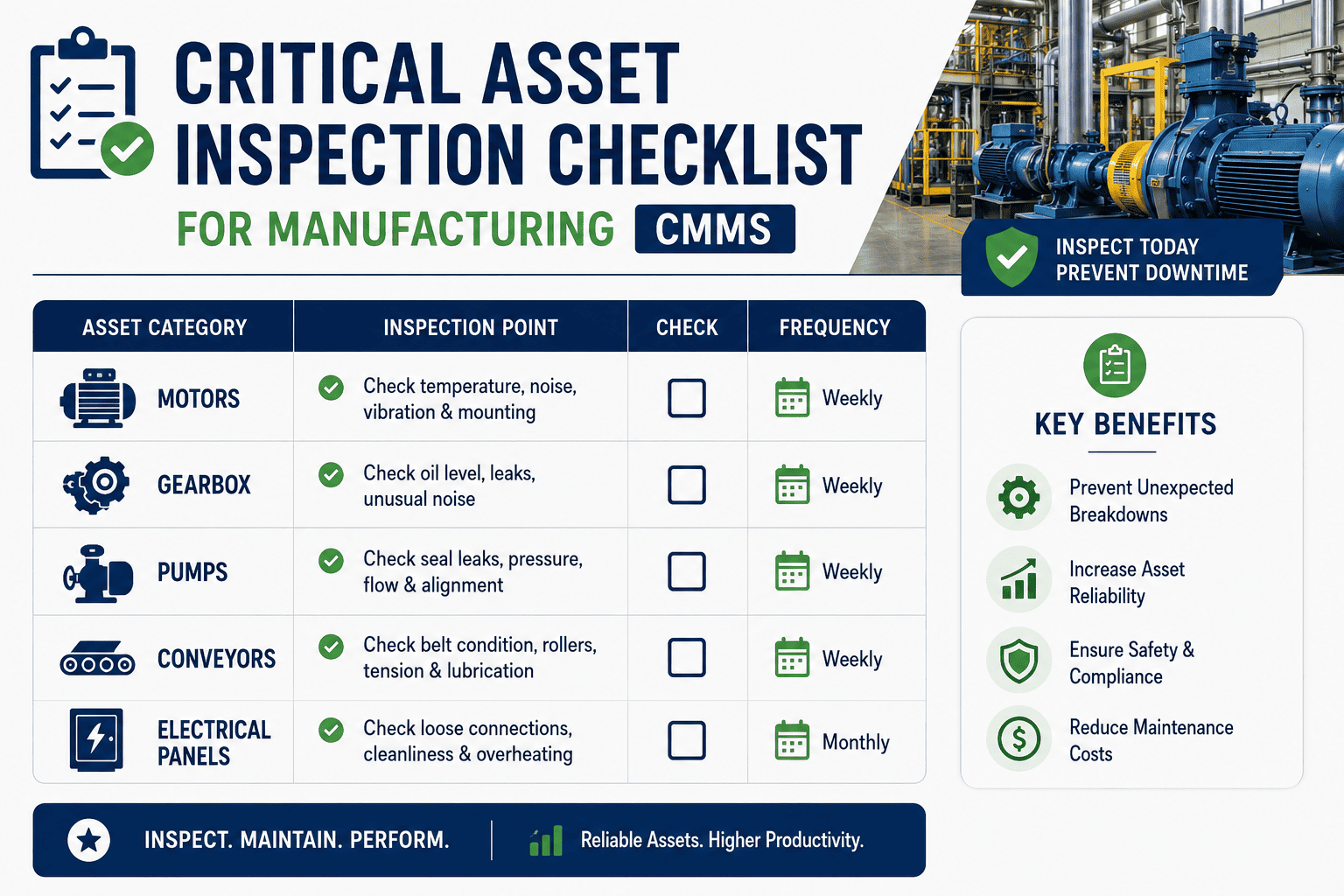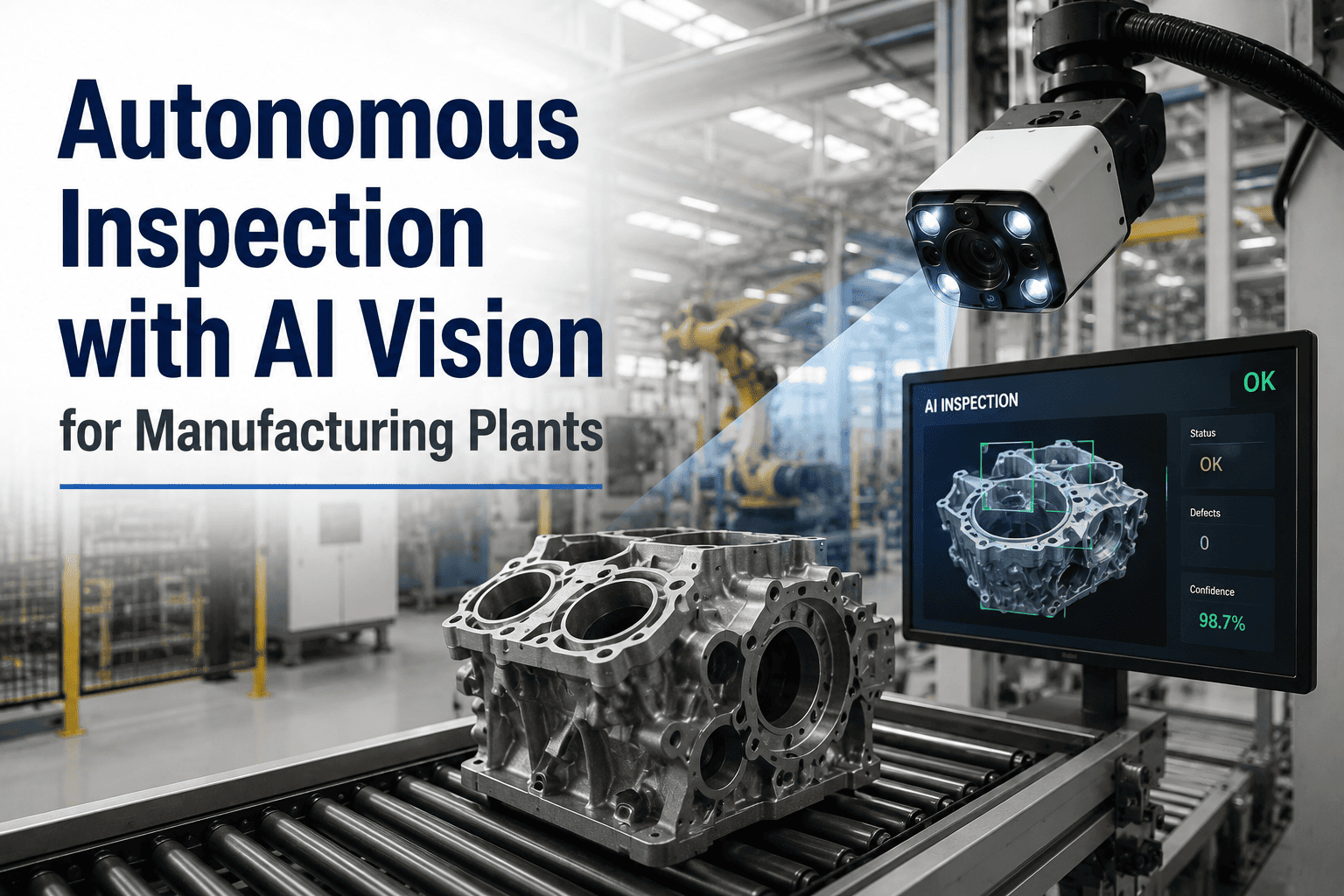
Autonomous inspection with AI vision is transforming manufacturing plants by replacing slow, inconsistent manual checks with always-on cameras that detect surface defects, weld flaws, seal failures, and dimensional deviations in milliseconds. Modern AI vision inspection systems now match or exceed human accuracy on repetitive defect recognition tasks while logging every result for traceability—then route that data straight into a CMMS so maintenance teams can trigger work orders the moment an anomaly appears. This guide covers camera and lighting selection, model training data, edge deployment, false-reject tuning, and CMMS integration for equipment-linked root cause analysis. Ready to connect your inspection data to automated work orders? Start Free Trial and see how OxMaint closes the loop.
AI Vision Inspection Guide
What if every asset inspected itself—24/7, without a human in the loop?
Autonomous AI camera inspection catches defects 10× faster than manual review, reduces false rejects to under 1%, and feeds every anomaly straight into your CMMS as an auto-generated work order. No clipboards. No missed cracks. No delayed fixes.
The Business Case
Why manufacturing plants are moving to autonomous AI vision inspection
Human inspectors on high-volume lines miss 2–5% of defects due to fatigue, distraction, and speed—each escaped defect costing anywhere from $200 to $40,000 in rework, warranty claims, or recalls. AI vision inspection closes that gap.
Worked Example
A 180-asset automotive components plant spending $42K/yr on manual inspection labor and losing $86K/yr to escaped seal defects deployed 12 AI vision cameras across three critical stations. Within 90 days, defect escape rate dropped from 3.2% to 0.4%, inspection throughput rose 8×, and the system auto-created 147 CMMS-linked work orders for equipment drift before failures occurred—saving an estimated $118K in the first year.
Step-by-Step Guide
How to deploy AI camera inspection in a manufacturing plant
A proven six-stage deployment path—from camera selection to CMMS integration—that takes most mid-sized plants 8–12 weeks from kickoff to production.
Weeks 1–2
Camera & lighting selection
Choose industrial cameras with global shutter sensors (1.6–5 MP) matched to line speed. Add directional LED lighting, polarizers, or structured light depending on surface reflectivity. Matte metal parts need diffuse lighting; transparent or glossy surfaces require cross-polarization to eliminate glare that hides defects.
Weeks 3–5
Training data collection & labeling
Capture 3,000–10,000 images per defect class including pass samples. Label weld porosity, surface scratches, seal gaps, dimensional deviations, and print errors. Balance the dataset—70% good, 30% defective—and augment with rotation, brightness, and noise variations so the model generalizes beyond the training line.
Weeks 6–7
Model training & validation
Train a convolutional neural network (CNN) or vision transformer on the labeled dataset. Target ≥95% precision and ≥90% recall on the validation set. Use transfer learning from pre-trained models (YOLOv8, EfficientDet) to cut training time from weeks to days, even with smaller datasets.
Week 8
Edge deployment
Deploy the trained model on edge GPU devices (NVIDIA Jetson, industrial IPCs) at each inspection station. Edge processing keeps latency under 50ms, avoids cloud dependency, and protects proprietary process data. Configure the inference engine to run continuously and stream results to a local dashboard and your CMMS API.
Weeks 9–10
False-reject tuning
Run the system in shadow mode for 5–7 days, comparing AI decisions against human inspectors. Tune confidence thresholds: lower them to catch borderline defects, raise them to reduce false rejects. The goal is a false-reject rate under 1% while maintaining a defect catch rate above 98%.
Weeks 11–12
CMMS integration & go-live
Connect the vision system to your CMMS via REST API or MQTT. Every detected anomaly auto-generates a work order linked to the specific asset, includes the defect image, severity score, and timestamp, and routes to the correct maintenance technician. This closes the inspection-to-action loop that most plants still handle manually.
Comparison
Manual inspection vs. AI vision inspection: what changes
The gap between human-only and AI-augmented inspection is not incremental—it is structural. Here is what plants measure before and after deployment.
| Metric | Manual Inspection | AI Vision Inspection |
|---|---|---|
| Inspection speed | 5–15 parts/min | 50–200 parts/min |
| Defect catch rate | 70–80% | 95–99% |
| False-reject rate | 3–7% | <1% |
| Fatigue impact | Accuracy drops 15% after 4 hrs | Zero fatigue, 24/7 consistent |
| Data logged per part | Pass/fail on clipboard | Image, defect type, coordinates, severity |
| CMMS trigger | Manual work order entry, hours later | Auto work order in <1 second |
| Annual cost (mid-size line) | $45K–$120K labor + defect escapes | $15K–$35K hardware + software |
Product Integration
How OxMaint connects AI vision data to maintenance action
Inspection data without action is just expensive photography. OxMaint's AI-powered CMMS turns every vision-system anomaly into a tracked, prioritized, and resolved maintenance event.
Auto-generated work orders from vision triggers
When an AI camera flags a defect or anomaly, OxMaint instantly creates a work order linked to the exact asset, attaches the defect image, assigns severity, and routes it to the right technician—cutting anomaly-to-action time from hours to under 60 seconds.
Outcome: 85% faster response to equipment drift
Defect-trend analytics for root cause analysis
OxMaint aggregates vision-system data by asset, defect type, and time window. Spot repeating patterns—a specific CNC machine producing surface flaws every Tuesday, a seal press drifting after 400 cycles—and schedule corrective maintenance before the trend becomes a breakdown.
Outcome: 30–50% reduction in unplanned downtime
Predictive maintenance from inspection patterns
Feed vision-detected anomaly rates into OxMaint's predictive engine. When defect frequency on an asset exceeds the learned baseline, the system predicts failure windows and recommends intervention—moving your plant from reactive to predictive maintenance on inspection-backed data.
Outcome: Predict failures 7–21 days before they happen
Full audit trail for ISO 55000 & quality compliance
Every inspection result, work order, and corrective action is timestamped, asset-linked, and searchable. Generate compliance reports for ISO 55000, IATF 16949, or FDA 21 CFR Part 11 audits in minutes instead of days—with defect images attached as evidence.
Outcome: 90% faster audit preparation
ROI Breakdown
What does autonomous AI vision inspection cost—and what does it save?
A typical mid-sized plant deploying AI vision inspection on 3–5 critical lines sees payback in 6–11 months. Here is the formula and a real-cost breakdown.
Payback Period Formula
Payback (months) = Total Deployment Cost ÷ (Monthly Labor Savings + Monthly Defect-Cost Avoidance + Monthly Downtime Avoidance)
| Cost / Saving Category | Year 1 Amount | Notes |
|---|---|---|
| Cameras, lighting & edge GPU hardware | $18K–$35K | One-time, 3–5 stations |
| AI model training & integration | $8K–$20K | One-time, internal or vendor |
| CMMS software (OxMaint) | $6K–$14K/yr | Per plant, unlimited assets |
| Inspection labor savings | +$38K–$72K/yr | Reallocate 2–4 inspectors |
| Defect-escape cost avoidance | +$45K–$110K/yr | Fewer recalls, rework, warranty |
| Downtime avoidance (CMMS-triggered fixes) | +$25K–$80K/yr | Catch drift before failure |
| Net Year 1 benefit | $52K–$193K | After all costs |
| Payback period | 6–11 months | Typical range |
Close the Inspection-to-Action Loop
See OxMaint turn vision-system defects into resolved work orders
Book a 30-minute demo and watch a live AI camera anomaly trigger a CMMS work order, route to a technician, and close out—in real time.
Frequently Asked Questions
Autonomous inspection with AI vision: top questions answered
How accurate is AI vision inspection compared to human inspectors?
Production-grade AI vision models achieve 95–99% defect-detection accuracy on well-defined tasks like weld inspection, surface defect detection, and dimensional checks, versus 70–80% for human inspectors who fatigue after 4 hours. The key is sufficient training data (3,000+ labeled images per defect class) and proper lighting. AI also maintains consistent accuracy 24/7, while human performance degrades throughout a shift.
How does AI vision integrate with a CMMS for autonomous maintenance?
AI vision systems connect to a CMMS like OxMaint via REST API or MQTT. When the camera detects an anomaly, it sends the defect type, image, severity, and asset ID to the CMMS, which auto-generates a work order and routes it to the correct technician. This eliminates manual entry delays and links every defect to the specific equipment for root cause analysis. Start Free Trial to test the integration on your assets.
What types of defects can AI vision detect in manufacturing?
AI vision detects surface scratches, weld porosity, seal gaps, dimensional deviations, print errors, missing components, contamination, color variation, and assembly defects. With the right camera and lighting setup, models can also identify subtle issues like micro-cracks, coating thickness variation, and label misalignment that human inspectors often miss at production line speeds.
How much does it cost to deploy AI vision inspection in a plant?
A typical 3–5 station deployment costs $26K–$55K for hardware (cameras, lighting, edge GPUs) plus $8K–$20K for model training and integration. Annual CMMS software runs $6K–$14K per plant. Most mid-sized plants see net Year 1 benefits of $52K–$193K through labor savings, defect-cost avoidance, and downtime reduction, achieving payback in 6–11 months.
Can AI vision inspection run on the edge without cloud connectivity?
Yes—most production AI vision systems deploy on edge GPU devices like NVIDIA Jetson or industrial IPCs at each inspection station. Edge processing keeps inference latency under 50ms, eliminates cloud dependency for real-time decisions, and protects proprietary process data. The edge device sends results to your CMMS via local network, so inspection and work-order generation continue even if the internet connection drops.
Start in Minutes
Connect your AI vision data to a CMMS that acts on it
Every defect your cameras catch should become a resolved work order—not a spreadsheet entry. See how OxMaint makes that automatic.
Free 14-day trial · No credit card