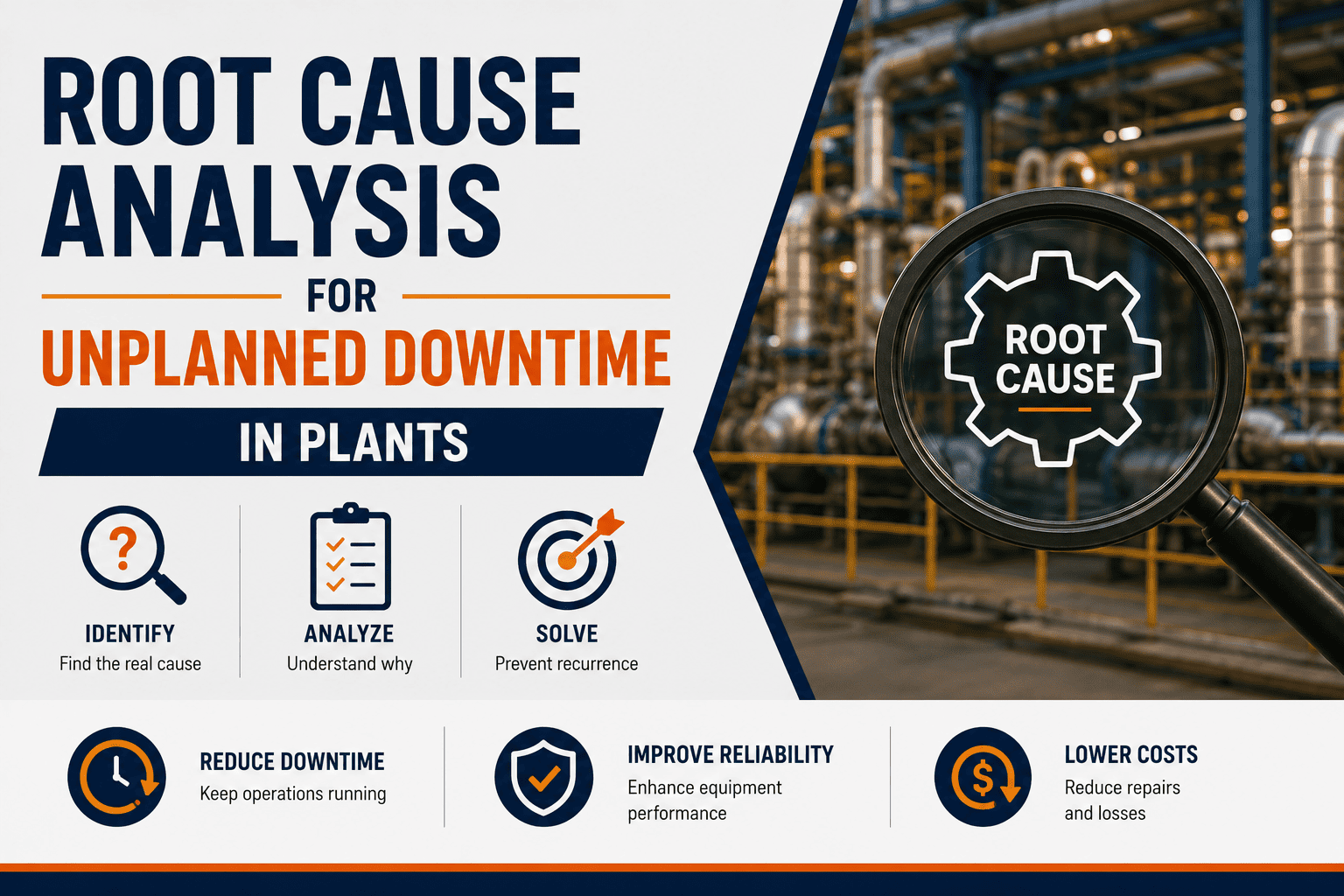
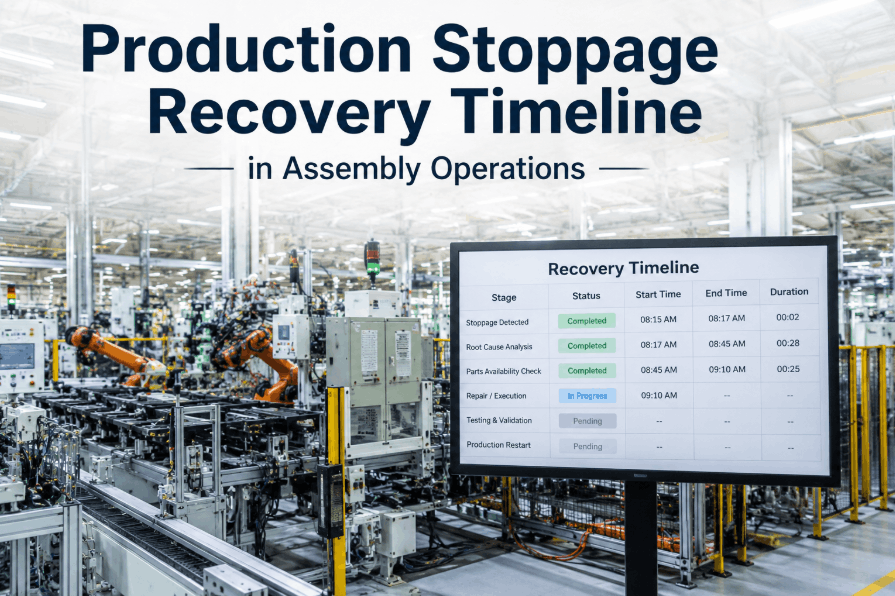
When a discrete manufacturing line stops unexpectedly, restart time is rarely lost in a single place — it's distributed across a sequence of steps where different teams stall, handoffs are unclear, and recovery depends on whoever is available rather than whoever is accountable. Mapping the recovery sequence from stop event to normal flow exposes where restart time is actually being lost, which teams stall under pressure, and how production returns to plan — or fails to. Sign Up Free to build your discrete line's unplanned stop recovery map in OxMaint and close the restart gaps costing output today. OxMaint structures the recovery sequence from fault detection through root cause documentation — giving every team a defined role, a measured response window, and a shared incident record. Book a Demo to see how OxMaint's recovery workflow integrates with your current maintenance and production response structure.
Reliability Engineering · Discrete Manufacturing · 2026
Unplanned Stop Recovery Map for Discrete Manufacturing
Map the recovery steps after an unexpected stop to expose where restart time is lost, which teams stall, and how production returns to normal flow under pressure.
62%Of unplanned stop restart time is lost in detection, escalation, and parts — not in the repair itself
−34%MTTR reduction in plants with structured recovery maps vs. ad-hoc response
8 minAverage time saved per incident with automated escalation and parts pre-check
97%Root cause documentation compliance with OxMaint incident closure requirements
The 7-Stage Recovery Map — Where Restart Time Is Actually Lost
Most discrete manufacturing plants measure MTTR — but few measure where within the recovery sequence the time is lost. The seven-stage map below breaks the recovery sequence from initial stop event to verified production resumption, showing the typical time distribution and where process gaps compound restart delay. Sign Up Free to configure OxMaint's recovery stage tracking for your discrete line and start measuring where time is lost per incident.
01
Fault Detection
Typical: 0–8 min
Detection Gap
Time from equipment stop to confirmed fault identification. Detection delay occurs when operators don't immediately recognize a stop, or when automated alerts are absent. Every minute here extends MTTR by one minute.
02
Maintenance Escalation
Typical: 2–20 min
Handoff Stall
Time from fault confirmed to maintenance technician dispatched. Plants without automated escalation routing lose significant time here — the right person isn't notified, or the notification reaches a dispatcher who then calls a technician.
03
Technician Travel and Assessment
Typical: 5–15 min
Response Window
Physical travel to the equipment and initial fault assessment. Technician arrives without fault context — spends additional minutes reviewing the situation that the operator already documented verbally.
04
Parts and Tools Sourcing
Typical: 10–60 min
Largest Variable
The highest-variance stage in the recovery map. When the required part is not stocked at point of use, technician goes to stores, storeroom is closed, or the part is in a different location — this stage can dominate total MTTR on its own.
05
Repair Execution
Typical: 15–120 min
Core Repair
The actual repair work — the only stage that cannot be compressed without skill or tooling improvement. Often the smallest contributor to total MTTR in well-structured recovery programs. The stages around it are where time is won or lost.
06
Production Sign-Off and Restart
Typical: 5–30 min
Restart Delay
Time between repair complete and production running at target rate. Production supervisor unavailable for sign-off, operator not ready, or safety clearance process adds delay — often the most avoidable stage of all.
07
Root Cause Documentation
Typical: 0–45 min
Prevention Input
Root cause capture at incident close — the step that converts a reactive repair into a preventive maintenance trigger. Skipped under shift pressure in 70%+ of incidents without mandatory CMMS closure requirements.
Recovery Response — Without vs. With OxMaint
The structural difference between ad-hoc incident response and a CMMS-supported recovery map is visible in every stage of the sequence. The comparison below shows what changes — and how much time is recovered — when OxMaint structures the escalation, dispatch, parts-check, and documentation stages of unplanned stop recovery. Book a Demo to walk through your plant's current recovery map and identify the stages where OxMaint can close the largest time gaps.
Recovery Response Maturity — Where Does Your Plant Score?
Unplanned stop recovery capability in discrete manufacturing ranges from entirely informal response to fully structured CMMS-supported workflows with automated escalation, parts pre-check, and mandatory root cause documentation. The maturity framework below identifies where each plant's recovery response currently sits — and the specific structural gap extending MTTR today. Book a Demo to assess your plant's current recovery maturity with an OxMaint solutions engineer.
Unplanned Stop Recovery Maturity
Score 5 = structured CMMS-supported recovery map · Score 1 = ad-hoc response only
5
Full Recovery Map · CMMS-Integrated · Auto-Escalation
All seven recovery stages structured, timed, and measured. Automated fault detection, skill-based escalation, parts pre-check, restart coordination, and root cause documentation all operating from a single CMMS workflow.
Profile: MTTR compressed to repair time plus minimum overhead. Every incident generates a prevention trigger. Recovery resilience is a systematic capability, not an individual performance.
4
Structured Dispatch · Partial Documentation
Escalation routing and dispatch structured. Fault context passed to technician at assignment. Root cause documentation partial — completed on major incidents but skipped on shorter events.
Action: Enforce root cause closure on all incidents. Parts pre-check and restart coordination workflows are the remaining gaps — both configurable in OxMaint without hardware changes.
3
Work Order Logging · Manual Escalation
Incidents logged in CMMS after the fact. Escalation still verbal — dispatcher calls available technician. Fault context not transferred at assignment. Parts gap discovered at job site.
Gap: Manual escalation is the primary MTTR driver at this level. Automated skill-based routing and fault context transfer are the two changes with the highest recovery impact.
2
Informal Response · Verbal Reporting Only
Recovery depends on individual technician skill and availability. Stops reported verbally, dispatched by supervisor judgment, and documented retrospectively if at all.
Risk: Recovery time varies widely by who responds. Root cause is never captured — the same failures repeat without prevention trigger.
1
No Recovery Structure
Unplanned stops handled entirely reactively with no defined sequence, accountability, or documentation. MTTR unmeasured. Repeated failures have no systematic prevention pathway.
Risk: Every stage of the recovery map is adding unnecessary time. MTTR is a function of whoever is available rather than a managed operational metric.
Structure Your Recovery Map Before the Next Unplanned Stop.
OxMaint builds the recovery sequence your discrete line needs — automated escalation, fault context transfer, parts pre-check, and root cause documentation in one CMMS workflow.
How OxMaint Structures Each Recovery Stage
OxMaint connects the seven stages of unplanned stop recovery into a single workflow — from automated fault notification through skill-based escalation, parts availability confirmation, restart coordination, and mandatory root cause documentation. Each incident becomes a prevention input as well as a repair record, building the maintenance intelligence that reduces recurrence over time. Sign Up Free to map your discrete line's recovery sequence in OxMaint and start compressing MTTR at the stages that matter most. Book a Demo to see how OxMaint's recovery workflow adapts to your plant's shift structure, skill configuration, and escalation hierarchy.
Fault Notification
Stop → Alert in 60s
Automated fault detection and technician notification
Stop event triggers automatic work order creation and mobile notification to the qualified technician — skipping the verbal chain that adds 5–15 minutes before the right person is dispatched.
Skill-Based Escalation
Fault → Right Tech
Escalation routed by required skill, not availability
OxMaint routes the work order to the technician with the right skill set for the reported fault type — not simply whoever is nearest or answers the dispatcher's call first.
Parts Pre-Check
Before Dispatch
Parts availability confirmed before technician travels
OxMaint cross-references required parts against storeroom inventory at work order creation. Parts gaps flagged before dispatch — eliminating the mid-repair discovery that doubles effective repair time.
Root Cause Closure
Every Incident
Prevention trigger captured at incident close
CMMS closure requires root cause entry. Completion automatically triggers PM schedule review and, where applicable, parts reorder — converting reactive repair records into a preventive maintenance knowledge base.
"
Before OxMaint, our average MTTR was 94 minutes. We mapped the recovery stages and found that 52 minutes of that was before any repair work started — detection lag, dispatcher calls, technician travel without context, and finding the part. We configured OxMaint's automated escalation and parts pre-check in one afternoon. Three months later our MTTR is 61 minutes. The repair time didn't change — the overhead around it did.
Reliability Manager — Discrete Manufacturing, 8 production lines, Monterrey, Mexico
Frequently Asked Questions
What is an unplanned stop recovery map?
A recovery map documents the sequence of steps from initial fault detection through production resumption — showing which teams are responsible at each stage, how long each stage should take, and where time is currently being lost during unplanned stop events.
Where is most restart time typically lost in discrete manufacturing?
Research consistently shows that 60–65% of unplanned stop restart time is lost before the repair begins — in detection lag, escalation routing, technician travel without fault context, and parts sourcing. The repair itself is often the smallest contributor to total MTTR.
How does OxMaint reduce maintenance escalation time?
OxMaint replaces the verbal dispatcher chain with automated work order routing by required skill set. The right technician receives a mobile notification with fault context within 60 seconds of stop event confirmation — eliminating 5–20 minutes of escalation overhead.
Why is root cause documentation important after an unplanned stop?
Root cause documentation converts a reactive repair event into a prevention trigger. Without it, the same failure recurs with no PM schedule adjustment or parts pre-positioning. OxMaint enforces root cause capture at incident close and uses it to update the PM plan automatically.
Can OxMaint track recovery stage timing per incident?
Yes — OxMaint records timestamps at each stage of the recovery workflow: fault notification, technician assignment, job start, repair complete, and production sign-off. Stage-by-stage MTTR analysis is available per asset, per line, and per shift period.
Turn Every Unplanned Stop Into a Structured Recovery — Not a Scramble.
OxMaint maps the recovery sequence, automates escalation, and captures root cause — compressing MTTR at the stages that don't require better repair skills, just better process.