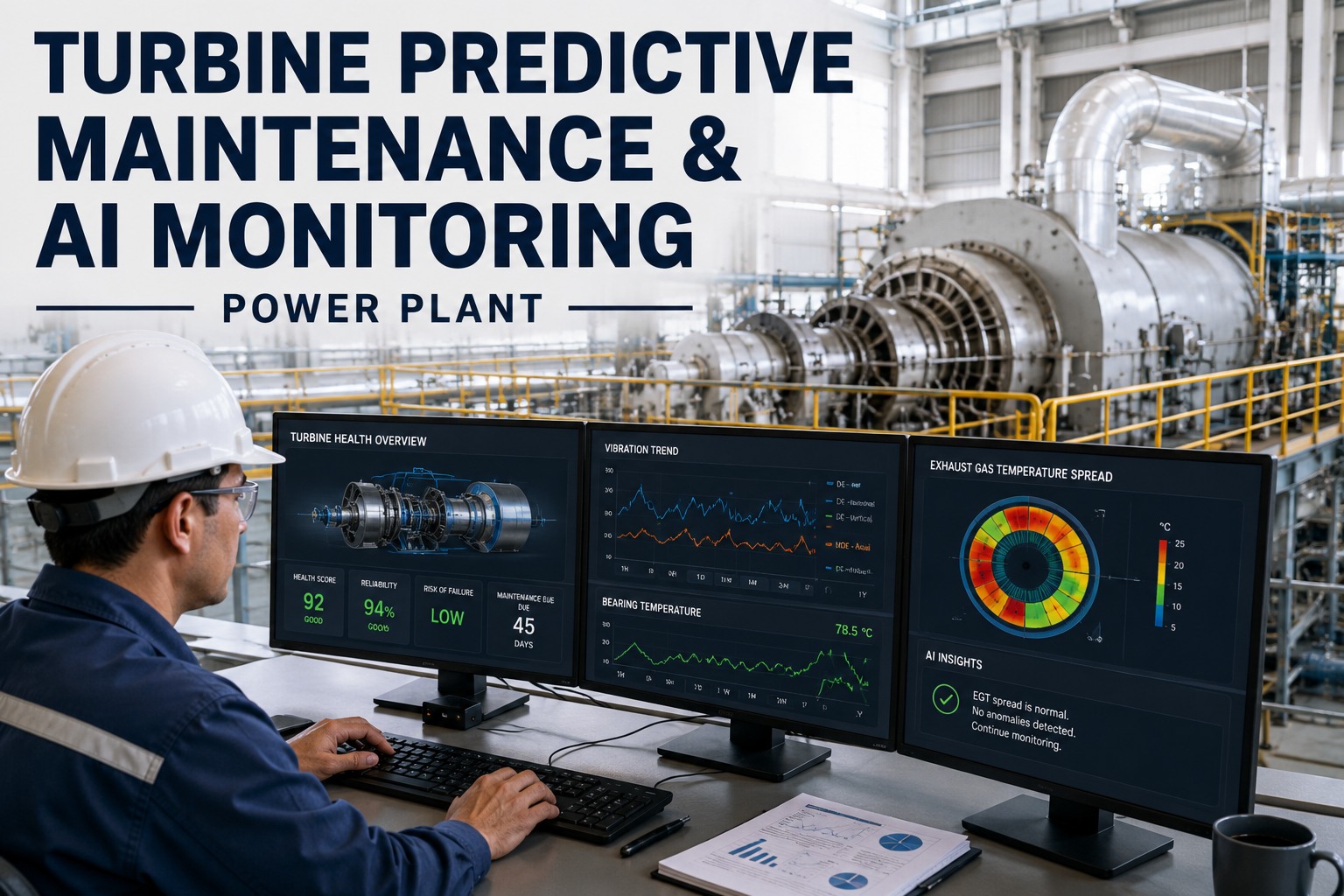
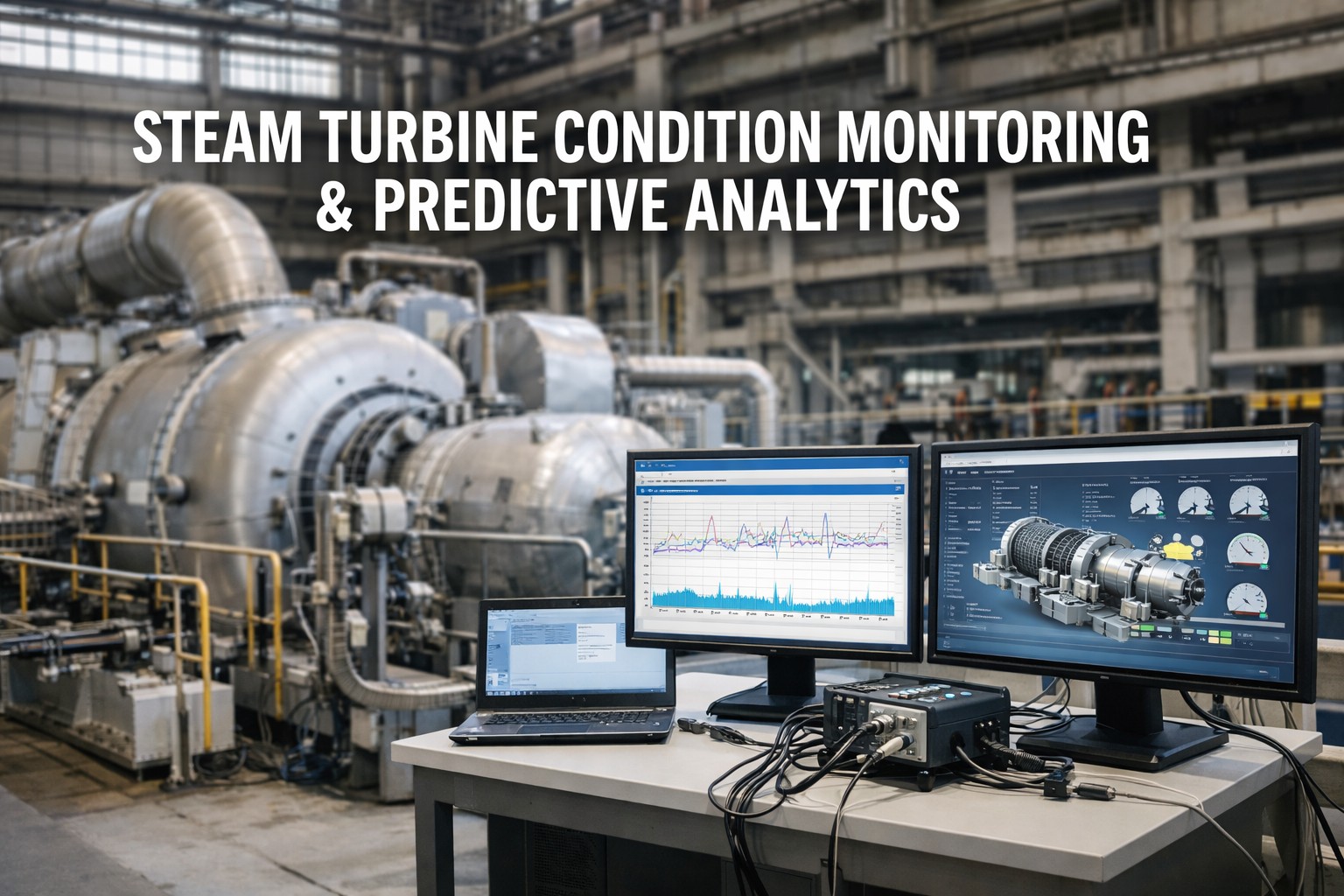
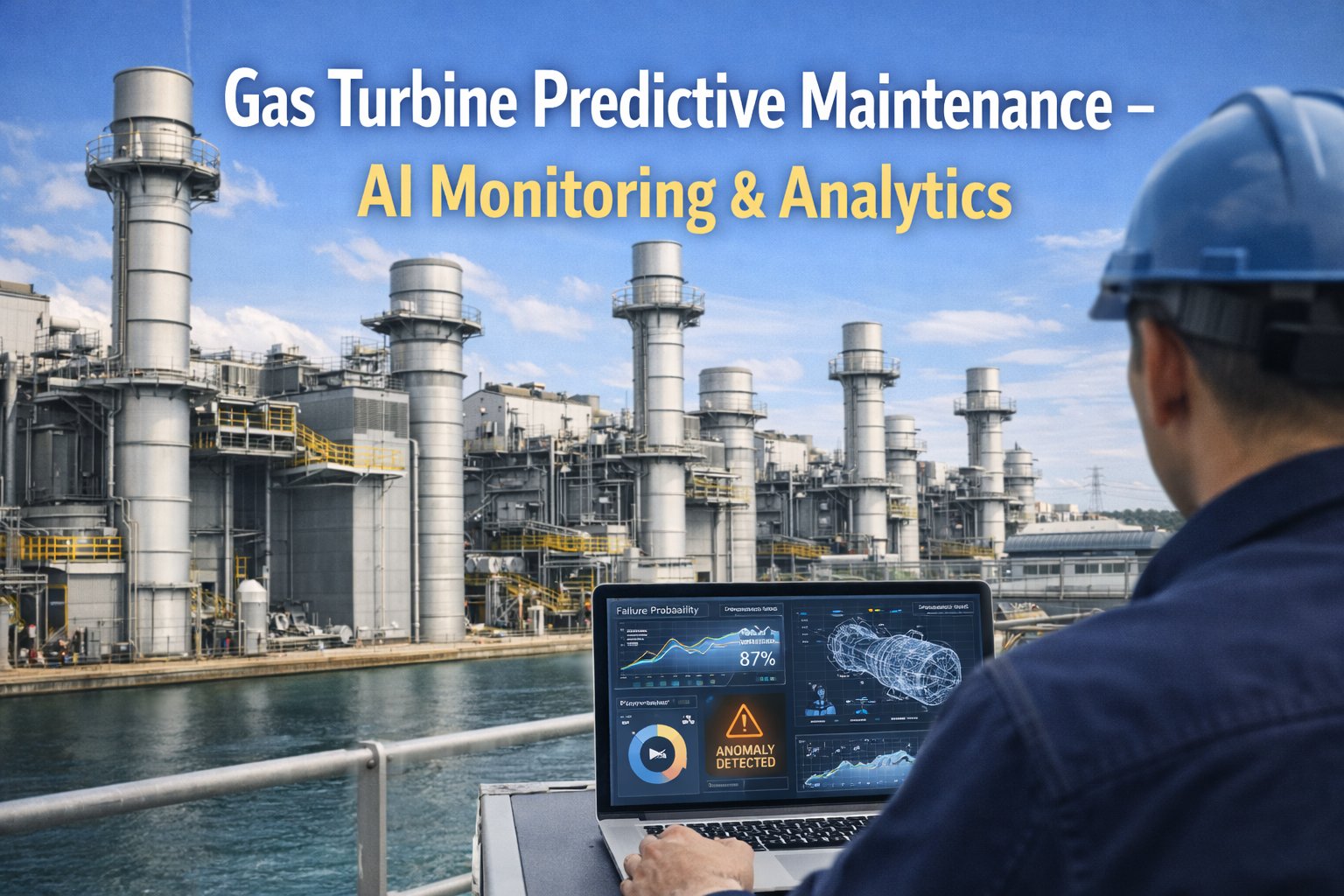
Unplanned outages at power plants cost the global energy sector over $150 billion annually — and the most preventable fact is that 68% of major equipment failures send detectable sensor signals 2–8 weeks before causing physical damage. Start AI predictive maintenance on your power plant assets with OxMaint and convert those invisible warning signals into scheduled repairs before a single megawatt of generation is lost. Book a 30-minute demo to see OxMaint AI in action — free to start, no infrastructure lock-in.
Power Generation · AI Predictive Maintenance · OxMaint CMMS
AI Predictive Maintenance for Power Plants — Forecast Failures Before They Cost You
Continuous AI monitoring across turbines, generators, boilers, and pumps detects failure patterns weeks before breakdown — automatically creating OxMaint work orders so your team acts on intelligence, not emergencies.
45%
Reduction in unplanned outages
6 Weeks
Average advance failure warning
30%
Lower total maintenance spend
10× ROI
Typical return within 18 months
The True Cost of Doing Nothing
Every Hour Offline Is a Number Your Finance Team Remembers
Reactive maintenance in power generation triggers cascading financial losses across every hour offline, emergency parts procurement, regulatory exposure, and reputational risk — far beyond the repair bill alone.
$500K
Revenue lost per hour during an unplanned gas turbine outage at a 500MW plant — before any repair cost is counted.
72 hrs
Average restoration time for an unplanned turbine failure, versus 8 hours for the same repair in a planned maintenance window.
3–5×
Emergency spare parts cost premium over planned procurement — a price paid exclusively by reactive maintenance programs.
68%
Of major power plant equipment failures are preceded by detectable sensor anomalies 2–8 weeks before physical breakdown.
How It Works
From Sensor Signal to Scheduled Repair in 4 Steps
OxMaint's AI maintenance pipeline converts raw sensor data from your critical power plant equipment into actionable scheduled maintenance — without manual analysis, missed alerts, or data leaving your facility.
01
Sensors Stream Live Data
Vibration, thermal, current, pressure, and acoustic sensors on turbines, generators, boilers, and pumps send continuous readings via OPC-UA, Modbus, or MQTT protocols — 24 hours a day.
→
02
AI Detects Anomalies
Machine learning models compare live readings against each asset's own learned baseline — flagging bearing wear, rotor imbalance, insulation degradation, and cavitation patterns weeks before failure.
→
03
Failure Window Calculated
Remaining Useful Life (RUL) models estimate operating hours remaining before critical failure — giving your maintenance team a precise, data-backed planning window measured in weeks, not hours.
→
04
Work Order Auto-Created
OxMaint generates a CMMS work order with sensor data, anomaly classification, asset location, and recommended action attached — so crews act on intelligence, not instinct or guesswork.
Critical Assets Monitored
Six Asset Classes. Continuous AI Coverage. Zero Blind Spots.
Power plant equipment failures don't reveal themselves through visual inspection. AI monitoring covers the six asset categories where failures carry the highest financial impact and where IoT sensor data provides the strongest predictive signal.
Gas & Steam Turbines
Blade vibration · Rotor imbalance · Bearing temperature · Exhaust gas deviation · Hot-section degradation
Failure cost: $2M – $15M per event
Generators & Alternators
Stator winding temperature · Rotor vibration · Insulation resistance trends · Motor current signature analysis
Failure cost: $1M – $8M per event
Boilers & Heat Exchangers
Tube wall temperature · Steam pressure deviation · Combustion efficiency · Flue gas composition
Failure cost: $500K – $3M per event
Cooling Water Pumps
Vibration frequency spectrum · Cavitation acoustic signatures · Bearing temperature · Flow rate deviation
Failure cost: $200K – $1M per event
Power Transformers
Oil temperature · Dissolved gas analysis (DGA) · Partial discharge monitoring · Load current profile
Failure cost: $1M – $5M per event
Fuel & Feed Systems
Fuel flow consistency · Valve response time · Pressure drop patterns · Actuator position drift
Failure cost: $100K – $800K per event
OxMaint monitors every asset. Every anomaly becomes a scheduled work order — automatically.
Connect your plant's IoT sensor data to OxMaint's AI engine and turn every failure prediction into a planned repair. Before the grid feels it.
Proven Outcomes
What Power Plants Measure After 12 Months With OxMaint AI
These outcomes are tracked across power generation deployments where OxMaint's AI predictive maintenance replaced reactive and time-based programs — measured over the first full year of live operation.
45%
Fewer Unplanned Outages
Developing faults caught weeks before failure — converting emergency shutdowns into planned maintenance windows with crew and parts fully prepared.
30%
Lower Maintenance Cost
Eliminating unnecessary time-based servicing and emergency repair cost premiums reduces total maintenance spend per MWh generated.
92%
Prediction Accuracy
Models trained on plant-specific equipment signatures achieve high precision — minimising false alarms that erode trust in AI-generated maintenance alerts.
2.3%
Plant Availability Gain
Each 1% availability gain at a 500MW plant equals approximately $4.4M in additional annual generation revenue — making ROI compound over time.
Strategy Comparison
AI Predictive vs Reactive vs Time-Based Maintenance — Side by Side
Understanding where each maintenance strategy performs and where it fails is the starting point for building a program your power plant can genuinely depend on across every season and every load cycle.
| Factor |
Reactive Maintenance |
Time-Based (PM) |
AI Predictive — OxMaint |
| Failure warning time |
Zero — acts only after failure |
Days — fixed schedule only |
6–8 weeks advance notice |
| Maintenance cost per event |
3–5× emergency premium |
Fixed interval regardless |
30% lower on average |
| Equipment lifespan impact |
Shortened by run-to-failure |
Moderate — over-service risk |
Extended by condition-based care |
| Decision basis |
No data — failure triggers action |
Historical intervals only |
Real-time IoT sensor + AI analysis |
| Grid reliability risk |
High — unpredictable shutdowns |
Moderate — random failures missed |
Lowest unplanned outage rate |
| CMMS work order creation |
Manual after breakdown occurs |
Calendar-triggered only |
Automatic with full sensor context |
Common Questions
What Power Plant Teams Ask About AI Predictive Maintenance
What types of failures can AI detect in power plant equipment?
AI predictive maintenance identifies bearing wear, winding insulation degradation, rotor imbalance, pump cavitation, transformer oil deterioration, and combustion inefficiencies — typically 4–8 weeks before they cause physical damage or generation loss. Detection relies on continuous comparison of vibration, thermal, current, and pressure readings against each asset's own learned baseline, not generic thresholds.
OxMaint integrates with all major sensor protocols and auto-generates work orders the moment anomaly scores cross configurable risk thresholds. Most power plants identify their first preventable failure event within 60 days of live deployment.
How long does AI predictive maintenance implementation take for a power plant?
OxMaint deployment follows four phases: sensor baseline data collection in weeks 1–3, AI model training and shadow-mode validation in weeks 3–6, live deployment with CMMS integration in weeks 6–8, and continuous model refinement from month three onwards. Plants with existing OPC-UA or Modbus sensor networks often go live within 5–6 weeks — no proprietary hardware is required.
Book a scoping call to receive a deployment timeline specific to your plant's asset count, sensor infrastructure, and generation type. Your existing sensor investment is fully leveraged, not replaced.
Does it work for both gas turbine and steam turbine power plants?
OxMaint's AI engine is asset-agnostic and deployed across combined-cycle gas turbine (CCGT), steam turbine, hydro, and wind generation facilities. Machine learning models adapt to each asset type's specific failure signatures during the baseline training phase — gas turbines monitored for blade vibration and hot-section degradation, steam turbines for rotor eccentricity and seal wear.
Start a free trial to assess compatibility with your specific fleet. The platform also supports legacy equipment with limited sensor coverage through partial-data anomaly detection models trained on available signals.
How does OxMaint connect to existing SCADA and DCS systems in a power plant?
OxMaint connects to plant control systems through standard industrial protocols — OPC-UA, Modbus TCP, MQTT, and REST API — without any modification to your SCADA or DCS architecture. Sensor data flows into the analytics engine through these interfaces, and generated maintenance work orders sync back to existing EAM or ERP systems via webhook integration. No proprietary hardware is required, and most protocol integrations complete in one to two engineering days.
Sign up for a free sandbox trial to test connectivity with your current plant systems before committing to full deployment across your asset fleet.
Free to Start · No Infrastructure Lock-In · OxMaint AI CMMS
Your Plant's Next Turbine Failure Is Already Sending Signals. Is Your Maintenance Program Listening?
OxMaint AI converts continuous IoT sensor data from your power plant's critical assets into scheduled maintenance work orders — automatically. Every anomaly becomes a repair plan. Every failure prediction becomes a scheduled intervention. Before downtime costs you another day of generation revenue.