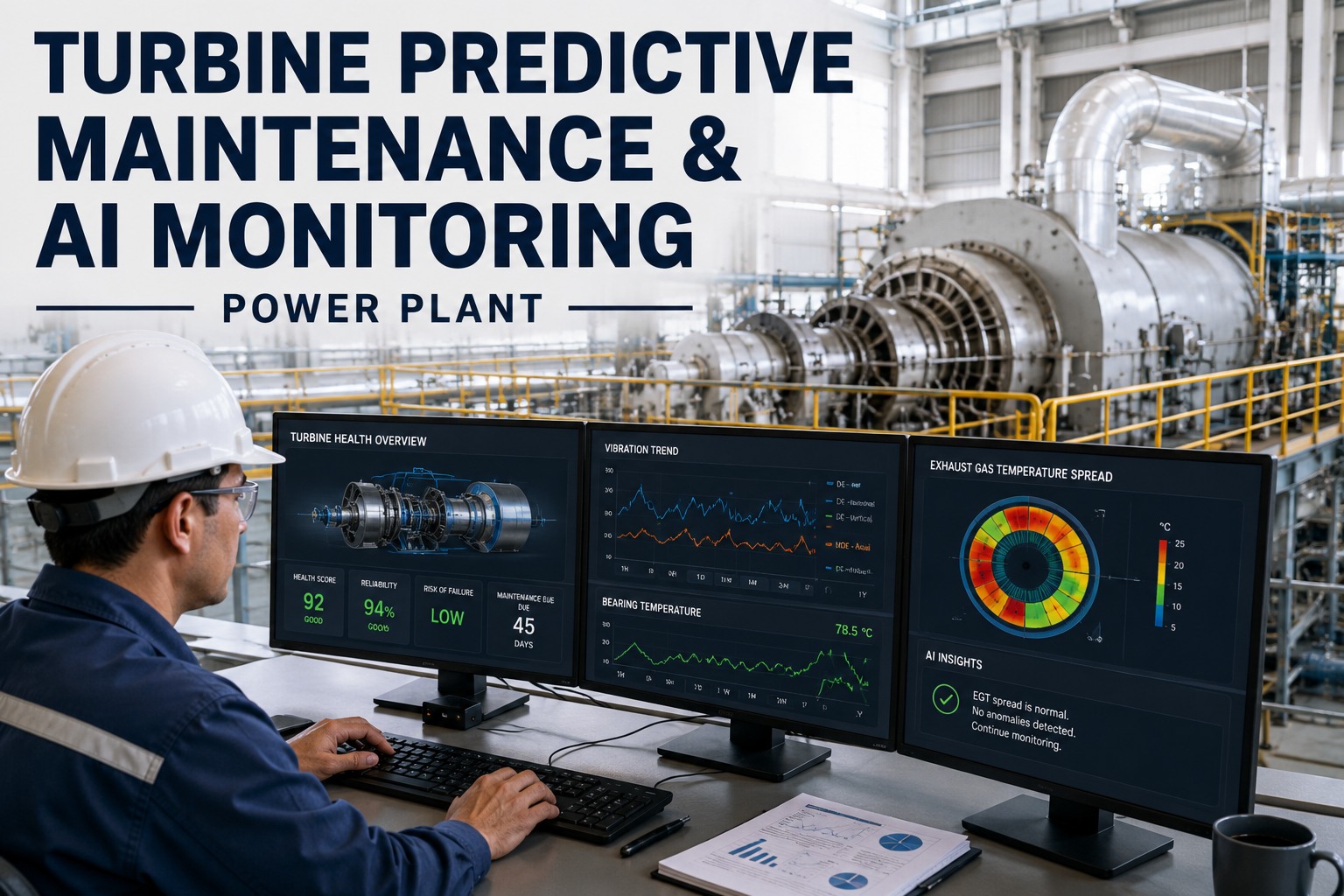
Power plants running reactive or calendar-based maintenance schedules lose an estimated $1M–$3M per forced outage event — and the average U.S. thermal plant experiences 5–8 of these per year. AI predictive maintenance changes that equation entirely: instead of waiting for failure or replacing parts on a fixed schedule, continuous sensor intelligence detects degradation weeks in advance, converting emergency shutdowns into planned service windows. Plants deploying AI-driven maintenance through a platform like Oxmaint report 35–50% reductions in unplanned downtime and maintenance cost savings of 25–40% annually. If your plant is still operating on inspection rounds and paper work orders, the gap between where you are and where you could be is measured in millions.
The Shift From Reactive to Predictive: A Real Cost Comparison
Every week a turbine runs without AI monitoring is a week of invisible degradation that only shows up on the income statement after it fails.
See your plant's AI savings potential — in one session, no commitment.
Oxmaint maps your asset profile against real failure data and projects your first-year ROI before you commit to anything.
What AI Predictive Maintenance Actually Does Inside a Power Plant
AI doesn't replace your maintenance team — it gives them weeks of advance warning instead of seconds of crisis response.
Continuous Sensor Monitoring
Vibration, temperature, pressure, current draw, and oil viscosity sensors stream data 24/7 from every critical asset. Oxmaint ingests this through OPC-UA, Modbus, and PI Historian — no ripping out existing SCADA or DCS infrastructure.
AI Anomaly Detection
Machine learning models trained on power plant failure signatures identify deviations from healthy baselines — bearing wear, rotor imbalance, thermal drift — at signal levels too subtle for alarm thresholds to catch. Deep learning models achieve F1-scores exceeding 90% accuracy.
Automated Work Orders
When the AI flags an anomaly, Oxmaint auto-generates a prioritized work order with sensor readings attached, spare parts availability checked, and scheduling matched to the next planned outage window — not to the next crisis.
Failure Probability Scoring
Each asset carries a rolling failure probability score. Procurement orders parts 30 days before predicted need at standard cost. Maintenance scheduling targets the highest-risk assets first — so no crew gets spread across low-priority inspections while a turbine bearing is trending toward failure.
Which Equipment Delivers the Fastest AI Maintenance ROI
Start with the 15–20% of assets responsible for 70% of your forced outages. Prove value fast. Expand from there.
| Asset Class | Failure Detection Lead Time | Emergency Cost / Event | Planned Cost / Event | Savings per Event |
|---|---|---|---|---|
| Gas Turbine | 4–12 weeks | $500K – $2M | $180K – $500K | 60–75% |
| Generator / Transformer | 3–8 weeks | $400K – $1.5M | $150K – $400K | 62–73% |
| Boiler / Steam System | 4–16 weeks | $300K – $800K | $100K – $250K | 58–69% |
| BFP / Major Pumps | 2–6 weeks | $80K – $220K | $30K – $75K | 63–66% |
| ID / FD Fan Bearings | 10–30 days | $60K – $150K | $20K – $55K | 63–67% |
What Plants Report After 12 Months on AI Maintenance
Of organizations implementing AI predictive maintenance report positive returns within 18 months.
Documented by a major U.S. utility after deploying AI across 67 generation units.
DOE-confirmed reduction in unexpected equipment failures at plants using AI condition monitoring.
Against a $300K–$500K platform investment, typical first-year value reaches $3M–$6M.
Common Questions About AI Predictive Maintenance
A Single Prevented Outage Pays for the Platform
The math is straightforward: one prevented gas turbine failure saves $500K–$2M. Oxmaint's AI detects the warning signals 4–12 weeks before failure — giving your team time to plan, not panic. Join power plant operators saving $2.5M–$8M annually.