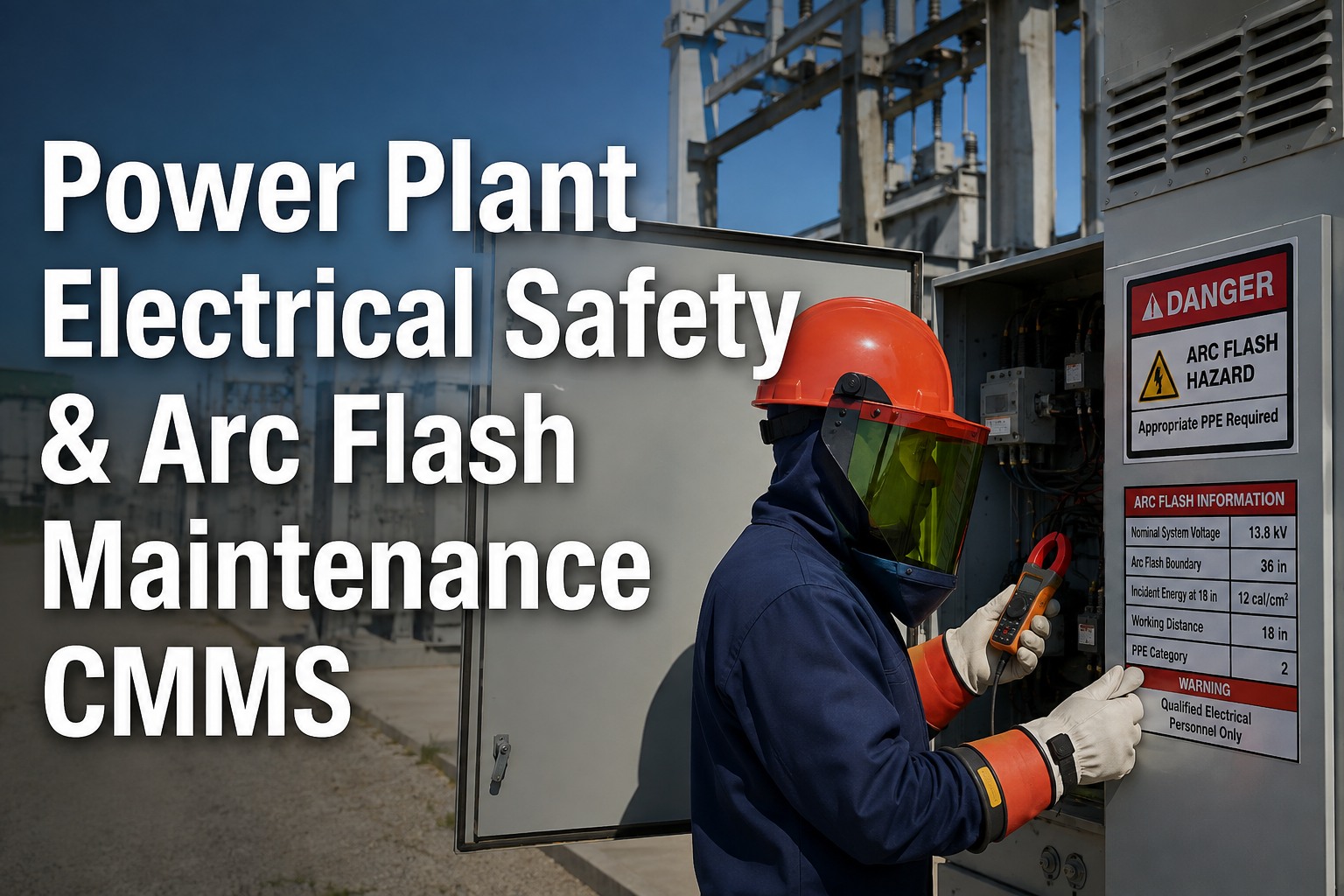
Arc flash incidents cause more than 30,000 injuries in the United States every year, with 149 electrical fatalities annually — and OSHA updated its arc flash enforcement guidance in November 2024 for the first time in nearly two decades specifically because half the facilities subject to NFPA 70E requirements still cannot demonstrate a compliant program when inspectors arrive. The compliance failure is almost never in the physical protection equipment or the initial arc flash study. It is in the documentation trail: arc flash studies that were performed but never updated after a transformer replacement, PPE records that exist in HR files but cannot be cross-referenced to the specific panel where a worker will be doing energized work, and equipment labels that faded two years ago and were never replaced in the maintenance record. OxMaint structures arc flash compliance as an ongoing maintenance program rather than a one-time study, so the documentation your safety audit requires is always current and always retrievable. Start a free trial and build your first arc flash asset register today.
30,000+
Arc flash incidents per year in the US
$156K
Average OSHA penalty for a serious arc flash violation
5 years
Maximum arc flash study review cycle before it must be updated (NFPA 70E)
3 years
PPE training refresh requirement under NFPA 70E 2024
The 2024 standard update
Six compliance areas NFPA 70E 2024 tightened — and what each one requires documented
The 2024 edition of NFPA 70E introduced tightened requirements across six areas that directly affect how power plants document and manage arc flash compliance. Each area creates a specific, ongoing documentation obligation that must be retrievable on demand — not assembled before an audit. Understanding exactly what is required in each area is the first step to building a maintenance program that keeps those records current automatically.
70E-1
Arc flash risk assessments
Required for every piece of equipment where energized work may be performed. Must use IEEE 1584-2018 calculation methodology for power plant voltage ranges. Review trigger required if system configuration changes — not just every 5 years.
Document: Study date, methodology, calculated incident energy, arc flash boundary per panel
70E-2
Equipment arc flash labeling
Every panel, switchboard, and MCC must carry a current arc flash warning label with incident energy level, arc flash boundary, required PPE category, and nominal voltage. Labels must be updated when a study changes the calculated values.
Document: Label issue date, current study reference, next review trigger in asset record
70E-3
PPE selection and inspection records
PPE must be selected using either the Incident Energy Method (from the arc flash study) or the PPE Category Method (NFPA 70E tables, only applicable within defined system parameter ranges). Inspection and retirement records per item required.
Document: PPE item, arc rating, in-service date, inspection log, retirement record per employee
70E-4
Qualified worker training records
Workers performing energized electrical work must be retrained every three years. Training records must include the specific equipment types covered, the topics addressed, and the instructor qualification. Generic safety training does not satisfy this requirement.
Document: Employee name, equipment scope, training date, next renewal due date, instructor
70E-5
Energized work permits
An Energized Electrical Work Permit (EEWP) must be issued every time work is performed within the arc flash boundary and the system cannot or will not be de-energized. The permit must document justification for energized work, PPE selected, and supervisor authorization.
Document: Permit number, panel ID, justification, PPE used, authorized by, date and time
70E-6
Incident investigation and corrective action
Any arc flash incident or near miss must be investigated, documented, and result in corrective action records. OSHA and NFPA 70E both require the investigation record to include root cause analysis, corrective actions taken, and program updates made in response.
Document: Incident report, root cause, corrective actions, program changes, closure date
The review trigger problem
When a valid arc flash study becomes invalid — and why most plants miss the trigger
NFPA 70E does not require a new arc flash study only on a five-year calendar. It requires a new study whenever a significant change occurs to the electrical system that would affect the calculated fault current, clearing time, or system impedance. The most common missed triggers in power plants are transformer replacements that change available fault current, protective relay settings updates that change clearing times, and circuit additions that alter the fault current distribution. Plants without a CMMS linkage between equipment change work orders and arc flash study review status cannot know when a study has been invalidated by a system modification.
Transformer replacement or re-rating
Changes available fault current at downstream panels. Any arc flash study using the old transformer impedance values is invalid immediately after the new unit is energized.
Protective relay settings update
Fault clearing time is the second variable in IEEE 1584 incident energy calculation. A relay coordination study that changes any upstream clearing time invalidates the arc flash study for all downstream equipment on that circuit.
New load or circuit addition to existing switchgear
Adding a branch circuit to an existing panel changes the effective fault current distribution. This may or may not change the calculated incident energy significantly — but the study must be reviewed to confirm, and the review record must be filed.
Utility supply changes affecting available fault current
Changes to the utility interconnection, generation capacity additions, or transmission configuration updates can alter the available fault current at the plant service entrance and all downstream panels.
Five-year calendar review — regardless of changes
Even with no system changes, the arc flash study must be reviewed at least every five years per NFPA 70E to confirm that it remains current and that no undocumented system modifications have invalidated the calculations.
Your arc flash program should run itself
Link equipment change work orders to arc flash study review status automatically
OxMaint connects equipment modification work orders to arc flash study review triggers. When a transformer replacement is completed in the CMMS, the arc flash study records for downstream panels are flagged for review — before the new equipment is energized, not months later during an audit.
Common questions
What safety and maintenance teams ask about arc flash compliance documentation
How does OxMaint store arc flash study results against individual panel assets?
Each electrical panel, switchboard, and MCC is configured as a separate asset in OxMaint. The arc flash study result — calculated incident energy, arc flash boundary, required PPE category, and study date — is stored directly in that asset record. When the study is updated, the new result replaces the old one and the prior study is archived in the asset's history.
Start a free trial to configure your electrical asset register with arc flash fields.
Can OxMaint track PPE inspection and retirement records per individual PPE item?
Yes. Arc-rated PPE — suits, hoods, gloves, and face shields — are tracked as individual asset records with in-service date, inspection history, arc rating, and retirement trigger. When an item reaches its inspection interval or damage threshold, an inspection work order is generated automatically. The retirement record stays in the system as audit evidence.
Book a demo to see the PPE tracking workflow.
How does the energized work permit (EEWP) workflow operate in OxMaint?
EEWPs are issued from within the work order for the specific energized task. The permit form captures the panel asset ID, justification for energized work, PPE selected with arc rating confirmation, and supervisor authorization. The completed permit is stored with the work order record and remains retrievable for OSHA audit purposes without separate filing.
Does OxMaint track the five-year NFPA 70E arc flash study review cycle automatically?
Yes. The arc flash study date for each panel asset triggers a review work order automatically 90 days before the five-year review deadline. The review work order also triggers if a linked transformer or relay asset has a completed modification work order, regardless of calendar date — so system-change-triggered reviews are caught automatically.
Can we document arc flash incident investigations and corrective actions in the same platform?
Yes. Arc flash incidents and near misses are logged as corrective work orders against the panel asset where the event occurred. The work order captures the incident description, root cause finding, corrective actions assigned, and program update documentation. The complete investigation record is linked to the asset history and exportable for OSHA recordkeeping compliance.
Audits pass when records are current, not when they are assembled
Arc flash compliance documentation that does not require a pre-audit scramble
The most common outcome of a power plant arc flash safety audit is not a finding on the PPE or the equipment — it is a finding on the records. An outdated study, a missing EEWP, a training record in an HR file that cannot be cross-referenced to the panel where work was done. OxMaint makes arc flash compliance a continuous maintenance workflow, not a periodic documentation project your team runs under pressure the week before an inspector arrives.