Most CMMS platforms were not designed for power plants. They were designed for facilities management, adapted for manufacturing, and stretched to cover generation assets as an afterthought. The result is software that handles work orders adequately but fails at the features that actually matter in power generation: equivalent operating hour tracking, NERC PRC-005 compliance automation, turbine and boiler asset hierarchies, SCADA integration, and the critical path scheduling tools that protect multi-million-dollar outage windows. Before your team shortlists any CMMS vendor, book a demo with OxMaint to see how a platform built specifically for power plant complexity handles each of the features below. Or sign up free to explore the platform with your own asset data before committing to anything.
Best Power Plant CMMS Features Plant Engineers Should Demand in 2026
The non-negotiable capabilities that separate a purpose-built power generation CMMS from a generic work order system wearing a power plant label.
Why Generic CMMS Fails in Power Plants
A facilities management CMMS handles room service requests and HVAC filter replacements. A power plant CMMS needs to track equivalent operating hours on a gas turbine hot section, enforce NERC PRC-005 protection relay test intervals, generate GADS event reports for NERC compliance, and correlate DCS historian data with work order history to catch degradation before it becomes a forced outage. These are not the same software category wearing different labels. The consequences of choosing wrong are measured in forced outages, regulatory penalties, and seven-figure maintenance budget overruns.
The 15 Features Plant Engineers Should Demand
Your CMMS asset structure must reflect how power plants are actually organized: plant → unit → system → subsystem → component. A gas turbine asset hierarchy looks nothing like an HVAC asset hierarchy. Pre-configured templates for gas turbines, steam turbines, boilers, generators, HRSGs, and balance-of-plant systems should come out of the box — not require months of custom configuration.
Gas turbine inspection intervals are defined in EOH — not calendar hours — because a cold start damages hot section components far more than a steady-state base-load hour. Your CMMS must calculate EOH automatically using configurable multipliers for base-load hours, cold starts, warm starts, hot starts, and trip events from your OEM's inspection manual. When EOH hits the threshold, the work order generates automatically — regardless of calendar time.
When a vibration sensor crosses its threshold, a work order should generate automatically — not wait for a reliability engineer to notice a report and manually create a task. Condition-based triggering connects sensor alerts directly to work order creation, assigns them to the right technician, and logs the sensor reading as the work order initiation evidence. This converts predictive monitoring intelligence into maintenance action without human-in-the-loop latency.
Technician adoption is the single largest determinant of CMMS success. A platform that is painful to use in the field gets abandoned regardless of management mandates. The mobile interface must work offline (plant floors have connectivity gaps), support barcode/QR asset scanning, allow photo and voice note capture, and enable work order completion in under 60 seconds for standard tasks. Plants with high mobile interface adoption see 40% better data quality than those relying on desktop entry.
NERC PRC-005 sets maximum testing intervals for protection system components — most relay functions require testing at intervals from 3 months to 12 years depending on the maintenance basis selected. Your CMMS must pre-load the PRC-005 maintenance basis, auto-generate work orders at the correct interval, retain every test result with a 6-year immutable history, and produce compliance summary reports that are audit-ready without manual compilation. Non-compliance penalties reach $1 million per day per violation.
Every unplanned outage, derating, and planned outage event at a bulk electric system generator must be reported to NERC via GADS. Manual GADS data entry is time-consuming, error-prone, and commonly results in late filings. A power plant CMMS should auto-populate GADS event reports from work order data — outage start, end, cause code, and MWh lost — and flag incomplete data before submission deadlines. This feature alone justifies the platform cost for many mid-size generators.
Work cannot begin on energized or pressurized equipment until isolation is confirmed and a Permit to Work is issued. In a standalone PTW system, technicians wait — sometimes for hours — for permit status that the CMMS cannot see. Integrated PTW links permit status directly to work orders: technicians see real-time PTW status in the same interface where they receive and complete work, eliminating the idle time that is one of the biggest drivers of planned outage overruns.
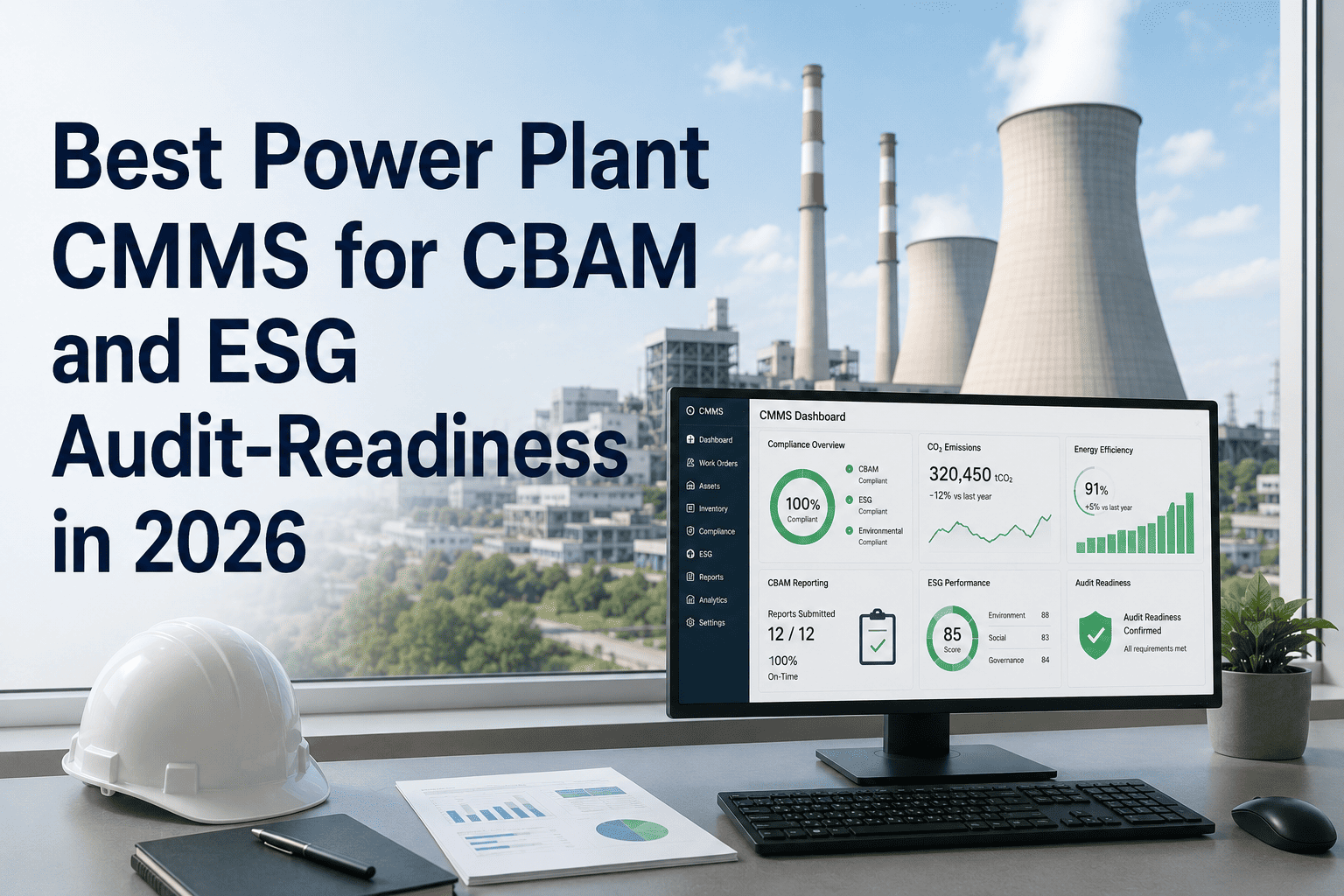
Every maintenance record in the CMMS should be timestamped, electronically signed, and immutable — retrievable in seconds during regional entity audits rather than requiring manual compilation from filing systems. For nuclear plants, Maintenance Rule (10 CFR 50.65) records need to be retained for the life of the plant. For conventional generators, NERC requires 6-year retention on protection system maintenance records. A CMMS that generates compliance records as a byproduct of normal maintenance activity — not as a separate administrative layer — cuts compliance documentation time by up to 60%.
Your plant's operational intelligence lives in the DCS historian — temperatures, pressures, vibration signatures, and process variable trends that reveal equipment health in real time. A CMMS that cannot ingest this data is blind to the most important asset health information your plant generates. Demand native connectors for OSIsoft PI, OPC-UA, Modbus TCP, DNP3, and your SCADA historian. Integration should be completed in 2–4 weeks, not months — and should not require a separate integration middleware project.
Most utilities and large IPPs run SAP PM, Oracle eAM, or IBM Maximo as their financial backbone. A power plant CMMS should integrate bidirectionally with these systems — so that work orders created in the CMMS sync cost data to the ERP without double entry, and purchase orders raised in the ERP flow back to the CMMS for parts availability visibility. Plants without ERP integration end up with two maintenance realities that diverge over time, undermining both systems.
AI anomaly detection models that learn from plant-specific operational data — not generic industrial baselines — are what separate 2026's best CMMS platforms from those relying on static thresholds. Models trained on your turbine's actual vibration history detect subtle pre-failure patterns that fixed-threshold alerts miss entirely. Industry data shows plants using AI-native CMMS report 61% reduction in forced outage frequency within 18 months of go-live, with false-positive rates below 10% in mature deployments.
A power plant CMMS serves multiple user groups — maintenance technicians, reliability engineers, plant managers, outage contractors, and corporate finance — each needing different data access levels. SSO integration with your corporate identity provider (Active Directory, Azure AD, Okta) removes the friction of separate CMMS credentials. Role-based access controls ensure contractors see only their assigned tasks, technicians see only their plant, and finance sees cost data without maintenance operational detail.
A 500 MW gas plant outage is a $4–9 million event before a single wrench turns. Sixty-eight percent of planned outages run over schedule — and the primary cause is that the schedule was built in a spreadsheet with no live critical path. Your CMMS outage planning module must build and maintain a live critical path with task dependencies, resource constraints, and float calculations — updating in real time as work progresses. A two-hour slip must be visible to all teams within minutes of the deviation occurring, not at end-of-shift.
Twenty-nine percent of outage overruns trace back to parts not confirmed in stock until work is already underway. The CMMS must cross-reference every work order in the outage plan against live inventory 6–10 weeks before outage start — raising procurement alerts for every gap with lead time calculations. Parts ordered at standard lead time cost a fraction of emergency procurement on an expedited basis. Material readiness gates should be non-negotiable milestones in any outage planning runway.
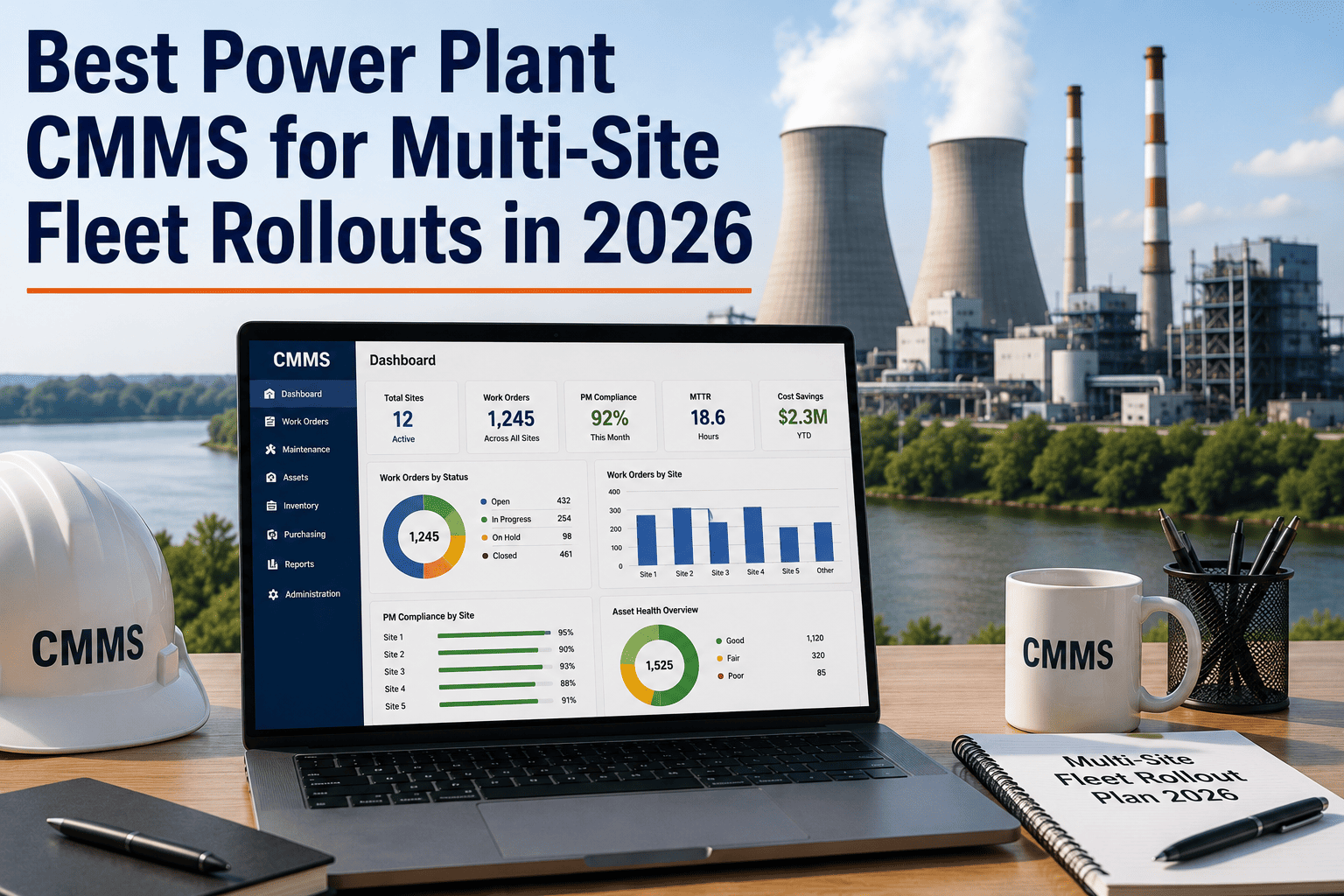
Any operator managing more than one generation asset needs a consolidated fleet view — not a tab-switching exercise across plant-specific logins. The multi-site dashboard must show work order backlogs, PM compliance rates, open corrective actions, and inventory gaps across all plants from a single screen. For IPPs managing mixed fleets (gas + solar + wind), the dashboard must normalize KPIs across different asset classes so that performance is comparable at the portfolio level, not just the plant level.
Stop Evaluating. Start Seeing It in Your Own Plant.
OxMaint delivers every feature on this list — built specifically for power generation complexity, not adapted from a generic facilities platform. Go live in 4 weeks. First ROI data in 30 days.
CMMS Feature Scorecard: What to Demand vs. What to Accept
Not all features carry equal weight. Use this scorecard to evaluate any CMMS vendor against the requirements that actually determine whether the platform delivers in a power plant environment.
| Feature | Priority | Red Flag if Missing | OxMaint |
|---|---|---|---|
| Power plant asset hierarchies | Non-Negotiable | Shadow maintenance within 90 days | Included |
| EOH-based PM scheduling | Non-Negotiable | Premature or missed turbine inspections | Included |
| Condition-based work order triggering | Non-Negotiable | Predictive monitoring not acted on | Included |
| NERC PRC-005 automation | Non-Negotiable | $1M/day/violation compliance risk | Included |
| NERC GADS event reporting | Non-Negotiable | Manual data entry, late filings | Included |
| SCADA / DCS / historian integration | Non-Negotiable | Blind to real-time asset health | Included |
| Permit-to-Work integration | Non-Negotiable | Crew idle time during outages | Included |
| Outage critical path management | Non-Negotiable | Undetected schedule slippage | Included |
| Material readiness engine | Non-Negotiable | Parts shortages mid-outage | Included |
| ERP integration (SAP / Oracle) | Important | Dual maintenance realities diverge | Included |
| AI predictive failure detection | Important | Static thresholds miss subtle degradation | Included |
| Multi-site fleet dashboard | Important | No cross-plant performance visibility | Included |
| SSO & role-based access | Standard | Credential management overhead | Included |
| Mobile-first technician interface | Non-Negotiable | Low adoption, poor data quality | Included |
| Audit-ready compliance records | Non-Negotiable | Days of manual compliance prep per audit | Included |
Frequently Asked Questions
Your Next CMMS Should Work as Hard as Your Plant Does
OxMaint delivers every non-negotiable feature on this list — purpose-built for power generation complexity, not adapted from facilities management software. EOH tracking, NERC compliance, SCADA integration, outage planning, AI predictive detection, and a technician interface that crews actually use. Live in 4 weeks. ROI data in 30 days.