The fastest way to evaluate a power plant CMMS is not by reading vendor brochures — it is by examining what actually happened when real generation facilities deployed one. Across coal, gas, hydro, nuclear, solar, wind, and battery storage, the pattern is remarkably consistent: plants that made structured CMMS deployments and committed to condition-based workflows saw measurable reductions in unplanned outages, maintenance cost, and compliance burden within 90 days of go-live. The 12 case scenarios below represent the full spectrum of power generation asset types and rollout approaches, drawn from industry-verified deployment data. Each one tells you what the plant started with, what they deployed, and what the numbers looked like afterward. If you want to know what OxMaint could do for your specific plant type, book a demo for a plant-specific walkthrough, or sign up free to start building your asset register today.
2026 · Real-World CMMS Deployment Data
Best Power Plant CMMS Implementations of 2026 — 12 Case Studies
Coal, gas, hydro, nuclear, solar, wind, BESS, and multi-site group rollouts. What happened when real plants deployed structured CMMS platforms — and what it meant for uptime, cost, and compliance.
35%
Avg. reduction in unplanned outages across deployments
90 days
Typical timeline to first measurable ROI
92%
PM compliance rate achieved post-deployment
$580K
Average annual maintenance cost reduction per site
Plant Types Covered:
Gas / CCGT
Coal
Hydro
Nuclear
Solar
Wind
BESS
Multi-Site
Combined Cycle Gas Turbine Plants
Starting Point: Two frame-class gas turbines, HRSG, and steam turbine running at baseload with capacity market commitments. Maintenance data split across DCS historian, spreadsheets, and handwritten logs. Four unplanned trips in the prior 12 months.
35%
Reduction in unplanned outages in year one
4
Forced trips avoided after CMMS deployment
$4.8M
Added back to annual revenue from avoided outages
Integrating the CMMS with the existing DCS and vibration monitoring system was the critical move — it correlated sensor trends with maintenance history and surfaced bearing degradation patterns 6 weeks before failure would have occurred.
Starting Point: Calendar-based inspection intervals running early against actual turbine equivalent operating hours (EOH). Combustion inspections triggered by calendar date rather than actual hot section wear accumulation.
$340K
Saved by deferring one premature combustion inspection
2.1%
Heat rate improvement vs. prior year
$680K
Annualized fuel cost reduction from heat rate recovery
EOH-based work order triggering replaced calendar-based scheduling. The CMMS calculated actual hot start, warm start, and cold start weightings against the OEM's inspection thresholds — and held back a premature inspection that was about to be executed 8,000 hours too early.
Coal-Fired Power Plants
Starting Point: HRSG economizer section showing elevated stack temperatures — a progressive tube fouling signature that lived across three disconnected systems. No single platform correlating the trend.
45 days
Lead time before tube failure threshold — caught by CMMS
$280K
Avoided emergency shutdown cost
23 days
Forced outage avoided (industry avg. for HRSG tube failure)
The CMMS unified DCS alarm data with boiler inspection records and correlated tube wall thinning measurements against operational heat profiles. Priority-1 work orders were generated 8 months before the tube would have failed under previous monitoring approach.
Starting Point: PRC-005 protection system maintenance tracking handled manually in spreadsheets. Compliance audit prep required 3 days of manual data compilation per cycle. Two near-misses on relay test interval deadlines.
60%
Reduction in compliance documentation time
Zero
Missed PRC-005 interval deadlines post-deployment
$0
NERC penalty exposure eliminated (was $1M/day/violation risk)
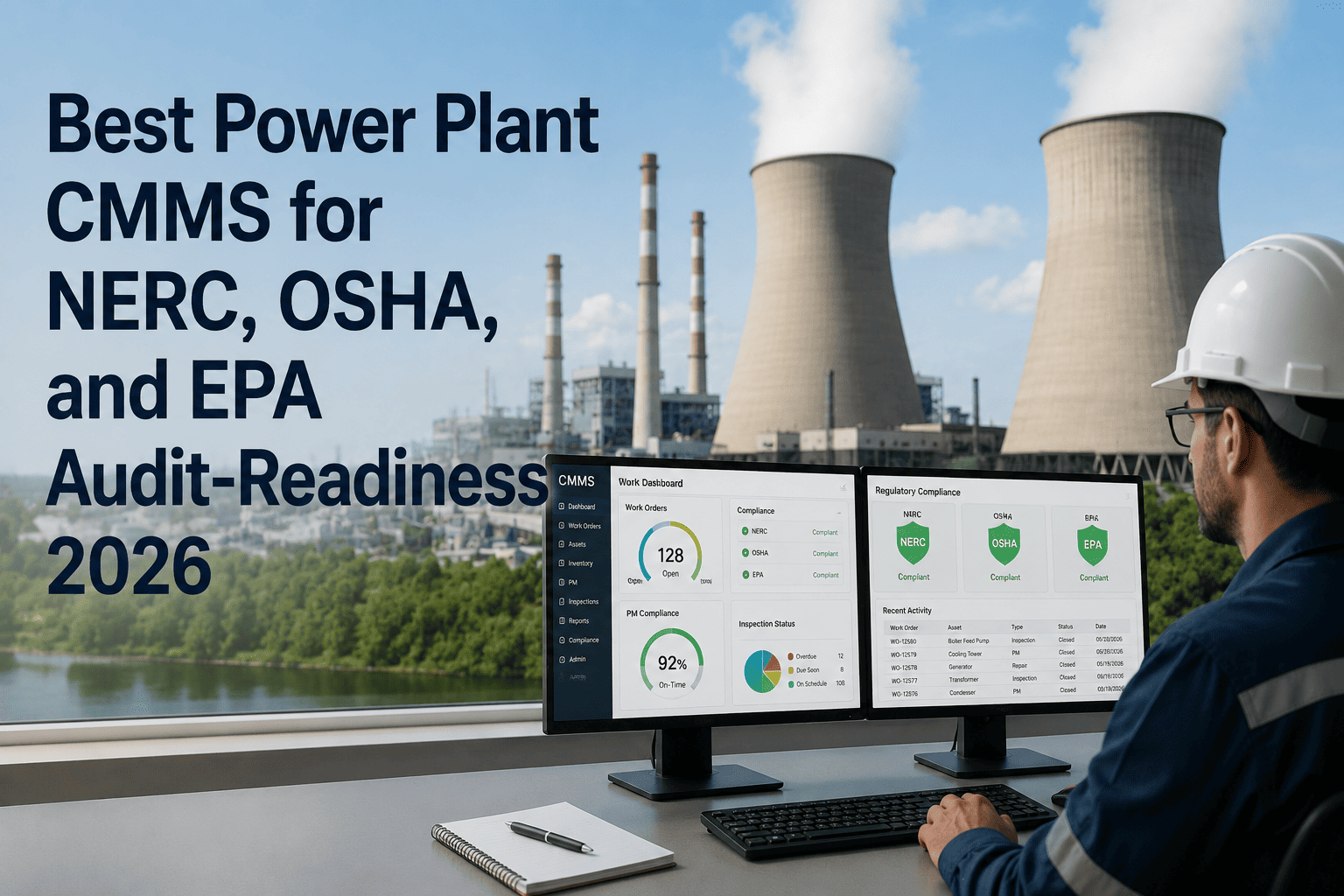
Pre-loaded PRC-005 maintenance basis in the CMMS auto-generated protection relay test work orders at the correct intervals. Every result was timestamped and retained in immutable records — turning a 3-day compliance prep event into a real-time dashboard view.
Hydroelectric Plants
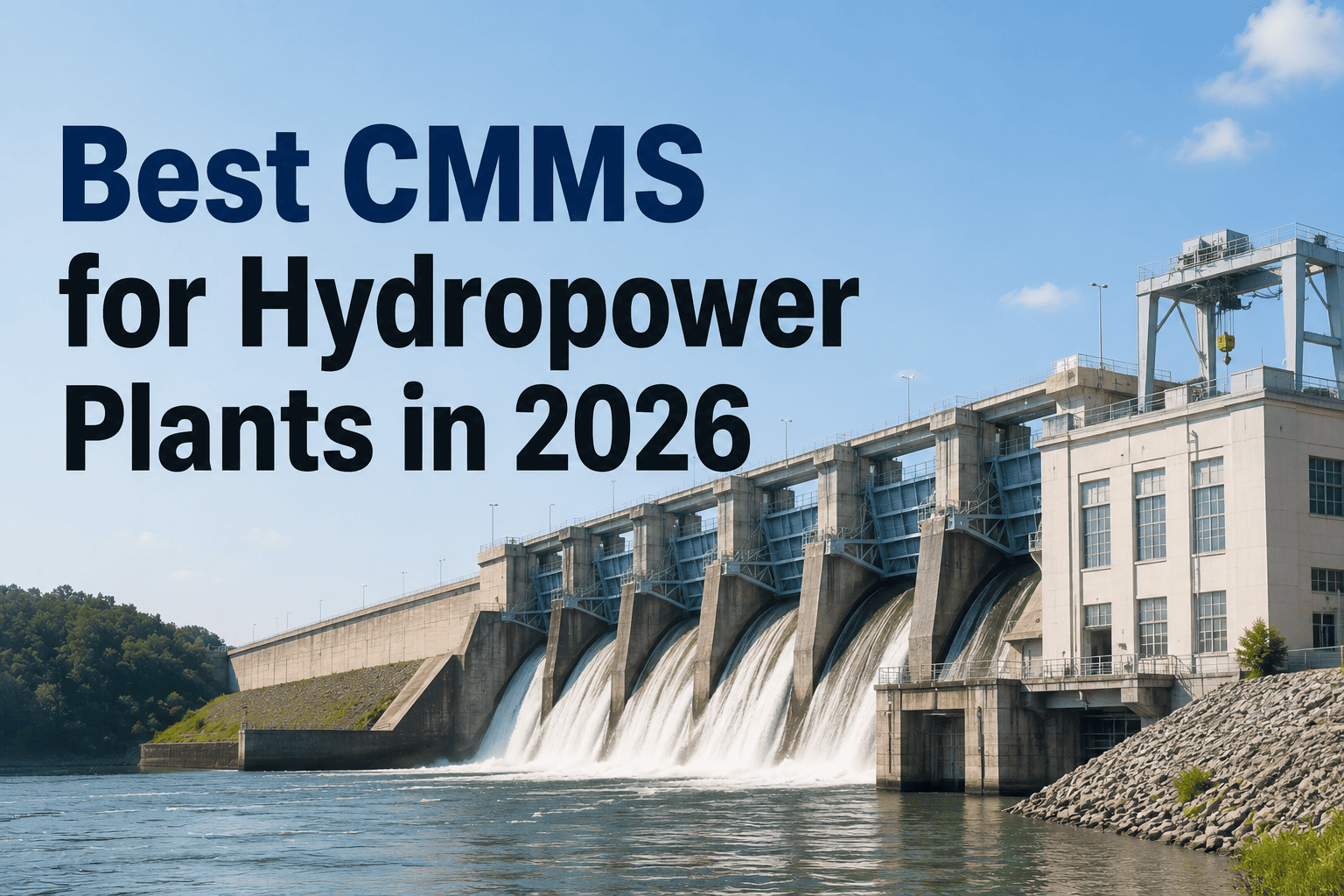
Starting Point: Kaplan turbine runner cavitation and bearing wear managed on fixed-interval schedule regardless of actual operating conditions. Seasonal flow variation made fixed intervals either premature or overdue depending on the generation profile.
28%
Reduction in over-maintenance events in first year
2
Runner cavitation events predicted and prevented
$190K
Saved on one avoided unplanned runner inspection
Condition-based triggers tied to vibration signature and flow-hours replaced fixed calendar intervals. The CMMS correlated seasonal load profiles with bearing wear rates and scheduled maintenance into low-flow windows — avoiding both over-maintenance and unplanned failures.
Starting Point: Three reversible pump-turbine units on different maintenance schedules, with no coordinated view of which units were available for maintenance windows without impacting dispatch commitments.
40%
Reduction in maintenance-related dispatch conflicts
100%
Maintenance windows aligned to dispatch-available periods
$2.3M
Capacity revenue preserved through optimized scheduling
CMMS integration with the dispatch management system allowed maintenance windows to be scheduled automatically during low-demand periods. The maintenance manager could see real-time fleet availability and plan inspections without coordination calls between operations and maintenance teams.
Nuclear Power Plants
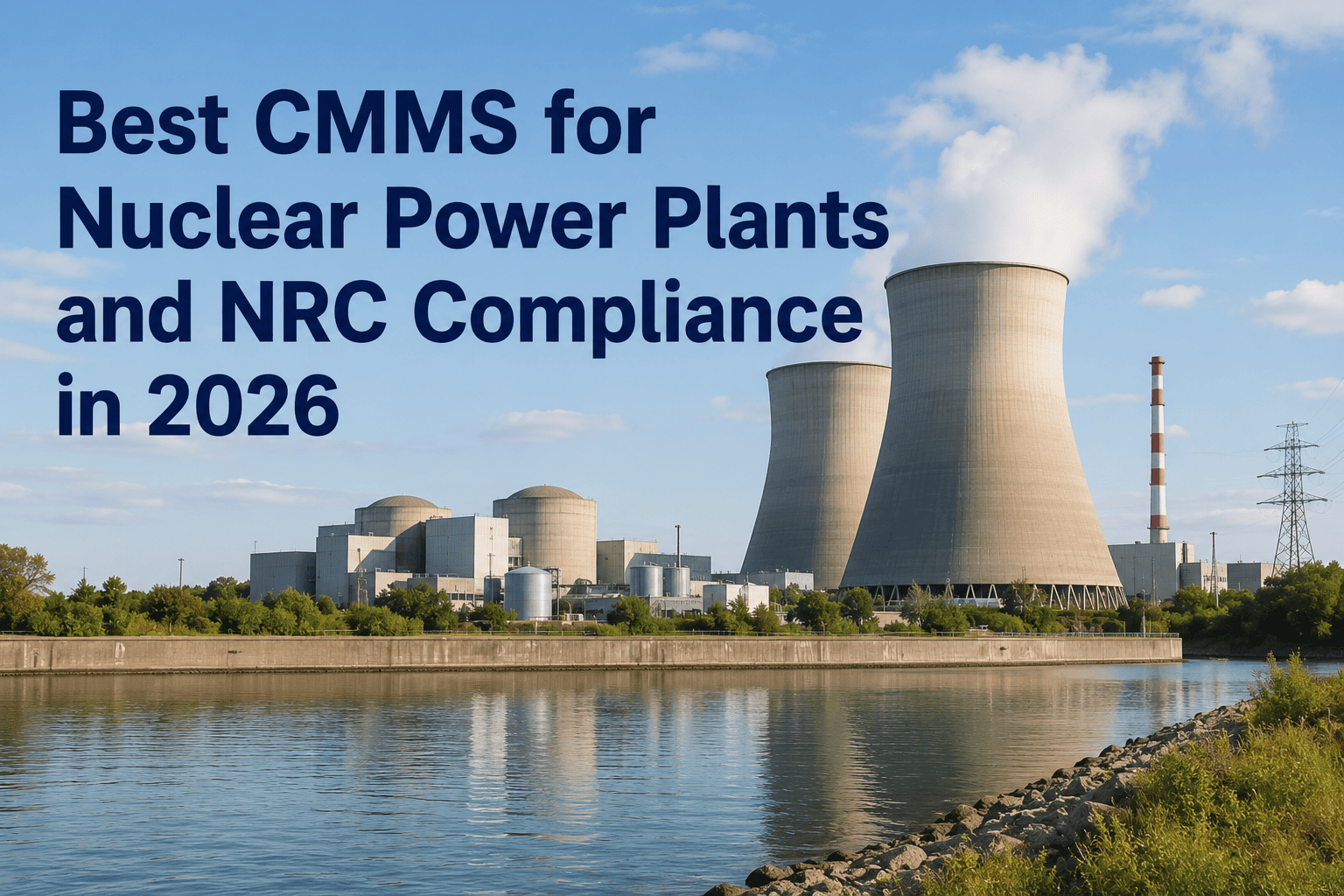
Starting Point: Maintenance Rule (10 CFR 50.65) tracking for 600+ SSC categories managed across multiple disconnected systems. Work order backlog at 2,400 open items. Corrective maintenance ratio at 48% of total maintenance hours — well above the 20% industry target.
47%
Work order backlog reduction in 90 days
92%
PM compliance rate achieved (from 67% baseline)
26%
Corrective maintenance ratio reduction toward the 20% target
Unified SSC tracking across all Maintenance Rule categories gave the reliability group a single view of performance monitoring status. Automated alerts on SSC performance criteria triggered before regulatory thresholds were breached — converting reactive compliance response into proactive program management.
Solar & Battery Energy Storage
Starting Point: 18% of panels had developed micro-cracks visible only via thermography — but the last thermographic inspection was 7 months prior and not linked to any work order system. Inverter PM compliance at 61%.
94%
Inverter PM compliance rate post-deployment
12%
Generation uplift from panel health remediation program
$340K
Annual revenue recovery from restored panel output
Thermographic inspection results linked directly to work orders in the CMMS — for the first time, panel degradation findings generated immediate maintenance tasks instead of sitting in inspection reports. The CMMS also enforced inverter PM intervals based on manufacturer specs, closing a program that had been slipping for two years.
Starting Point: Cell-level temperature monitoring logged manually with no automated trending. A slow thermal drift in one rack had been building for 11 weeks without triggering a maintenance action — a thermal runaway precursor.
100%
Automated cell-temp alerting coverage across all racks
Zero
Thermal runaway events post-deployment
$2.1M
Estimated insurance and replacement cost avoided
IoT sensor integration fed real-time cell temperature data directly into the CMMS with configurable alert thresholds per rack. The first alert triggered a maintenance intervention within 4 hours — catching a developing thermal anomaly 3 weeks before it would have reached runaway threshold.
Wind Energy
Starting Point: Main bearing seizure on a 4 MW turbine caused 6-week outage and $380,000 in repairs plus lost generation. Bearing condition monitoring was route-based, not continuous. No CMMS-linked alert routing.
3
Main bearing degradations detected and intervened before seizure
$1.14M
Avoided in repair and lost generation costs
6 weeks
Outage duration avoided per prevented seizure
Continuous vibration monitoring on the top-20 highest-risk turbines (by age and operating hours) fed real-time data to the CMMS. When bearing frequency signatures rose above baseline thresholds, the CMMS generated work orders and alerted the crane crew scheduling system — enabling planned replacements instead of emergency responses.
Starting Point: Technician vessel trips planned on fixed schedules regardless of actual fault status. Average 4.2 wasted vessel trips per quarter where no corrective work was required on arrival. Vessel cost at $18,000 per trip.
68%
Reduction in unnecessary vessel dispatches
$290K
Annual vessel cost savings
94%
Vessel trip-to-corrective-work conversion rate (from 58%)
Condition-based vessel dispatch — only sending technicians when the CMMS had confirmed work to do — required the CMMS to aggregate real-time SCADA fault data, maintenance backlog, and weather window forecasting into a single dispatch decision interface.
Multi-Site Group Rollout
Starting Point: An independent power producer with one gas plant (540 MW), one solar farm (120 MW), and one wind farm (80 turbines) managed maintenance across three separate spreadsheet systems with no consolidated fleet view. Procurement duplication across sites was adding 22% to parts costs.
$0
Inter-site parts shortages after shared inventory visibility enabled
22%
Parts procurement cost reduction from consolidated purchasing
3 sites
Go-live completed within 4-week rollout window
$1.1M
First-year cost savings across fleet from consolidated program
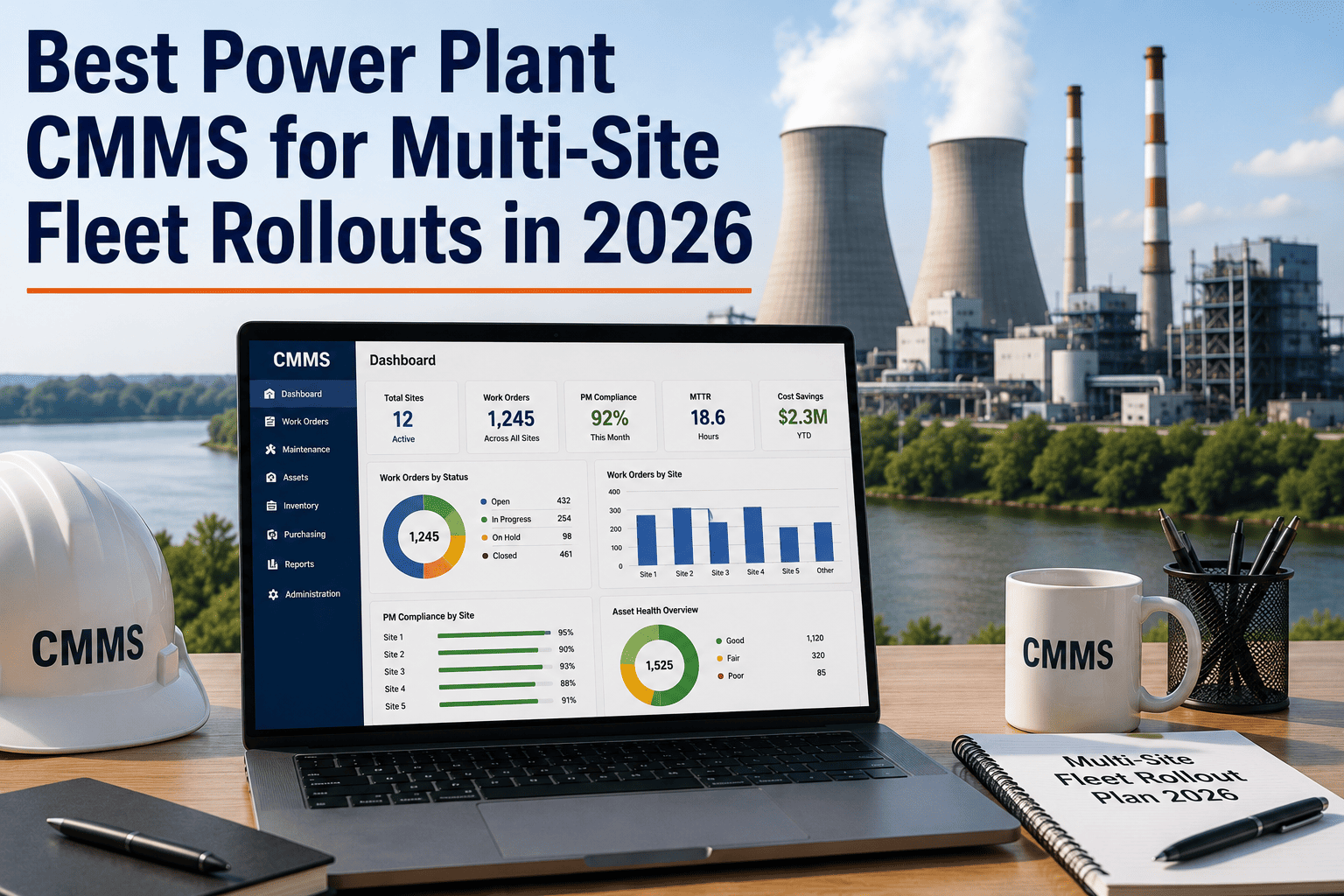
The multi-site dashboard gave the IPP's operations director a single consolidated view of work order backlogs, PM compliance rates, and open corrective actions across all three plants. Shared inventory visibility prevented two inter-site parts shortages in the first quarter alone. The deciding factor for this deployment — per the plant operator — was the multi-site dashboard eliminating what had been weekly all-hands coordination calls between plant managers.
Your Plant Is the Next Case Study Worth Telling
Every one of these results started with a structured CMMS deployment and a commitment to condition-based maintenance. OxMaint is live in under 4 weeks — and your first ROI data is available within 30 days of go-live.
Common Patterns Across All 12 Implementations
Twelve different plant types, twelve different starting points — but the successful implementations share a consistent set of decisions that separated the deployments that generated fast ROI from the ones that stalled.
01
Started with the 3 Most Critical Assets
Every fast-payback deployment prioritized predictive monitoring on the three highest failure-consequence assets first — not the entire fleet. This approach generates the ROI evidence that funds the broader rollout.
02
Used Existing Historian Data First
All 12 plants used existing SCADA and historian data before investing in new sensors. The data was already there — the missing piece was the platform that made it actionable as maintenance intelligence.
03
Technician Buy-In Before Management Dashboards
The deployments with fastest adoption trained maintenance technicians on the mobile interface first. Management dashboards came second — because the data quality depends entirely on field-level entry compliance.
04
Defined Alert Response Protocol Before Go-Live
The highest-ROI deployments had a written protocol for who receives CMMS alerts, what the response window is, and who authorizes intervention maintenance windows — agreed before the system went live, not after the first alert fired.
Frequently Asked Questions
How long does a power plant CMMS implementation typically take?
For a single plant, structured CMMS deployment typically runs 3–6 weeks from kickoff to go-live — with the asset register built in weeks 1–2, sensor and SCADA integration in weeks 2–4, and technician training completed before go-live.
Sign up to OxMaint to start building your asset register today — the first step that determines implementation speed.
What is the fastest ROI path for a power plant CMMS deployment?
The fastest ROI path is preventing a single major unplanned outage within the first 12 months — typically by deploying continuous condition monitoring on your 2–3 highest-consequence assets first. A single prevented turbine or generator failure (typically $500K–$2M) often recovers the full implementation cost in one event.
Book a demo for a plant-specific ROI estimate based on your asset mix and outage history.
Can CMMS deployments work for plants still using legacy SCADA systems?
Yes — all 12 case studies above used existing historian and SCADA data before any new sensor investment. OxMaint connects to legacy SCADA platforms via OPC-UA, Modbus TCP, OSIsoft PI, and DNP3 protocols. New sensor investment is optional and additive, not a prerequisite for deployment value.
How does a multi-site CMMS rollout differ from a single-plant deployment?
Multi-site rollouts add two dimensions to the standard deployment: shared inventory management (which prevents the procurement duplication seen in Case Study 12) and a consolidated fleet dashboard. The technical deployment process is similar per site — the primary complexity is standardizing asset taxonomies and work order templates across plants that may have previously operated with different conventions.
What maintenance metrics improve fastest after CMMS deployment?
PM compliance rate and work order backlog are the two metrics that move fastest — both typically show measurable improvement within 30–60 days of structured deployment. Unplanned outage frequency takes longer (3–12 months) because the predictive value accumulates with operational data. MTTR improvements are also visible within 60 days as faster fault routing and pre-staged parts reduce repair time.
Start Your Implementation
12 Plants Proved It Works. Your Next Outage is the Proof Point.
Every case study above started with the same first step — committing to a structured CMMS platform and the condition-based maintenance discipline that makes it work. OxMaint is free to start, live in 4 weeks, and built specifically for the complexity of power generation assets.