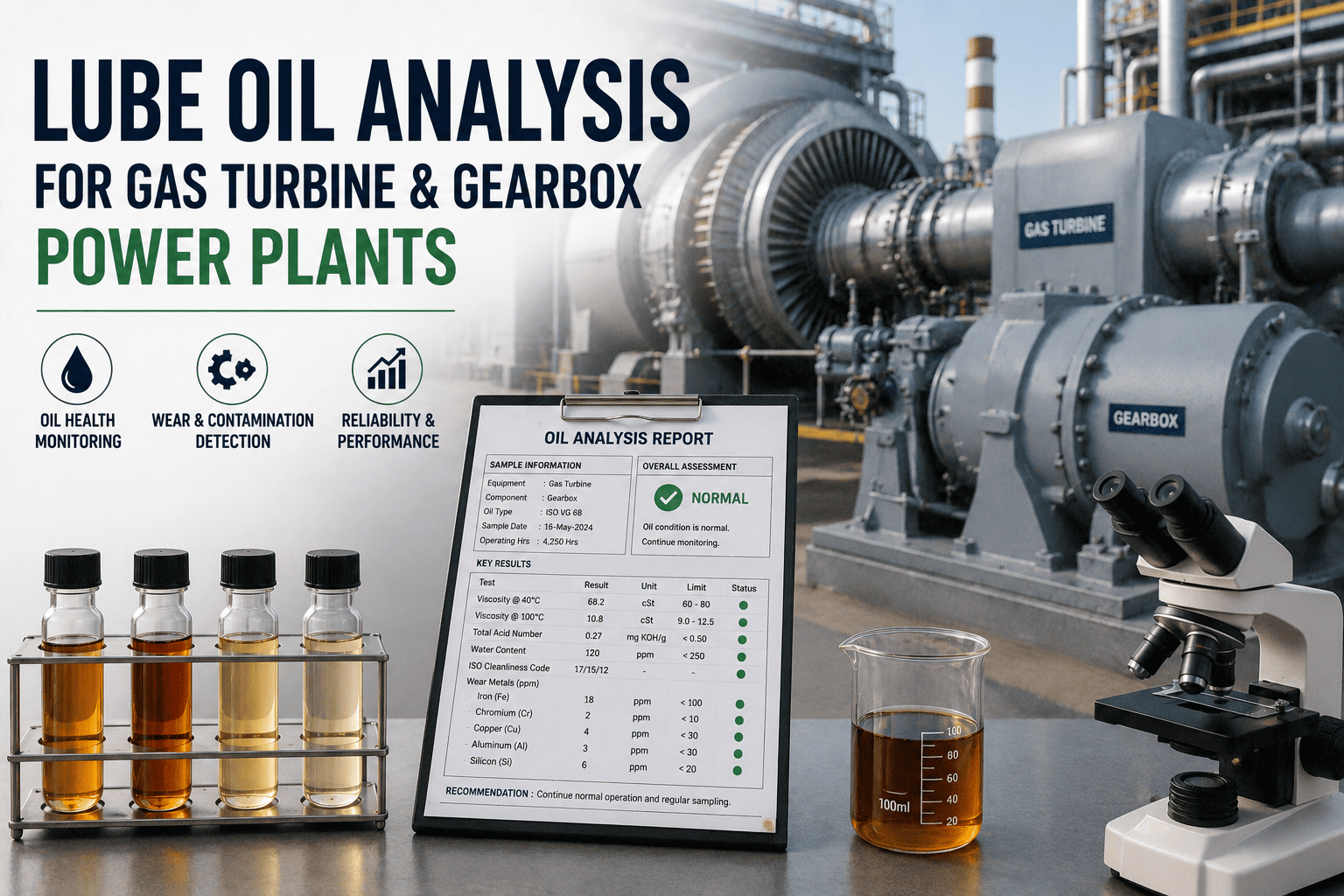
Particle contamination found in the lube oil of a steam turbine bearing at ISO cleanliness code 22/19 — a two-level shift above the normal baseline of 14/11 — is enough to trigger an emergency inspection before bearing temperatures or vibration sensors show any sign of distress. That is the entire value proposition of a structured oil analysis programme: the oil carries evidence of internal degradation weeks before any other monitoring technology can detect it. Power plants running continuous, high-load rotating equipment — turbines, generators, boiler feed pumps, compressors, and gearboxes — cannot afford to manage lubrication on guesswork, calendar-based changes, or visual inspection alone. OxMaint tracks every oil sample, lube route, and analysis result in one platform, links findings to CMMS work orders, and keeps your lubrication records audit-ready at all times. Start your free trial to put your lubrication programme on a digital foundation, or book a demo to see live oil analysis dashboards for power plant rotating equipment.
Power Plant Lubrication Excellence
Your Oil Is Talking. Is Anyone Listening?
Every turbine bearing, gearbox, and pump carries real-time evidence of its own condition — in the oil. A structured lubrication programme reads that evidence before failure speaks for itself.
70%
Of bearing failures linked to lubrication
4–6 wk
Advance warning oil analysis provides
ISO 18/16/12
Target cleanliness for turbine lube systems
100 ppm
Max water in turbine lube oil
The 5 Pillars of Lubrication Excellence in Power Plants
A lubrication excellence programme is not a single task — it is five interconnected disciplines that must all function together. Weakness in any one pillar degrades the protection delivered by the others.
01
Lube Room Standards
A dedicated, contamination-controlled lube room with colour-coded containers, sealed transfer equipment, desiccant breathers on storage tanks, and clear lubricant identification. Cross-contamination from the lube room is the most common source of new oil arriving at machines already above target cleanliness.
Target: ISO cleanliness at dispensing point ≤ 16/14/11
02
Oil Sampling Programme
Consistent sampling from fixed, live-zone ports — not drain plugs or dipsticks — at defined intervals for every critical asset. Sample representativeness determines the entire value of the analysis that follows. A poorly taken sample from a dead zone gives false reassurance.
Turbine lube: sample every 250–500 operating hours
03
Laboratory Analysis and Trending
Single-point results are rarely diagnostic. The value is in trending: viscosity drift, TAN progression, particle count shift, and wear metal accumulation rate over multiple samples tell the machine's story. A two-level shift in ISO cleanliness code warrants immediate investigation regardless of absolute value.
Act on: ISO code shift ≥ 2 levels from baseline
04
Contamination Control
Ingression control through kidney loop filtration, desiccant breathers, and positive-pressure headspace management. Water is the most common contaminant in power plant lube systems — above 1,000 ppm it accelerates oxidation, promotes rust, and dramatically shortens bearing life.
Critical threshold: water above 1,000 ppm
05
CMMS-Tracked Lube Routes
Every grease point, oil top-up, and filter change is a scheduled work order with a defined lubricant type, quantity, interval, and close-out record. Undocumented lubrication tasks are invisible to reliability programmes — and to auditors.
Target: 100% lube route compliance tracked in CMMS
Oil Analysis Parameters: What Each Test Tells You
A full oil analysis panel for power plant rotating equipment covers eight core test parameters. Each answers a different diagnostic question. Understanding what each parameter reveals — and what it misses — is essential for interpreting results correctly and avoiding costly missed detections.
Kinematic Viscosity
Target: ±10% caution / ±20% action
What it detects
Viscosity drop signals fuel dilution or shear degradation. Rise indicates oxidation, additive depletion, or water contamination. Always confirm correct oil grade was added after any oil change.
Flag: 20%+ deviation from baseline
Total Acid Number (TAN)
Target: New oil baseline + 0.5 caution / +1.0 action
What it detects
Rising TAN indicates oxidation and additive depletion. In turbomachinery, oxidation causes varnish and sludge deposits on bearing surfaces and control valve components.
Flag: TAN increase >1.0 mg KOH/g above new oil
Water Content (ppm)
Target: <100 ppm turbine lube / <500 ppm general
What it detects
Water is the most common liquid contaminant in power plants. Turbine seal failures and heat exchanger leaks show here first — often 2–4 weeks before any mechanical symptom appears.
Flag: Above 1,000 ppm = critical action
Particle Count (ISO 4406)
Turbine target: ISO 18/16/12 or better
What it detects
Counts particles at 4μm, 6μm, and 14μm per ml. Hard particle contamination above target accelerates bearing fatigue, reduces journal bearing film strength, and clogs servo valves in hydraulic governors.
Flag: Code shift ≥ 2 levels from baseline
Wear Metals (ICP Spectroscopy)
Asset-specific limits; trend rate more than value
What it detects
Iron, chromium, copper, lead, tin, and aluminium each correspond to specific wear surfaces. A rapid rate-of-change in Fe or Cu is more diagnostic than a single high reading. Baseline the first sample after every oil change.
Flag: Rate-of-change doubling over 2 samples
Ferrography
Requested on caution or action findings
What it detects
Separates magnetic particles by size and examines morphology under microscope. Smooth spherical particles = normal adhesive wear. Cutting-type particles = abrasive contamination ingress. Fatigue spall platelets = advanced bearing damage.
Flag: Cutting particles or fatigue platelets present
FTIR Analysis
Caution: oxidation >25 A/cm / nitration >20 A/cm
What it detects
Measures oxidation and nitration products directly in the oil. Detects degradation weeks before viscosity or TAN tests reach action thresholds. Particularly important for turbine oils where varnish precursors are below 4μm and invisible to particle counters.
Flag: Oxidation products trending upward over 3 samples
Varnish Potential (QSA/MPC)
MPC Patch Colour: <15 caution / >40 critical
What it detects
Turbine oil varnish is a resin-like deposit that builds on bearing surfaces and servo valve spools. QSA or MPC tests measure the lubricant's propensity to form varnish before any visible deposit appears — giving 4–12 weeks of advance warning.
Flag: MPC colour rating above 25 warrants investigation
CMMS-Integrated Oil Analysis
Oil Sample Results That Trigger Work Orders — Not Just Reports
OxMaint logs every oil sample, tracks parameter trends against your configured alert thresholds, and automatically raises a CMMS work order when any result crosses a caution or action limit — so findings don't get lost in an inbox.
ISO 4406 Cleanliness Codes: What the Numbers Mean for Power Plant Equipment
ISO 4406 reports oil cleanliness as three numbers — for example, 18/16/12 — representing particle counts at the 4μm, 6μm, and 14μm size thresholds per millilitre of oil. Each code number doubles the particle count of the one below it. Two code levels represent a fourfold difference in contamination. The table below maps target cleanliness levels to specific power plant systems.
| Power Plant System |
Recommended ISO Code |
Particle Limit at 6μm (per ml) |
Primary Risk Above Target |
Sampling Interval |
| Steam turbine lube oil |
18/16/12 |
1,300 – 2,500 |
Bearing fatigue, servo valve stiction, varnish |
Every 250–500 hrs |
| Gas turbine lube oil |
17/15/11 |
640 – 1,300 |
High-speed bearing wear, governor valve failure |
Every 500 hrs |
| Hydraulic governor system |
16/14/11 |
320 – 640 |
Servo valve spool wear, control instability |
Monthly |
| Generator bearing lube |
18/16/13 |
1,300 – 2,500 |
White metal bearing erosion, insulation contamination |
Every 500 hrs |
| Boiler feed pump gearbox |
19/17/14 |
2,500 – 5,000 |
Gear tooth pitting, bearing wear |
Monthly |
| Cooling water pump bearings |
20/18/15 |
5,000 – 10,000 |
Rolling element fatigue, seal degradation |
Quarterly |
Sampling Schedule and Lube Route Frequency by Asset
An effective lubrication programme matches task frequency to the criticality and operating severity of each asset. OxMaint auto-generates and tracks every task in this schedule, with escalation alerts for overdue routes and exception flags for out-of-limit sample results.
Daily
Turbine lube oil pressure and temperature log
Oil reservoir level check (turbine and generator)
Bearing temperature trending review
Lube oil cooler differential temperature
Filter differential pressure check
Weekly
Greaser route — all critical motor bearings
Gearbox oil level visual check
Lube oil makeup log (abnormal consumption flag)
Kidney loop filtration unit status
Desiccant breather colour indicator check
Monthly
Oil sample — turbine lube system (live zone port)
Oil sample — generator bearing lube
Water contamination check — turbine oil (Karl Fischer)
Filter element replacement verification
Lube room cleanliness and storage audit
Annual / Outage
Full lube oil flush and system clean
Oil change decision: ferrography + TAN + FTIR review
Lubricant consolidation review (rationalise grades)
Lube route task list review and update
Greaser training and competency check
Frequently Asked Questions
How do we decide when to change turbine oil versus extend its service life?
The decision should be based on a combination of TAN progression, FTIR oxidation level, varnish potential (MPC or QSA), and antioxidant depletion — not calendar interval alone. Many turbine oils in well-managed systems run 5–8 years between changes. OxMaint tracks all relevant parameters in trend charts and flags when the data supports an oil change recommendation.
Set up your oil life tracking in OxMaint.
What is the correct sampling location for turbine lube oil analysis?
The correct location is a live-zone port in the return line between the bearing and the reservoir — not the drain plug, not a dead-leg, and not the reservoir itself. Return-line sampling captures fresh wear particles before they settle or are filtered. Reservoir samples are heavily diluted and will underreport active wear conditions by a significant margin.
Can OxMaint track oil analysis results from external labs and link them to work orders?
Yes. OxMaint accepts oil analysis data entry from any laboratory source and maps results to the relevant asset record. When any parameter crosses a configured caution or action threshold, a CMMS work order is automatically created and assigned. The full sample history is retained against the asset for trend analysis and audit evidence.
Book a demo to see the lab integration.
What does ferrography add that ICP spectroscopy doesn't cover?
ICP spectroscopy detects dissolved and very fine wear metals (typically below 5–10μm) and gives element concentration by mass. Ferrography separates larger magnetic particles, examines their shape under a microscope, and identifies the wear mechanism — normal adhesive wear versus abrasive cutting versus fatigue spalling. Each wear type points to a different root cause and a different maintenance action. The two tests are complementary, not redundant.
Why is varnish a specific problem in turbine oils that doesn't affect other lubricants as severely?
Turbine oils operate at high temperatures for extended periods with significant air contact in large reservoir systems. Oxidation produces polar degradation compounds below 4μm — invisible to standard particle counters — that deposit as resin-like varnish on bearing surfaces, servo valve spools, and heat exchanger tubes. Varnish can cause control valve stiction, bearing surface damage, and filter plugging without any conventional oil analysis parameter showing an action-level result.
OxMaint Lubrication Management
From Sample Bottle to Work Order — Every Oil Finding Actioned
8
Oil analysis parameters tracked per asset
4–6 wk
Advance warning before bearing failure
100%
Lube route compliance tracked in CMMS