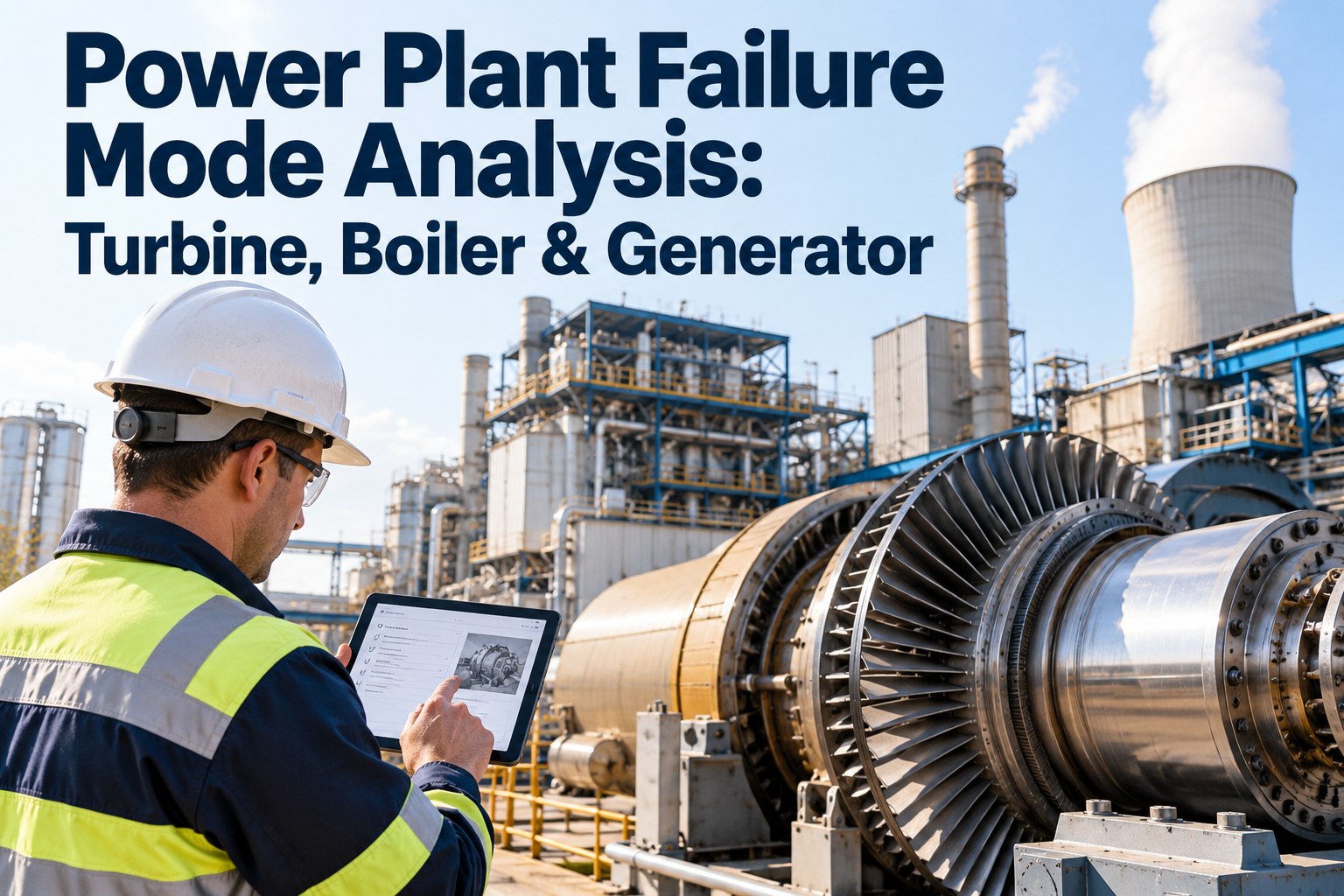
Predictive maintenance is no longer a research project — it is how the best-run power plants in the world protect their most consequential assets. In 2026, the combination of affordable IIoT sensors, AI anomaly detection models, and purpose-built CMMS platforms has made condition-based maintenance achievable for any generation fleet — not just the nuclear operators and major utilities who pioneered it. Industry data shows 95% of organizations that implement predictive maintenance report positive ROI, with 27% achieving full payback within the first year. The ten wins below represent the highest-impact applications of predictive maintenance technology across gas turbines, steam systems, generators, transformers, cooling towers, and renewable assets. Each one is backed by the sensor technology, detection method, and financial outcome data that makes the case concrete. To see how OxMaint ties predictive intelligence directly into your maintenance workflows, book a demo built around your specific asset mix, or sign up free to start building your plant's predictive maintenance foundation today.
2026 · Power Plant Predictive Maintenance
Top 10 Predictive Maintenance Wins in Power Plants 2026
Vibration analysis, oil analysis, IR thermography, motor current signature, DGA, and AI failure prediction — the techniques delivering the highest ROI across every generation asset class in 2026.
95%
of organizations implementing PdM report positive ROI
61%
Forced outage reduction at AI-native CMMS plants
6 months
Typical advance warning from vibration analysis on bearings
4.8×
Cost reduction: planned vs. emergency repair
The Predictive Maintenance Technology Stack in 2026
Predictive maintenance is not one technology — it is a layered stack of sensing, analysis, and action capabilities. Understanding which technique works on which asset, and at what stage of the P-F curve it detects failure, is the foundation of any effective predictive program. Different methods deliver different lead times — and the best programs deploy multiple techniques to catch failures that any single method would miss.
Ultrasonic Detection
Earliest detection
Detects friction and turbulence at the very first onset of degradation — before any other method registers change
Vibration Analysis
3–6 months lead time
Detects physical changes in mass, stiffness, and damping — the longest useful lead time of any mainstream technique
Oil Analysis / DGA
Weeks to months
Reveals internal wear particles and chemical degradation invisible to external sensors — critical for gearboxes, transformers, and turbines
IR Thermography
Days to weeks
Detects heat generated by friction and electrical resistance — powerful for electrical systems and bearings at operating load
AI Multi-Sensor Fusion
Full P-F curve coverage
Correlates vibration, temperature, current, and process variables simultaneously — catching patterns no single sensor detects
The 10 Highest-Impact Predictive Maintenance Wins
How It Works
Triaxial accelerometers mounted on bearing housings capture vibration signatures at 10 kHz+ bandwidth. AI models detect imbalance, misalignment, and bearing defect frequencies — specific patterns in the frequency spectrum that indicate inner race, outer race, and rolling element degradation — weeks before failure becomes audible or thermal.
Lead Time
3–6 months of advance warning — the longest lead time of any common predictive technique. Enough time to plan a bearing replacement into the next scheduled maintenance window rather than responding as an emergency.
$500K–$2M
Cost of a prevented gas turbine bearing failure
4.8×
Planned vs. emergency repair cost ratio
6 weeks
Typical forced outage duration avoided per event
OxMaint ingests continuous vibration data via IIoT sensors and OPC-UA historian feeds, applies plant-specific AI baseline models, and generates maintenance work orders automatically when bearing defect frequencies exceed thresholds — no manual alert monitoring required.
How It Works
AI models correlate steam temperature profiles, vibration signatures, and performance efficiency indicators simultaneously. Unlike single-sensor monitoring, multi-sensor fusion catches blade erosion and seal degradation patterns that appear only in the relationship between process variables — not in any individual sensor reading.
Lead Time
8–14 weeks of actionable advance warning on developing hot section degradation — sufficient to schedule an inspection outage during a planned low-demand window and avoid an unplanned trip during peak generation season.
38%
Avg. maintenance cost reduction in 18 months post-deployment
61%
Forced outage frequency reduction vs. prior 2-year baseline
10%
False-positive rate in mature AI deployments
OxMaint's AI anomaly detection learns from your specific steam turbine's operational profile — not generic industrial baselines. Accuracy improves continuously as plant-specific failure patterns accumulate, with false-positive rates falling below 10% in mature deployments.
How It Works
Dissolved gas analysis samples transformer oil to detect hydrogen, acetylene, ethylene, and other gases produced by internal faults — arcing, hot spots, and partial discharge. The specific gas combination (using the IEC Duval Triangle method) identifies fault type and severity. DGA results interpreted against IEEE C57.104 limits provide months of warning before catastrophic failure.
Lead Time
Weeks to months depending on fault progression rate. Online DGA monitoring provides continuous trending; lab-based sampling provides quarterly snapshots. Combined approach gives both depth of analysis and real-time alerting.
$2M–$8M
Replacement cost of a major power transformer
18 months
Lead time for transformer procurement — makes early detection essential
72 hrs
Minimum advance warning from continuous online DGA
OxMaint links DGA test results directly to transformer work order history. When results approach IEEE C57.104 action levels, the platform automatically generates a Priority-1 investigation work order and alerts the reliability engineer — converting a lab result into a maintenance action without manual review delay.
How It Works
Thermal imaging cameras detect abnormal hot spots in generator windings, bus bars, and electrical connections without requiring shutdown. Insulation degradation, loose connections, and cooling system restrictions all produce distinctive thermal signatures detectable at operating load. AI-automated scan analysis now processes thousands of thermal data points per inspection, catching anomalies that manual visual review misses.
Detection Requirement
Equipment must be operating at 40%+ load for accurate thermal readings. Ambient temperature and airflow conditions affect baseline calibration. Annual thermographic surveys combined with quarterly focused spot checks provide optimal coverage at manageable cost.
$1M–$4M
Generator rewind or replacement cost avoided
45 days
Advance warning on winding insulation degradation
Zero
Shutdown required for thermographic inspection
Thermographic inspection findings upload directly into OxMaint work orders with geo-tagged location data and severity classification. Hot spot findings above threshold automatically generate follow-up work orders at the correct priority level — eliminating the manual handoff between inspection report and maintenance planning.
How It Works
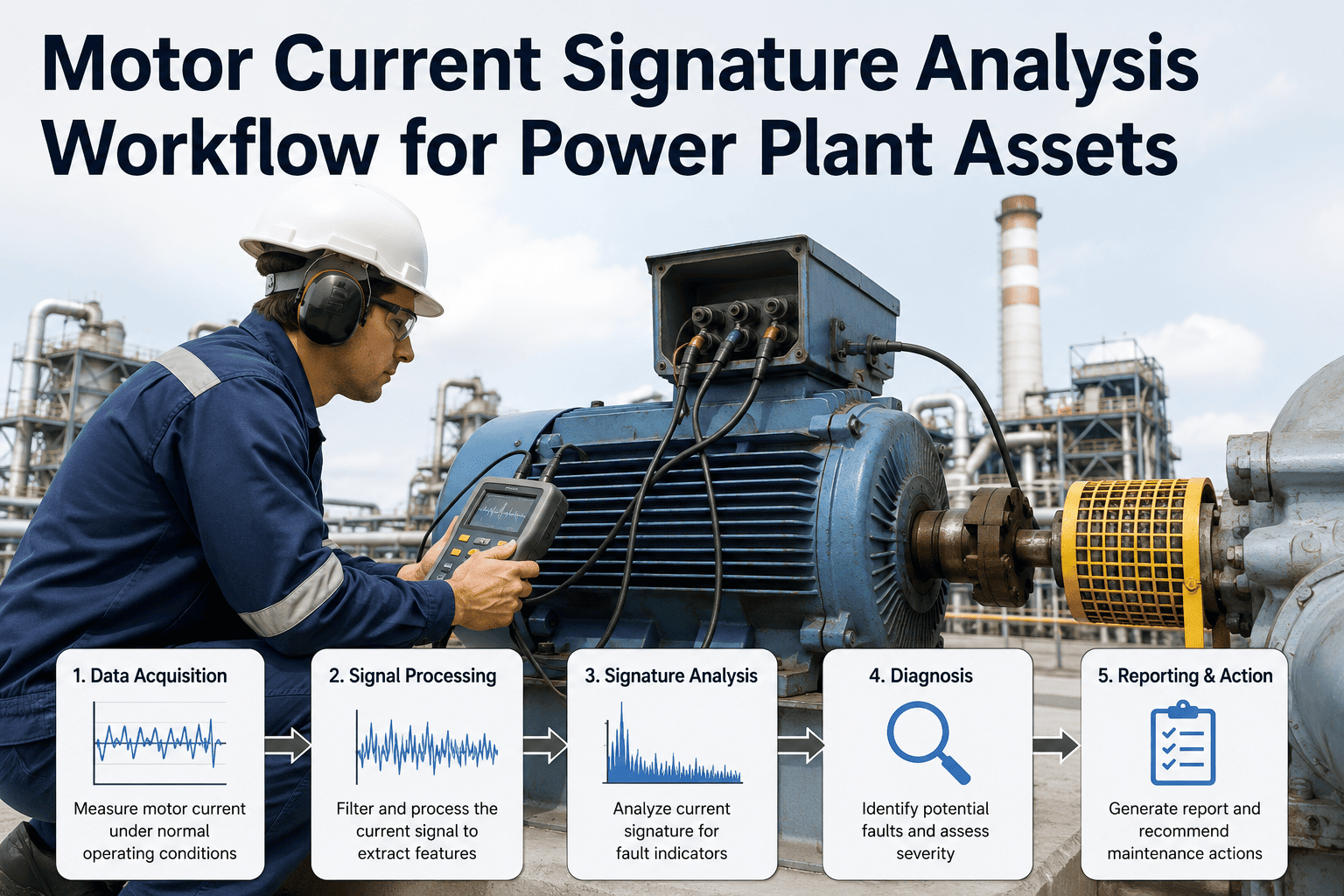
Motor current signature analysis monitors the electrical supply current waveform to detect mechanical and electrical faults in motors, pumps, and fans without physical contact sensors. Broken rotor bars produce characteristic current sidebands at specific frequencies. Bearing faults, misalignment, and partial blockages produce distinctive current signature anomalies that MCSA detects weeks before mechanical vibration monitoring would alert. Power plant balance-of-plant has hundreds of motors — MCSA provides condition monitoring at scale without a sensor on every shaft.
Coverage Advantage
A single current monitoring point covers the motor and its driven load simultaneously. For balance-of-plant with 200+ motors, MCSA delivers condition monitoring coverage that would cost 10× more to achieve with individual vibration sensors.
10–15%
Below-optimal efficiency caught before output impact appears
10×
Lower cost than individual vibration sensors on equivalent coverage
$200K+
Annual fuel and output recovery per 200 MW plant from motor efficiency program
OxMaint integrates MCSA data feeds from current monitoring systems and applies AI fault classification to every motor in the asset register — prioritizing corrective action by fault severity and asset criticality so maintenance teams focus on the motors that matter most.
How It Works
Ultrasonic thickness measurements on boiler and HRSG tube sections track wall thinning from corrosion, erosion, and flow-accelerated corrosion (FAC) over successive inspection cycles. When thickness readings are trended against failure threshold in the CMMS, progressive degradation becomes visible months before a tube actually fails. AI correlation with operating temperature and chemistry data identifies the highest-risk tube sections for prioritized inspection.
Why It Matters
HRSG tube failures are among the costliest forced outage events in combined cycle plants — 23-day average outage duration and $28M+ in lost revenue and emergency repairs in documented cases. Wall thinning caught 45 days before failure threshold saves the entire cost of that event.
45 days
Advance warning on tube wall failure threshold — CMMS-trended
$280K
Avoided emergency shutdown cost per caught event
23 days
Forced outage duration avoided per prevented tube failure
OxMaint structures boiler tube inspection data by section and location, trending wall thickness readings over successive inspection cycles and flagging sections approaching minimum thickness limits automatically. Inspection findings generate priority-weighted work orders before the tube reaches failure threshold.
How It Works
Heat rate degradation and output loss from compressor fouling are measurable in DCS data before they become visible operationally. AI performance models calculate actual vs. design heat rate continuously and trigger offline compressor wash recommendations when the efficiency loss crosses the economic threshold where washing cost is less than continued fuel waste. This replaces fixed quarterly wash schedules with condition-based washing that responds to actual fouling rate — which varies significantly by season, inlet air quality, and load profile.
Frequency Optimization
Condition-based washing programs typically add 2–3 additional washes per year in high-fouling conditions while deferring washes in clean conditions — net improvement in both fuel cost and compressor wear compared to fixed interval programs.
2.1%
Heat rate improvement vs. fixed-schedule washing program
$680K
Annualized fuel cost reduction at a 280 MW CCGT
8.4 MW
Output improvement at full load post-wash vs. degraded baseline
OxMaint's performance analytics module tracks heat rate against design curves in real time and calculates the economic wash trigger point automatically — generating a wash recommendation work order when the efficiency loss value exceeds the wash execution cost, with all calculations visible to the maintenance planner.
How It Works
Continuous vibration sensors on main bearings, gearbox input/output shafts, and generator bearings provide real-time condition data normalized against wind speed and power output. AI models distinguish mechanical degradation signals from the variable-load noise inherent in wind turbine operation — a challenge that makes wind turbine vibration analysis significantly more complex than fixed-speed rotating equipment analysis.
Logistics Value
For offshore wind, knowing which specific turbines need corrective work before dispatching a vessel is worth tens of thousands of dollars per trip. Condition-based dispatch increases trip-to-corrective-work conversion rates from below 60% to above 90% in documented deployments.
$380K
Repair + lost generation cost per main bearing seizure avoided
6 weeks
Forced outage duration avoided per prevented seizure
94%
Vessel trip-to-corrective-work conversion rate (from 58%)
OxMaint integrates wind turbine CMS data via SCADA feed and generates work orders when bearing defect frequencies exceed fleet-calibrated thresholds — automatically scheduling crane crew mobilization and vessel dispatch around the weather window with the shortest wait time.
How It Works
Cell-level and rack-level temperature sensors feed continuous data into the CMMS, where AI trending models compare each rack's thermal profile against its operational baseline and against fleet-wide averages. A rack running 3–5°C above its normal operating temperature for sustained periods is a thermal runaway precursor — detectable weeks before the condition reaches the runaway threshold. Manual temperature logging, by contrast, provides point-in-time readings that miss the progressive drift pattern entirely.
Safety and Financial Stakes
BESS thermal runaway events involve fire, complete system loss, and extended insurance claims. The combination of asset replacement cost, lost revenue, and insurance premium increases means a prevented thermal runaway event saves $2–5M per incident in total consequence cost.
3 weeks
Advance warning before thermal runaway threshold from continuous trending
$2.1M
Insurance and replacement cost avoided per prevented event
4 hrs
Response time from first CMMS alert to maintenance intervention
OxMaint configures alert thresholds per rack based on manufacturer specifications and operational baselines. When cell temperatures exceed threshold for a sustained period, a Priority-1 work order generates automatically and the on-call maintenance technician receives an immediate mobile alert — no manual monitoring required.
How It Works
Cooling tower basin chemistry (cycles of concentration, biocide dosing, pH, and conductivity) combined with approach temperature trending reveals fill media fouling, biological growth, and fan gearbox degradation weeks before they appear on condenser backpressure trends. By the time LP turbine backpressure has deteriorated enough to show on the DCS trend, blade stress has already accumulated. Early chemistry and thermal detection intervenes in the degradation chain 4–8 weeks earlier.
Compounding Effects
Cooling tower degradation impacts condenser performance, which impacts LP turbine efficiency, which raises heat rate and reduces output — a degradation chain where each step amplifies the previous one. Early intervention breaks the chain at the lowest-cost point.
3%
Turbine efficiency maintained vs. degraded baseline
$200K+
Annual fuel and output recovery per 200 MW plant
4–8 weeks
Earlier intervention vs. waiting for backpressure trend deterioration
OxMaint tracks cooling tower chemistry test results and approach temperature readings over time, flagging deviations from baseline before they cascade into condenser and turbine performance impacts. Automated work orders for biocide dosing, fill media inspection, and fan gearbox checks fire at the right time — not after the LP turbine is already suffering.
Every Win Above Started With Connected Data and a Work Order System That Acted on It
OxMaint connects your sensors, historian, and SCADA data to a maintenance workflow that turns predictive intelligence into maintenance action automatically — without manual alert monitoring or data export exercises.
Building Your Predictive Maintenance Program: The Right Sequence
Every successful predictive maintenance program in power generation follows a similar build sequence. Starting in the wrong place — or trying to deploy everything at once — is the most common reason PdM programs fail to deliver their projected ROI within the first year.
Step 1
Start With Your 3 Highest-Consequence Assets
Deploy continuous monitoring on the assets where a failure would cost the most — typically your gas turbine, generator, and main power transformer. These are the assets where prevented failures cover the entire program cost in a single event.
Weeks 1–4
Step 2
Use Existing Historian Data First
Your SCADA and DCS historians already contain months or years of asset health data. Load this into your CMMS before purchasing new sensors — it establishes the baselines that make AI anomaly detection accurate from day one.
Weeks 2–6
Step 3
Define Alert Response Protocol Before Go-Live
Who receives alerts? What is the response window? Who authorizes an intervention maintenance window? These decisions must be made before the first alert fires — not after. Programs without defined response protocols see 60% of early alerts go unacted on.
Week 3 (before go-live)
Step 4
Expand to Balance-of-Plant on Proven ROI
Once your first prevented failure generates documented ROI, use that evidence to fund expansion to balance-of-plant motors, pumps, and cooling systems. MCSA and ultrasonic methods provide cost-effective coverage at scale.
Months 3–12
Frequently Asked Questions
What is the single highest-ROI predictive maintenance investment for a gas-fired power plant?
Continuous vibration monitoring on the gas turbine bearing train delivers the highest ROI — with 3–6 months of advance warning and a single prevented failure worth $500K–$2M in avoided repair and lost generation costs. The second-highest is power transformer DGA monitoring, where an undetected failure can cost $2–8M in transformer replacement alone plus 18+ months of lead time on a new unit.
Sign up to OxMaint to start deploying these programs with purpose-built CMMS support.
How many sensors do I need to start a predictive maintenance program?
You may need zero new sensors to start. All 12 case studies in OxMaint's documented deployments started with existing historian and SCADA data before any new sensor investment. The AI anomaly detection models establish baselines from historical data and begin generating useful predictions within 60–90 days of data ingestion. New sensors are additive once the data-driven program is delivering value.
What is the difference between predictive maintenance and preventive maintenance in a power plant?
Preventive maintenance runs on fixed time or usage intervals — inspect the turbine every 8,000 hours regardless of actual condition. Predictive maintenance runs on condition-based triggers — inspect when sensor data indicates developing degradation, regardless of calendar time. The best power plant maintenance programs use both: preventive for components where condition monitoring is impractical, and predictive for high-consequence assets where sensor data provides actionable lead time.
Book a demo to see how OxMaint manages both within a single platform.
How long before a predictive maintenance program pays for itself in a power plant?
Industry data shows 95% of organizations implementing predictive maintenance report positive ROI, with 27% achieving full payback within the first year. For power plants, payback often occurs after preventing a single major forced outage — a turbine or generator failure costing $500K–$2M recovers the entire program investment in one event. Programs deployed on the highest-consequence assets first consistently achieve the fastest payback.
Can predictive maintenance work on older plants with legacy SCADA systems?
Yes — OxMaint connects to legacy SCADA platforms via OPC-UA, Modbus TCP, OSIsoft PI, and DNP3. Older plants with historian data going back 5+ years have an advantage: more historical failure data produces more accurate AI anomaly detection models from the start. Legacy SCADA age is not a barrier to predictive maintenance deployment.
Start Predicting. Stop Reacting.
The Next Forced Outage at Your Plant Is Predictable. OxMaint Proves It.
Every technique in this guide is integrated into OxMaint's predictive maintenance platform — from vibration and DGA to IR thermography and AI multi-sensor fusion. Connect your existing sensors and historian data, set your alert response protocol, and start preventing the failures that cost your plant the most. Free to start. Live in 4 weeks. First predictive alert within 30 days of data ingestion.