A condenser losing half a degree of vacuum sounds trivial until it is translated into fuel cost — a few millimeters of mercury of lost vacuum across a large steam turbine can add measurable heat rate penalty and cost a mid-size plant real money over a year of continuous operation. Air ingress into the condenser shell is one of the most common yet least monitored efficiency losses in thermal power generation, because the leak paths are usually invisible and the symptom shows up gradually in heat rate rather than as a sudden alarm. Most plants only find the leak source during a planned outage, months after the efficiency loss began. A structured detection and monitoring approach closes that gap using OxMaint's condition monitoring platform for power plant condensers.
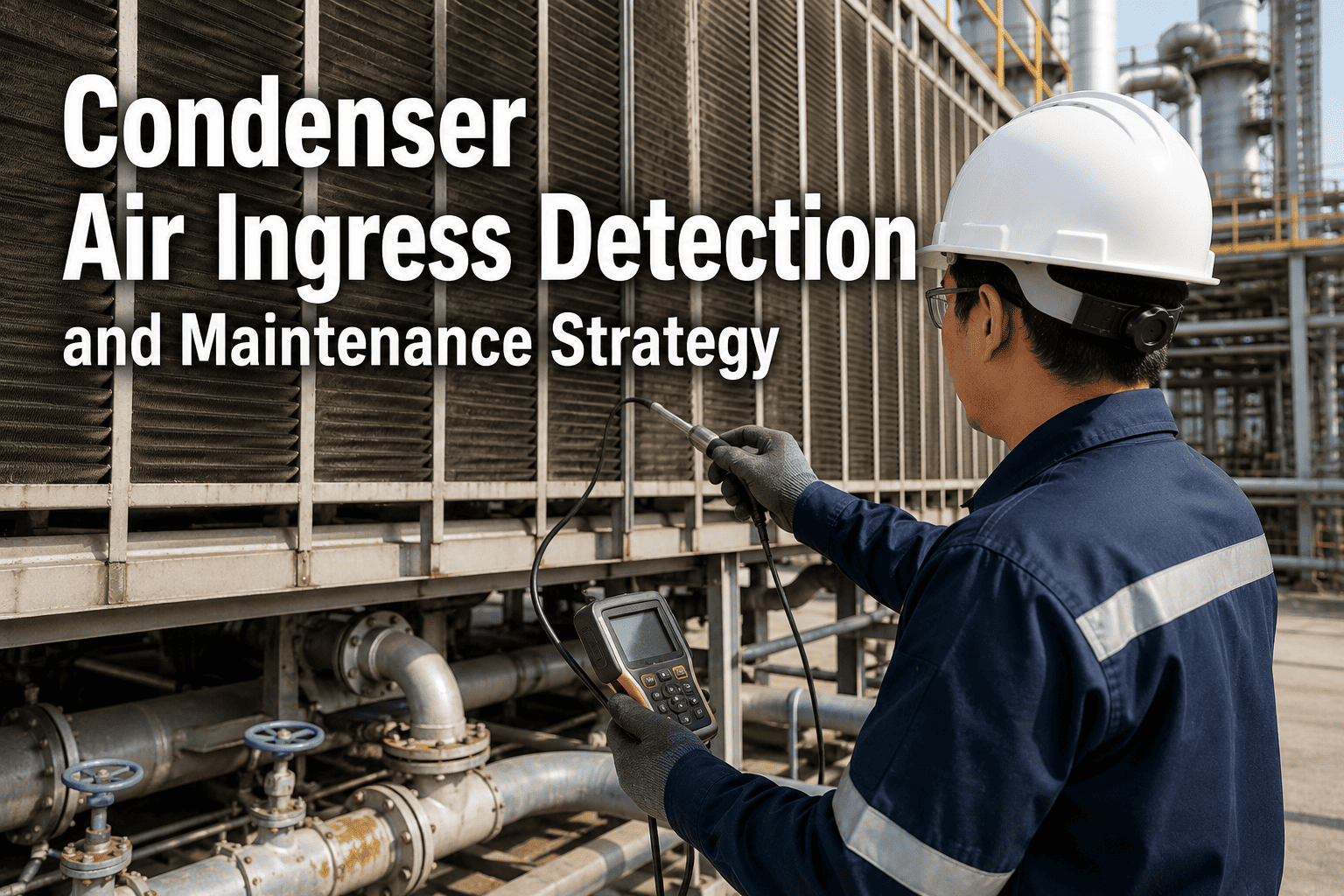
Condenser Air Ingress Detection and Maintenance Strategy
Air leaking into a condenser under vacuum degrades heat transfer, raises backpressure, and quietly erodes turbine heat rate. Here is how reliability teams find leak sources fast and keep vacuum performance where it belongs.
What Air Ingress Actually Costs a Plant
Air entering the condenser shell blankets the tube surfaces, reducing the effective heat transfer area and raising condenser backpressure. That backpressure increase translates directly into turbine heat rate degradation, and the relationship compounds the longer the leak goes undetected.
Where Air Actually Gets In
Condensers operate under vacuum, which means any imperfect joint on the low-pressure side is a potential leak path pulling ambient air inward rather than letting steam escape outward — the opposite of a pressurized system, which is why these leaks are so hard to spot visually.
Turbine Shaft Gland Seals
Worn low-pressure turbine gland packing is one of the most common entry points, particularly on older units approaching an overhaul interval.
Expansion Joints & Flanges
Rubber expansion joints on the LP turbine exhaust and condenser neck degrade with thermal cycling and are a leading leak source.
Valve Stem Packing
Valves on lines connected to the condenser vacuum space, including extraction and drain valves, leak through worn stem packing.
Instrument Connections
Pressure taps, level instrument connections, and sample points on the condenser shell are frequently overlooked leak sources.
Manway & Access Covers
Gasket degradation on manway covers and inspection ports, particularly after previous maintenance work disturbed the seal.
Tube-to-Tubesheet Joints
Rolled or welded tube joints that have loosened from thermal cycling, usually detected through tube-side leak testing.
Detection Methods Compared
No single detection method finds every leak source, which is why plants with mature condenser reliability programs combine at least two of the methods below.
| Method | Best For | Typical Accuracy | Requires Outage? |
|---|---|---|---|
| Helium leak testing | Small, precise leak locations | Very high | No — can run online |
| Ultrasonic leak detection | Gland seals, flanges, valve packing | High | No — can run online |
| Soap bubble / foam testing | Accessible joints and covers | Moderate | Usually offline |
| Vacuum decay rate test | Overall system leak rate trend | Confirms presence, not location | No — routine test |
| Dissolved oxygen monitoring | Ongoing trend indicator | Indirect indicator | No — continuous |
Turn Vacuum Loss Into a Work Order Before It Shows Up in Heat Rate
OxMaint tracks condenser backpressure, vacuum decay rate, and dissolved oxygen trend against baseline so drift gets flagged while it is still a minor leak, not a heat rate problem.
Building a Continuous Monitoring Timeline
The strongest condenser reliability programs treat air ingress monitoring as a continuous loop, not a periodic inspection task.
KPIs for Condenser Vacuum Performance
Backpressure Deviation
Difference between actual and design condenser backpressure at a given load and cooling water temperature.
Vacuum Decay Rate
Rate of pressure rise when the vacuum system is isolated, used as a direct indicator of total air ingress.
Dissolved Oxygen Trend
Feedwater dissolved oxygen level as an early indirect signal of condenser air ingress.
Leak Survey Closure Time
Time from confirmed vacuum drift to a completed leak survey identifying the source.
Frequently Asked Questions
How much heat rate impact can a single condenser air leak really cause?
The impact scales with the size and location of the leak, but even a moderate leak that raises backpressure by a small amount can produce a measurable heat rate penalty when sustained across months of operation. The effect compounds because higher backpressure reduces turbine exhaust efficiency, and the plant burns more fuel per unit of generation to compensate. A leak that seems minor in isolation often turns out to be a meaningful contributor once the fuel cost is annualized. Book a demo to see how OxMaint quantifies this impact for your fleet.
Can air ingress be detected without taking the condenser offline?
Yes, several detection methods including ultrasonic leak detection, helium tracer testing, and vacuum decay rate testing can all be performed while the unit remains in service. Online detection is generally preferred because it avoids the production loss of an outage and allows leaks to be caught and scheduled for repair before they grow. Offline methods like soap bubble testing are typically reserved for confirming a suspected location during a planned outage.
What is the relationship between dissolved oxygen and air ingress?
Air entering the condenser under vacuum carries oxygen and nitrogen into the steam cycle, and a portion of that oxygen ends up dissolved in the condensate and feedwater. Rising dissolved oxygen levels are therefore a useful indirect signal of increasing air ingress, and they matter independently because dissolved oxygen accelerates corrosion in feedwater heaters, economizers, and boiler tubes. Tracking this trend gives an early warning even before backpressure has moved significantly. Start free in OxMaint to trend dissolved oxygen alongside vacuum data.
Why does the same leak size cause different vacuum impacts on different units?
Condenser design, air removal system capacity, and cooling water temperature all influence how sensitive a given unit is to a fixed amount of air ingress. A condenser with a larger air removal system and colder cooling water has more margin to absorb a leak before backpressure moves noticeably, while a unit already running near its design backpressure limit will show the impact of the same leak much sooner. This is why baseline-relative monitoring, rather than fixed absolute thresholds, tends to catch problems earlier.
How do we prioritize which leak source to fix first when multiple are found?
Prioritization should weigh both leak rate and repair complexity — a large leak at an easily accessible flange should typically be addressed before a smaller leak buried inside a tube bundle requiring extended access work. Leaks affecting dissolved oxygen and feedwater chemistry directly also deserve priority over leaks with a purely thermodynamic vacuum impact, since corrosion damage compounds over time in a way that lost efficiency does not. Sign in to OxMaint to rank open leak findings by combined risk and repair cost.
Give Your Condenser the Same Monitoring Discipline as Your Turbine.
OxMaint centralizes vacuum, backpressure, dissolved oxygen, and leak survey history so every drift gets caught, tracked, and closed before it becomes a heat rate problem.