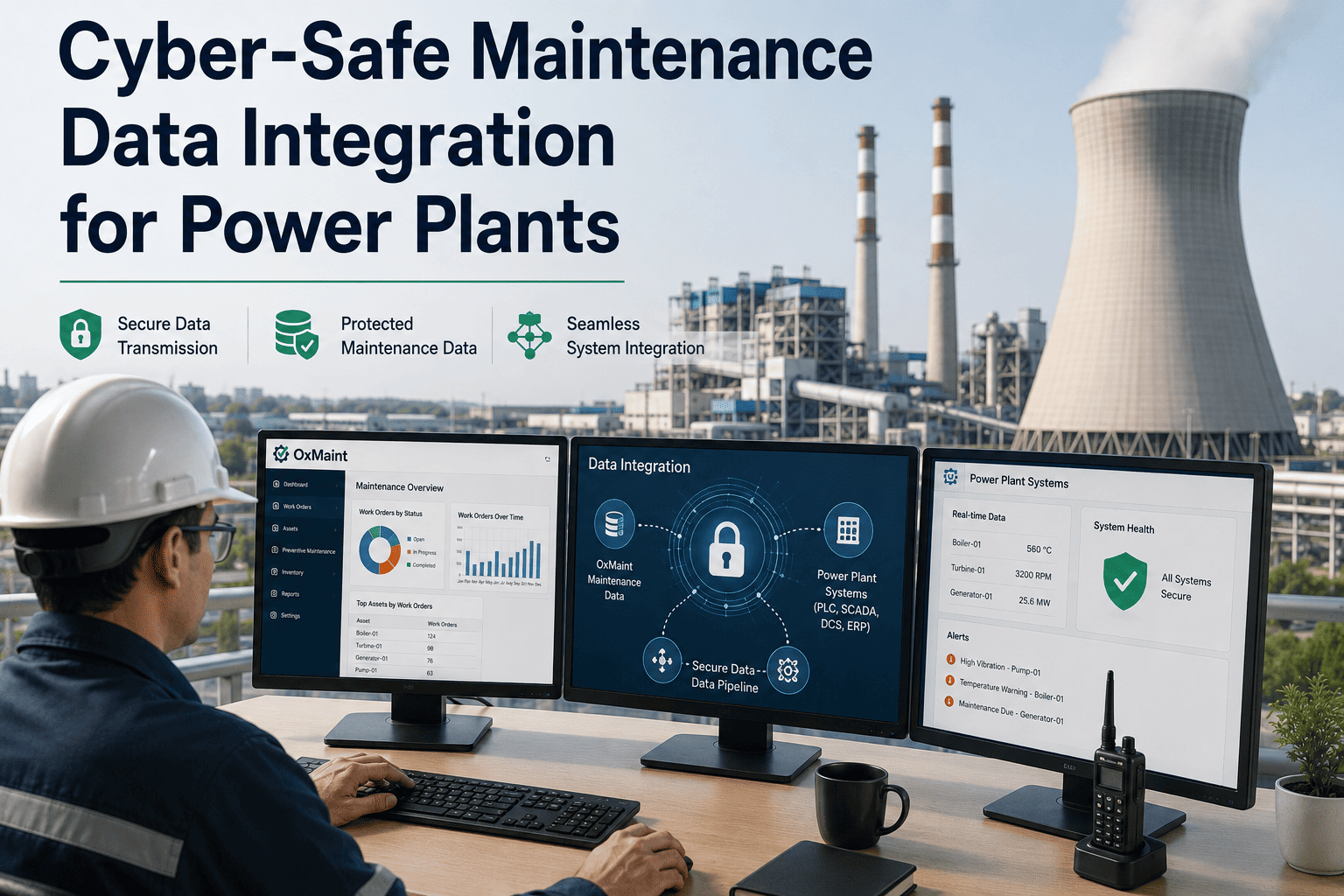
When security teams harden a power plant, they focus on the SCADA servers, the DCS, and the PLCs — and they overlook the system that quietly holds the keys to all of it. Your CMMS knows every asset, every maintenance window, every technician credential, every vendor contact, and in many plants it connects directly to control systems for condition data. To an adversary, that is a map of your generation fleet and a trusted door into the OT network. Ransomware against energy and utilities rose sharply in 2025, a single NERC CIP violation can cost up to $1 million per day, and the maintenance platform is increasingly the path of least resistance. Cyber-safe integration means pulling maintenance data without ever opening that door. This page explains how OxMaint integrates with OT systems securely for power generation.
$1M / day
Maximum penalty for a single NERC CIP violation — CMMS asset records and OT integrations fall in scope under CIP-002
80%
Year-over-year rise in ransomware against energy and utilities through 2025, now the most-targeted sector
~60 / day
New vulnerable points NERC estimates the U.S. grid is gaining every single day as IT and OT converge
Enterprise Integrations · Cyber Reliability
Pull Maintenance Data From OT — Without Opening a Door Into It
OxMaint reads sensor and asset data through one-way, read-only channels and never writes back to the control layer. Deploy in cloud, on-premise, or fully air-gapped mode, engineered for NERC CIP, IEC 62443, and NIST SP 800-82 environments.
The Blind Spot: Your CMMS Is OT Attack Surface
Most power facility security assessments never audit the maintenance platform, yet it is one of the richest targets in the building. The CMMS holds asset inventories, maintenance schedules, technician access credentials, vendor lists, and network diagrams buried in work-order attachments — and it frequently integrates with the historian and ERP, giving it pivots into OT-adjacent segments below the SCADA radar. The documented intrusion pattern is rarely loud: the maintenance system is seldom the final target, but it is often the entry point. Any platform that touches your OT network without purpose-built controls becomes three liabilities at once — a credential vector, a lateral-movement pathway, and a compliance exposure.
1 · Entry
A phishing email harvests a technician's CMMS login. With no MFA, the credential works on the first try.
OxMaint blocks itEnforced MFA, certificate-pinned mobile connections, and zero-trust access — every user, device, and connection verified.
2 · Recon
The attacker browses asset records, vendor lists, and network diagrams embedded in work-order attachments.
OxMaint blocks itLeast-privilege roles and encryption at rest (AES-256) limit what any single credential can ever see.
3 · Pivot
CMMS integrations with the historian and ERP become pivots into OT-adjacent segments below the SCADA radar.
OxMaint blocks itOne-way read-only data pull means there is no writable path from the CMMS into the control network to pivot through.
4 · Impact
The adversary plants ransomware, wipes compliance records, or waits months for an operationally costly moment.
OxMaint blocks itImmutable, timestamped audit logs and air-gapped deployment options remove the records to wipe and the reach to encrypt.
Where OxMaint Sits in the Purdue Model
The Purdue Model remains the shared language of OT security — it organizes the plant into layers so everyone from the CISO to the operator can see which boundary protects what. NERC CIP, IEC 62443, and NIST SP 800-82 all mirror these boundaries, and the Level 3/4 line — the Industrial DMZ — is where most energy-sector security investment concentrates. Cyber-safe integration means data flows up the layers while access never flows down. OxMaint is engineered to respect that rule: it consumes process data through the DMZ and never establishes a writable path into the control levels below.
L4/5
Enterprise IT & Cloud
Business systems, ERP, and cloud analytics. OxMaint's dashboards and reporting live here or in the DMZ, never reaching directly into control networks.
DMZ
Industrial DMZ — Level 3/4 Boundary
Dual firewalls with whitelist-only rules; the buffer where data is shared without direct IT-to-OT connectivity. CMMS platforms needing two-way connectivity belong here — never wired straight into control. Data diodes enforce one-way flow where absolute assurance is required.
▲ Data flows up (read-only)
▼ Access never flows down
L3
Operations & Historian
Site operations and the process historian. OxMaint subscribes here through read-only OPC connections to pull asset and condition data — the highest point it ever reads from.
L0–2
Control & Process — SCADA, DCS, PLCs
Field devices, controllers, and the process itself. OxMaint never writes here: no control commands, no configuration changes, no attack surface into the process layer.
One-Way By Design
Read-Only Means There Is Nothing to Exploit Downward
All sensor and asset data is pulled through one-way, read-only channels. No control commands, no configuration writes, no inbound path into the process layer — data diode and unidirectional gateway compatible, so the maintenance platform can never become a route into your SCADA network.
Three Deployment Modes for Three Risk Postures
A single deployment model cannot serve a commercial peaker plant and a nuclear-adjacent facility under NRC mandates. Some plants need cloud convenience; others have air-gap requirements that physically forbid cloud connectivity, and data-sovereignty laws that prohibit critical-infrastructure records from leaving the country. OxMaint offers the full range so the deployment matches the compliance reality, not the other way around.
Cloud
For: standard IT environments, multi-site fleets
Fastest to deploy, with TLS 1.3 in transit and AES-256 at rest. Suited to plants without air-gap mandates that want managed updates and fleet-wide visibility.
On-Premise
For: NERC CIP / FERC-regulated BES assets
Data and application run on customer-owned infrastructure. Satisfies CIP-007 and CIP-011 isolation requirements that cloud vendors cannot guarantee, with full data ownership.
Air-Gapped
For: nuclear, high-impact, data-sovereign sites
No external connectivity at all. Meets NRC 10 CFR Part 73.54 and data-residency laws where third-party cloud storage is categorically non-compliant.
From Security Control to Audit Evidence
The same architecture that keeps adversaries out also produces the evidence auditors demand. Every action — work-order creation, asset-record change, login event, permission change — is timestamped, attributed to a user, and retained in an immutable log. That log is simultaneously your NERC CIP compliance record and your forensic foundation after an incident. The mapping below shows how OxMaint capabilities line up to the CIP standards most often cited in Regional Entity audits.
| NERC CIP Standard | What It Requires | OxMaint Capability |
| CIP-002 |
Identify and classify BES cyber systems |
Asset register tags CMMS records and OT integration points by impact rating |
| CIP-005 |
Electronic security perimeters and access points |
DMZ-deployable with read-only flows; no direct connectivity into the control network |
| CIP-007 |
System security management and patch tracking |
Patch compliance becomes scheduled work orders with ownership and due dates |
| CIP-010 |
Configuration change management |
Equipment changes logged with timestamps, flagging records that need review |
| CIP-011 |
Protect BES cyber system information |
AES-256 at rest, TLS 1.3 in transit, least-privilege roles, on-prem isolation |
"We had two consecutive NERC CIP audits where our biggest exposure was not the technical controls — it was the documentation. The team was doing the right things, but we couldn't produce clean evidence chains for our patch-management reviews or our access records. Moving maintenance onto a system that timestamps and attributes every action turned audit prep from a binder sprint into an export."
— IT/OT Security Lead, Bulk Electric System Operator
Frequently Asked Questions
Q1Can OxMaint connect to our OT network without becoming an attack path into SCADA?
Yes — that is the core of the design. OxMaint pulls all sensor and asset data through one-way, read-only channels and never writes back to the control layer, so there are no control commands, no configuration changes, and no inbound path into the process levels. Where a platform needs two-way connectivity it is deployed in the Industrial DMZ behind dual firewalls, never wired directly into the control network, and the architecture is data-diode and unidirectional-gateway compatible for sites that require absolute one-way assurance. Because there is no writable path downward, the maintenance platform cannot be used to pivot into SCADA.
Book a demo to review the architecture for your network.
Q2Why is the CMMS considered a cybersecurity risk if it is "just" maintenance software?
Because it holds the most useful reconnaissance data in the plant. A maintenance platform stores asset inventories, maintenance windows, technician credentials, vendor contacts, and often network diagrams attached to work orders — and it frequently integrates with the historian and ERP, giving it reach into OT-adjacent segments. The documented intrusion pattern across power-sector incidents is that the CMMS is rarely the final target but often the door: a phished technician credential leads to recon, then a pivot through integrations, then impact. Securing the maintenance platform is therefore not optional hardening — it closes one of the most exploited gaps in OT environments, which is exactly why purpose-built controls matter.
Q3We have strict air-gap and data-residency requirements. Does cloud rule OxMaint out?
No. OxMaint offers cloud, on-premise, and fully air-gapped deployment modes so the deployment matches your compliance posture. For NERC CIP and FERC-regulated bulk electric system assets, on-premise deployment runs on your own infrastructure and satisfies the CIP-007 and CIP-011 isolation requirements that cloud vendors cannot guarantee. For nuclear or high-impact sites under NRC 10 CFR Part 73.54, or where data-sovereignty laws prohibit critical-infrastructure records from leaving the jurisdiction, the air-gapped mode operates with no external connectivity at all. You are never forced into a cloud model that conflicts with a licensing requirement, which is increasingly a baseline expectation rather than a premium option.
Q4How does the integration help us actually pass a NERC CIP audit?
The same controls that secure the data also generate the evidence. Every work-order creation, asset-record change, login, and permission change is timestamped, attributed to a specific user, and retained in an immutable audit log that serves as both your CIP compliance record and your forensic trail. Patch-management items under CIP-007 become scheduled work orders with owners and due dates rather than entries on a risk register nobody reads, and configuration changes under CIP-010 are logged automatically. That converts audit preparation from a manual binder-assembly sprint into an export of an already-complete evidence chain — which is where most teams' real exposure lives, since auditors typically find documentation gaps, not control gaps.
Start a free trial to see the audit-ready logs.
Q5What encryption and access controls protect maintenance data in transit and at rest?
OxMaint encrypts data in transit using TLS 1.3 and at rest using AES-256, and mobile technician access uses certificate-pinned connections to prevent interception. Access follows zero-trust and least-privilege principles — every user, device, and connection is verified, and roles limit what any single credential can reach, so a compromised login cannot browse the entire asset base. Multi-factor authentication closes the most common entry vector, where a phished password with no second factor works on the first try. These controls align with the protection requirements in NERC CIP-011, IEC 62443, and NIST SP 800-82, and they apply consistently across cloud, on-premise, and air-gapped deployments so your security posture does not depend on which mode you run.
Enterprise Integrations · Cyber Reliability
Integrate Maintenance Data Without Expanding Your Attack Surface
Built for NERC CIP, IEC 62443, and NIST SP 800-82 environments. See how OxMaint pulls maintenance data securely and produces audit-ready evidence — without ever opening a path into your control network.