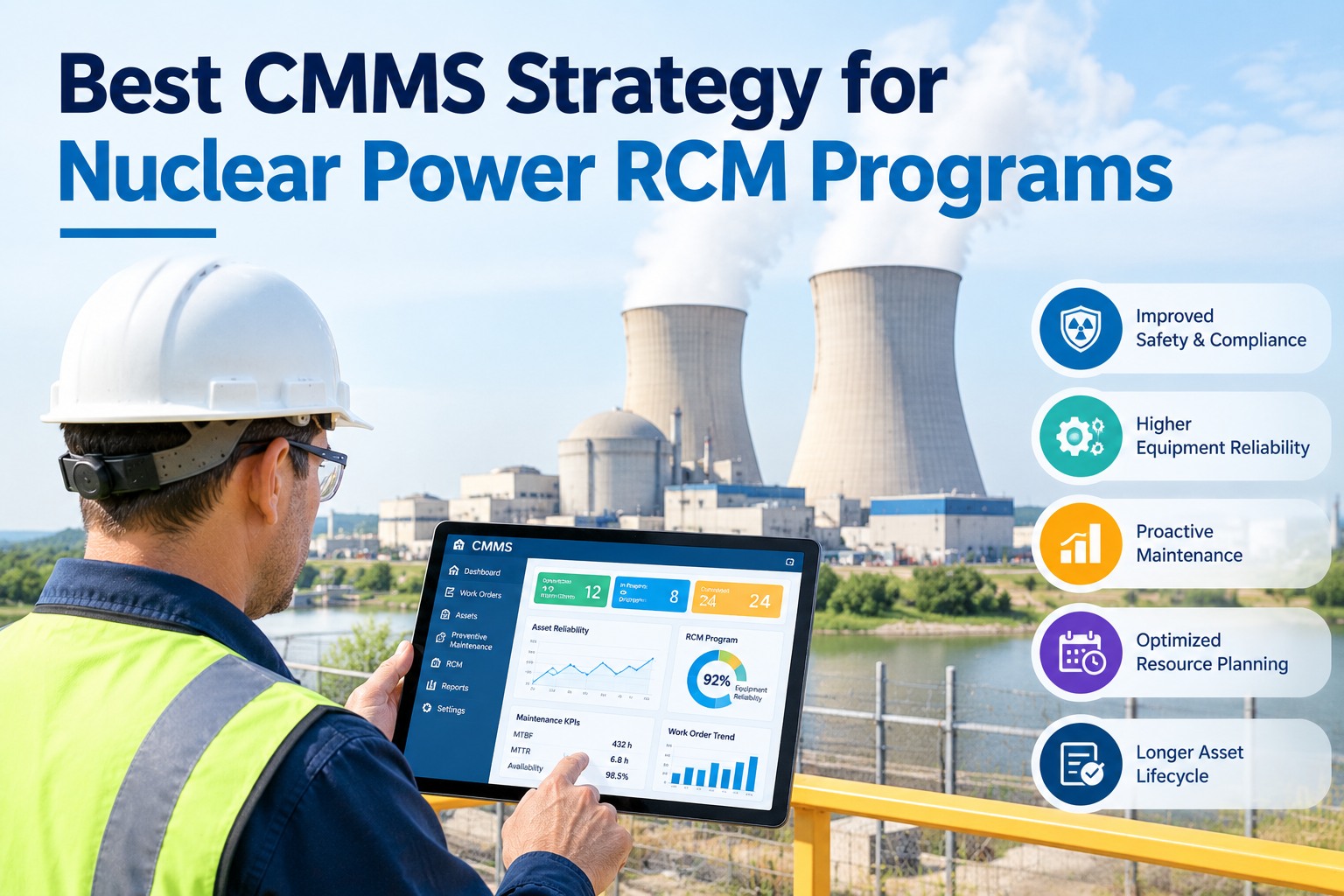
Nuclear power plants operate under the most demanding maintenance compliance framework of any industry on earth — where a single missed preventive task on a safety-related system is not a quality issue but a federal violation subject to NRC enforcement action, civil penalties, and in severe cases, forced shutdown. With 93 operating reactors in the United States collectively regulated under 10 CFR 50.65, ASME Section XI In-Service Inspection requirements, and 10 CFR 50 Appendix B Quality Assurance criteria, the gap between what a generic CMMS can track and what nuclear maintenance actually demands has never been wider. Oxmaint's nuclear-ready CMMS is purpose-built for this environment — delivering 10 CFR 50.65 maintenance rule monitoring, ISI program tracking, surveillance test scheduling, and corrective action program integration in one auditable platform that plants can trust during NRC inspections. Book a compliance walkthrough with a nuclear maintenance specialist today.
The CMMS Built for 10 CFR 50.65, ISI Programs, and NRC Audit Readiness
Every work order. Every surveillance test. Every ISI inspection milestone. Tracked, documented, and audit-ready — in one platform designed for the regulatory complexity of nuclear operations.
Why Nuclear Maintenance Compliance Is Unlike Any Other Industry
Nuclear plants do not self-certify compliance. The NRC conducts resident inspections 365 days a year and targeted inspection procedures that scrutinize maintenance effectiveness, work control, and corrective action programs directly. Understanding the regulatory layers is the first step to building a CMMS strategy that survives them.
What Generic CMMS Platforms Cannot Handle in Nuclear
Most CMMS platforms are built for industrial maintenance. Nuclear maintenance operates under a fundamentally different set of constraints — where work authorization, configuration control, and regulatory traceability requirements disqualify platforms that lack purpose-built compliance architecture.
| Requirement | Generic CMMS | Oxmaint Nuclear CMMS |
|---|---|---|
| 10 CFR 50.65 SSC Goal Tracking | No structured framework — manual workarounds required | Dedicated (a)(1) and (a)(2) status tracking with goal monitoring and automatic escalation alerts |
| ISI Interval and Period Management | Calendar-based scheduling without 10-year interval structure | ASME XI interval tracking with period completion percentages and overdue inspection flags |
| Corrective Action Program (CAP) Integration | Separate work orders with no condition report linkage | Bidirectional CAP linkage — condition reports create work orders, work orders close condition reports |
| Surveillance Test Scheduling and Documentation | Standard PM scheduling without operability tracking | Technical Specification-linked surveillance tracking with missed test operability determination workflow |
| Equipment Qualification (EQ) Record Tracking | No qualified life expiration monitoring capability | EQ record management with qualified life expiration alerts and replacement work order auto-generation |
| Immutable Audit Trail for NRC Inspection | Editable records without regulatory-grade version control | Locked, timestamped, user-attributed record chain — inspection-ready without data reconstruction |
| Work Authorization and Configuration Control | Standard approval routing without nuclear work control | Multi-level authorization with outage planning, hold point management, and post-maintenance test tracking |
How Oxmaint Manages the Maintenance Rule — From SSC Classification to (a)(1) Recovery
The Maintenance Rule requires plants to classify every in-scope SSC, set measurable performance goals, monitor actual performance against those goals, and take action when goals are not met. Oxmaint structures this entire workflow within the CMMS — making maintenance rule compliance a continuous process, not a quarterly scramble before the assessment due date.
Every asset in Oxmaint is assigned its maintenance rule classification — safety-related, non-safety-related but within scope, or excluded. Classification drives which performance goals apply, which monitoring parameters are tracked, and how failures are coded and analyzed.
For SSCs in (a)(2) status, Oxmaint monitors availability, reliability, and condition goals in real time. Reliability goals track mean time between failures. Availability goals track planned and forced outage hours. When performance trends toward a goal threshold, alerts fire before the goal is missed — not after.
When an SSC fails to meet its (a)(2) goal, Oxmaint automatically escalates to (a)(1) status and triggers the corrective action plan workflow. The CAP includes root cause analysis assignment, corrective action work order generation, and scheduled re-assessment milestones with Engineering and the 10 CFR 50.65 Expert Panel review queue.
Oxmaint generates the annual Maintenance Rule assessment report directly from live plant data — no manual aggregation, no data reconstruction. The report includes goal performance summaries, (a)(1) population status, engineering panel findings, and program health metrics — structured for direct submission or management review board presentation.
In-Service Inspection Management — 10-Year Intervals, Period Completion, and Overdue Alerts
ASME Section XI organizes inspections into 10-year intervals divided into three periods. Plants must complete required inspection percentages within each period. Missing interval milestones without NRC-approved relief requests is a significant regulatory finding. Oxmaint tracks every ISI line item against interval and period requirements — in real time, not quarterly.
What Oxmaint Delivers for Nuclear Maintenance Programs
Technical Specification-required surveillance tests are scheduled, tracked, and documented with missed test operability determination workflows. Frequency extensions, deferrals, and as-left data capture are logged with full regulatory traceability to the applicable Technical Specification action level.
Condition reports from your CAP system flow directly into Oxmaint work orders. Corrective maintenance actions close automatically when work is completed and verified. Significant condition adverse to quality (SCAQ) workflows include root cause assignment, effectiveness review scheduling, and closure verification.
Every safety-related electrical component's qualified life, harsh environment designation, and replacement date is tracked in Oxmaint. As qualified life expiration approaches, replacement work orders are auto-generated with lead time sufficient to complete procurement and installation before the expiration date.
Refueling outage work packages are built, sequenced, and resource-loaded in Oxmaint — with hold points, post-maintenance test requirements, and Configuration Risk Management Program inputs integrated directly into the work package workflow rather than managed in separate systems.
Oxmaint's PM basis documentation module links every preventive maintenance task to its regulatory basis — vendor recommendations, 10 CFR 50.65 goals, ASME code requirements, or INPO AP-913 program elements — so PM deferrals and deletions are defended by documented basis, not habit or production pressure.
Resident and regional inspectors conduct IP 71111.12 Maintenance Effectiveness inspections by reviewing plant data against 10 CFR 50.65 requirements. Oxmaint generates inspection-ready packages covering SSC goal status, (a)(1) population health, maintenance rule scope, and maintenance effectiveness assessment history — in the format inspectors expect.
What Nuclear Maintenance Managers Ask Before Selecting a CMMS
How does Oxmaint support 10 CFR 50.65 Maintenance Rule program documentation for NRC inspection?
Can Oxmaint integrate with our existing Corrective Action Program software?
How does Oxmaint handle ASME Section XI ISI program tracking across multiple inspection intervals?
Is Oxmaint compliant with 10 CFR 50 Appendix B Quality Assurance record-keeping requirements?
How long does implementation take for a nuclear plant with an existing CMMS and historical data?
Nuclear Maintenance Compliance Is Not a Feature. It Is the Foundation.
Oxmaint is the CMMS built for the regulatory realities of licensed nuclear operations — 10 CFR 50.65 maintenance rule monitoring, ASME Section XI ISI tracking, Equipment Qualification record management, and Corrective Action Program integration in one platform that your QA organization can validate and your NRC inspector can review with confidence.