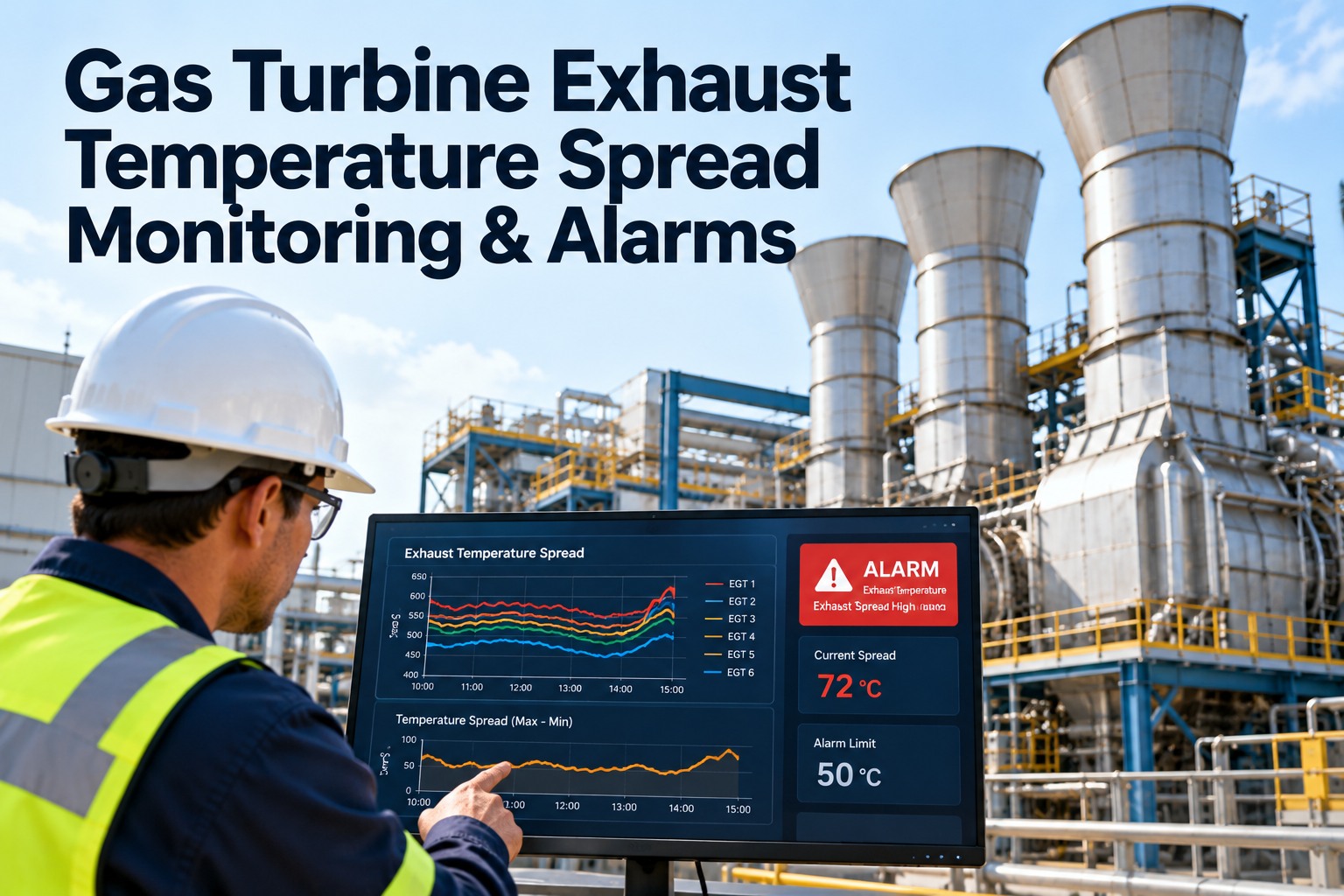
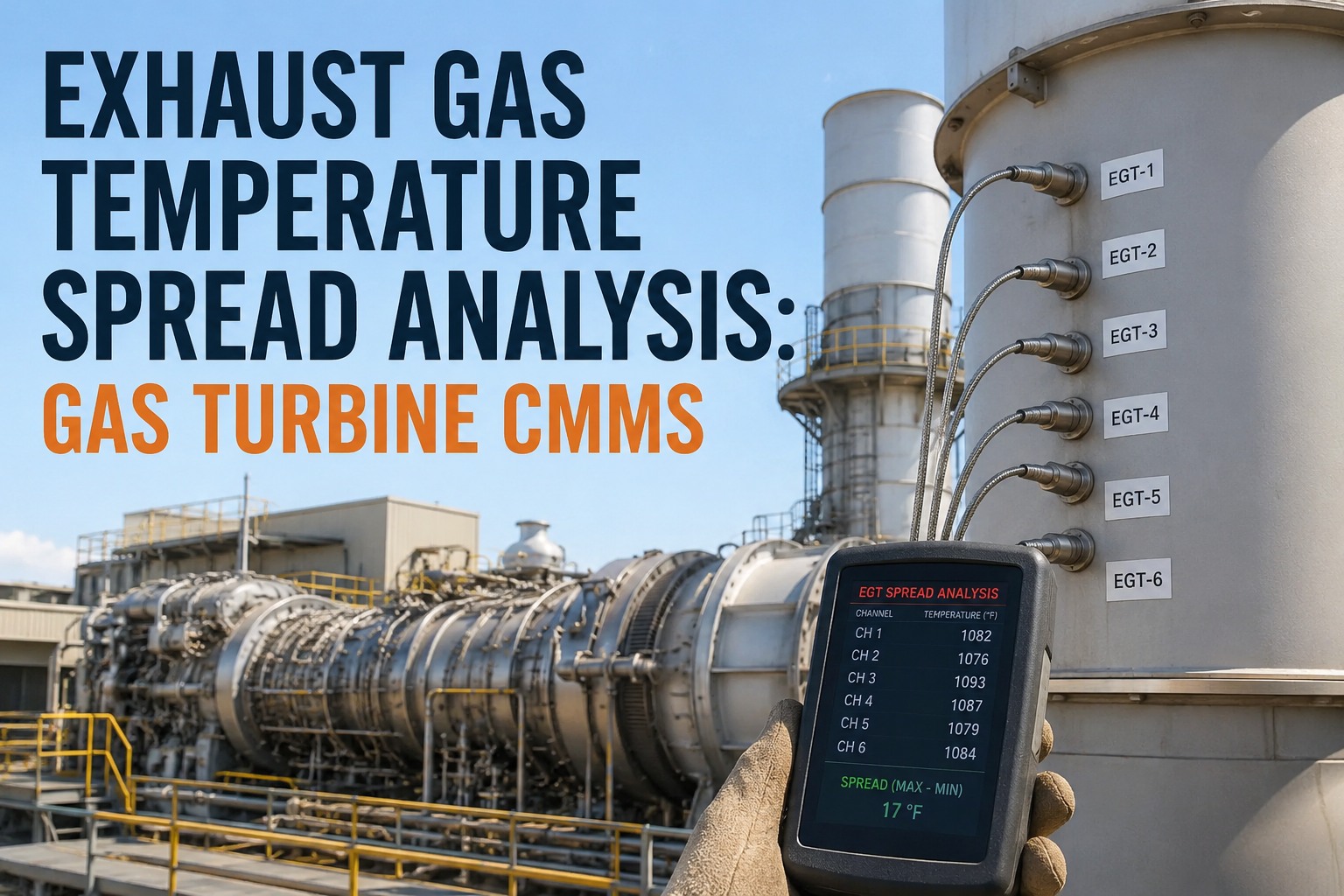
One thermocouple in the exhaust ring reads 80°C below the rest. Is it a plugged fuel nozzle starving one combustor — or just a dead sensor? The answer decides whether you investigate a combustion fault or ignore a bad wire, and it hides in one detail: which neighbours it sits between. Exhaust temperature spread is the earliest, cheapest fault signal a gas turbine gives — if someone reads the pattern. OXMAINT AI is the AI-powered maintenance management software that turns a spread alarm into an asset-linked investigation and work order — or book a demo of spread-to-work-order in OXMAINT AI.
GAS TURBINE · EXHAUST TEMPERATURE SPREAD MONITORING & ALARMS · 2026
Gas Turbine Exhaust Temperature Spread Monitoring & Alarms
A widening spread between exhaust thermocouples is combustion trouble announcing itself — a fouled nozzle, a cracked liner, a losing flame. OXMAINT AI is the AI-powered CMMS that reads the spread pattern, separates a real combustion fault from a failed sensor, and raises a ranked investigation work order before the gradient eats blade life or trips the unit. The spread trend becomes the maintenance action, on time.
1 · Read spread
2 · Decode pattern
3 · Work order
4 · Close loop
4–5°C
spread on a healthy turbine — all combustors burning evenly
15–30°C
the watch zone — trend it, and borescope if it keeps climbing
adjacent
hot/cold pair is the tell — a real combustion fault, not a dead sensor
hours
spread drifts well before the fault derates or trips the unit
The Exhaust Thermocouple Ring
A ring of thermocouples sits around the exhaust, one reading per segment. On a healthy unit they sit within a few degrees of each other. When one combustor misbehaves, its thermocouple breaks from the pack — and the gap between highest and lowest is the spread. Start free and track the spread trend in OXMAINT AI.
TC1
TC2
TC3
TC4
TC5
TC6
TC7
TC8
TC9
TC10
TC11
TC12
within band — even burn cold outlier — one combustor running lean or starved
Spread Alarm Bands
Spread isn't one threshold — it's a ladder. Each band carries a different response, and the top of the ladder is where the OEM combustion monitor protects the machine.
< 15°CNormal — even combustion, nothing to do but trend.
15–30°CWatch zone — investigate the trend, plan a borescope if it climbs.
> 30°CCombustion trouble — alarm raised, raise an investigation work order.
High + adjacentTrip risk — high spread with an adjacent hot/cold pair; protection acts.
The Spread Pattern Decoder
The magnitude of the spread and the shape of the pattern together fingerprint the cause. This is the reference that turns a spread reading into an investigation target.
Cause
Typical spread
Pattern
Fouled fuel nozzle30–80°CCold spot at the affected combustor
Cracked liner / transition50–120°CCold spot with an adjacent hot area
Fuel flow divider fault40–100°CMultiple uneven hot / cold spots
Loss of flame100–200°COne thermocouple far below the rest
DLN primary flashback60–150°CHot spot with combustion instability
Hula / side seal leak25–70°CCold spot from cooling-air bypass
Thermocouple failureapparent onlyA single extreme outlier — no real heat change
The Adjacency Test
One question separates a combustion fault from a wiring problem: are the hot and cold readings next to each other on the ring? Get this right and you stop chasing dead sensors as if they were cracked liners — schedule a walkthrough of pattern alarms in OXMAINT AI.
ADJACENT HOT / COLD
Real Combustion Fault
Neighbouring thermocouples diverging is a genuine hot streak — the steepest gradient across nozzles and blades, and the worst case for component life. Investigate the combustor.
LONE OUTLIER
Likely Failed Thermocouple
A single extreme reading with normal neighbours is usually the sensor, not the fire — common on older frames and often misdiagnosed. Check the thermocouple before the combustor.
Why Spread Matters: Component Life
Spread isn't just a fault flag — the gradient itself damages the machine. An adjacent hot/cold pair puts the steepest thermal stress straight across the hot-section nozzles and buckets, so a tolerated spread quietly spends blade life you can't get back.
Steeper Gradient
Adjacent hot and cold readings mean the sharpest temperature change across a single blade pass.
Thermal Fatigue
That cycling gradient drives low-cycle fatigue in nozzles, buckets and transition pieces.
Spent Life
Hot-section parts run hotter than designed, so the hours tick off the component's life faster.
Compounded Cost
An ignored spread turns a nozzle cleaning into a hot-gas-path repair — the fault scales up.
How OXMAINT AI Turns Spread Into Action
OXMAINT AI isn't a turbine control system — it is the AI-powered maintenance management software that takes the spread signal and turns it into a tracked, asset-linked fix. Put your unit on it when you start free and connect spread monitoring to OXMAINT AI.
Spread Baseline & Trend
Exhaust spread tracked against the unit's baseline and load, so a slow climb is caught in the watch zone.
Pattern & Adjacency Check
The hot/cold pattern is read for adjacency, separating a combustion fault from a failed thermocouple.
Cause Decoding
Spread magnitude and shape are mapped to a probable cause — nozzle, liner, flow divider, flame.
Alarm → Work Order
A combustion-trouble spread raises a ranked investigation work order on the combustor or fuel system.
Combustion-Health Register
Nozzles, liners, transition pieces and thermocouples tracked as assets tied to the spread they drive.
Fleet Spread View
Spread trend and open investigations across every unit on one screen, with full history.
The Spread Told You First. Did You Read It Right?
A widening spread is the cheapest warning a gas turbine gives — and the easiest to misread as a bad sensor. OXMAINT AI reads the pattern, checks adjacency, and routes a real combustion fault to a work order, so the warning becomes a fix instead of a trip.
EXPERT REVIEW
Written for reliability, performance and maintenance teams at gas-turbine plants. OXMAINT AI is a maintenance management platform, not a turbine control or protection system — the OEM combustion monitor (such as GE Mark alarm points) performs the real-time alarming and tripping. OXMAINT AI consumes the spread signal and correlates it with combustion-asset condition to prioritise investigation. Spread thresholds and root-cause ranges here are typical industry figures; the OEM settings and the specific DLN system are the authority for your unit.
Frequently Asked Questions
What is exhaust temperature spread?
The difference between the highest and lowest of the thermocouples placed around the gas-turbine exhaust. A healthy unit sits around 4–5°C with all combustors burning evenly; a widening spread means one or more are not.
Start free and trend spread in OXMAINT AI.
Why does adjacency matter so much?
Because it separates a real fault from a dead sensor. Adjacent hot and cold readings are a genuine combustion hot streak with a steep gradient across the blades; a single outlier with normal neighbours is almost always a failed thermocouple. Reading adjacency stops you chasing the wrong problem.
Book a demo of pattern alarms in OXMAINT AI.
What does a cold spot usually mean?
Most often a fouled or worn fuel nozzle starving one combustor (typically 30–80°C), or a hula-seal leak bypassing cooling air (25–70°C). A very cold single reading can signal loss of flame. The magnitude and pattern narrow it down.
Start free and decode cold spots in OXMAINT AI.
Does spread actually damage the turbine?
Yes. An adjacent hot/cold pattern creates the steepest thermal gradient across hot-section nozzles and buckets, driving low-cycle fatigue and running parts hotter than designed — so a tolerated spread spends blade life and can turn a cleaning into a hot-gas-path repair.
Walk the component-life impact in a demo of OXMAINT AI.
Does OXMAINT AI replace the turbine combustion monitor?
No. The OEM control system and combustion monitor handle the real-time alarms and trips. OXMAINT AI takes the spread signal, checks the pattern, and turns a combustion-trouble condition into a prioritised maintenance investigation and work order.
Start free and connect spread to maintenance in OXMAINT AI.
Read the Spread, Fix the Combustor.
Run spread-to-maintenance on OXMAINT AI: exhaust spread trended against baseline, the pattern checked for adjacency, the cause decoded, and a combustion-trouble reading routed to a ranked investigation work order — so the earliest warning the turbine gives becomes the repair your crew makes, before it trips.