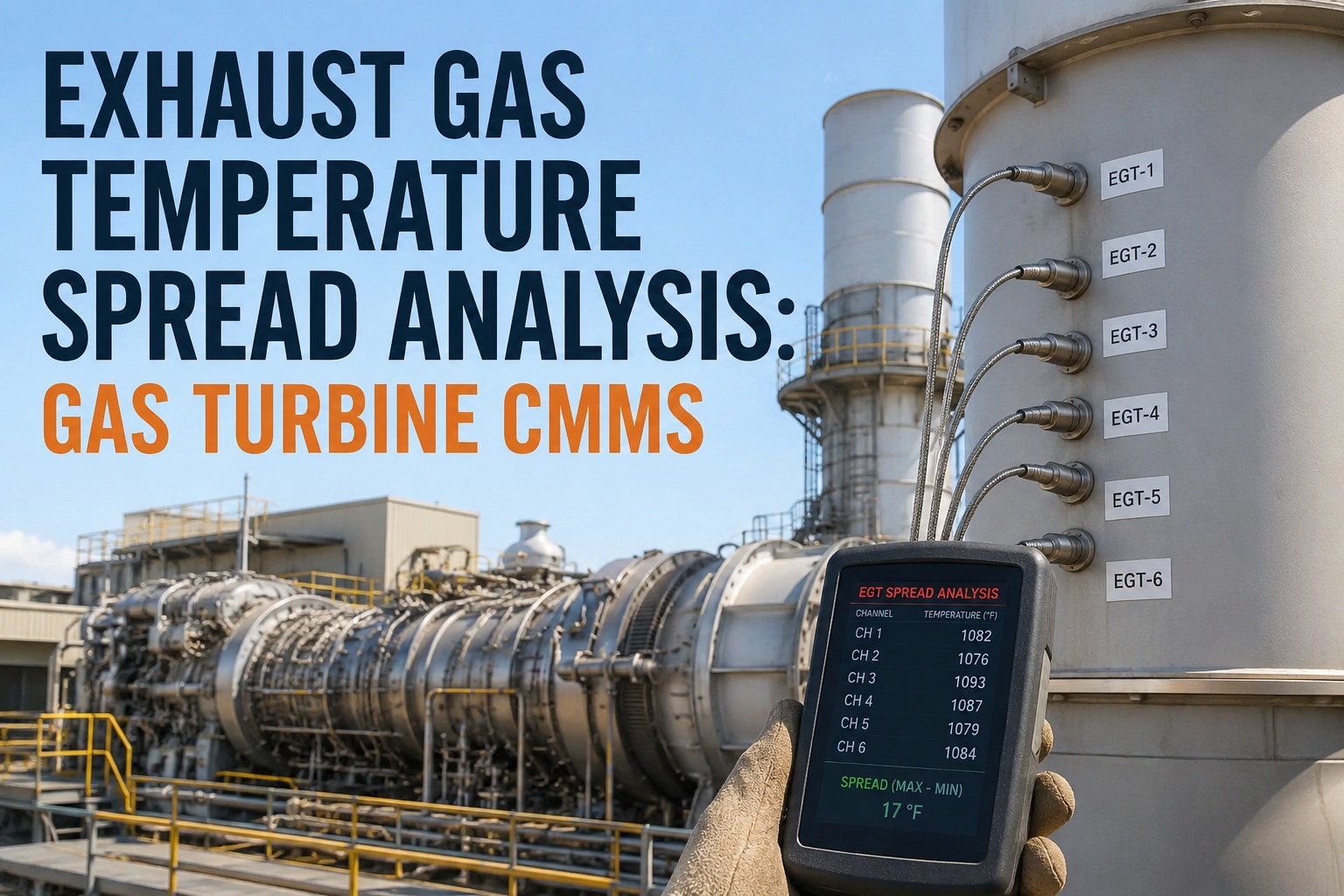
A gas turbine running with undetected exhaust temperature spread (ETS) is not just running inefficiently — it is destroying the most expensive components in the plant at an accelerated rate. At 3,600 RPM, every turbine blade passes each combustor 60 times per second. When one combustor runs hotter or colder than the rest, every blade that passes through that hot streak experiences damaging thermal stress — hundreds of thousands of times per hour. Most ETS problems start as 15–20°C deviations that operators dismiss as normal variation. By the time the spread reaches trip level, significant blade life has already been consumed. Start your free OxMaint trial to bring real-time ETS analytics and automated alerts to your turbine fleet, or book a demo to see how DCS/SCADA integration delivers early combustion fault detection before damage occurs.
Why Exhaust Temperature Spread Is the Most Critical Diagnostic Parameter in a Gas Turbine
60×
per second each blade passes a combustor at 3,600 RPM
50°C
combustor outlet temperature increase reduces blade life by an order of magnitude
4–12 Wks
advance warning achievable with AI-powered ETS anomaly detection
What Exhaust Temperature Spread Actually Tells You
ETS is the differential between the highest and lowest thermocouple readings placed radially around the gas turbine exhaust. On a healthy turbine, all combustors burn at roughly equal temperatures, producing a relatively uniform exhaust temperature profile across the measurement plane. When the spread widens, it is a direct signal that something inside the combustion system is wrong — and that information is visible nowhere else in the turbine's instrumentation.
Healthy Turbine — Uniform ETS Profile
T1520°C
T2518°C
T3521°C
T4519°C
T5522°C
T6520°C
T7519°C
T8521°C
T9518°C
Spread
4°C
All combustors balanced. Spread within 5°C. Normal operation.
Fault Condition — High ETS with Adjacent Hotspot
T1519°C
T2581°C
T3576°C
T4521°C
T5471°C
T6518°C
T7522°C
T8520°C
T9517°C
Spread
110°C
Adjacent hot and cold spots detected. Combustion fault — immediate action required.
The critical physics here: hot combustion gases from each individual combustor travel axially through the turbine stages with very little circumferential mixing. This is why exhaust thermocouples can map which combustor is running hot or cold — the thermal "fingerprint" of each combustor remains largely intact by the time it reaches the exhaust measurement plane. The worst ETS condition occurs when the hottest and coldest readings are adjacent — this creates the steepest thermal gradient across the turbine nozzles and blades, maximizing mechanical stress.
What Causes High Exhaust Temperature Spread
Understanding the root cause of ETS is essential to responding correctly. The same 80°C spread can have five different causes — each requiring a completely different intervention. Operators who treat ETS as a single-cause problem frequently misdiagnose it and repeat the fault cycle.
| Root Cause |
ETS Pattern |
Typical Spread |
Rate of Development |
Primary Action |
| Fouled or blocked fuel nozzle |
Cold spot at affected combustor |
30–80°C |
Gradual (weeks) |
Nozzle inspection and cleaning |
| Cracked combustion liner or transition piece |
Cold spot with adjacent hot area |
50–120°C |
Progressive (days–weeks) |
Borescope inspection; liner replacement |
| Fuel flow divider fault (liquid fuel) |
Multiple uneven cold/hot spots |
40–100°C |
Rapid (hours) |
Flow divider test; valve inspection |
| Loss of flame in one combustor |
Very cold spot — one TC far below others |
100–200°C |
Sudden |
Shutdown; flame detector and igniter check |
| DLN combustor primary zone flashback |
Hot spot with combustion instability |
60–150°C |
Rapid/intermittent |
Combustion tuning; fuel pressure check |
| Hula seal or transition piece side seal leak |
Cold spot — cooling air bypassing combustor |
25–70°C |
Gradual |
Seal inspection during next outage |
| Thermocouple failure (instrumentation fault) |
Single extreme outlier (very high or very low) |
Apparent only |
Sudden |
TC calibration check; replace sensor |
The ETS Alarm Architecture: From Warning to Trip
Gas turbine control systems implement ETS monitoring in a structured alarm hierarchy. Understanding this hierarchy — and where your monitoring system sits within it — determines whether you get actionable warning or just a trip you did not see coming.
Normal Operation
ETS < 15°C
All combustors balanced. Exhaust profile within baseline footprint. No action required.
Watch Zone
ETS 15–30°C
Deviation from baseline footprint detected. OxMaint flags trending — investigate at next opportunity. Schedule borescope if trend continues.
Combustion Trouble Alarm
ETS > Allowable Limit
DCS generates COMBUSTION TROUBLE alarm (L30SPA). If sustained for 3 seconds, alarm latches. OxMaint auto-creates CMMS work order with fault signature and recommended action.
TC Trouble Alarm
Spread > 5× Allowable
EXHAUST THERMOCOUPLE TROUBLE alarm (L30SPTA) generated. Indicates likely failed TC rather than combustion fault. System must distinguish instrumentation failure from real combustion event.
High ETS Trip
High Spread + Adjacent TC Pair
Turbine trips on HIGH EXHAUST TEMPERATURE SPREAD. Both high magnitude AND adjacent TC readings required for trip. At this point, blade damage is likely already in progress.
DCS / SCADA Integration
Catch ETS Problems Before the Alarm — Not After the Trip
OxMaint connects directly to your DCS or SCADA, reads individual thermocouple channels in real time, and flags deviation from each turbine's learned temperature footprint — giving you 4–12 weeks of warning before ETS reaches trip level.
Beyond Simple Threshold Alarms: The Footprint Method
Most DCS implementations compare current ETS values against fixed absolute thresholds — if the spread exceeds X degrees, trigger an alarm. This approach misses the most valuable early detection opportunity: deviation from each turbine's own established temperature profile.
Traditional Threshold Monitoring
✕
Fixed absolute limits (e.g. trip at 80°C spread regardless of turbine history)
✕
No account for manufacturing tolerances or thermocouple positioning variation
✕
Cannot detect gradual drift within the "normal" band that signals early deterioration
✕
Instrumentation faults (failed TCs) indistinguishable from real combustion events
✕
No load-correction — same limit at 50% load and 100% load despite different temperature ranges
Catches problems late. Often only at trip point.
Footprint-Based Monitoring (OxMaint)
✓
Establishes the unique temperature profile of each turbine across all load points empirically
✓
Alerts on deviation from the turbine's own footprint — sensitive to 5–10°C shifts that absolute limits miss
✓
Load-corrected baselines — each TC reading evaluated against ambient-corrected expected value at current output
✓
Statistical outlier detection separates TC instrumentation faults from real combustion anomalies
✓
Trending rate analysis — gradual drift identified weeks before threshold violation
Catches problems 4–12 weeks early. Prevents blade damage.
What Happens When ETS Goes Undetected
The consequences of running a gas turbine with elevated exhaust temperature spread are not linear. They compound over time, accelerating component failure in exactly the components that are most expensive to replace and most difficult to access.
Hours 0–72
Thermal Fatigue Cycles Begin
Blades passing through the hot streak experience cyclic thermal stress 60–85 times per second. Thermal barrier coating begins micro-cracking at affected positions. No external symptoms visible. Spread registers as within "acceptable" range.
Cumulative damage cost: Low — but accumulating silently
Days 3–14
Accelerated Blade Creep and Oxidation
Sustained elevated temperatures exceed design parameters for affected blade positions. Creep elongation progresses. Operators may observe slight spread increase but attribute it to ambient variation. Combustion liner condition deteriorating at hot combustor.
Cumulative damage cost: Moderate — blade life shortened measurably
Weeks 2–6
Spread Widening — Approaching Alarm Level
Root cause (fouled nozzle, cracked liner, seal leak) continues to develop. Spread reaches combustion trouble alarm level. DCS generates alarm — often acknowledged and reset without root cause investigation. Blade damage now significant at affected positions.
Cumulative damage cost: Significant — unplanned maintenance now likely at next inspection
Trip Event
High ETS Trip — Turbine Shutdown
Both high spread magnitude AND adjacent TC pair condition met. Turbine trips automatically. Borescope inspection reveals blade damage — cracking, tip curl, or TBC spallation at hot streak positions. Emergency outage replaces blades and combustion hardware. Lost generation plus repair: $500K–$2.5M depending on extent of damage.
Total event cost: $500K–$2.5M
How OxMaint Integrates ETS Monitoring with Your CMMS
Monitoring ETS in isolation is only half the solution. The value comes from closing the loop — translating a thermal anomaly detected at 2 AM into a structured work order that reaches the right technician with the right information before the next shift begins.
ETS Monitoring: What the Numbers Show
40%
of reported F-class gas turbine reliability issues could have been prevented with better instrumentation and monitoring upgrades, per GE Vernova fleet data from 1,350+ units
97.2%
fault classification accuracy achieved by machine learning models on gas turbine thermal data, distinguishing healthy from faulty combustion conditions
$125K
average cost per hour of unplanned gas turbine downtime in the power generation sector — every hour of warning OxMaint provides converts directly to this value
Frequently Asked Questions
How is ETS different from simply monitoring average exhaust gas temperature?
Average exhaust temperature tells you the overall energy balance of the turbine — useful for performance tracking but blind to combustion imbalance. ETS tracks the spread between individual thermocouples placed circumferentially around the exhaust, revealing whether any single combustor is running significantly hotter or colder than its neighbours. A turbine can have a perfectly normal average exhaust temperature while simultaneously running with a dangerous 90°C spread — because the hot and cold spots cancel each other out in the average. This is precisely why ETS monitoring requires individual TC channel analysis, not aggregated readings.
Start your OxMaint trial to see TC-level ETS analytics applied to your turbine data.
What is the difference between a Combustion Trouble Alarm and an ETS trip, and how does the system decide which to trigger?
A Combustion Trouble Alarm (L30SPA in GE Mark systems) is generated when the spread magnitude exceeds the allowable limit — typically sustained for three seconds before it latches. An ETS trip requires two conditions to be met simultaneously: the spread must exceed a magnitude threshold AND the highest and lowest readings must come from adjacent thermocouples. This adjacency requirement is critical — it distinguishes a real combustion hot-streak (adjacent hot and cold) from a single failed TC (a single outlier). OxMaint's anomaly classification logic replicates this adjacency logic and adds pattern analysis to distinguish instrumentation faults from combustion faults, reducing false work orders while catching real problems earlier.
Book a demo to see the alarm logic in action.
Can OxMaint detect ETS problems even when a thermocouple has failed?
Yes — and this is one of the more important capabilities. Failed TCs are a leading cause of false ETS alarms and missed real combustion events. OxMaint's statistical outlier detection identifies readings inconsistent with the expected profile for that TC position — flagging the TC as a probable instrumentation fault rather than a combustion anomaly. The system continues to monitor the remaining TC array and uses neighbouring TC values to estimate the expected reading for the failed position, maintaining combustion monitoring coverage without requiring operators to jumper failed sensors. This is especially valuable for operators running GE Frame 5 or Frame 6 units where TC failures are common and misdiagnosed as combustion problems.
Sign up free and connect your TC data to test this on your unit.
How long does it take to see the first ETS anomaly alerts after connecting OxMaint?
Instrumentation fault detection — identifying failed or drifting TCs — is active from day one and requires no baseline learning period. Combustion footprint deviation detection begins delivering meaningful alerts after 2–4 weeks of normal operation, once the platform has established each turbine's load-corrected temperature profile across its typical operating range. Facilities running units with known ETS history often see the platform confirm pre-existing patterns within the first week, validating the integration before the full baseline is established. Most operators receive their first actionable combustion anomaly alert within 30 days of connection.
Book a demo to discuss deployment for your specific turbine model and DCS platform.
Does OxMaint support ETS monitoring for both DLN and conventional combustion systems?
Yes. Both DLN (Dry Low NOx) and conventional can-annular combustion systems are supported. DLN systems have additional ETS failure modes — particularly primary zone flashback and mode-transfer instability — that produce characteristic TC signature patterns different from conventional combustor faults. OxMaint's combustion fault library includes DLN-specific patterns for GE, Siemens, and Mitsubishi platforms, allowing the classification engine to differentiate between a conventional nozzle fouling event and a DLN premix instability event. This distinction matters because the corrective actions are completely different.
Start your free trial to begin configuring your combustion system type and monitoring parameters.
OxMaint ETS Analytics
Your Turbine's Thermocouples Are Sending You a Warning. Is Anyone Reading It?
4–12 Wks
early warning before blade damage
97.2%
fault classification accuracy
1–2 Wks
DCS integration time