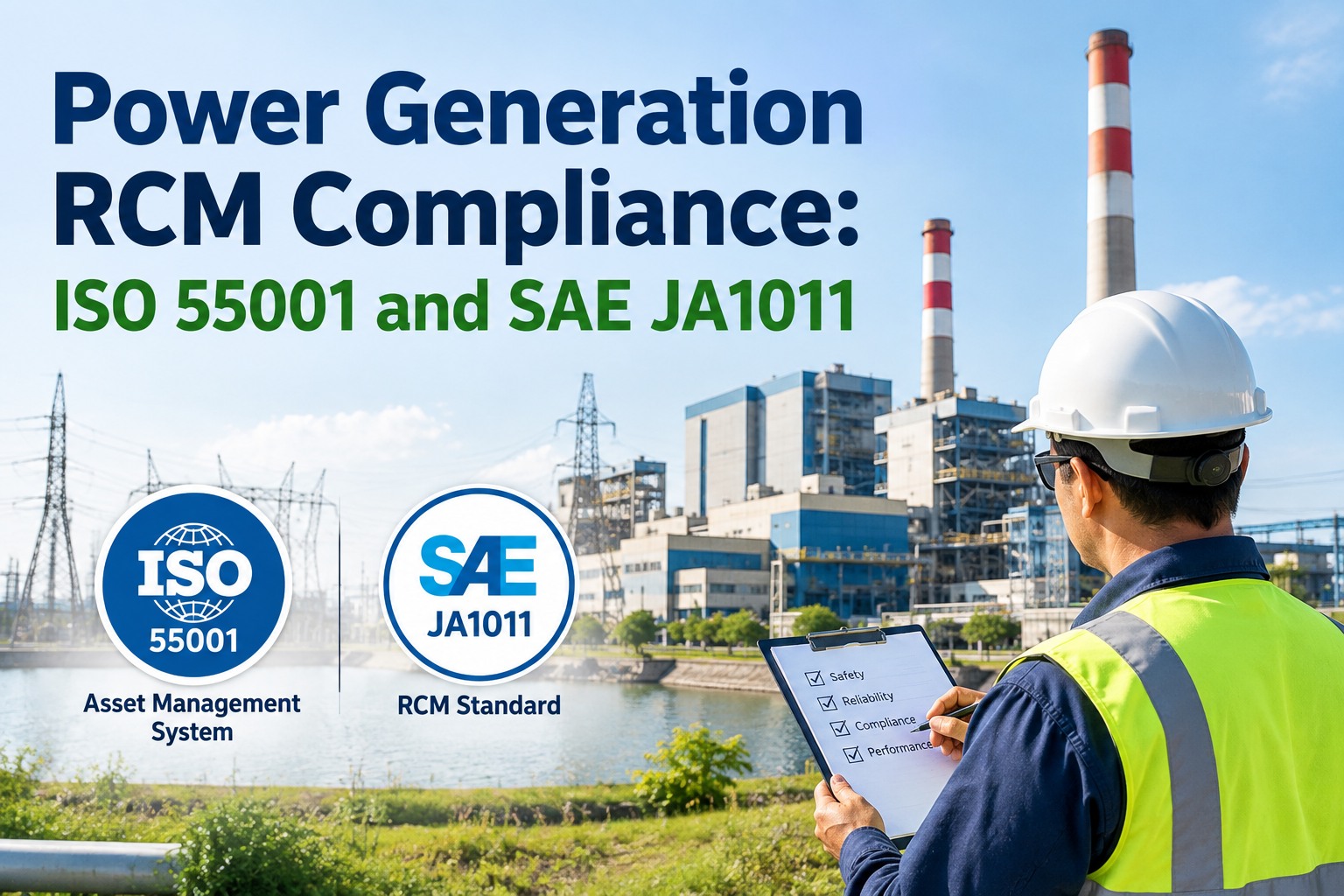
ISO 55000 power plant asset management compliance transforms how generation facilities plan, execute, and prove the value of maintenance across every asset lifecycle stage. For power plants pursuing ISO 55000 compliance, the standard demands a documented asset management system — not just a maintenance checklist — covering policy alignment, risk-based planning, and measurable performance outcomes. A CMMS built for ISO 55000 support bridges the gap between board-level asset strategy and floor-level execution by capturing work order history, preventive schedules, failure data, and cost analytics in one auditable platform. Whether your plant targets ISO 55000 generation certification or internal alignment with the 2026 update, the right software makes evidence-gathering continuous instead of a year-end scramble. Start your Start Free Trial today to see how OxMaint maps every work order to your asset management policy.
ISO 55000 Power Plant Compliance Guide
Can your CMMS prove ISO 55000 compliance — or just log work orders?
ISO 55000 doesn't reward plants that fix things fast. It rewards plants that can prove assets are managed against a documented policy, with risk-based plans, lifecycle costing, and continuous improvement evidence on demand. If your CMMS can't produce that audit trail in minutes, your next certification attempt is at risk.
ISO 55000 Compliance Requirements
What ISO 55000 actually demands from a power plant asset management system
ISO 55000 defines an asset management system as a set of interrelated elements that align policy, objectives, and processes. For a power plant, that means your CMMS must connect each turbine, boiler, transformer, and auxiliary system to a documented strategy — not just a PM schedule. Below are the six requirement areas auditors examine most closely, and what evidence each one expects from your maintenance software.
Asset Management Policy Alignment
Every work order, PM trigger, and inspection route must trace back to a stated organizational objective — availability targets, emissions limits, or cost-per-MWh. Auditors look for a documented link between the asset register and the SAMP (Strategic Asset Management Plan).
Risk-Based Maintenance Planning
ISO 55000 requires criticality-ranked assets and failure-mode-driven task selection. Your CMMS should store FMEA or RBI results and auto-generate PMs from them — not rely on tribal knowledge or vendor-recommended intervals alone.
Lifecycle Cost & Performance Evidence
The standard expects whole-life cost tracking — capital, maintenance, downtime, and disposal — per asset. A compliant CMMS aggregates labor, parts, and outage costs against each asset record for trend analysis.
Competence & Training Records
Technicians must be certified for the assets they work on. The CMMS should enforce skill-level assignment rules, block work order completion by unqualified staff, and maintain a training-matrix audit trail.
Continual Improvement (CAPA)
Auditors expect closed-loop corrective and preventive action records linked to failures, near-misses, and NCRs. The CMMS must show that root-cause findings changed PMs, training, or spare strategies.
Documented Information & Audit Readiness
Procedures, policies, asset registers, risk registers, and performance reports must be version-controlled and instantly retrievable. A CMMS with role-based access and exportable audit packs turns a 3-week scramble into a 30-minute export.
Implementation Roadmap
How to align a power plant CMMS with ISO 55000 — a 6-phase timeline
Most 200–500 MW plants close ISO 55000 gaps in 9–14 months when they follow a structured roadmap. Each phase below maps a standard requirement to a concrete CMMS configuration step, so maintenance and reliability teams know exactly what to build — and what evidence to collect — before the auditor arrives.
Audit current asset register, PM coverage, and documentation gaps
Import every asset into the CMMS, classify by criticality, and identify which assets lack a documented failure strategy. Typical finding: 30–40% of assets have no risk-ranked PM behind them.
Map each asset class to organizational objectives in the CMMS
Configure custom fields linking assets to availability, emissions, and cost targets. Every PM and work order inherits these tags so reports roll up automatically to the Strategic Asset Management Plan.
Load FMEA / RBI results and regenerate PMs from failure modes
Replace calendar-based PMs with condition- and usage-based triggers where data supports it. Plants typically cut PM volume 15–25% while increasing coverage of high-criticality assets.
Enable cost capture on every work order — labor, parts, downtime
Configure the CMMS to auto-calculate asset total cost of ownership. This produces the whole-life cost evidence ISO 55000 auditors expect and surfaces replace-vs-repair decision points.
Close the loop between failures, root cause, and PM changes
Build workflows that require a root-cause code and corrective action before a failure work order closes. This creates the closed-loop evidence trail that distinguishes a compliant system from a reactive one.
Generate evidence packs and run an internal audit simulation
Configure saved reports for policy alignment, risk coverage, training compliance, and performance KPIs. A policy-aligned CMMS produces a complete audit pack in under an hour — not a three-week scramble.
Cost of Non-Compliance
The real cost of a failed ISO 55000 certification attempt
A mid-sized 180-asset power plant spending $42K/year on maintenance management can lose far more than the certification fee when an audit fails. Between re-audit costs, unplanned downtime from under-maintained assets, and insurance premium increases, the financial impact compounds quickly. Here's what the numbers look like when compliance gaps go unaddressed.
A 180-asset gas-fired plant spending $42K/yr on maintenance management
Without a CMMS aligned to ISO 55000, this plant faced 14 hours of unplanned downtime per quarter, spent 6 weeks preparing for each internal audit, and held 23% of its PMs in spreadsheets disconnected from the asset register. After implementing OxMaint with policy-tagged work orders and automated CAPA workflows, audit prep dropped to 2 days, unplanned downtime fell 35%, and the plant passed its ISO 55000 stage-2 audit on the first attempt — with an evidence pack generated in 45 minutes.
How OxMaint Helps
How OxMaint maps to ISO 55000 power plant asset management
OxMaint is built around the same lifecycle logic ISO 55000 demands — policy-linked assets, risk-based planning, cost traceability, and closed-loop improvement. Each capability below maps to a specific clause in the standard and produces the auditable evidence your certification body expects.
Policy-Aligned Asset Register
Tag every asset with organizational objectives, criticality tier, and risk profile. Work orders and PMs inherit these tags so reports roll up directly to your SAMP — the evidence ISO 55000 clause 6.2 requires.
Risk-Based PM & Predictive Triggers
Load FMEA and RBI results directly into OxMaint, then auto-generate PMs from failure modes. Vibration, temperature, and oil-analysis thresholds trigger work orders before failures escalate — satisfying clause 8.1 operational planning.
Lifecycle Cost Tracking
Every work order captures labor hours, parts cost, and downtime minutes against the asset record. OxMaint aggregates these into a total-cost-of-ownership dashboard that supports replace-vs-repair decisions — the whole-life costing evidence clause 6.1 demands.
Closed-Loop CAPA Workflows
No failure work order closes without a root-cause code and corrective action. OxMaint tracks each CAPA through implementation, links it back to the updated PM, and produces the continual-improvement evidence trail clause 10.1 auditors expect.
Compliance Comparison
Spreadsheet maintenance vs. OxMaint CMMS for ISO 55000 compliance
Most power plants start with spreadsheets and paper logs. The table below shows what changes — clause by clause — when maintenance moves to a CMMS engineered for ISO 55000 alignment. The gap between "we think we're compliant" and "we can prove it" is where audits fail.
| ISO 55000 Requirement | Spreadsheets & Paper | OxMaint CMMS |
|---|---|---|
| Policy alignment (6.2) | Manual tagging; breaks when staff leave | Auto-inherited policy tags on every asset & work order |
| Risk-based planning (8.1) | FMEA stored in separate Excel files; PMs don't reference it | FMEA loaded in-system; PMs auto-generated from failure modes |
| Lifecycle costing (6.1) | Costs spread across multiple sheets; no per-asset TCO | Real-time TCO dashboard per asset, class, and plant |
| Competence records (7.2) | Training matrix in HR; no link to work assignment | Skill-level enforcement blocks unqualified work order completion |
| Continual improvement (10.1) | CAPA tracked in email threads; no link to PM changes | Closed-loop CAPA requires root cause before work order closes |
| Audit readiness (7.5) | 42+ engineering hours per audit cycle | One-click evidence pack export in under 45 minutes |
See OxMaint on your assets — book a 30-min demo
Walk through a live ISO 55000 evidence pack, policy-aligned asset register, and closed-loop CAPA workflow on a power plant dataset. Discover how OxMaint maps every work order to your asset management policy.
ISO 55000 Frequently Asked Questions
Power plant ISO 55000 compliance — your questions answered
What is ISO 55000 and why does it matter for power plants?
ISO 55000 is the international standard for asset management systems. For power plants, it provides a framework to align maintenance decisions with business objectives — reliability, cost, safety, and emissions — and prove that alignment to regulators, insurers, and boards. Plants that certify typically see 15–25% OEE improvements and lower insurance premiums because risk is documented and managed, not assumed.
Does a CMMS guarantee ISO 55000 compliance?
No software guarantees certification on its own — ISO 55000 is a management system, not a tool. However, a CMMS like OxMaint that supports policy alignment, risk-based planning, lifecycle costing, and closed-loop CAPA provides the documented evidence auditors require. Without one, most plants spend 40+ hours per audit pulling records from disconnected spreadsheets. You can Start Free Trial to test OxMaint's audit-pack export on your own asset data.
How long does it take a power plant to achieve ISO 55000 certification?
A typical 200–500 MW plant with an existing CMMS takes 9–14 months to close gaps and pass a stage-2 audit. Plants starting from spreadsheets should budget 12–18 months. The timeline compresses significantly when the CMMS is pre-configured with ISO 55000 fields, CAPA workflows, and evidence-pack reporting from day one.
What changes in the ISO 55000 2026 update?
The 2026 revision emphasizes data-driven decision-making, climate-related risk integration, and stronger links between asset management and ESG reporting. Power plants will need to show that emissions targets, physical climate risks, and energy-transition assets are reflected in their asset management plans — all of which require CMMS fields and reports that capture non-financial performance alongside traditional maintenance KPIs.
How much does ISO 55000 compliance cost a power plant?
Certification body fees range from $40K–$120K depending on plant size and scope, but the larger cost is internal — typically 1,200–2,000 engineering hours for gap assessment, documentation, and system configuration. A CMMS that comes pre-mapped to ISO 55000 clauses can cut that internal effort by 40–60%, making the total investment closer to $75K–$150K instead of $150K–$300K.
Turn your CMMS into an ISO 55000 evidence engine
Join the power plants that cut audit prep from weeks to hours, passed certification on the first attempt, and made every work order traceable to policy. Start your free trial or book a personalized demo on your asset data.
Free 14-day trial · No credit card