Multi-unit power plant operations run on a planning paradox: every unit has its own outage window, its own PM schedule, and its own crew requirements — but all of them share the same technicians, the same storeroom, and the same grid dispatch commitments. When planning boards exist only on whiteboards or disconnected spreadsheets, conflicts stay invisible until a forced outage makes them expensive. A digital maintenance planning board collapses all units onto a single calendar view, flags crew and parts conflicts weeks in advance, and lets planners drag and sequence work without hunting through multiple systems. The result is fewer schedule collisions, shorter outages, and a planning process that survives shift changes without losing context. To see how OxMaint's preventive maintenance scheduling module runs multi-unit planning boards for power plants, start a free trial or book a 30-minute planning walkthrough with a power specialist.
Preventive Maintenance Scheduling · Planning & Scheduling · Power Plant CMMS
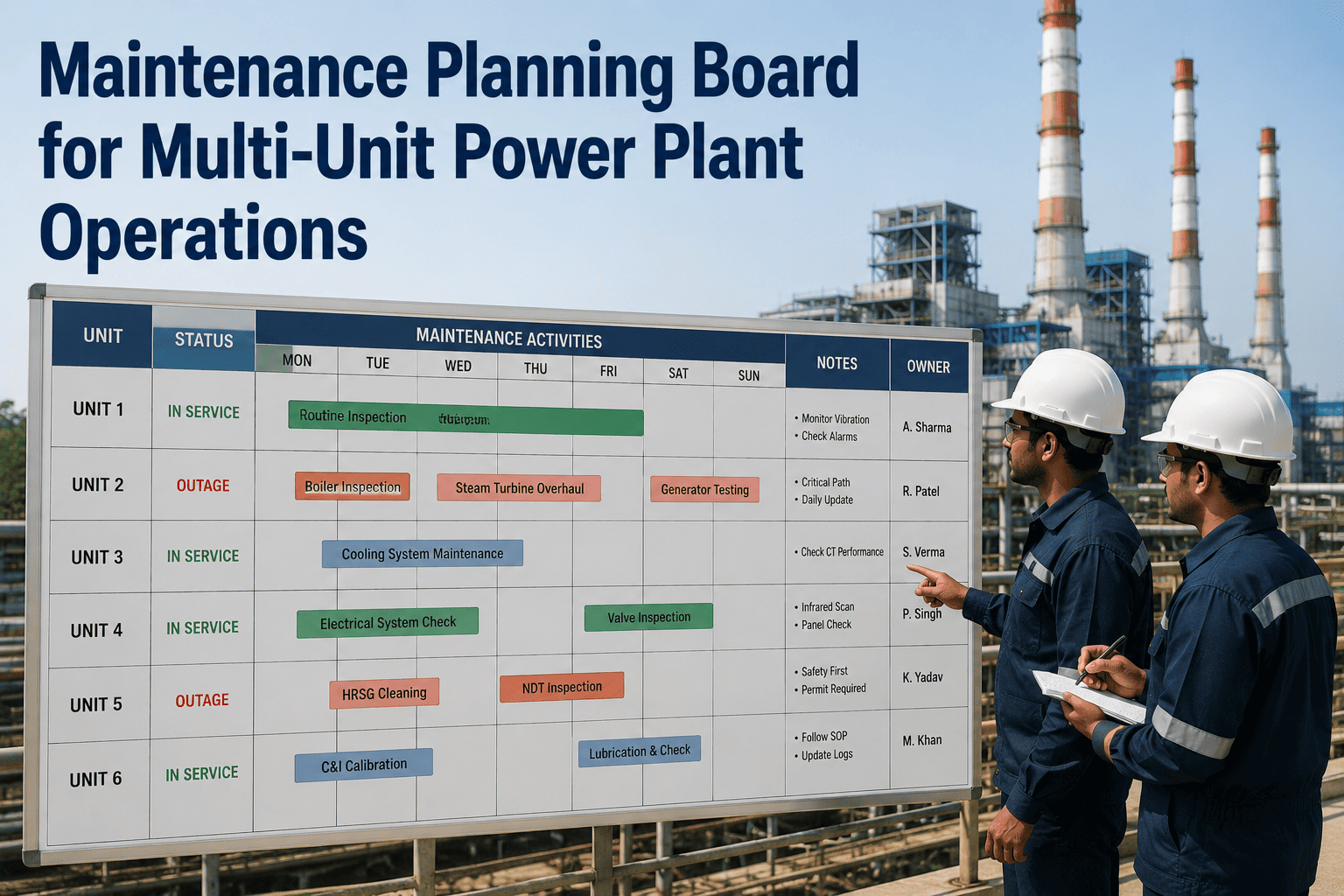
Maintenance Planning Board for Multi-Unit Power Plant Operations
One digital board. Every unit. Every crew. Every PM window — visible, conflict-free, and always current. Stop planning on whiteboards that don't survive a shift change.
25–35%
Reduction in major overhaul duration with digital critical path planning
4.8×
Cost difference: planned repair vs emergency breakdown
80%+
Planned work order ratio at best-in-class power plants
30–60 days
Multi-site fleet rollout timeline on OxMaint
The Hidden Cost of Disconnected Planning Boards
In a multi-unit plant, a scheduling error doesn't stay in one unit. It ripples across crews, storerooms, and grid commitments simultaneously.
Common Multi-Unit Planning Failures
Crew Double-Booking
Unit 2 and Unit 3 PM windows overlap — same three turbine technicians assigned to both. Nobody catches it until Day 1 of the outage.
Cost: 1–2 day outage extension
Parts Not Pre-Staged
Replacement bearings allocated for Unit 1 combustion inspection. Unit 3's coinciding overhaul draws from the same storeroom lot — no alert fired.
Cost: Emergency procurement premium
PM Schedule Drift
A PM pushed by two weeks in one unit propagates into the next quarter schedule without recalculation. Three months later, two critical inspections land in the same week.
Cost: Reactive work and compliance gap
Grid Commitment Clash
ISO/RTO dispatch requirement conflicts with planned outage window on Unit 1. No planner had visibility into the generation commitment calendar when scheduling the outage.
Cost: Capacity market penalty
What a Digital Multi-Unit Planning Board Looks Like
OxMaint's planning board gives schedulers a live Gantt view across all units — with crew loading, parts availability, and compliance windows layered on the same timeline.
GT-1
Combustion Insp.
PM Rounds
GT-2
PM Rounds
Hot Gas Path Overhaul
BOP
Cooling Tower
Relay Testing
Transformer Oil
Five Planning Board Capabilities That Multi-Unit Plants Can't Run Without
These are the features that separate a real multi-unit planning tool from a repurposed calendar or a project management add-on.
01
EOH-Aware PM Scheduling
PM intervals for turbines and generators aren't calendar-based — they're driven by Equivalent Operating Hours. OxMaint tracks EOH counters per asset and recalculates PM due dates automatically when cycling intensity or cold starts change the consumption rate. No more manual interval adjustments when dispatch profiles shift.
02
Cross-Unit Crew Conflict Detection
When a planner assigns the same certified welder to overlapping outage windows on two different units, the system flags the conflict before the schedule is published. Skill-based matching ensures the right craft type is available for each work package — not just any available headcount.
03
Condition-Based Scope Triggers
When vibration trending or oil analysis flags a degradation on a specific asset, OxMaint proposes adding the corrective work to the next scheduled outage window for that unit — so scope additions are absorbed into planned downtime rather than forcing an unscheduled trip.
04
Parts Pre-Staging Across All Units
The planning board checks storeroom inventory against every work package on the calendar — not just the next outage. When two units share a critical spare and both need it within the same quarter, the system flags the conflict and triggers procurement weeks before the shortfall matters.
05
NERC PRC-005 Compliance Calendar
Protection relay testing intervals under NERC PRC-005 range from 3 months to 12 years per component. OxMaint pre-loads your maintenance basis and auto-generates relay testing work orders at the correct interval across all units — with every result retained as audit evidence for the required six-year retention period.
One Planning Board. Every Unit. Zero Schedule Conflicts.
OxMaint's multi-unit planning board deploys in 1–3 days per site. Your first conflict-free outage window is weeks away, not a 12-month implementation project.
The Planning Maturity Ladder for Multi-Unit Plants
Where does your plant's planning process sit right now? Each rung has a specific operational consequence and a specific CMMS capability that unlocks the next level.
Level 4
Predictive Planning
Condition-based scope triggers feed automatically into the outage plan. AI alerts propose intervention timing. Planning horizon extends 12+ months on live sensor data.
Enabled by: IoT integration + OxMaint predictive alerts
Level 3
Integrated Scheduling
All units on a single digital board. EOH-driven intervals. Cross-unit crew and parts conflict detection active. PM compliance tracked live.
Enabled by: OxMaint multi-unit planning board
Level 2
Digital But Siloed
CMMS is live but units plan independently. Crew and parts conflicts surface at execution, not planning. PM intervals are calendar-based, not EOH-aware.
Gap: No cross-unit visibility
Level 1
Whiteboard Planning
Outage windows set on whiteboards and emailed spreadsheets. Planning knowledge lives in supervisors' heads. Context lost on every shift change.
Gap: No persistent planning record
Frequently Asked Questions
How does OxMaint handle EOH-based PM intervals across multiple turbine units?
OxMaint tracks Equivalent Operating Hours per asset and recalculates PM due dates automatically when cycling intensity or cold starts change the consumption rate. When an asset's EOH counter reaches the OEM-specified inspection threshold, a work order is generated and placed on the planning board automatically — no manual interval adjustment needed when dispatch profiles shift.
Start a free trial to see EOH scheduling live.
Can OxMaint planning boards coordinate with ISO/RTO dispatch commitments?
Yes. OxMaint's outage windows can be flagged against grid dispatch obligation periods so planners can identify calendar conflicts before they become generation shortfall events. The system also integrates with existing ERP and scheduling tools — outage data can be exported to or imported from Primavera P6 or MS Project without re-entering data.
Book a demo to walk through the integration options.
What is the realistic benefit of moving from whiteboard planning to a digital multi-unit board?
Plants that adopt structured digital planning boards report 25–35% reductions in major overhaul duration, primarily from eliminating the three most common causes of outage overrun: parts not staged for critical path tasks, crew conflicts discovered at execution rather than planning, and scope additions that weren't assessed against the critical path before approval. The financial impact is direct — a 500 MW plant loses approximately $850K per day in every unplanned outage extension.
How does OxMaint manage NERC PRC-005 relay testing schedules across multiple units?
OxMaint pre-loads your PRC-005 maintenance basis and auto-generates relay testing work orders at the correct interval for each component across all units. Every result is retained as timestamped audit evidence for the required six-year retention period. One-click audit export packages sorted by NERC standard and asset turn a week-long audit preparation into a minutes-long report pull.
How quickly can OxMaint's planning board be operational for a multi-unit plant?
Most single-site deployments are fully live within one to three days — asset hierarchy loaded, PM schedules configured, mobile work orders active. Multi-site fleet rollouts typically complete in 30–60 days per site on a rolling schedule.
Start a free trial and have your first unit's PM calendar configured before the end of the week.
Replace Your Whiteboard With a Planning Board That Runs Your Whole Plant
Multi-unit coordination, EOH-aware PM intervals, cross-unit crew conflict detection, parts pre-staging, and NERC compliance calendars — all in one platform that deploys in days. OxMaint is the preventive maintenance scheduling engine built for power plant operations at every scale.