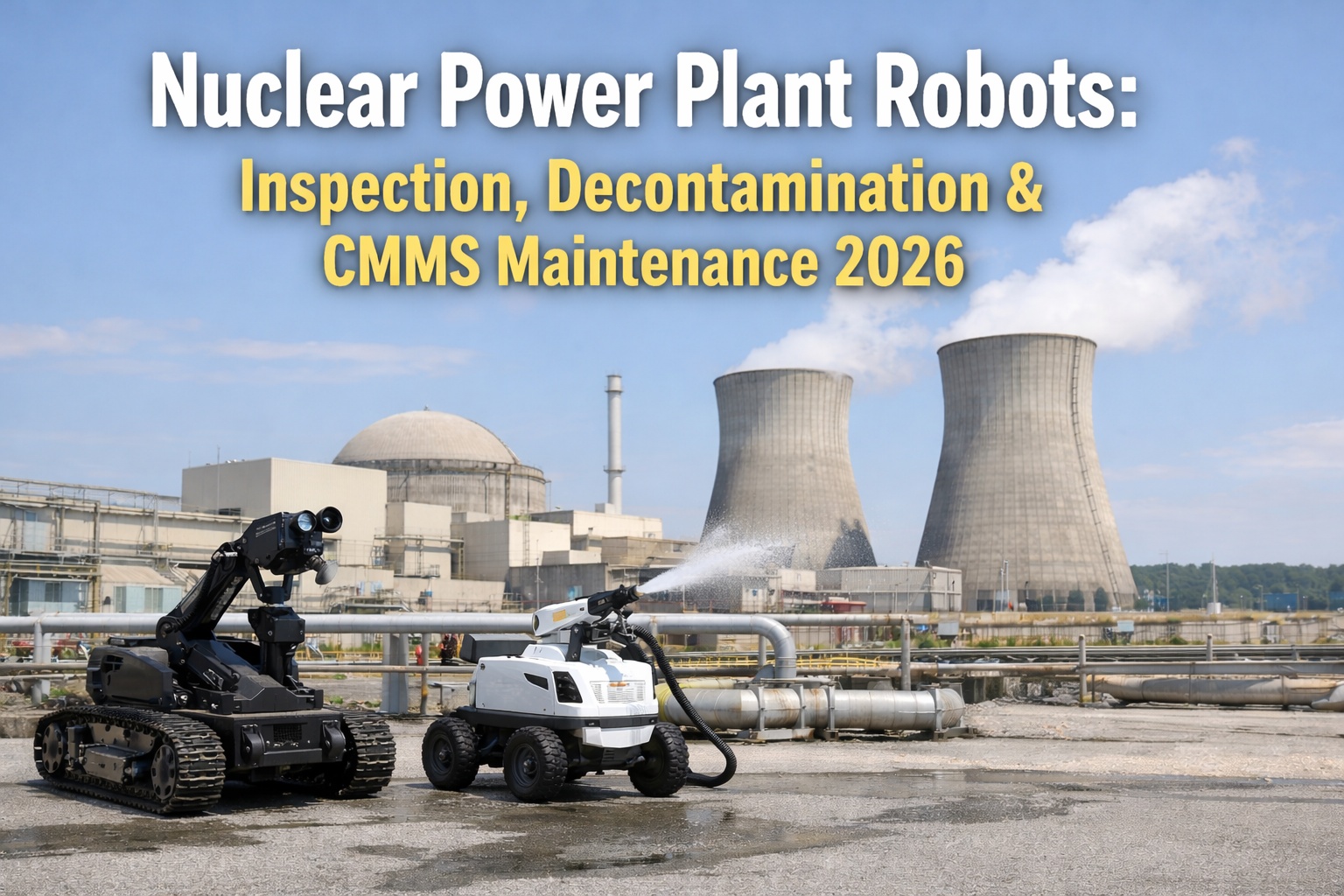
Nuclear power plants contain some of the most hazardous maintenance environments in any industry. Reactor containment zones expose workers to ionizing radiation measured in millisieverts per hour. Spent fuel pools demand underwater inspections in highly radioactive water. Steam generator tube bundles are so confined and irradiated that human entry requires months of dose planning, and even then workers are limited to minutes of exposure. For decades, these realities have constrained inspection frequency, driven up labor costs, and placed human workers in harm's way. Robotic inspection systems are rewriting this equation entirely — deploying autonomous and teleoperated machines into zones where humans cannot safely go, capturing data that manual inspections could never collect, and doing so continuously rather than in brief, dangerous windows. A modern CMMS platform like Oxmaint plays a central role in coordinating these robotic maintenance workflows — receiving inspection findings, generating prioritised work orders with thermal images and radiation maps, and closing the loop between robotic detection and maintenance execution in minutes rather than days.
Why Robotics for Nuclear Hazardous Zones?
Nuclear facilities face a unique intersection of challenges that make robotic maintenance not optional but essential. Radiation fields degrade human health, aging infrastructure demands more frequent inspections, regulatory requirements grow stricter each year, and unplanned shutdowns cost over a million dollars per day. Here is why leading nuclear operators are standardising on robotic inspection systems:
Radiation Dose Elimination
Robots absorb radiation that would otherwise be absorbed by human workers. Every robotic inspection is a dose that a human did not receive. With NRC limiting annual exposure to 50 mSv and plants targeting ALARA (As Low As Reasonably Achievable), robots are the primary tool for keeping cumulative workforce dose well below regulatory limits.
Continuous Monitoring Capability
Human inspectors are limited to brief entry windows. Robots can patrol continuously, capturing data over hours or days rather than minutes. This transforms inspection from periodic snapshots into continuous condition monitoring, detecting degradation trends that brief human visits would entirely miss.
CMMS Integration
When a robot detects a corroded pipe, a cracked weld, or abnormal radiation readings, the finding flows directly into Oxmaint as a prioritised work order with location coordinates, sensor data, severity classification, and recommended corrective action — closing the loop in minutes.
Modular Multi-Robot Fleets
Modern nuclear facilities deploy fleets of specialised robots — quadrupeds for walkdowns, underwater crawlers for fuel pools, aerial drones for containment surveys, and pipe crawlers for steam generator tubes. A distributed architecture enables all platforms to share data and coordinate through a common scheduling system.
Regulatory Compliance
NRC inspections demand complete, timestamped documentation of every safety check. Robotic systems automatically log inspection data with GPS coordinates, radiation readings, and visual evidence into a centralised CMMS audit trail — eliminating gaps in compliance records and reducing preparation time for regulatory reviews.
Outage Optimisation
Refueling outages averaged 107 days in 1990; today they average 35 days. Robotic pre-outage inspections identify scope accurately before the outage begins, robotic in-outage inspections work 24/7 without dose limits, and post-outage verification is completed faster. Every day saved avoids over $1M in lost generation revenue.
Hazardous Zone Applications: Where Robots Replace Risk
Each area of a nuclear plant presents unique radiation, temperature, access, and contamination challenges that determine the robot platform, sensor payload, and inspection strategy. Schedule a demo to see how Oxmaint manages robotic inspection workflows across every zone:
Reactor Containment
Hazards: Ionizing radiation fields up to several Sv/hr near the reactor vessel, elevated temperatures, confined access through airlock systems, potential for airborne contamination during maintenance activities.
Robot platform: Radiation-hardened quadruped robots that walk rather than roll, minimising floor contact and contamination spread. Tested to withstand substantial cumulative radiation doses without adverse effects on electronics or mobility.
Inspection targets: Reactor pressure vessel external surfaces, piping weld integrity, containment liner condition, concrete degradation assessment, valve and pump status verification, radiation mapping for dose planning.
CMMS workflow: Robot captures thermal, visual, and radiation data at predefined waypoints. Anomalies auto-generate Oxmaint work orders with severity classification, coordinates, and attached sensor imagery for maintenance planner review.
Spent Fuel Pool
Hazards: Highly radioactive fuel assemblies submerged under 12+ metres of shielding water, limited visibility, potential for fuel cladding damage releasing fission products, confined underwater navigation between storage racks.
Robot platform: Submersible remotely operated vehicles (ROVs) engineered for radioactive underwater environments. Equipped with radiation-tolerant cameras, ultrasonic sensors, and manipulator arms for close-range fuel assembly and rack inspection.
Inspection targets: Fuel assembly physical condition, storage rack structural integrity, pool liner leak detection, water clarity and chemistry monitoring points, underwater piping condition, silt accumulation mapping.
CMMS workflow: Underwater inspection findings are uploaded post-mission. Oxmaint links each finding to the specific fuel assembly or rack position in the asset hierarchy, triggering corrective maintenance or regulatory notifications as required.
Steam Generator Tubes
Hazards: Thousands of narrow tubes (typically 19-22mm inner diameter) per steam generator, elevated radiation from primary coolant deposits, extreme confinement preventing any human access, tube degradation from pitting, stress corrosion cracking, and fretting wear.
Robot platform: Miniature eddy current testing probes and crawling inspection robots designed to traverse individual tubes. Robotic manipulators position probes at tube sheet openings, while automated systems drive probes through full tube length.
Inspection targets: Tube wall thickness and integrity via eddy current signals, tube support plate intersections, U-bend regions, tube-to-tubesheet welds, foreign object detection, tube plugging verification.
CMMS workflow: Eddy current data is analysed and defect indications classified by severity. Oxmaint receives tube-specific defect records linked to exact tube position (row/column), triggering plug-or-repair decisions tracked through work order completion.
Decommissioning Sites
Hazards: Unpredictable radiation levels in partially dismantled facilities, structural instability, contaminated debris, legacy waste with uncertain characterisation. Some areas of decommissioning sites have not been entered by humans in decades.
Robot platform: Multi-purpose quadrupeds equipped with LiDAR for 3D mapping, radiation detectors for contamination surveys, and manipulator attachments for sample collection. Aerial drones provide overhead structural assessment and coverage of hard-to-reach areas.
Inspection targets: Radiation contamination mapping for decommissioning planning, structural condition assessment of aging buildings, waste characterisation surveys, debris field mapping, decontamination verification.
CMMS workflow: Robotic survey data feeds directly into Oxmaint to generate decommissioning task sequences, track waste removal progress, and maintain the regulatory documentation chain required for site licence surrender.
Every Robotic Inspection Creates a Maintenance Decision. Automate Both.
Oxmaint receives robotic inspection findings and automatically generates prioritised work orders with radiation data, visual evidence, severity classification, and recommended actions — from detection to dispatched repair in under 5 minutes.
Robot Architecture for Nuclear Hazardous Zones
A typical inspection robot deployed in nuclear hazardous zones integrates the following hardware and software layers, all feeding data into a centralised maintenance management system:
Sensor Payload Specifications
ROI: The Business Case for Nuclear Robotic Inspection
Replace Radiation Exposure With Robotic Precision. Start With Oxmaint.
Oxmaint turns robotic inspection findings into prioritised, dispatched, tracked maintenance work orders — closing the loop from detection to verified repair across every hazardous zone in your facility.
Frequently Asked Questions
How do robots withstand nuclear radiation?
Radiation-hardened robots use a combination of strategies: electronics shielding with high-density materials to protect sensitive components, relocation of vulnerable electronics away from direct radiation exposure paths, radiation-tolerant component selection verified through extensive testing, and modular design that allows quick replacement of components showing radiation degradation. Mission durations are planned around cumulative dose budgets for the robot itself, with maintenance intervals tied to radiation exposure hours tracked in the CMMS.
Can nuclear inspection robots operate fully autonomously?
Current best practice in nuclear facilities is supervised autonomy: robots execute pre-programmed inspection routes autonomously, automatically capturing visual, thermal, and radiation data at predefined waypoints, while a qualified operator monitors from the control room with full override capability. Autonomy levels are configurable per zone — higher autonomy for well-mapped, predictable environments, and closer human supervision for first-time inspections or areas near active systems. Full unsupervised autonomy is not yet standard practice in active nuclear facilities due to safety-critical operations and regulatory oversight requirements.
How does Oxmaint process robotic inspection data?
When a robot's anomaly detection algorithms classify a finding (for example, a corroded pipe section with high severity at specific coordinates), the integration bridge packages the finding with supporting data — thermal image, 3D scan, radiation readings, timestamp — and posts it to Oxmaint's API. Oxmaint creates a work order with full finding details, attaches supporting evidence, assigns priority based on severity, routes it to the responsible maintenance planner, and links it to the specific equipment record in the asset hierarchy. Response time from robotic detection to dispatched work order: under 5 minutes. Sign up for Oxmaint to see this workflow in action.
What maintenance do the robots themselves require?
Robots operating in nuclear environments require dedicated maintenance programmes: post-mission decontamination surveys and sensor cleaning, periodic radiation tolerance assessments of electronic components, drive system inspections, battery health monitoring, and communication system verification. Oxmaint manages robot maintenance alongside plant maintenance — each robot has its own asset record, preventive maintenance schedule, and spare parts inventory within the same CMMS platform that receives their inspection findings.
Can we start with one robot and one zone?
Absolutely — and it is the recommended approach. Start with the highest-risk, highest-value zone, typically the area where human dose accumulation is greatest or where inspection frequency is limited by radiation constraints. Deploy one robot in supervised teleoperation mode for initial missions while operators build familiarity. Transition to supervised autonomy on established routes. Measure results: dose savings, defects found earlier, inspection coverage improvement. Most nuclear facilities that begin with one robot expand to multiple platforms across several zones within 12-24 months as the safety and operational benefits become clear.
From Hazardous Zone to Work Order in Under 5 Minutes. That's the Future of Nuclear Maintenance.
Oxmaint bridges the gap between robotic inspection technology and maintenance execution — ensuring every finding becomes a tracked, completed, verified repair with full regulatory documentation.