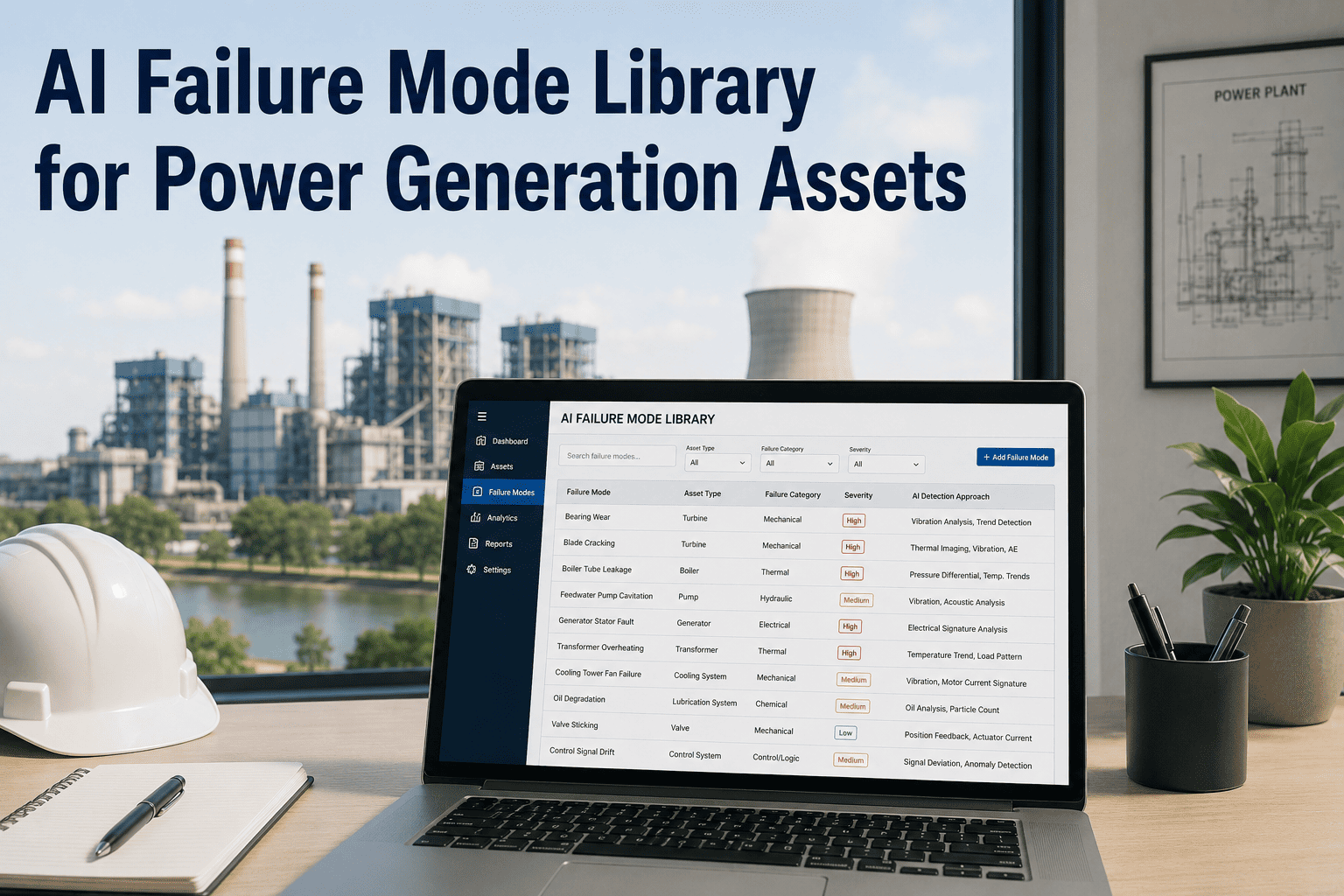
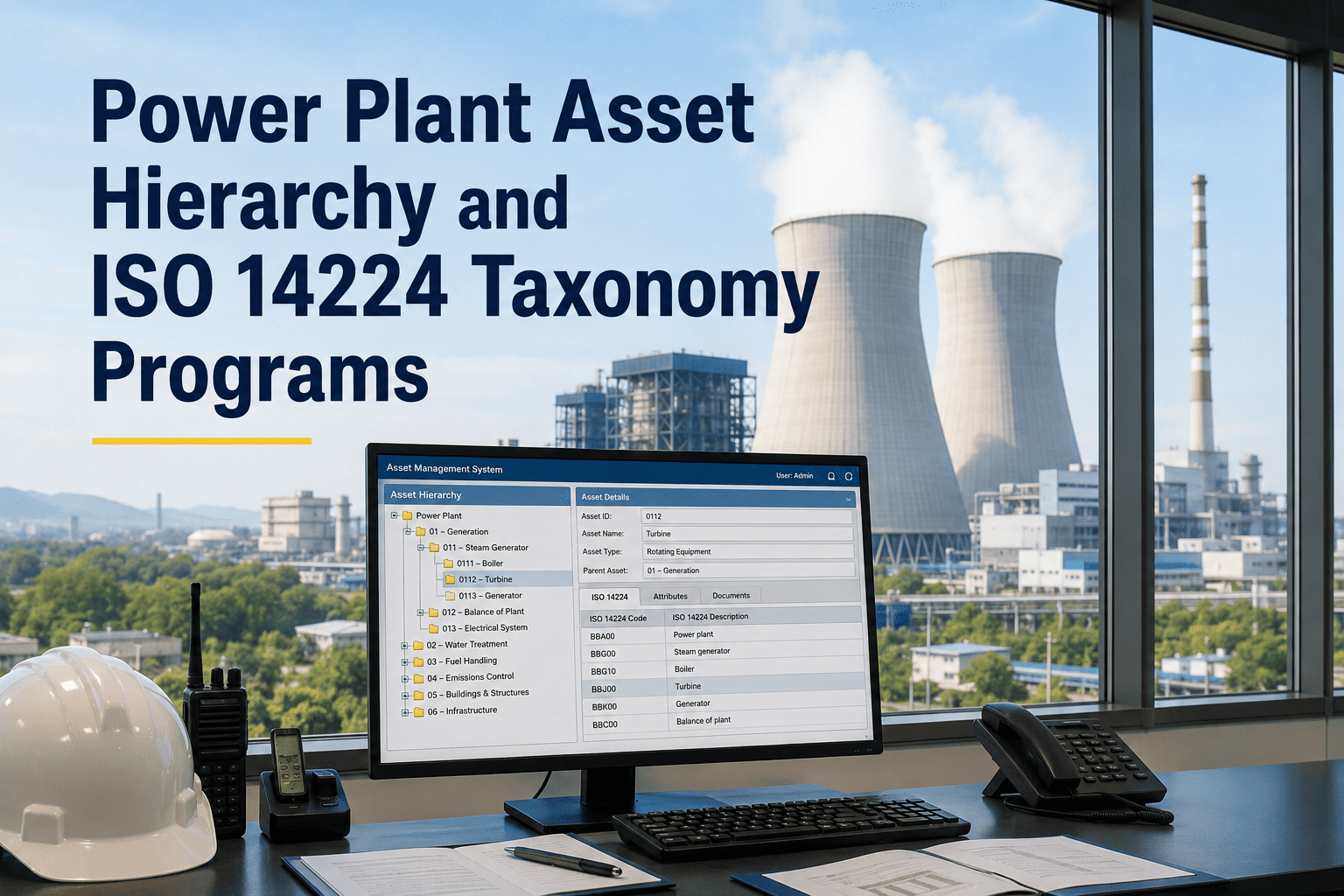
Every turbine, boiler, pump, and valve in your power plant generates maintenance data — but only a correctly structured asset hierarchy turns that data into decisions. Without a deliberate hierarchy, your CMMS becomes a flat list of equipment records that cannot answer the only questions that matter: which assets are most at risk, which failure modes are recurring, and where is maintenance spend going. This guide walks through the exact structure power plants need — from plant level down to individual component tags, failure codes, and criticality tiers — and shows how OxMaint enforces that structure automatically so your team spends time on reliability, not data entry. Explore the OxMaint asset management platform free or book a live hierarchy demo to see a real power plant asset tree built in OxMaint.
Asset Lifecycle Management · CMMS Strategy
Power Plant Asset Hierarchy Design for CMMS
From plant level to individual component tags — build the master data foundation that makes every work order, failure code, and maintenance cost traceable, reportable, and actionable.
6
hierarchy levels from plant to component
40%
faster root-cause analysis with structured tags
ISO 14224
aligned taxonomy for failure codes
Why Asset Hierarchy Is the Foundation of Every CMMS
A CMMS without a proper hierarchy is a digital filing cabinet — useful for storing records, useless for revealing patterns. When assets are organized in a logical parent-child tree, every work order, part consumption, and failure event automatically rolls up to the right unit, system, and plant. You stop searching for data and start reading it.
01
Failure trend analysis becomes automatic
When a pump belongs to a cooling water system which belongs to Unit 2, every pump failure rolls up automatically to system and unit level. Pareto charts build themselves.
02
Cost allocation is accurate, not estimated
Labour and parts charged to an asset flow up to its parent system and unit. The CFO can see maintenance cost by unit, by system, or by asset class — all from the same data source.
03
PM programs attach to the right equipment
Preventive maintenance schedules, inspection checklists, and lubrication routes are inherited from asset class. Add a new pump — it gets the right PM schedule automatically.
04
Regulatory reporting requires no rework
NERC GADS, environmental inspections, and insurance audits need equipment records organized by unit and system. A structured hierarchy makes those exports a button click, not a project.
The Six-Level Power Plant Asset Hierarchy
Every power plant — coal, gas, combined cycle, or renewable — maps onto the same six levels. The names change; the logic does not. Build this structure once in OxMaint and every report, KPI, and work order respects it automatically.
Level 1
Enterprise / Fleet
Example: Acme Power Group
The top of the tree. Multi-site operators use this level to benchmark plants against each other and consolidate capital spend across the portfolio.
Example: Riverside CCGT Plant
Each physical facility. Plant-level KPIs — availability, MTBF, maintenance cost — aggregate from everything below this node.
Example: GT Unit 1, GT Unit 2, Steam Train A
Generating units or process trains. This is the level that maps to generation output — downtime at unit level has a direct MW and revenue impact.
Level 4
System / Functional Area
Example: Fuel Gas System, Lube Oil System, Cooling Water
Functional groupings within a unit. System-level failure history reveals which subsystems are driving unplanned work — the highest-value insight for reliability engineers.
Level 5
Equipment / Asset
Example: GT-101 Gas Turbine, P-201 Lube Oil Pump
Individual maintainable equipment items. Work orders, PMs, parts, and failure codes attach here. This is the primary working level for technicians and planners.
Example: GT-101-BRG-DE (drive-end bearing)
Sub-components worth tracking independently. Use this level only where component-level failure history changes a maintenance decision — not for every bolt and gasket.
Asset Tagging Conventions That Actually Work
Naming conventions feel like an administrative detail until you are six months into operations and three technicians use three different names for the same pump. The standard below is based on ISO 14224 principles adapted for power generation environments.
Format
Unit – Equipment Type – Number – Sub-tag
GT1-P-101-DE
GT1 = Gas Turbine Unit 1, P = Pump, 101 = sequence, DE = drive end
Rule
Equipment type codes must be standardized fleet-wide
P = Pump, C = Compressor, T = Turbine, HX = Heat Exchanger, V = Valve, M = Motor, GT = Gas Turbine
Rule
Tag numbers persist for the life of the asset
When a pump is replaced, the tag stays. The history stays. Only the serial number and nameplate data update. Never retire a tag — close it with an end-of-life status.
Avoid
Common naming mistakes that poison your data
Free-text names like "big pump by boiler" or "old GT" — these cannot be queried, grouped, or reported on. OxMaint enforces pick-list asset classes to prevent free-text drift.
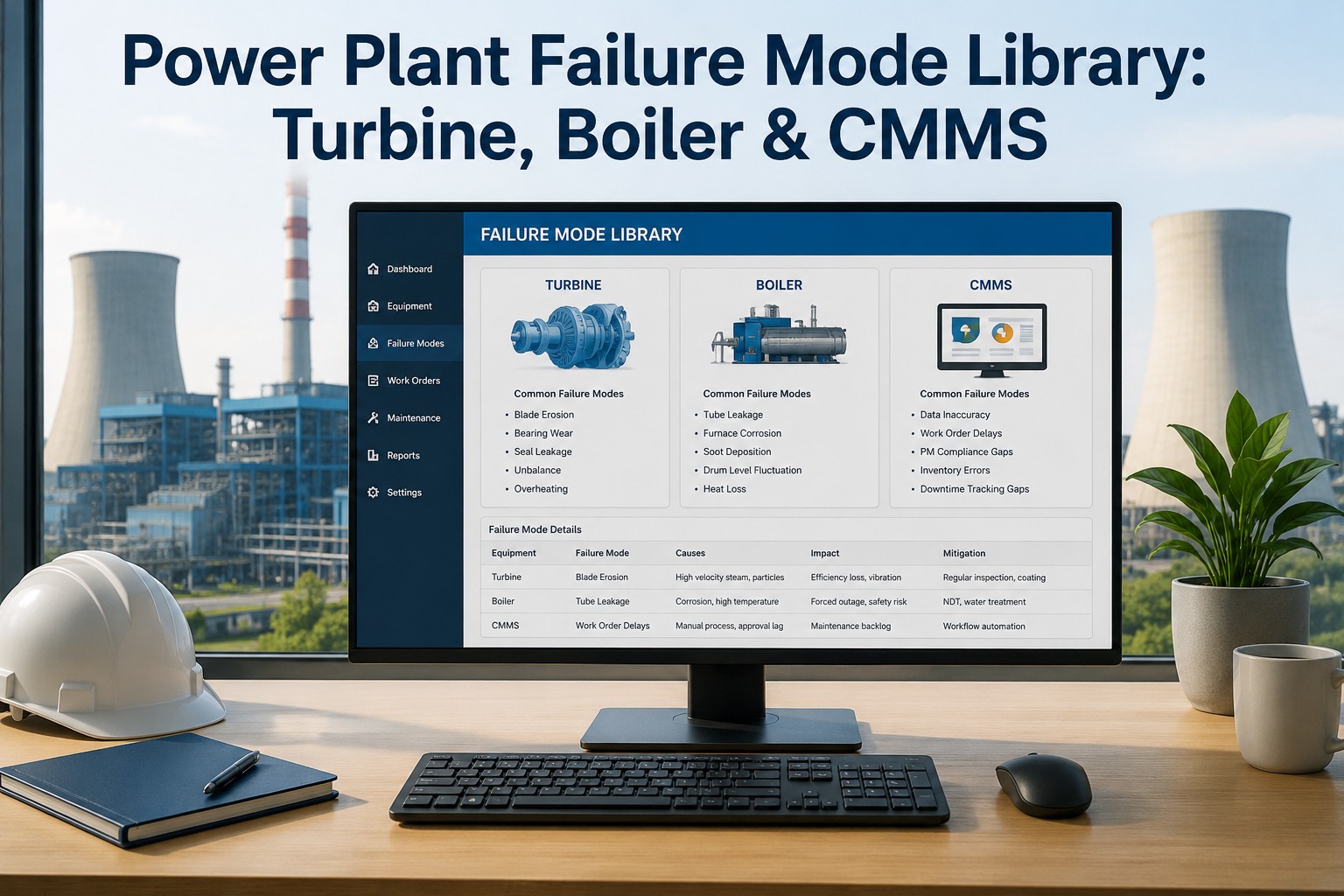
Failure Code Taxonomy for Power Generation
A failure code system with no structure produces pareto charts nobody believes. The ISO 14224 taxonomy below gives you three levels of failure classification that support root-cause analysis and reliability reporting without creating data entry friction for technicians.
| Level |
Code Type |
Examples (Power Generation) |
Used For |
| Failure Mode |
What happened |
Vibration high, Leakage external, Overtemperature, Erosion |
Pareto by symptom — what keeps breaking |
| Failure Cause |
Why it happened |
Bearing wear, Fouling, Seal degradation, Misalignment, Corrosion |
Root-cause analysis — what drives the failure mode |
| Maintenance Activity |
What was done |
Replace, Repair in-situ, Align, Clean, Inspect and return to service |
Labour and parts cost classification |
| Detection Method |
How was it found |
Vibration monitoring, Operator round, PM inspection, Failure in service |
Measures PM and CBM program effectiveness |
Asset Criticality: Not Everything Deserves Equal Attention
Criticality ranking tells your CMMS how to prioritize work orders, how often to run PMs, and which assets justify condition monitoring investment. A five-minute criticality assessment per asset prevents years of misallocated maintenance spend.
Tier A — Critical
Failure causes immediate generation loss or safety event. No standby available.
Gas turbine, main generator, HP steam turbine, main transformer
Highest PM frequency · Condition monitoring required · 24-hr response SLA
Tier B — Essential
Failure degrades output or forces derating. Limited redundancy available.
Lube oil system, cooling water pumps, HRSG feed pumps, fuel gas compressors
Standard PM frequency · Vibration monitoring recommended · 4-hr response SLA
Tier C — General
Failure has limited operational impact. Standby or manual workaround available.
Auxiliary pumps, lighting systems, HVAC, non-critical instrumentation
Reduced PM frequency · Condition monitoring optional · Next-shift response acceptable
Ready to build your asset hierarchy in OxMaint?
OxMaint ships with power generation asset class templates, ISO 14224-aligned failure code libraries, and criticality scoring built in. Your hierarchy goes live in days — not months of data engineering.
Power Plant Equipment Classes and What to Track at Each Level
Gas Turbines
Track at Level 5 (equipment): Equivalent operating hours, start counts, hot section inspections, compressor wash records, combustion inspection status
HRSGs
Track at Level 5+6: Tube thickness readings by section, attemperator performance, waterwall inspection history, thermal fatigue cycle count per header
Steam Turbines
Track at Level 5+6: Blade inspection records by stage, thrust bearing clearance history, HP/IP/LP section separately for outage planning accuracy
Transformers
Track at Level 5: Dissolved gas analysis (DGA) results over time, oil temperature trends, tap changer operation counts, insulation resistance records
Rotating Equipment
Track at Level 5+6: Vibration baselines, bearing temperature trends, seal condition, alignment records — grouped by equipment class for fleet analysis
Valves and Actuators
Track at Level 6 only for safety-critical valves: operation count, seat leakage test results, actuator torque records — standard valves at Level 5 system roll-up only
Frequently Asked Questions
How deep should a power plant asset hierarchy go?
Six levels is the practical maximum for most power plants. Go deeper only where component-level failure history changes a maintenance decision — typically for gas turbine hot gas path components, HRSG tube sections, and steam turbine blade rows.
OxMaint supports unlimited hierarchy depth but recommends stopping at the level where work orders are assigned.
Which standard should we follow for failure codes?
ISO 14224:2016 is the international standard for failure mode and cause classification in oil, gas, and power generation. OxMaint ships with a pre-built ISO 14224-aligned failure code library for rotating equipment, static equipment, electrical, and instrumentation — covering the most common power plant equipment classes without requiring custom data entry from your team.
Book a demo to see the library live.
Can we migrate our existing asset register into OxMaint?
Yes. OxMaint accepts asset imports via structured Excel templates. The migration process maps your existing equipment records to the six-level hierarchy, assigns asset classes, and links failure codes in a single import step. Historical work order data migrates in a second pass.
How does criticality ranking connect to work order priority in OxMaint?
Asset criticality tier in OxMaint automatically sets the default work order priority and response time SLA for that asset. A Tier A failure generates a critical work order with 24-hour closure SLA; a Tier C failure defaults to scheduled priority. This eliminates manual priority assignment and prevents critical assets from being treated as routine.
Your asset hierarchy is the foundation of every reliability improvement your plant will ever make.
OxMaint makes it easy — with power generation templates, ISO-aligned failure codes, and criticality scoring built in. Start building the right foundation today.