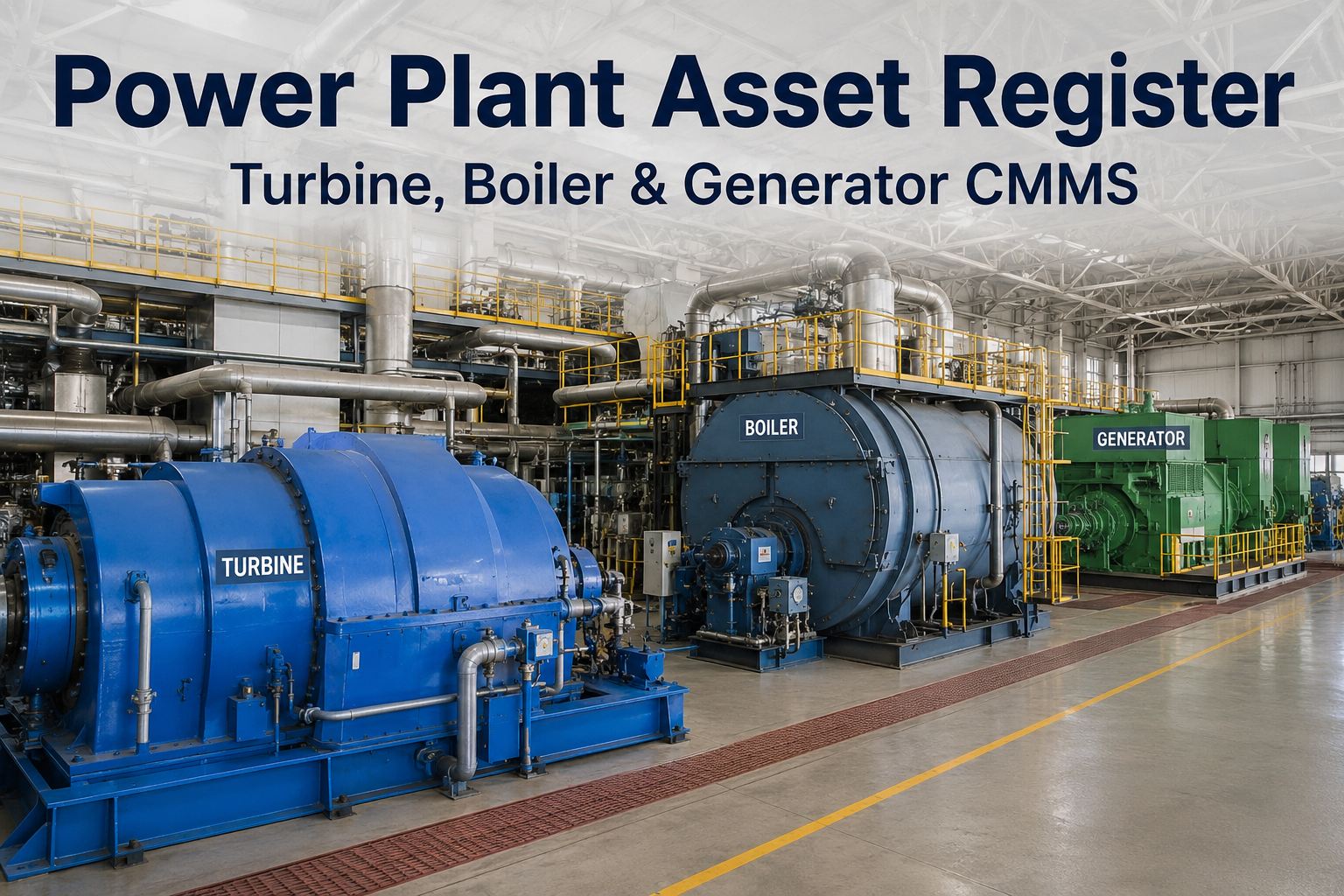
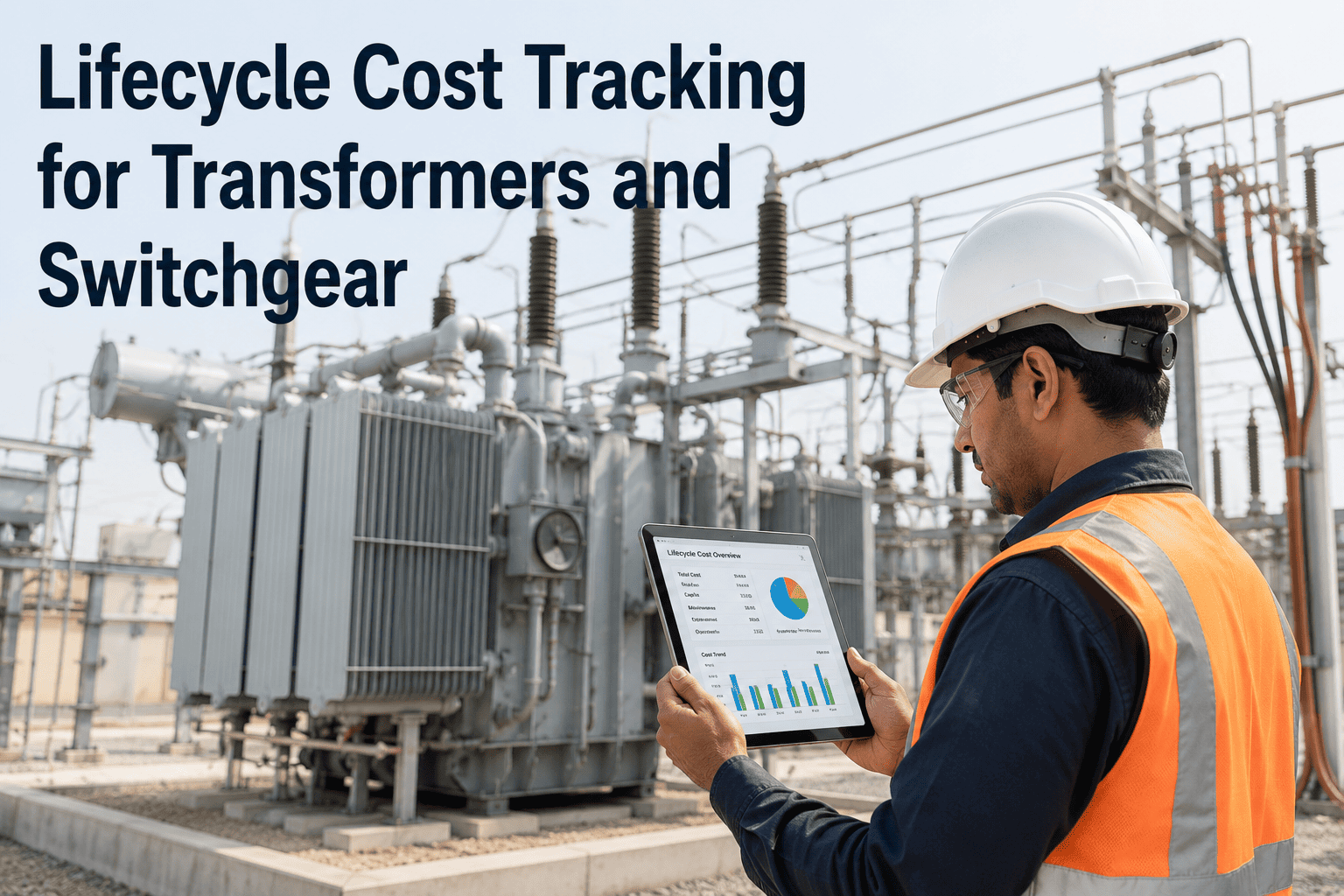
A gas turbine installed in 1998 and a transformer commissioned last year share one thing in common — both are generating lifecycle cost data that most plants are completely ignoring. The average power plant has between 3,000 and 15,000 maintainable assets. Each one has an acquisition cost, a maintenance cost history, a replacement cost forecast, and a remaining useful life estimate. When that data lives in disconnected spreadsheets, aging ERP modules, and technician memory, capital planning becomes guesswork, cost overruns become inevitable, and major assets get replaced either too early or catastrophically too late. Power plant asset management software changes that entirely — giving operators a live, unified view of every asset's health, cost, and lifecycle position so every maintenance and capital decision is grounded in data, not instinct.
Asset Intelligence — 2026 Guide
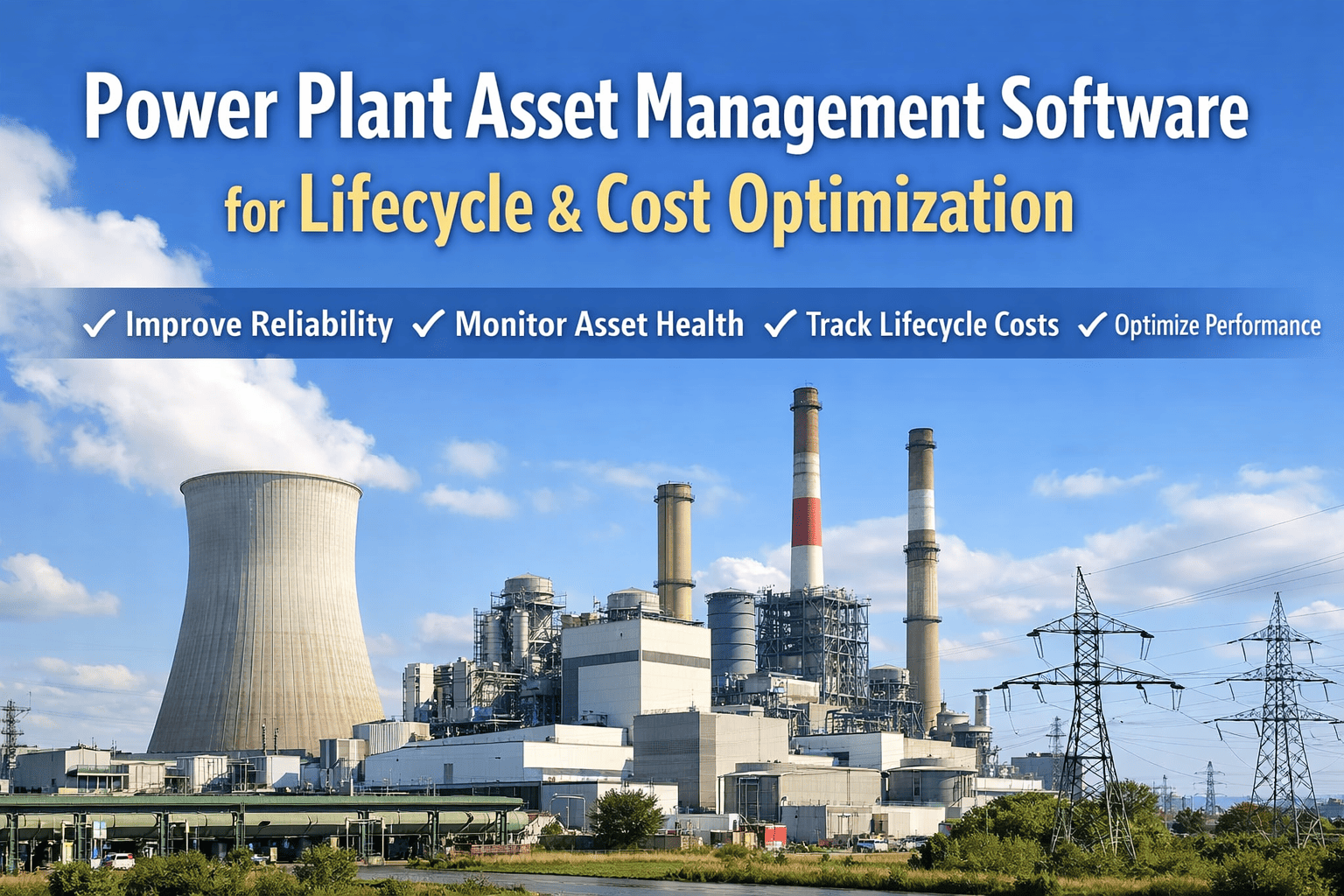
Power Plant Asset Management Software for Lifecycle & Cost Optimization
Track every turbine, boiler, generator, and transformer from commissioning to decommission — with real-time health monitoring, total cost of ownership data, and AI-driven replacement forecasting that turns asset decisions from gut feel into financial precision.
$2.3M
Avg annual savings from optimized asset replacement timing — 500 MW plant
30%
Capital budget waste from premature component replacement
68%
Reduction in asset-related unplanned failures with lifecycle monitoring
+6 yrs
Average life extension when assets are condition-managed vs. calendar-managed
The Asset Lifecycle Problem No One Talks About
Power plant operators obsess over uptime metrics and maintenance costs. But the decisions that have the biggest financial impact — when to overhaul versus replace a major component, whether to extend the life of an aging turbine or invest in a new unit, how to time capital expenditures against revenue cycles — are made with almost no data in most plants. That is the asset lifecycle gap, and it costs the industry billions annually in premature replacements and catastrophic late-stage failures.
4 Asset Categories That Demand Dedicated Lifecycle Tracking
Not every bolt and gasket in a power plant justifies lifecycle management investment. But these four asset categories — representing over 80% of all capital expenditure and forced outage risk — absolutely do. Each has unique degradation patterns, cost drivers, and replacement economics that require purpose-built tracking.
What to Track
Fired hours and starts per hot-section component
Thermal barrier coating degradation rate
Cumulative creep and fatigue cycles on blades and vanes
Compressor efficiency loss curve over operating life
Major overhaul cost history across CI, HGP, and MI intervals
Key Decision Point
Next overhaul ROI vs. new unit economics — requires 5–10 years of cost trend data to evaluate correctly
What to Track
Tube wall thickness measurements over inspection cycles
Pressure cycling fatigue accumulation
Chemical treatment cost and corrosion incident history
Heat transfer efficiency degradation from fouling
Refractory and casing condition over thermal cycles
Key Decision Point
Tube replacement vs. pressure vessel rerating vs. full replacement — each has a different NPV that only lifecycle cost data can correctly inform
What to Track
Stator and rotor winding insulation resistance trend
Hydrogen seal and cooling system condition
Vibration and alignment history over operating hours
Excitation system component replacement cycles
Partial discharge activity from online monitoring
Key Decision Point
Rewind vs. replacement — a $3M–$8M decision that requires complete winding history and degradation rate data to evaluate correctly
What to Track
Dissolved gas analysis (DGA) trend over years
Thermal aging factor and hotspot temperature history
Oil quality and moisture content over time
Load factor history and cumulative aging calculation
Tap changer operation count and wear condition
Key Decision Point
Refurbishment vs. replacement timing — transformers age catastrophically without continuous DGA and thermal monitoring despite 40+ year design lives
How Oxmaint Tracks Total Cost of Ownership Per Asset
Most platforms track what a repair cost in parts and labor — the direct cost. Oxmaint tracks the full economic picture of every asset: acquisition, maintenance history, downtime impact, efficiency loss, and projected replacement cost — giving plant managers and CFOs the data they need to make capital decisions with confidence.
TCO Breakdown — Where Power Plant Asset Costs Actually Go
Unplanned Repairs & Emergency Premiums
31%
Emergency labor at 4.8× rate, expedited parts, cascade damage — the largest reducible cost category
Planned Maintenance (Labor + Parts + Overhauls)
28%
All scheduled PM, inspection cycles, and major overhaul events across the asset's life
Downtime & Generation Revenue Loss
22%
Lost generation revenue, replacement power purchases, and grid penalty charges during forced outages
Acquisition & Commissioning
12%
Purchase price, installation, initial commissioning tests, first-year warranty claims
Efficiency Degradation Losses
7%
Heat rate increases, compressor fouling losses, and thermal efficiency decline over the operating life
What This TCO Data Enables
01
Repair vs. Replace Decisions
When cumulative maintenance cost approaches 60–70% of replacement cost, data-driven timing saves $400K–$900K per major asset on average
02
Capital Budget Accuracy
Asset health and lifecycle position data makes 5-year capital plans accurate to ±8% vs. ±40% with calendar-based assumptions
03
Insurance Premium Reduction
Documented asset condition histories reduce insurance premiums by 12–18% and improve claim outcomes by eliminating documentation gaps
04
OEM Warranty Protection
Complete maintenance records protect OEM warranty claims — gaps in service history cost plants an average $85K per disputed claim
Asset Health Scoring: One Number, Always Current
Oxmaint assigns every tracked asset a continuously updated health score from 0 to 100 — combining condition monitoring data, maintenance history, age-adjusted degradation rates, and operational stress factors. No more hunting through work order histories. One number, always current, always explained.
Health Score Input Weights
Sensor & Condition Data
45%
Maintenance History Quality
25%
Age vs. Design Life Position
20%
Operational Stress & Load Factor
10%
75–100HealthyNormal monitoring cadence
50–74WatchIncrease inspection frequency
25–49CautionPlan intervention within 90 days
0–24CriticalImmediate action required
Automated Score Updates
Health score recalculates every time new sensor data arrives, a work order closes, or an inspection result is recorded — always reflects current state, not last week's data.
Fleet-Wide Health Dashboard
Every asset in the plant sorted by health score on a single view. Worst-performing assets surface immediately — no hunting required across disconnected systems.
Trend Alerts Before Score Drops
When a health score trajectory indicates it will cross a threshold, Oxmaint sends an early warning — giving planners 4–12 additional weeks to prepare the intervention.
Benchmark Against Fleet Average
Each asset's score is benchmarked against its asset class fleet average — identifying underperformers degrading faster than expected for their age and operating profile.
Lifecycle Cost Comparison: Managed vs. Unmanaged Assets
| Asset Category |
Design Life |
Cost — Unmanaged |
Cost — Oxmaint Managed |
Life Extension |
10-Year Savings |
| Gas Turbine (F-class) |
25–30 yrs |
$22M–$38M lifecycle |
$14M–$24M lifecycle |
+4–7 yrs |
$6M–$14M |
| Steam Turbine |
30–40 yrs |
$18M–$28M lifecycle |
$12M–$19M lifecycle |
+5–9 yrs |
$5M–$9M |
| HRSG / Boiler |
25–35 yrs |
$12M–$22M lifecycle |
$8M–$15M lifecycle |
+3–6 yrs |
$3M–$7M |
| Main Power Transformer |
30–40 yrs |
$5M–$14M lifecycle |
$3.5M–$9M lifecycle |
+6–10 yrs |
$2M–$5M |
| Generator (Large Frame) |
25–35 yrs |
$14M–$24M lifecycle |
$9M–$16M lifecycle |
+4–7 yrs |
$4M–$8M |
Lifecycle costs include all planned and unplanned maintenance, overhauls, and capital replacement. Life extension based on condition-based vs. calendar-based replacement timing. Data from industry benchmarks and operator outcomes 2023–2025.
Know exactly where every asset stands — right now
Oxmaint builds a complete lifecycle record for every asset in your plant automatically — from first work order to replacement recommendation. Connect your first assets in days.
Frequently Asked Questions
What is the difference between asset management and maintenance management in a power plant?
Maintenance management focuses on executing and tracking individual repair and inspection activities — work orders, PM schedules, technician assignments. Asset management is a broader discipline that uses that maintenance data as one input into a longer-term view of each asset's health, total cost of ownership, remaining useful life, and replacement economics. Oxmaint integrates both: every work order executed contributes to the asset's lifecycle record, and that lifecycle record drives smarter maintenance decisions in return. The combination is what enables data-driven capital planning — knowing not just that a bearing was replaced last month, but that the turbine it belongs to has now accumulated $4.2M in maintenance costs against a $6M replacement threshold and is trending toward that threshold 18 months faster than expected.
How does Oxmaint calculate remaining useful life for power plant assets?
Remaining useful life estimation in Oxmaint combines four data streams: sensor-based condition degradation rates (vibration trends, temperature profiles, efficiency loss curves), cumulative operational stress factors (fired hours, thermal cycles, load factor history), maintenance quality indicators (PM compliance rate, overhaul quality scores), and asset class benchmarks from comparable equipment. The AI model produces a probabilistic RUL estimate — not a single number but a confidence range that updates continuously as new data arrives. For gas turbine hot-section components, where fired hours and starts per year drive degradation, the model achieves RUL prediction accuracy within ±15% at 12 months out for assets with 6 or more months of operational data.
Can Oxmaint track assets that were commissioned before the platform was deployed?
Yes — and this is critical for plants with aging fleets. Oxmaint supports historical data import from existing CMMS exports, maintenance log spreadsheets, SAP or Maximo extracts, paper record digitization, and DCS historian files. Older assets are not penalized with blank lifecycle histories. The platform builds the most complete record possible from all available sources, then begins real-time accumulation from deployment forward. For assets with sparse historical records, the AI model applies age-adjusted degradation models calibrated to the asset type and known operating profile while real-time data fills the gaps over subsequent months.
How does lifecycle cost tracking improve capital budget planning accuracy?
Oxmaint's capital planning module uses current asset health scores, RUL estimates, and historical cost accumulation rates to project maintenance and replacement expenditures on a rolling 1–10 year horizon. For each asset approaching a major decision point — overhaul, refurbishment, or replacement — the system generates a cost-benefit comparison showing the NPV of continuation vs. replacement under current condition trends. Finance teams receive a structured capital forecast with confidence intervals, replacing the typical approach of engineering judgment submitted annually in a spreadsheet. Plants using this approach report capital budget forecast accuracy improving from ±35–40% to ±8–12%, dramatically reducing mid-year budget revisions and emergency capital requests.
What happens to asset records when a major overhaul resets component health?
Oxmaint handles partial and full asset resets at the component level — not just the asset level. When a gas turbine completes a hot gas path inspection with new blades and vanes, the hot-section components receive a health reset while the compressor section, bearings, and auxiliary systems retain their accumulated history. This granular tracking is essential for correct RUL estimation after major overhauls, which often reset one subsystem while leaving others at their pre-overhaul condition. The platform maintains a complete version history showing the asset's condition both before and after each major overhaul — critical for OEM warranty compliance, insurance documentation, and future replacement economics analysis.
Every Asset in Your Plant Has a Story. Oxmaint Reads It.
From the turbine that has been running since 2001 to the transformer commissioned last spring — every asset is generating lifecycle cost and health data that should be driving your capital decisions. Oxmaint connects, collects, and converts that data into a continuous view of asset health, total cost, and remaining useful life across your entire fleet.