Power Plant CMMS Explained: Features, Benefits & ROI for 2026
By Johnson on March 18, 2026
Most power plants are sitting on a goldmine of operational data and doing almost nothing with it. Sensors measuring exhaust temperatures, vibration signatures, bearing conditions, and fuel flow are generating thousands of data points every minute — yet the maintenance team is still working off a calendar schedule designed in the 1990s. A Power Plant CMMS changes that equation entirely. It transforms scattered data into structured intelligence, reactive firefighting into proactive scheduling, and compliance scrambles into automated documentation. This page explains exactly what a power plant CMMS does, what features matter most, and what measurable ROI facilities are seeing in 2026, Sign Up Free on Oxmaint.
2026 Deep Dive — Power Generation
Power Plant CMMS Explained: Features, Benefits & ROI
From real-time analytics to predictive failure detection — understand what a modern CMMS actually does for thermal, gas, and renewable generation operations, and why the facilities using one outperform those that don't by a measurable margin every single year.
Cost per hour of unplanned downtime (energy sector avg)
65%
Reduction in forced outages with AI-native CMMS
38%
Avg maintenance cost reduction after CMMS deployment
10–20x
First-year ROI for combined-cycle plants on Oxmaint
What Is a Power Plant CMMS — and Why Does It Differ From Generic Software?
A CMMS (Computerized Maintenance Management System) is the operational brain of your maintenance department. A power-generation-specific CMMS goes further — it integrates directly with DCS and SCADA systems, ingests live sensor data, tracks hot-section component life, manages NERC CIP compliance documentation, and coordinates multi-unit outage planning. Generic facilities software handles none of these. The distinction is the difference between a work order tracker and a reliability intelligence platform.
Generic CMMS
Work order creation and tracking
Basic PM scheduling (calendar-based)
Simple asset register
No sensor or DCS integration
No turbine health monitoring
No NERC CIP compliance
No predictive failure AI
No outage planning for multi-unit
VS
Power Plant CMMS (Oxmaint)
Intelligent work orders auto-generated from sensor data
Full asset hierarchy with OEM specs and cost tracking
Live DCS/SCADA integration — OPC-UA, Modbus, PI
Real-time turbine health monitoring and anomaly detection
Auto-captured NERC CIP audit documentation per WO
AI predicts failures 3–18 months before they occur
Multi-unit critical path outage scheduling
6 Core Features That Define a Power Generation CMMS
Every feature below represents a specific, measurable gap between how most plants run today and how the top-performing facilities operate. Each one has a documented dollar impact — not a theoretical one.
01
Real-Time Analytics & Dashboards
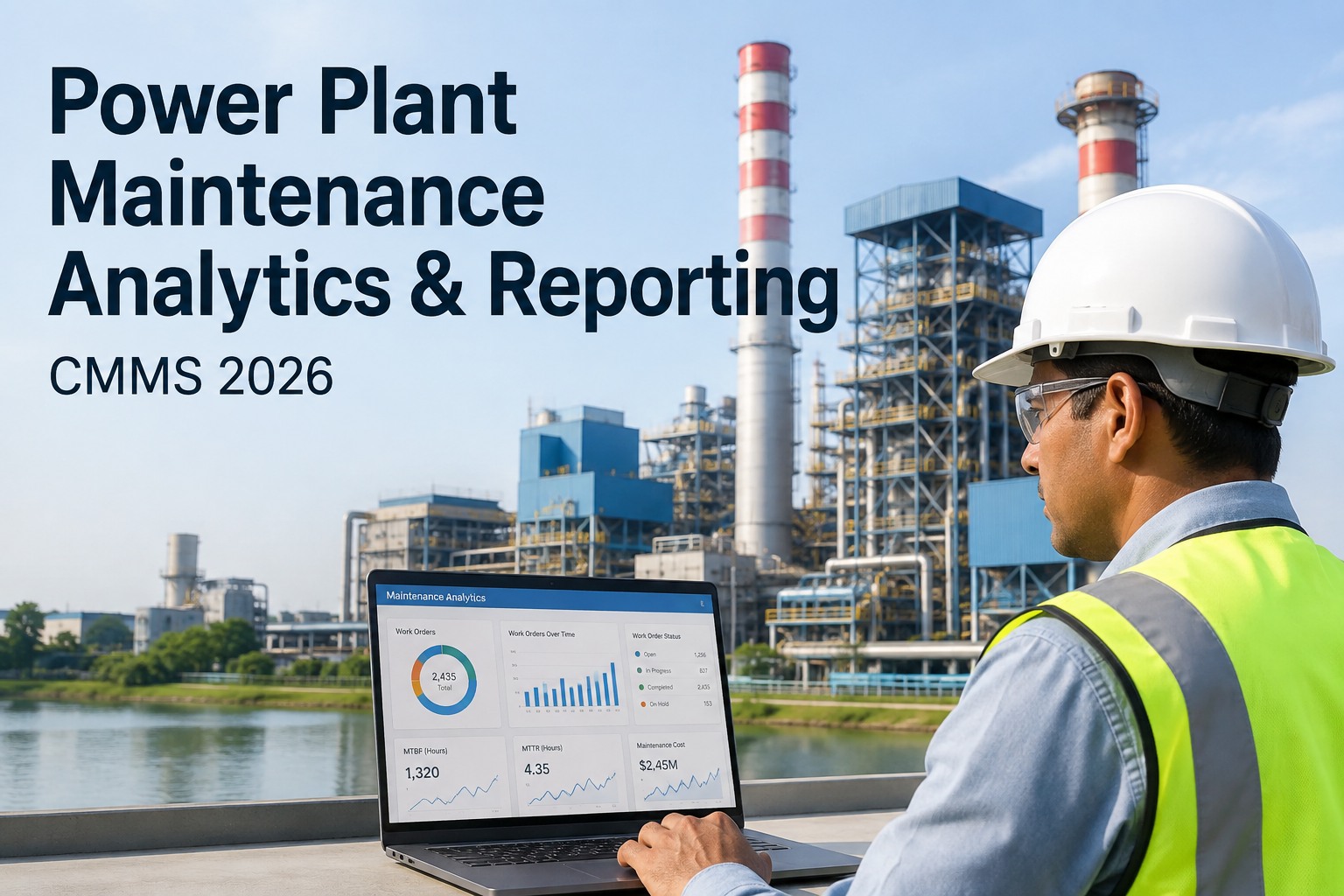
Live performance dashboards showing MTBF, MTTR, PM compliance rate, maintenance cost per MWh, and forced outage frequency — updated continuously from connected assets. No manual data pulls. No reporting lag. Decision-makers see what is happening right now, not what happened last month.
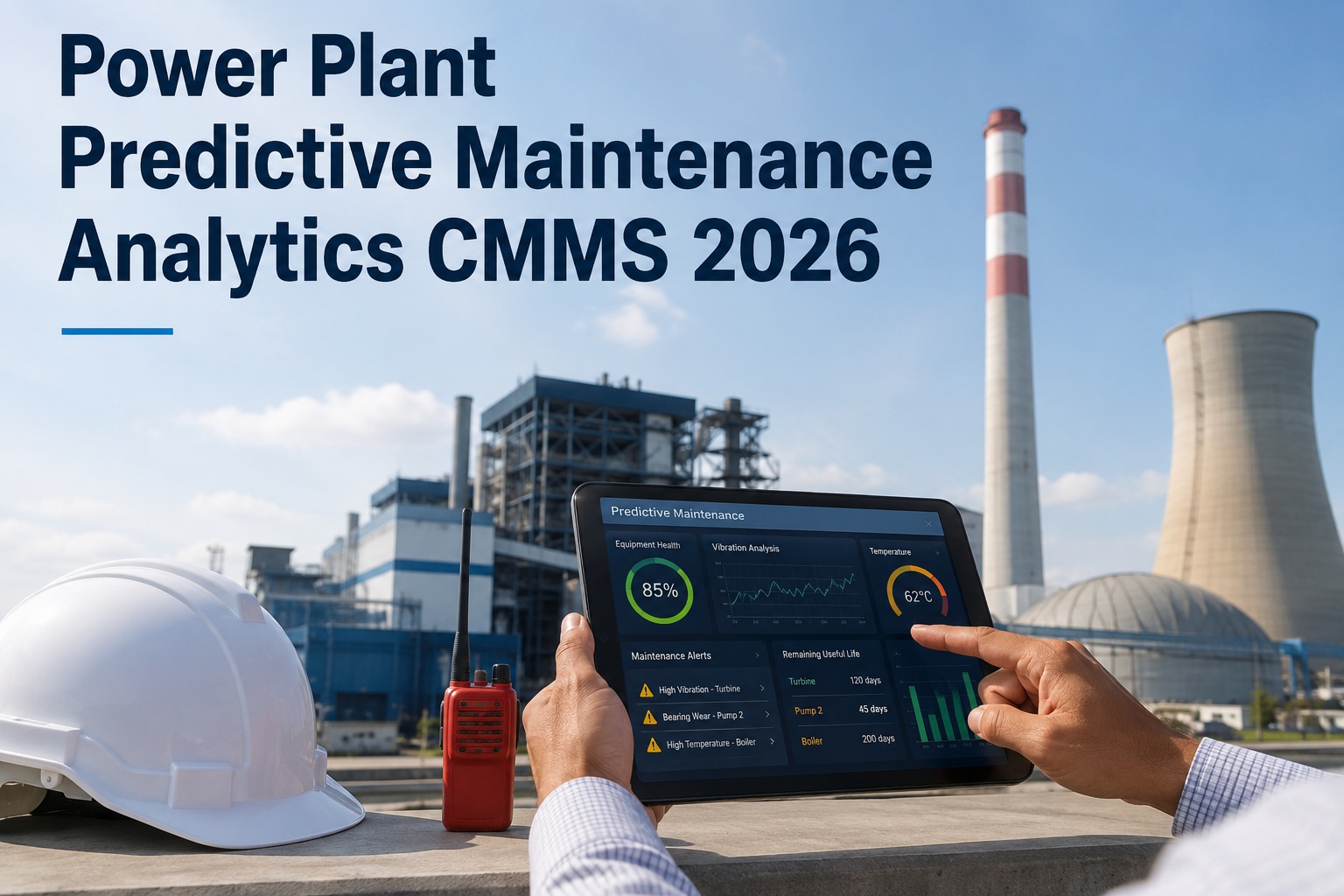
Machine learning models trained on your plant's operational data detect degradation signatures weeks or months before failure. Unlike threshold-based alerts that fire too late, Oxmaint's AI learns each asset's normal operating envelope and flags deviations invisible to operators — predicting hot-section blade wear, bearing deterioration, and compressor fouling with 85–92% accuracy.
Measurable Impact:3–18 month failure prediction window — 65% fewer forced outages in Year 1
03
Asset Management & Equipment Hierarchy
Complete digital twin of every asset from plant level down to sub-component — with full maintenance history, OEM specifications, document vault, warranty tracking, and lifecycle cost accumulation. When a technician needs to know the last time a bearing was replaced, the answer is one tap on a mobile device, not a filing cabinet search.
Measurable Impact:67% faster root cause analysis — 23% reduction in diagnostic labor
04
Work Order Management
Full work order lifecycle from auto-generation through closure — with priority scoring, technician assignment, parts reservation, and compliance documentation captured automatically. Technicians execute on mobile devices in the field, logging time, parts, and findings in real time. No paper. No re-entry.
Measurable Impact:47% backlog reduction in 90 days — PM compliance rate up to 92%
05
Regulatory Compliance Automation
NERC CIP, OSHA, EPA, and insurance inspection records captured automatically on every relevant work order. Audit packages generated in under four hours instead of six weeks. Version-controlled, timestamped, and tamper-evident — satisfying even the most demanding regulatory reviews without a last-minute scramble.
Multi-unit outage coordination with critical path scheduling, resource leveling, parts pre-staging, and contractor management — all inside the same platform as daily maintenance. Predictive alerts automatically schedule intervention timing to align with planned outage windows, eliminating the costly forced outage scenario entirely in most degradation failure modes.
Measurable Impact:4.8x cost reduction vs emergency repair — planned vs reactive
The Real-Time Analytics Advantage
Most plants have the data. The problem is it is locked inside DCS historian files nobody has time to analyze, or surfaced in monthly reports that describe problems three weeks after they started. Oxmaint's real-time analytics layer changes the information timeline — giving maintenance managers and reliability engineers a live view of every critical indicator across the entire fleet.
What Real-Time Analytics Looks Like in Practice
From sensor reading to actionable decision — in under 60 seconds
Sensor Data
EGT, vibration, pressure, bearing temp ingested every 30 seconds via DCS/SCADA
→
AI Analysis
Compared against learned baselines for that asset, load point, ambient condition
→
Smart Alert
Anomaly flagged with severity, component, failure mode, and estimated time-to-failure
→
Auto Work Order
WO created with parts list, labor estimate, and optimal outage timing — no human input needed
30 sec
Data ingestion cycle
<60 sec
Sensor to alert latency
85–92%
Anomaly detection accuracy
3–18 mo
Prediction lead time
ROI by the Numbers: What Plants Are Actually Seeing
The return on investment from a power plant CMMS is not a vendor projection — it is arithmetic based on well-documented cost categories. The numbers below are drawn from industry studies and operator-reported outcomes from facilities running AI-native platforms in 2024–2025.
Forced Outage Avoidance
$1.2M – $3.8M / yr
65–72% fewer events at avg $500K–$1.2M per outage
Heat Rate Optimization
$400K – $800K / yr
1.5% efficiency gain from AI-detected compressor fouling and combustion drift
Component Life Extension
$400K – $600K / yr
20% blade and hot-section life extension via optimal inspection timing
Compliance Labor Savings
$120K – $200K / yr
Audit prep from 6 weeks to 4 hours — NERC CIP, OSHA, insurance
Inventory Optimization
$280K – $420K / yr
25% reduction in safety-stock over-ordering — condition data replaces guesswork
Deployment is not a big-bang event — it is a phased value delivery curve. Here is what plants deploying Oxmaint actually experience across the first twelve months.
Weeks 1–3
Integration & Connection
DCS/SCADA data feeds connected via OPC-UA or Modbus. Existing CMMS and maintenance history imported. No DCS replacement. First sensor readings flowing into Oxmaint dashboards.
Weeks 3–8
AI Baseline Learning
Machine learning models learn each asset's normal operating envelope across load ranges and ambient conditions. First anomaly detections begin appearing — typically catching 3–5 pre-existing degradation conditions within the first month.
Month 2–4
First Prevented Failures
System transitions from learning to predicting. Work orders auto-generated with component-specific guidance, parts lists, and outage alignment. Most plants document their first prevented forced outage in this window — often recovering platform costs in a single event.
Month 4–8
Full ROI Positive
Prevented outages, compliance labor savings, and efficiency gains accumulate past platform investment cost. Maintenance scheduling shifts from calendar-based to condition-based across primary assets. PM compliance rate typically reaches 88–92%.
Month 6+
Compounding Returns
AI models continuously improve accuracy on plant-specific operational data. Predictive lead times extend. Capital planning shifts to use real asset health data instead of manufacturer schedules. Fleet-wide optimization becomes standard operating practice.
See Oxmaint in action for your plant type
Gas turbine, steam, combined-cycle, or renewable — our team will walk through a live demo built around your specific assets and failure modes.
What exactly does a power plant CMMS do that spreadsheets cannot?
Spreadsheets are static documents — they record what already happened. A power plant CMMS is a live operational system that connects to running equipment, detects degradation in real time, auto-generates work orders before failures occur, tracks compliance documentation automatically, and provides role-based dashboards for technicians, managers, and executives simultaneously. The practical difference: a spreadsheet tells you a bearing failed last Tuesday. Oxmaint tells you that same bearing will reach critical wear in approximately 11 weeks, schedules the replacement during the next planned outage window, reserves the part from inventory, and documents the intervention for NERC CIP purposes — all without a single manual entry.
How does predictive maintenance AI actually work — and what is its accuracy?
Oxmaint's predictive models use machine learning techniques including multivariate anomaly detection and supervised failure classification trained on continuous sensor data streams. Unlike threshold-based alerts (which fire only when a value exceeds a set limit — often too late), the AI learns each asset's normal operating profile across varying load points, ambient temperatures, and fuel conditions. It then detects statistical deviations from that learned baseline — subtle patterns that precede failure by weeks or months. Accuracy for major component failure mode prediction reaches 85–92% by month six of deployment, when models have learned seasonal and load-cycle variations. Recent independent assessments using XGBoost-based classification on gas turbine thermal data reported 97.2% accuracy in distinguishing healthy from faulty conditions.
What does NERC CIP compliance automation actually involve?
NERC CIP (Critical Infrastructure Protection) standards require detailed documentation of all maintenance, access, and change activities on Bulk Electric System (BES) Cyber Systems and associated physical infrastructure. In most plants, this documentation is manually assembled in parallel with work execution — creating a double-work burden and audit risk from inevitable documentation gaps. Oxmaint auto-captures CIP-required records on every relevant work order: who performed the work, when, what access permissions were in effect, what changes were made, and what testing was completed. When an audit cycle begins, a complete organized package is generated in under four hours. The average plant saves $120,000–$200,000 annually in compliance labor costs and achieves a 90%+ first-submission audit pass rate.
Can a small or mid-sized plant justify the investment in CMMS software?
The ROI threshold is much lower than most plant managers assume. Even a 100 MW gas peaker experiencing two forced outages per year at $300,000–$600,000 each saves $390,000–$780,000 annually from a 65% outage reduction. Oxmaint's entry pricing for smaller facilities starts well below the value of a single prevented event. The payback period for a 100–300 MW plant is typically 4–8 months — faster than most capital projects in generation. Cloud-native deployment also means no large upfront infrastructure investment; the platform scales with the number of assets you connect.
How is ROI from a power plant CMMS measured and reported?
Oxmaint tracks five primary ROI categories automatically: forced outage events prevented (with estimated cost avoidance per event), maintenance cost per MWh generated over time, PM compliance rate trend, parts and inventory carrying cost reduction, and compliance labor hours saved per audit cycle. These metrics are available in the executive dashboard at any time and generate automated monthly summary reports for management. For capital planning purposes, the system also tracks component remaining useful life against scheduled replacement cost — enabling forecast-based deferral decisions with documented financial justification.
Your Plant's Data Is Already Predicting Failures. Are You Listening?
Every exhaust thermocouple, vibration probe, and pressure transmitter on your turbines is broadcasting health information right now. Oxmaint connects to your existing infrastructure in 2–4 weeks, starts learning your assets immediately, and delivers its first prevented failure before most enterprise CMMS implementations are even half complete.