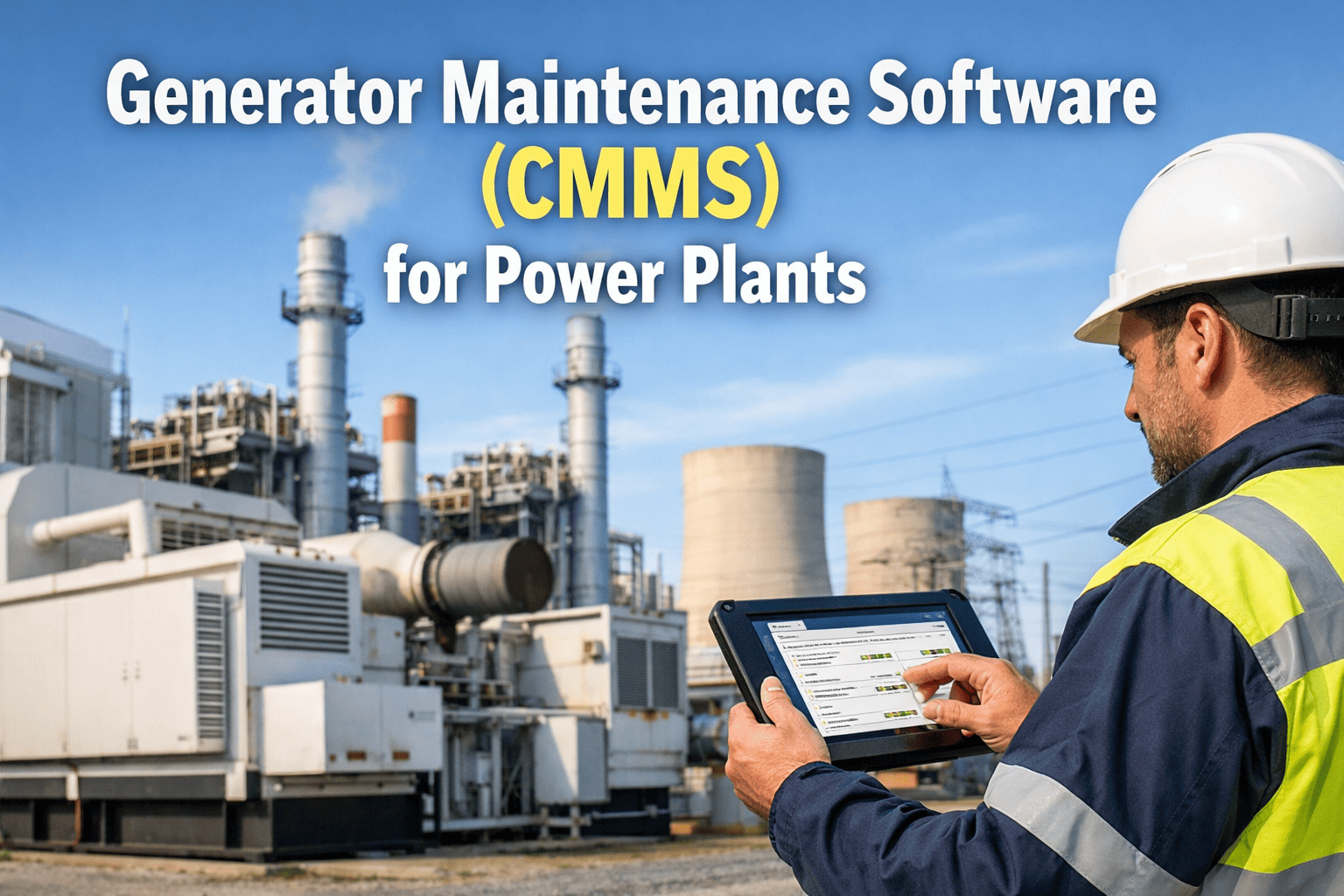
Managing a power plant's maintenance operations on spreadsheets, paper work orders, or disconnected systems quietly costs millions every year — not in a single visible event, but in accumulated emergency markups, duplicate labour, missed PM windows, and decisions made without complete asset data. A purpose-built CMMS (Computerized Maintenance Management System) changes the operating model entirely: one platform captures every work order, asset history, parts transaction, and sensor reading, then surfaces the patterns your team can act on. Plants that centralize on a modern CMMS like Oxmaint reduce maintenance costs by 25–35% within the first year and convert 55% emergency workloads into planned, scheduled activity. This guide breaks down exactly what a power plant CMMS does, what to look for, and why the right platform pays for itself before the year is out. Start your free trial or explore how Oxmaint fits your plant's specific setup.
Why Power Plant Maintenance Without a CMMS Always Costs More
Without centralized data, every maintenance decision is a guess. And in power generation, guesses come with six-figure price tags.
No Asset History Means No Failure Patterns
When work orders live on paper or separate spreadsheets, there is no way to identify which assets are trending toward failure. You only discover the pattern after the third expensive repair on the same pump — or after the turbine goes down on a Friday night.
Calendar PM Wastes Resources on Healthy Equipment
Fixed-interval maintenance replaces components on schedule, not on condition. Up to 25% of PM budget goes to components with significant remaining life — while genuinely degrading assets get the same treatment as perfectly healthy ones.
Inventory Managed by Gut Feel, Not Data
Without failure probability data, storerooms stock for every worst-case scenario simultaneously — locking up $800K+ in parts that may never be used while still placing emergency orders at 2.4× standard cost for items that were not stocked.
See what centralized maintenance management changes for your plant — live, in your first session.
Oxmaint maps your current workflow, identifies the highest-cost gaps, and shows how CMMS closes them — with zero commitment required.
What Oxmaint CMMS Does for Power Plant Operations
From work order creation to AI-driven asset analytics, every capability is built for the operational complexity of power generation.
Work Order Management
Every maintenance task — planned, corrective, or emergency — flows through a single digital system. Technicians receive work orders on mobile devices with asset history, safety procedures, and parts requirements pre-loaded. Supervisors see real-time completion status across every crew and shift. All labour, parts, and contractor costs attach automatically to each work order, building the cost-per-asset history that makes smarter decisions possible.
Full hierarchy from plant to component. Maintenance history, failure modes, and cost records per asset — searchable across your entire fleet.
Calendar, meter, and condition-based triggers. PM intervals adjust based on actual asset history, not manufacturer defaults.
Min/max levels set by failure probability, not guesswork. Procurement triggered 30 days before predicted need at standard cost.
How Power Plants Go Live on Oxmaint
Digital Foundation
CMMS deployed, asset register built, existing work order history imported. Paper-based PM scheduling replaced with digital triggers. Every labour, parts, and contractor cost starts flowing through one system.
PM Optimisation
Calendar PM intervals replaced with history-based scheduling. Unnecessary component replacements eliminated. Emergency vs. planned cost ratio established as a management KPI — so the number is visible and accountable.
Condition-Based Monitoring
IoT sensors connected to CMMS. Automated work orders generated on threshold breaches. Parts procurement aligned to predicted failure windows — 30 days ahead of need, at standard cost, no premium.
Full Predictive Maturity
AI failure probability models running on multi-variable sensor streams. Maintenance scheduled weeks before failure peaks. Asset lifespan modelling replaces guesswork at budget time. Reporting satisfies NERC CIP and ISO 55001 requirements automatically.
What Plants Achieve After 12 Months on Oxmaint CMMS
Industry 4.0 mature plants using AI-integrated CMMS report 38% lower maintenance spend versus reactive peers on equivalent equipment — the compounding effect of better scheduling, fewer emergencies, and optimised inventory.
CMMS Questions From Power Plant Teams
Start Cutting Maintenance Spend This Quarter
Preventive and predictive maintenance together costs $7–13 per horsepower. Reactive repairs cost $17–18. Oxmaint gives your plant the tools to make that shift in weeks — not years. Start free or talk to a power plant specialist today.