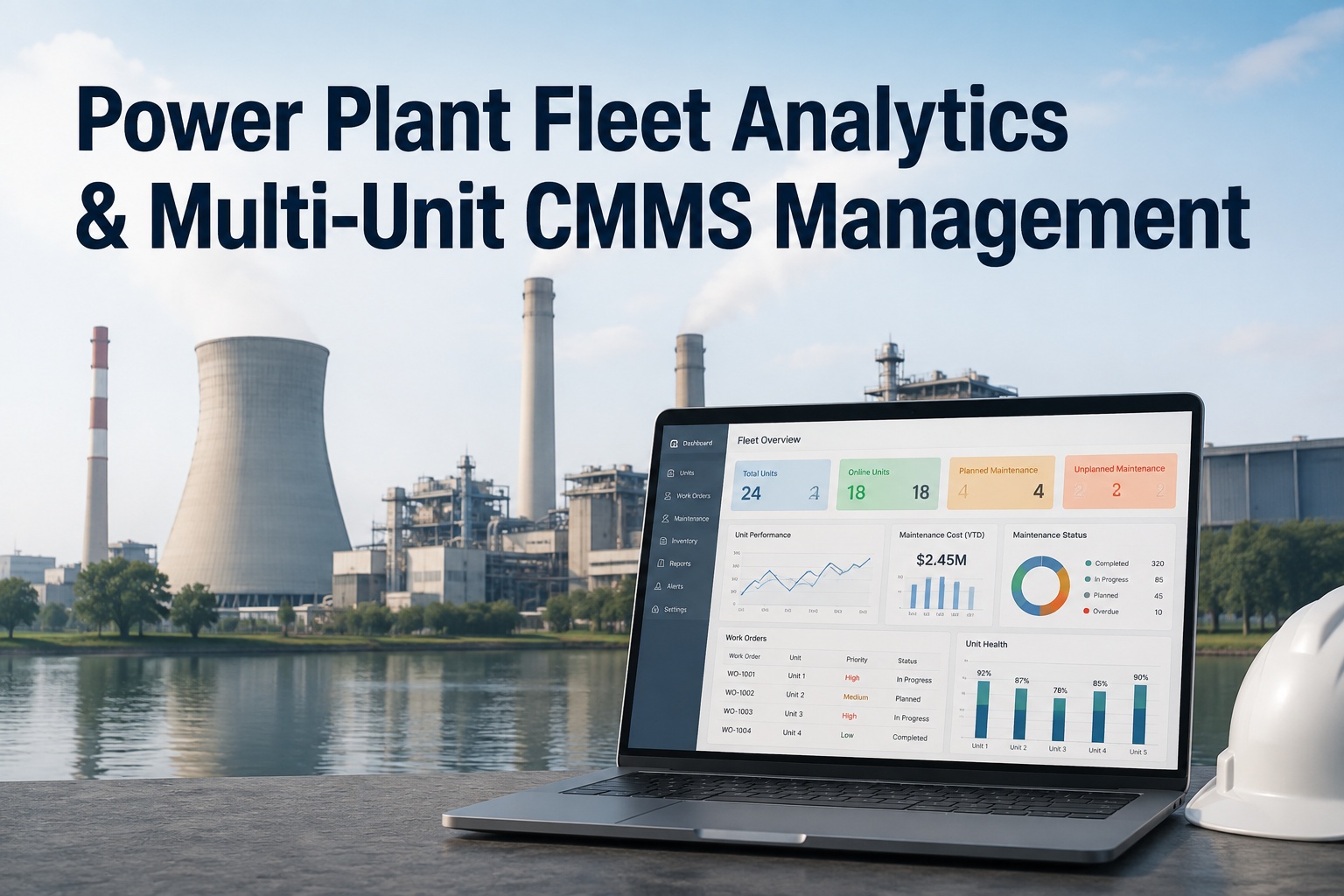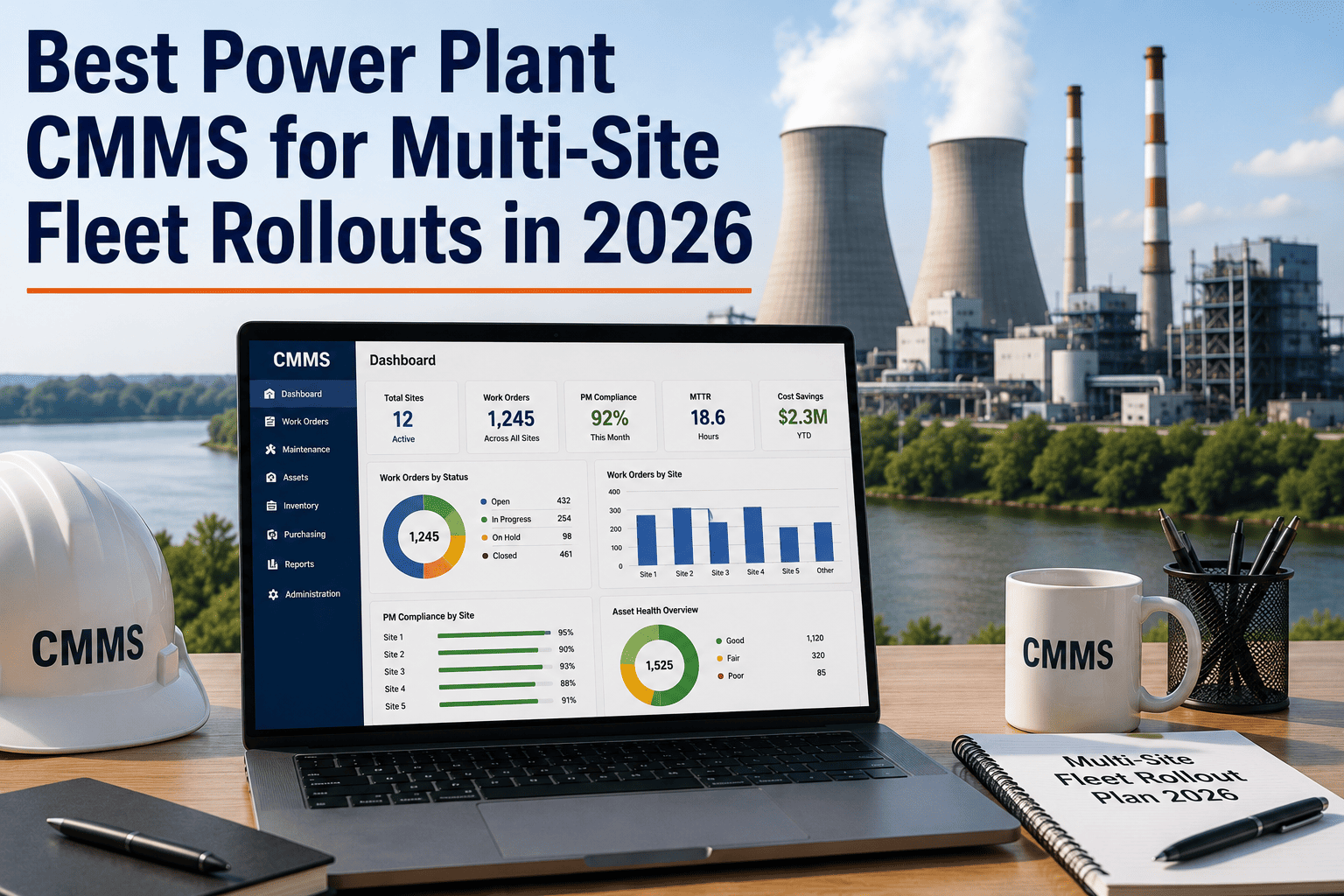
A generation fleet where one plant runs at 94% availability while another limps at 71% is not a talent problem — it is a data and process problem. When every site keeps its own maintenance records in disconnected systems, there is no shared baseline to identify why one plant outperforms another, no way to transfer best-practice PM procedures across the fleet, and no corporate dashboard that surfaces emerging reliability risks before they become forced outages. Multi-site CMMS standardization is how generation owners close that gap — and the companies deploying it now are setting the margin benchmarks everyone else chases. If your fleet is still managing maintenance plant by plant on different platforms, start a free Oxmaint trial and see what centralized visibility looks like in practice.
Power Generation Fleet Strategy — 2026
Multi-Site CMMS Standardization Across a Power Plant Group Fleet
Corporate PM standards, plant-level autonomy, fleet benchmarking, and CMMS-tracked rollout — for generation owners managing 3 to 300 facilities.
90 days
To full fleet KPI dashboard visibility after initial rollout
38%
Reduction in total maintenance costs within 18 months — AI-native CMMS deployers, 2023–2024
61%
Decline in forced outage frequency after fleet standardization with AI-native CMMS
30–60 days
Per-site rollout on a rolling schedule for multi-site fleet deployments
No Fleet Benchmarking
When each plant defines KPIs differently — different PM completion formulas, different downtime categories, different equipment hierarchies — you cannot compare Plant A's 94% availability against Plant B's 71% in any meaningful way. Best practices stay trapped at the site level.
Procedure Proliferation
Without a corporate PM template library, each plant engineer writes their own maintenance procedures. The same gas turbine hot-section inspection is documented 12 different ways across 12 sites — with 12 different step sequences, 12 different parts lists, and 12 different compliance interpretations.
Siloed Spare Parts Inventory
Plant B orders an emergency $40,000 bearing under expedited freight while Plant A has two in stock 180 km away. Without inter-site inventory visibility, this happens every quarter. A standardized fleet CMMS with shared inventory visibility eliminates it.
Compliance Reporting Burden
Corporate teams manually compile NERC CIP evidence, PM compliance rates, and inspection records from each site's separate system before every audit. What should be a one-click report becomes a two-week data collection exercise across 8 different spreadsheet formats.
Corporate Layer
Set once. Enforced everywhere.
PM Template Library
Standard inspection procedures for every equipment class — gas turbine, steam turbine, boiler, transformer, pump — defined at corporate and pushed to all sites as mandatory or advisory templates.
KPI Definitions
Uniform calculation methodology for availability, MTBF, MTTR, PM compliance rate, and forced outage rate — so fleet benchmarking compares the same metric, not different interpretations of it.
Asset Taxonomy
A standardized equipment hierarchy and failure code library applied across all sites — enabling fleet-wide FMEA, root cause analysis aggregation, and cross-site reliability benchmarking.
Compliance Frameworks
NERC CIP, ISO 55001, and environmental inspection requirements encoded as mandatory work order types — automatically tracked and reportable at fleet level without site-specific data collection.
Bidirectional Data Flow
Plant Layer
Local execution. Global visibility.
Local Asset Register
Each plant maintains its own asset register with site-specific equipment details, local equipment numbering, and plant-level maintenance history — within the corporate taxonomy framework.
Site-Specific Procedures
Plants can create local work instructions for equipment not covered by corporate templates — seasonal procedures, local contractor specifications, or site-specific safety requirements.
Local Inventory Management
Each plant manages its own spare parts stock with local reorder rules — while corporate sees inter-site inventory visibility to enable cross-facility parts transfers before emergency procurement.
Technician & Crew Management
Shift schedules, craft assignments, and contractor management remain at the site level — preserving local operational flexibility while feeding fleet workforce utilization analytics to corporate.
Enterprise Fleet CMMS
One Platform. Every Plant. One Version of the Truth.
Oxmaint's enterprise architecture gives corporate maintenance leaders the standardization layer they need — PM templates, KPI definitions, compliance tracking — while giving each plant the operational flexibility to manage local assets, crews, and procedures without IT overhead.
Plant / Unit
Availability %
PM Compliance
MTBF (days)
Open CMs
Status
Plant A — Gas Turbine Unit 1
94.2%
97%
142
3
On Target
Plant B — Combined Cycle Unit 2
88.7%
84%
97
18
Review Needed
Plant C — Coal Unit 3
71.4%
61%
54
41
Intervention
Plant D — Hydro Unit 1
98.1%
99%
198
1
On Target
Fleet benchmark view — Plant C's 61% PM compliance and 41 open corrective work orders explain the 71% availability gap vs Plant A. Corporate reliability team dispatched for root cause review.
Phase 1
Pilot Site (Weeks 1–6)
Select the highest-criticality site as the pilot. Migrate asset register, configure corporate PM templates, define KPI calculation rules, and go live with mobile work orders. Validate the data model and identify exceptions before fleet-wide rollout.
Output: Validated data model · Tested PM templates · Go-live playbook
Phase 2
Fleet Rollout (Weeks 7–18)
Roll out to remaining sites on a 30–60 day per-site schedule using the Phase 1 playbook. Each site's asset data is migrated and validated. Corporate PM templates are pushed. Technicians complete a one-day platform onboarding session.
Output: All sites live on unified CMMS · Asset registers migrated · Technicians onboarded
Phase 3
Fleet Dashboard Live (Week 10–12)
Corporate fleet KPI dashboard goes live as the second site completes onboarding. Availability, PM compliance, MTBF, and open work order counts are visible across all connected sites in real time — no monthly report compilation required.
Output: Real-time fleet dashboard · Automated compliance reports · Benchmark league table
Phase 4
Continuous Improvement (Month 4+)
Fleet benchmarking identifies underperforming sites. Best-practice PM procedures from high-availability plants are extracted and pushed as corporate templates. Inter-site parts transfers replace emergency procurement. Predictive models improve with growing fleet data.
Output: Measurable availability improvement · Maintenance cost reduction · Shared parts inventory
20–35%
Maintenance Cost Reduction
Within first 12 months of fleet standardization — driven by elimination of duplicate procurement, reduced emergency parts spend, and technician efficiency gains from standardized procedures.
35%
Faster Technician Training
When all sites use the same CMMS interface and standardized work procedures, new technicians and contractors onboard in days — not weeks navigating site-specific system variations.
25–35%
Faster New Site Integration
Acquired plants or newly commissioned units are brought into the fleet data model within weeks using the existing playbook — not months of custom configuration for each new asset class.
1-click
Audit-Ready Compliance Export
NERC CIP evidence, ISO 55001 inspection records, and PM compliance data across the entire fleet are exportable in a single report — eliminating the multi-week pre-audit data collection cycle.
Can individual plants maintain their own procedures while still contributing to fleet benchmarking?
Yes — this is by design. The two-tier model lets corporate define mandatory inspection points and KPI calculation methodology, while each plant creates local work instructions for site-specific equipment. Both layers feed the same fleet dashboard without forcing identical workflows on every site. Start a free trial to explore the configuration.
How do you handle different generation technologies across the fleet — gas, coal, hydro, and renewables?
The CMMS asset taxonomy supports technology-specific equipment classes and failure code libraries — gas turbine hot-section, hydro runner, wind gearbox — within a shared hierarchy. Corporate PM templates are technology-specific. Fleet KPIs use normalized availability metrics comparable across generation types.
What happens to site-level data when a plant migrates to the fleet CMMS?
Historical maintenance records, asset data, and PM history are migrated from legacy CMMS platforms or spreadsheets as part of the onboarding process — with data migration support included. Sites do not start with an empty asset register. Historical trend data is available from day one for baseline comparison.
How does fleet CMMS standardization support inter-site spare parts sharing?
With a shared inventory catalog and standardized part numbers across all sites, corporate can see real-time stock levels at every plant. When a site needs an emergency part, the system identifies the nearest site with available stock — enabling inter-site transfers before external procurement. Book a demo to see the inventory visibility layer.
How long does full fleet standardization take for a 10–15 site generation portfolio?
A 10–15 site fleet typically completes full rollout in 3–5 months on a rolling 30–60 day per-site schedule, with the fleet KPI dashboard live from Month 2 as the first few sites go live. Most enterprises reach 90-day full visibility within the first quarter of rollout completion.
Enterprise Fleet CMMS — Oxmaint
Stop Managing Plants. Start Managing a Fleet.
Oxmaint gives generation owners the corporate governance layer — PM templates, KPI standards, compliance tracking, fleet benchmarking — and the plant-level execution tools — mobile work orders, asset management, predictive scheduling — on a single platform. Every plant. One dashboard. Real-time.
3–300
Sites supported on one platform
90 days
To fleet-wide KPI visibility
Zero
On-site hardware required
Free
Data migration support included