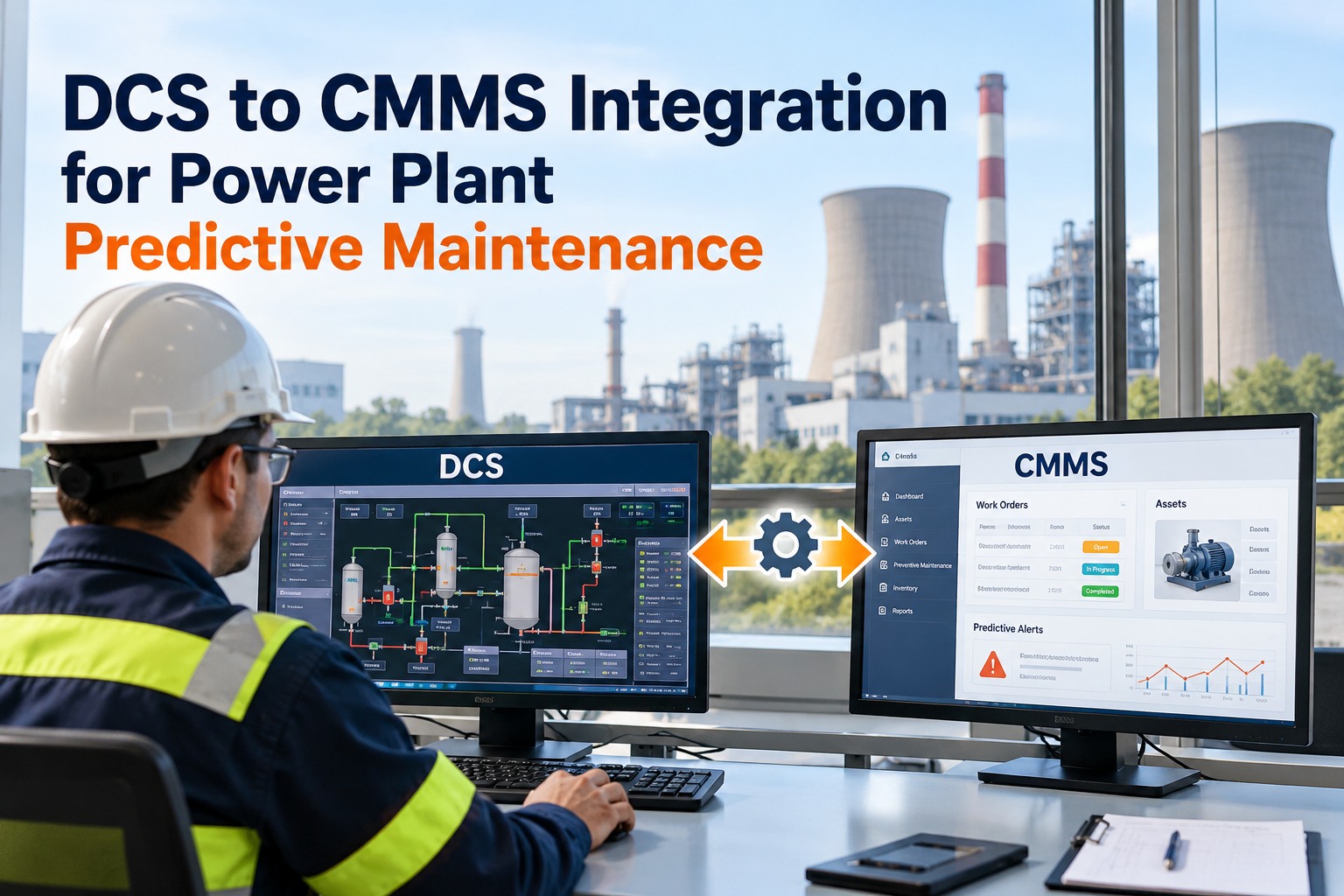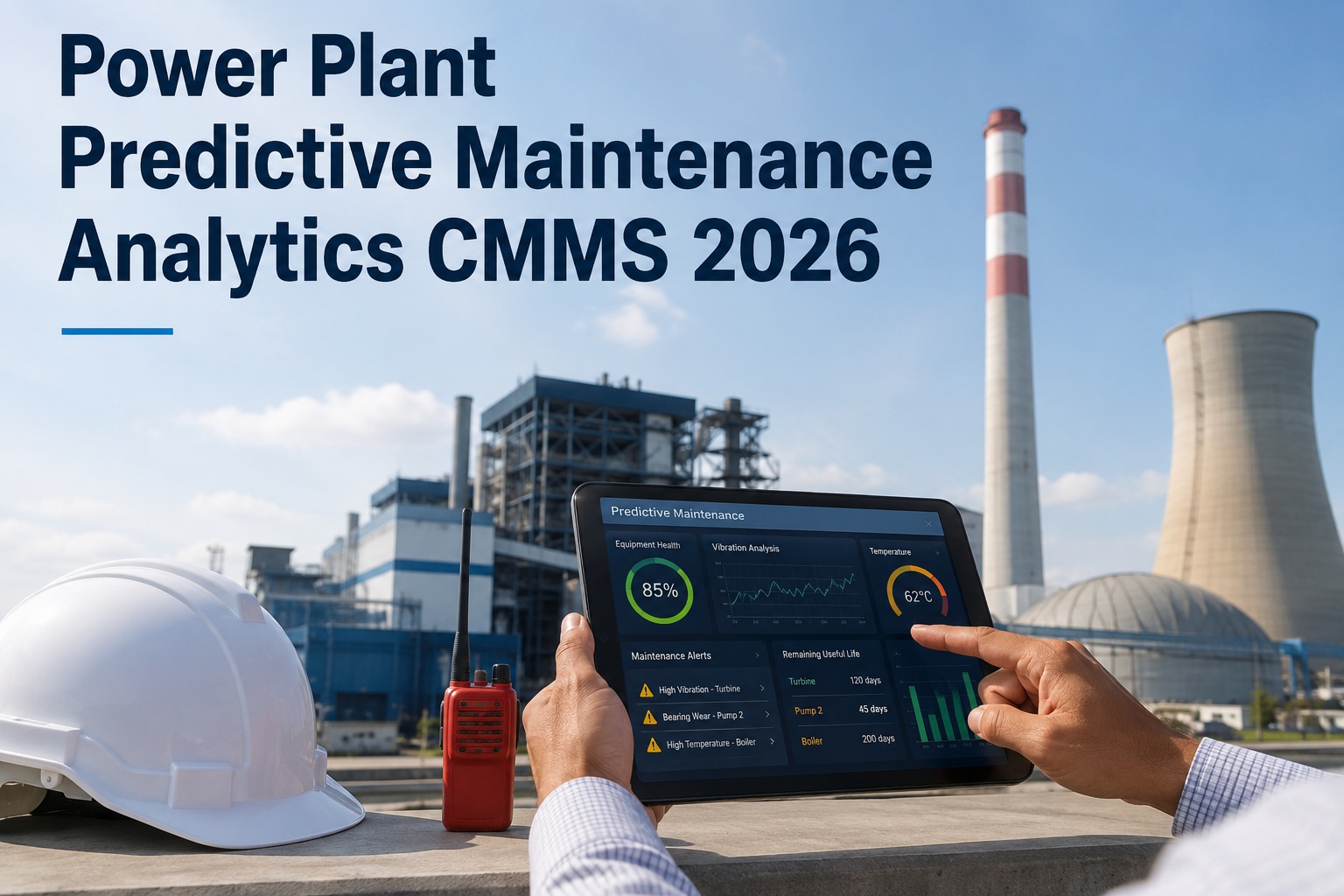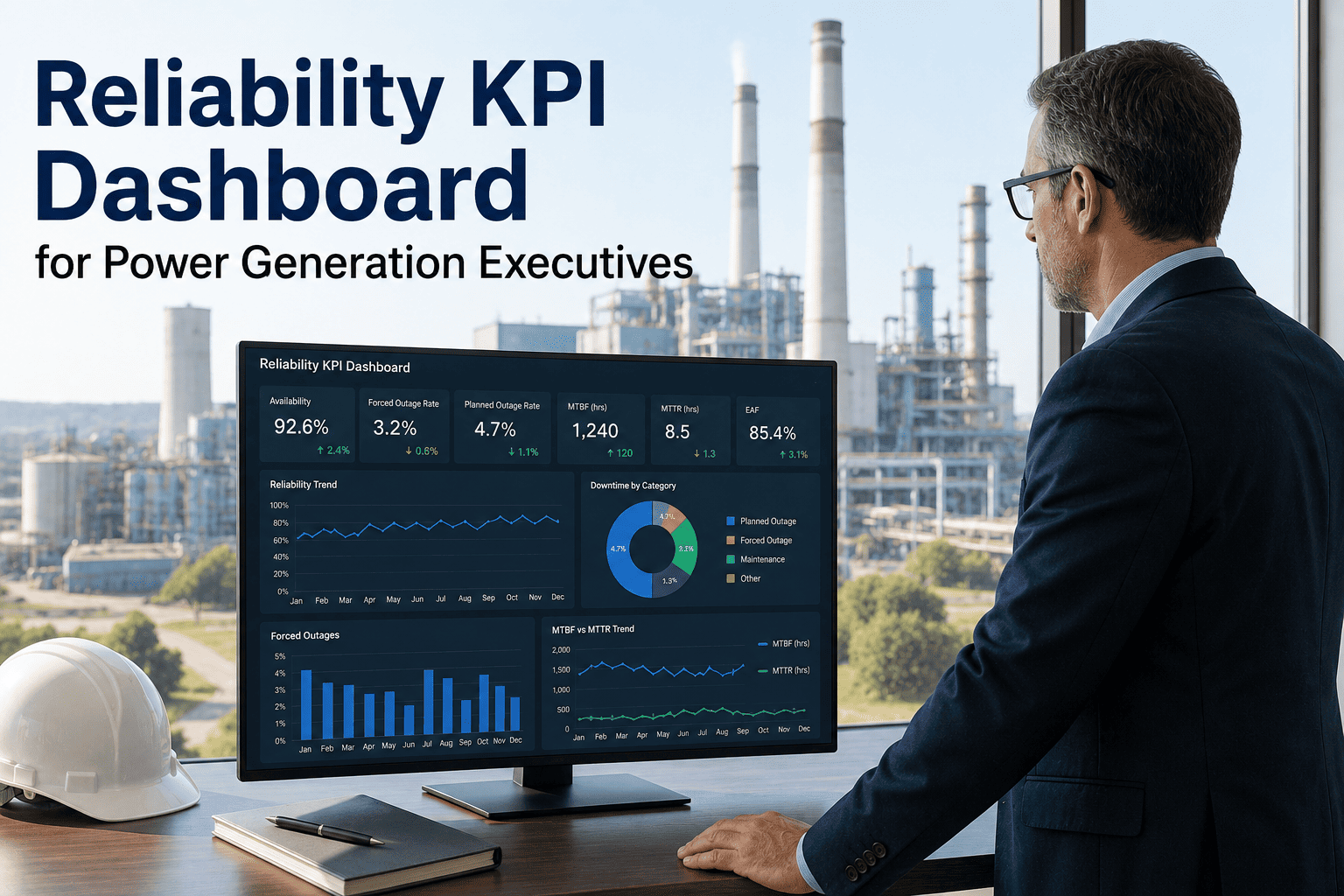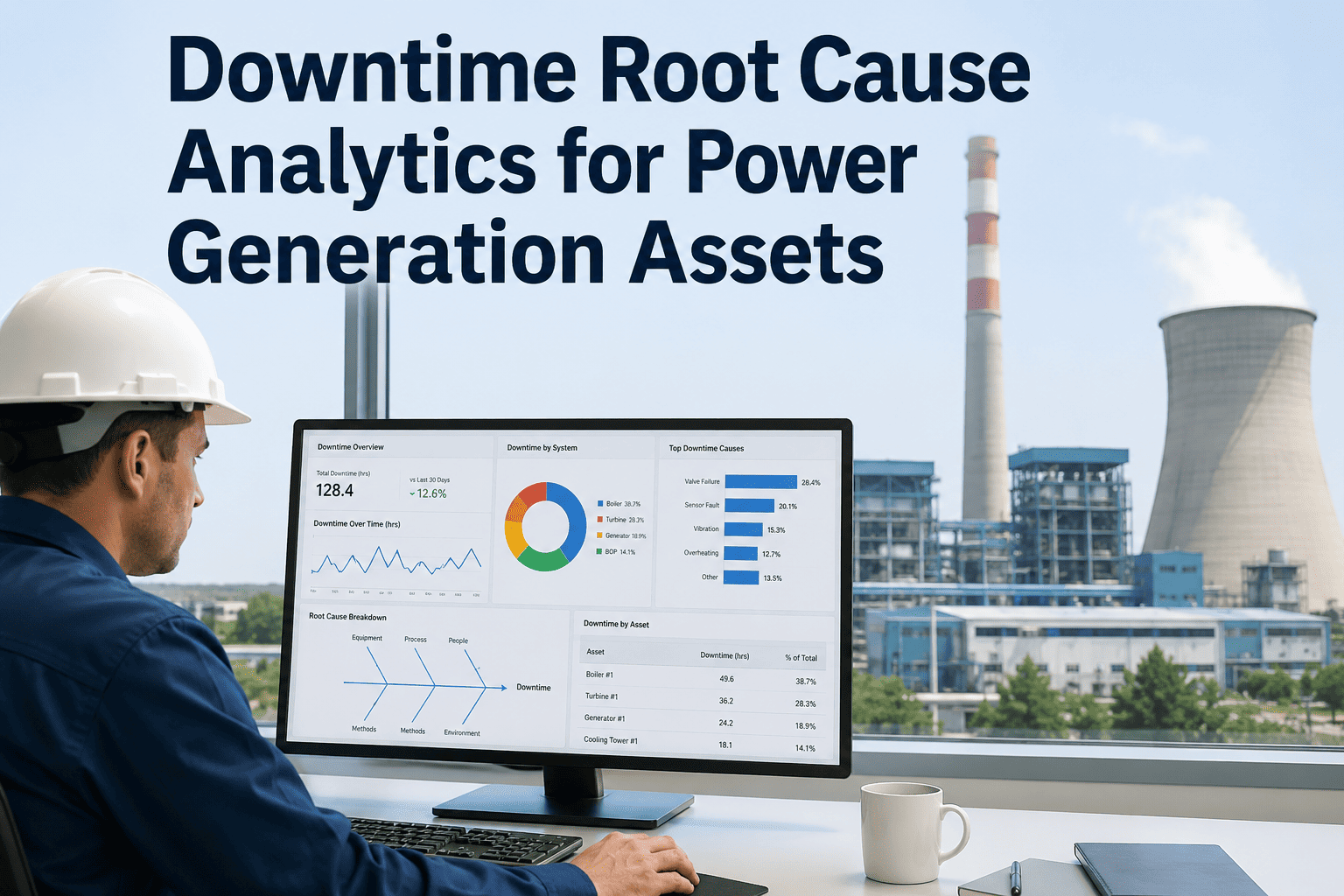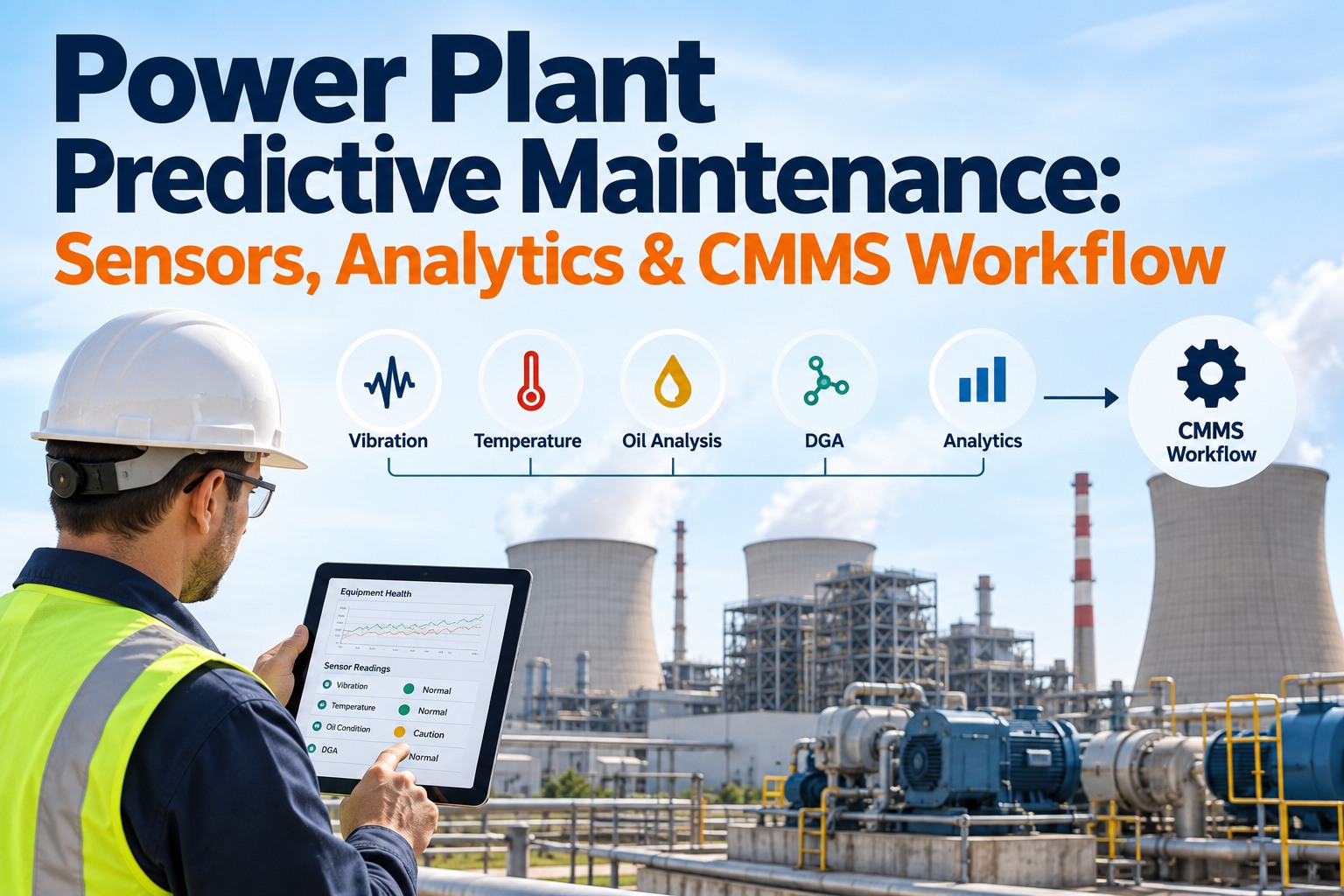
A 500 MW steam turbine at 4.5 mm/s is a $300 balancing job on the next planned outage; the same turbine at 11.8 mm/s can shed a bearing in 48 hours. That gap is a signal-processing problem — and it lives in readings your instruments already collect. Studies show correctly-selected sensor programs typically deliver 30–50% downtime reduction per asset. This guide walks the sensors that matter on the four core power-plant asset families, the analytics that turn readings into a fault call, and the CMMS workflow that closes the loop — all inside OXMAINT AI, the AI-powered CMMS/maintenance management software for power plants.
Power Plant Predictive Maintenance: Sensors, Analytics & CMMS Workflow
Vibration, DGA, oil analysis, wall thickness, operating parameters — every rotating and stationary asset in a power plant broadcasts its own health. OXMAINT AI is the AI-powered CMMS/maintenance management software that captures those signals, applies ISO / IEEE severity zones, and turns a drifting reading into a graded defect and a scheduled work order — before the next forced outage writes itself.
Four Asset Families, Four Failure Physics
The single biggest mistake in power-plant PdM is treating every asset the same way. A boiler degrades chemically and thermally, a turbine mechanically, a generator/transformer electrically, and a BFP hydraulically. Different physics need different sensors, different severity standards and different CMMS actions. OXMAINT AI holds the per-family rules so the workflow adapts to what the asset actually is. Sign up free and set up the first asset family in OXMAINT AI.
Sensor Selection Reference by Asset Class
Not every sensor belongs on every asset. Below is a working reference of primary and secondary sensors used on the highest-value machinery in a modern plant. In OXMAINT AI, each row corresponds to a device-class rule that turns the sensor stream into a graded defect and a routed work order. Book a demo to walk the reference on your fleet.
| Asset | Primary sensor | Secondary sensors | Alert threshold reference |
|---|---|---|---|
| Steam / gas turbine | Eddy-current proximity probes (X-Y) | High-freq accelerometer · Pt100 bearing · oil particle counter | >125 µm p-p (ISO 7919) · ISO 10816-2 Zone C/D |
| Generator | Partial discharge (PD) coupler | Winding RTD · rotor vibration · stator current signature | PD activity rise · winding rise >10°C from baseline |
| Power transformer | DGA (multi-gas) | Bushing PD · top-oil temp · load current · furan test | IEEE C57.104 status 2/3 · gas ratio flags (Duval) |
| Boiler tube (waterwall) | Ultrasonic thickness | Skin thermocouples · IR thermography · water chemistry | Thinning >40% original · skin temp rise, deviation trend |
| Boiler feed pump | Vibration (velocity + accel) | Motor current signature · seal leak · discharge pressure | ISO 10816-3 Zone C · MCSA sideband signature |
| ID / FD fan | Vibration (velocity) | Bearing temp · motor amps · blade erosion inspection | ISO 10816-3 Zone B/C by mount class |
| Cooling tower fan gearbox | Vibration (envelope / accel) | Oil condition · bearing temp · fan discharge pressure | Envelope defect frequencies · oil ISO code >18/16/13 |
ISO 10816 Severity Zones — The Reference Every Program Uses
Alarm limits aren't guesses — they are zone-boundary velocities published in ISO 10816-2 (large steam turbine sets, 50–3600 rpm) and ISO 10816-3 (industrial machines 15 kW and above). Below is the working table for large steam turbine generator sets rated 50 MW and above, mapped to the CMMS action OXMAINT AI applies at each zone. Sign up free — see the zone map applied to your assets in OXMAINT AI.
Transformer DGA — The Electrical Fingerprint
A power transformer whispers its failures in dissolved gases before any external symptom shows. IEEE C57.104 and IEC 60599 give you the framework; OXMAINT AI turns the gas ratios into a fault call and, when the pattern crosses status 2 or 3, a graded defect record — no more guessing whether the CH4 tick was noise. Book a demo to see DGA interpretation live in OXMAINT AI.
A Sensor Reading Isn't PdM. A Graded Defect With an Outage Window Is.
Most plants already have the instruments. What's missing is the software that reads the streams against a standard, opens a defect, drafts the work order, reserves the parts, and books the outage window. OXMAINT AI runs that whole loop.
The Analytics Stack — What Turns a Waveform Into a Fault Call
Between the sensor and the work order sits a stack of analytics techniques. Not every technique needs to run on every signal — the software applies the right one to the right stream. Below is the working analytics stack OXMAINT AI runs on incoming plant data. Sign up free and see the analytics on live signals in OXMAINT AI.
Sensor → Analytics → CMMS Workflow — Timestamped
What actually happens between a rising vibration reading on a boiler feed pump and a scheduled outage window? Below is the sequence, timestamped, inside OXMAINT AI. Every hand-off is automatic; no exports, no CSV bridges, no reliability-engineer inbox scramble. Book a demo to see the workflow live on plant data.
The Signal-Severity-Response Matrix
Every graded severity maps to a specific CMMS action. This is where a PdM program stops being reactive and becomes governed. Below is how OXMAINT AI grades each signal severity and what happens next. Sign up free and put your first signal on the matrix in OXMAINT AI.
| Severity | Example trigger | Grade | OXMAINT AI action | Lead time |
|---|---|---|---|---|
| Watch | ISO 10816 Zone B drift · early envelope tick | Info | Trend WO opened, weekly review flag | 60–90 days |
| Warn | Zone C entry · DGA status 2 · thickness <60% original | Corrective | WO drafted with parts & skill assignment | 7–14 days |
| Act now | Zone D entry · DGA status 3 · MCSA rotor-bar signature | Urgent | Emergency WO, forced-outage prep, escalation | < 48 hours |
| Trip | Sustained > 7.1 mm/s · transformer arc-fault | Trip / Isolate | Auto-notify ops, block re-start until inspected | Immediate |
What OXMAINT AI Gives a Plant Reliability & O&M Team
OXMAINT AI is the AI-powered CMMS/maintenance management software that stitches sensor, analytics and workflow into a single loop — so the data your instrumentation already produces stops living in dashboards and starts driving the outage schedule. Sign up free and switch on the first asset in OXMAINT AI.
Our reliability engineers had trend data going back years — nobody had time to read it all. The change with OXMAINT AI wasn't more data; it was the data finally becoming defects and work orders instead of dashboard exports. The first month, an envelope signature on Boiler Feed Pump 2B triggered a defect that turned out to be a bearing outer race with about two weeks of life left. Replaced on the next scheduled outage. No forced shutdown, no overtime, no vendor emergency call — just a workflow that closed on its own.
Frequently Asked Questions
From Sensor Stream to Signed Work Order — On One Platform.
Move power-plant predictive maintenance out of dashboards and into the workflow with OXMAINT AI — sensor ingest, ISO / IEEE severity mapping, physics + ML analytics, graded defects, outage-slotted work orders and a full evidence chain per asset. Start free — no credit card, unlimited users.