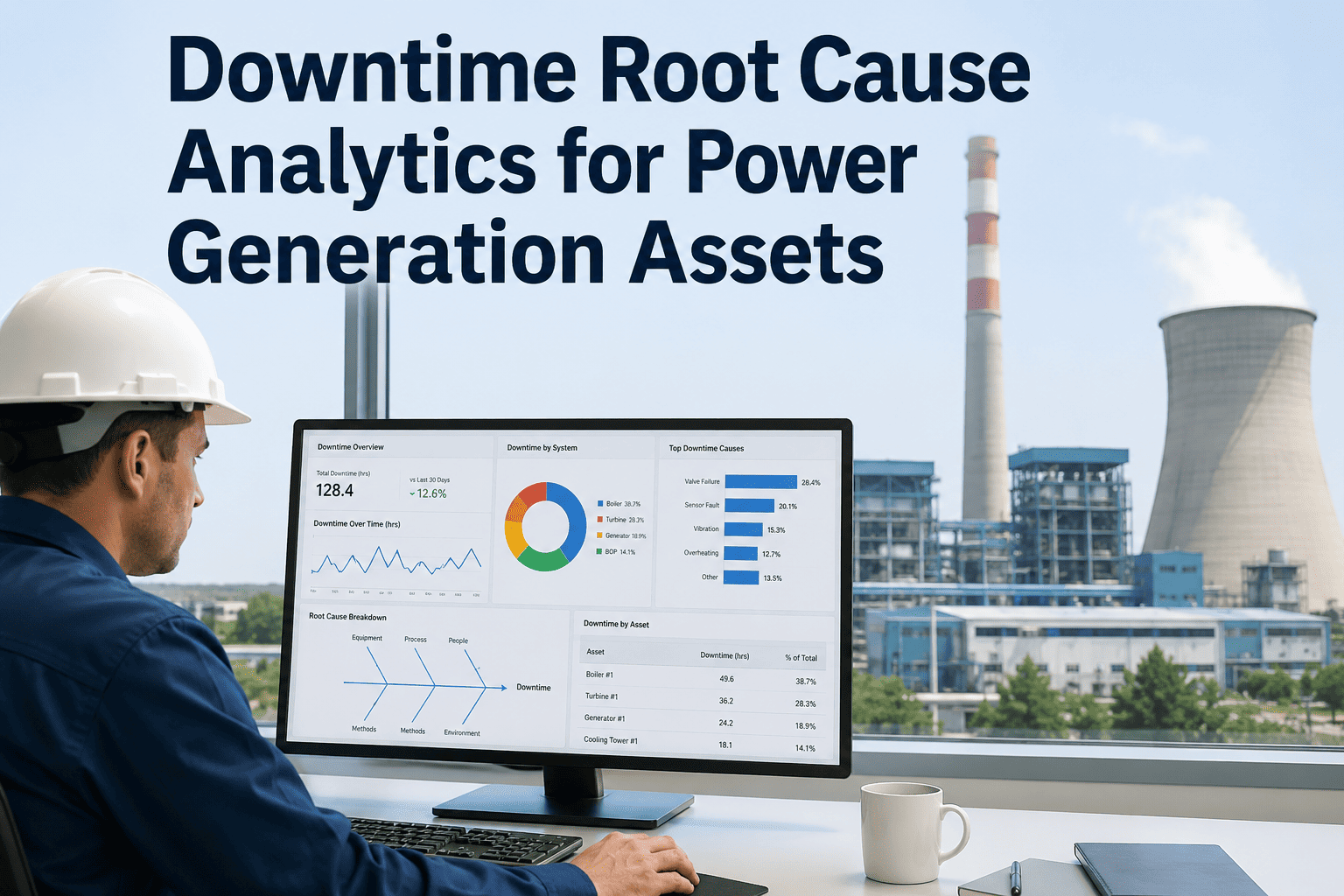
Power plants that still manage maintenance with spreadsheets, email chains, and paper inspection logs are not just inefficient — they are flying blind. When an economizer section shows rising stack temperatures and falling feedwater outlet temperatures across three disconnected systems — a DCS historian, a supervisor's spreadsheet, and handwritten log sheets — no one connects the dots. The resulting forced outage can cost $28 million or more in lost revenue and emergency repairs. A smart maintenance system eliminates those blind spots by centralizing AI, IoT sensors, and real-time monitoring into a single operational platform. Power plants implementing digital maintenance platforms report 30–45% reductions in unplanned outages and a 60% drop in compliance documentation time. Start a free trial on Oxmaint or book a demo to see how your plant can get there.
The Smart Maintenance System Built for Power Plants
AI, IoT, and real-time condition monitoring — integrated into one platform that turns reactive crisis management into proactive asset stewardship. Purpose-built for the complexity of power generation.
From Reactive Repairs to Smart Maintenance — The Evolution
Power plant maintenance has moved through three distinct generations. Plants still operating in the first two are leaving significant reliability and cost advantages on the table.
Equipment runs until failure. Emergency repairs dominate the maintenance budget. Downtime is unplanned, expensive, and often dangerous. Most legacy plants still operate with a significant reactive component.
Maintenance is scheduled at fixed intervals — monthly, quarterly, annually — regardless of actual equipment condition. Better than reactive, but generates unnecessary work orders while still missing condition-based warning signs.
Maintenance is triggered by actual equipment condition — sensor readings, vibration trends, temperature anomalies — analyzed by AI in real time. Work orders fire before failures happen. No unnecessary interventions. Maximum uptime.
What a Smart Maintenance System Actually Does — In a Power Plant
Smart maintenance is not a single technology — it is four capabilities working together. Here is how Oxmaint delivers each pillar for power generation environments.
IoT sensors feed vibration, temperature, pressure, and lubrication data directly into Oxmaint. The platform monitors every connected asset continuously — not just at inspection time. When a sensor reading crosses a defined threshold, a work order fires automatically.
Oxmaint's AI analyzes historical maintenance records, sensor trends, and operational data to identify failure patterns before they manifest physically. AI-driven analytics can increase failure prediction accuracy to 90% while reducing maintenance costs by up to 12%.
Smart maintenance does not stop at detection — it acts. Oxmaint automatically creates, prioritizes, and dispatches work orders when AI or IoT signals indicate a problem. The right technician gets the right job, with parts and SOPs pre-attached, before the equipment degrades further.
Every maintenance event, sensor reading, and work order outcome is centralized in Oxmaint's cloud platform. Plant managers get a live dashboard showing fleet health, upcoming PM obligations, SLA status, and cost trends — across all sites, all assets, all shifts.
How Power Plants Transition to Smart Maintenance with Oxmaint
Most power plant teams go fully live with smart maintenance in under 30 days. Here is the proven path from legacy maintenance management to AI-driven operations.
Import existing equipment data from spreadsheets or legacy CMMS. Each asset — generators, turbines, boilers, transformers — is assigned a criticality score based on its operational impact. High-criticality assets get priority monitoring configurations from day one.
Connect existing sensors — vibration, temperature, pressure, current draw — to Oxmaint's IoT ingestion layer. Define alert thresholds for each asset type. When readings cross limits, work orders fire automatically without manual review.
Build automated PM schedules for every asset — triggered by runtime hours, calendar intervals, or sensor readings. Configure technician profiles with certifications, skill sets, and shift schedules so the routing engine dispatches correctly from the start.
With operational data flowing, Oxmaint's AI begins identifying patterns and generating predictive alerts. Operations dashboards are configured for plant managers — showing fleet health, upcoming PMs, open work orders, and SLA status in real time.
What Changes When a Power Plant Goes Smart
These are the operational metrics that shift when power plants replace spreadsheet-driven maintenance with Oxmaint's AI and IoT-connected platform.
| Operational Metric | Traditional Maintenance | Smart Maintenance (Oxmaint) | Change |
|---|---|---|---|
| Failure prediction accuracy | Low — based on fixed intervals | Up to 90% with AI analytics | Condition-based precision |
| Unplanned outage rate | Baseline | 30–45% reduction | Detected before failure |
| Maintenance cost per asset | Baseline | 25–30% reduction | Less reactive, less waste |
| Compliance documentation time | Days of manual assembly | Single export | 60% time reduction |
| Energy consumption | Baseline | 5–15% reduction | Optimized operations |
| First-visit repair completion | 51% | 84% | +33 percentage points |
Smart Maintenance for Power Plants — Answered
Does Oxmaint require us to replace our existing sensors or SCADA system?
How quickly does Oxmaint's AI start generating useful failure predictions?
Can Oxmaint support multi-site power generation portfolios?
What does smart maintenance cost compared to reactive maintenance?
Your Plant's First AI-Driven Work Order Fires in 14 Days
Oxmaint's smart maintenance platform is built to go live fast — using your existing asset data, your existing sensors, and your existing maintenance team. No long implementation cycles. No new hardware required.