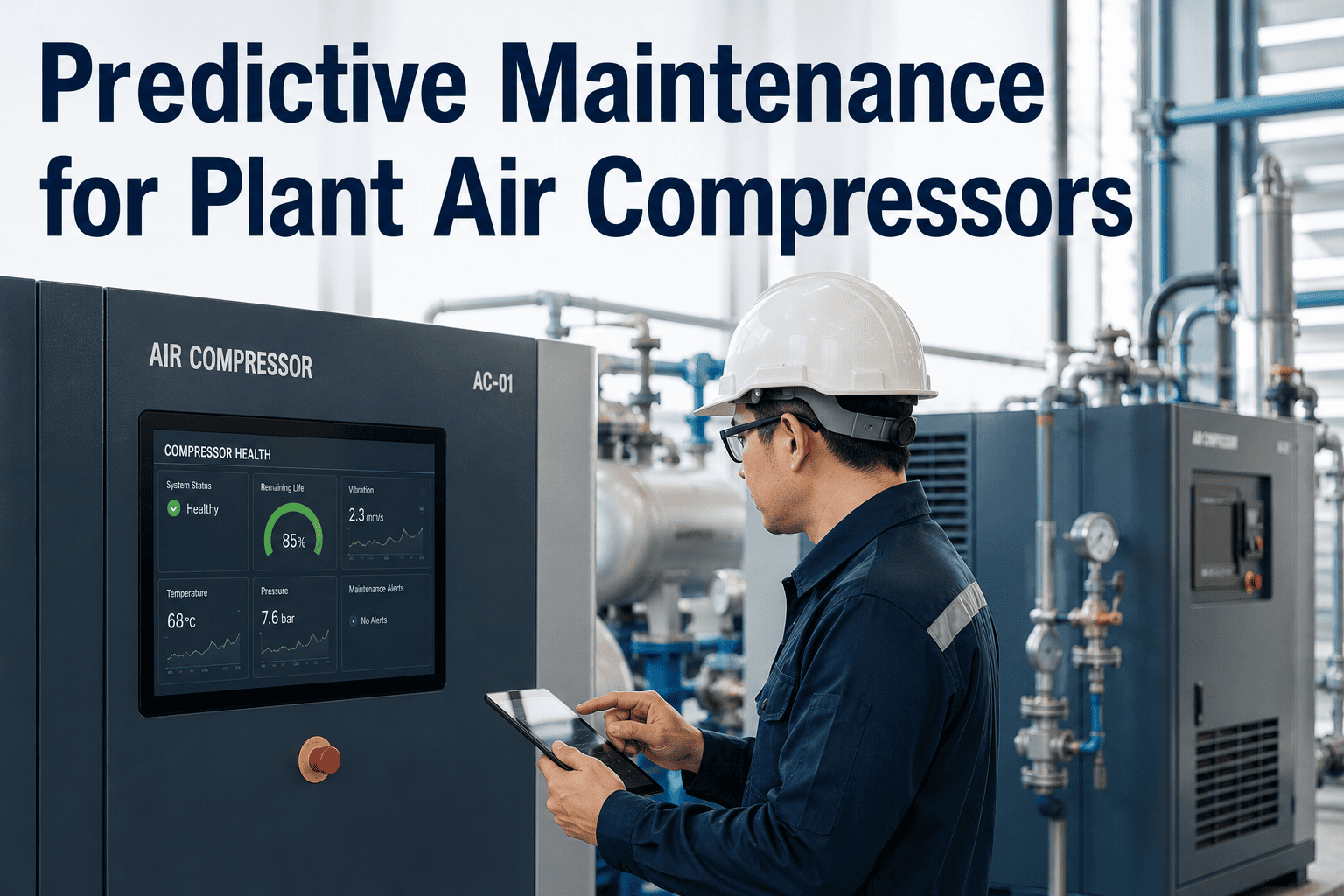
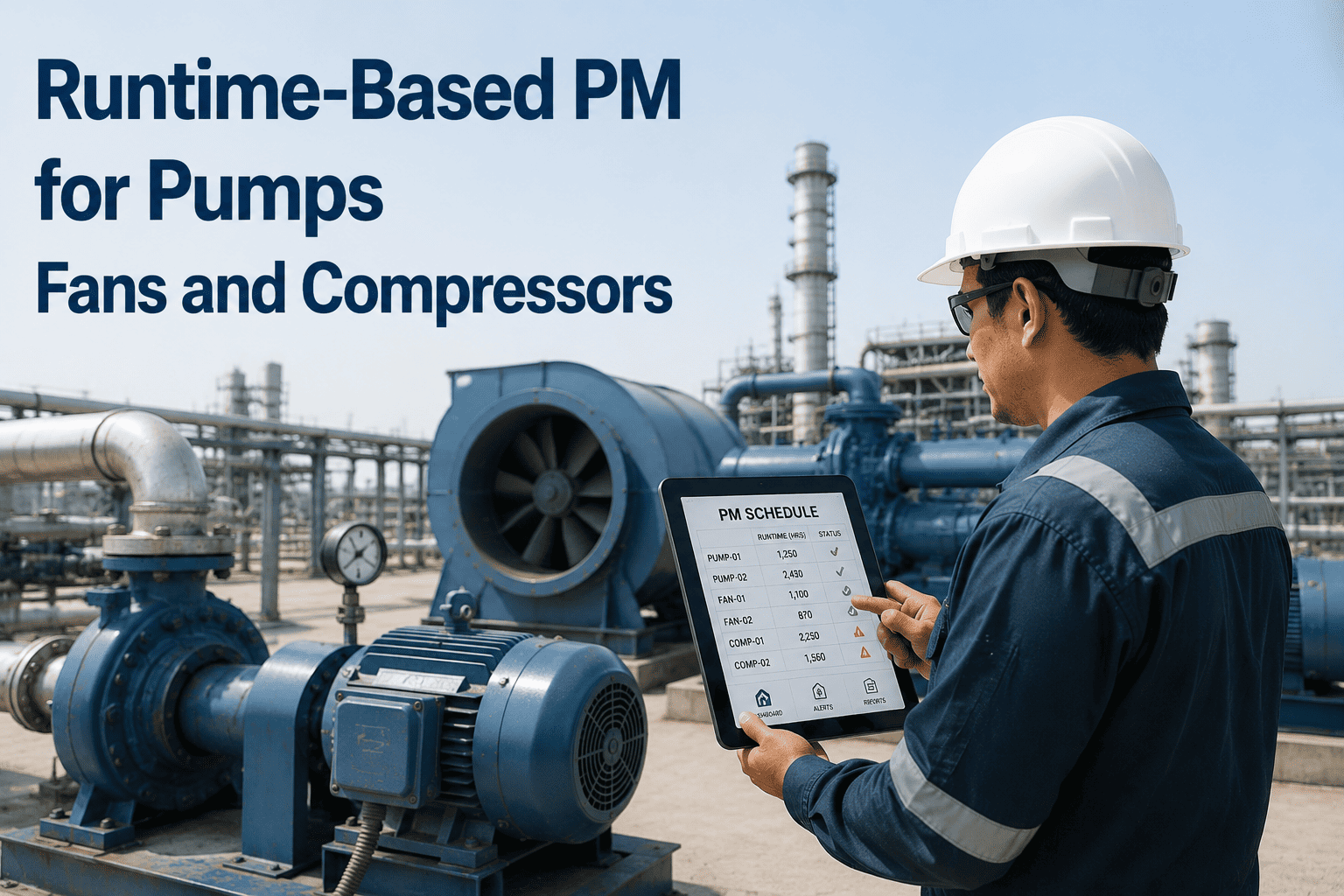
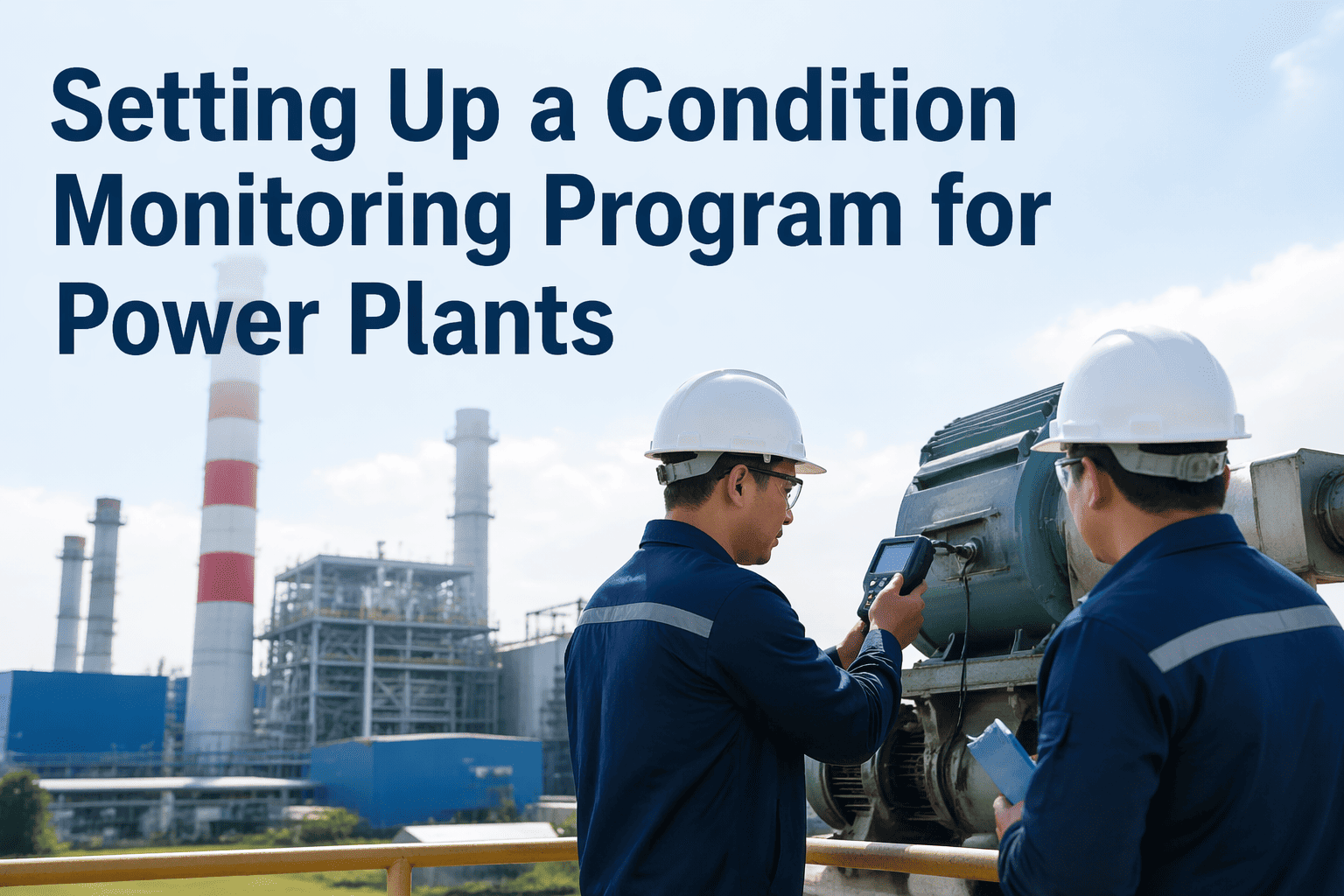
Air compressors are the silent backbone of every power plant — feeding instrument air to control valves, actuators, and pneumatic systems that keep the turbines spinning. When a service air compressor fails without warning, it doesn't just take itself offline. It can cascade into valve malfunctions, process upsets, and forced outages that cost $50,000 to $300,000 per hour in lost generation. Most compressor failures are not sudden — they announce themselves weeks in advance through rising vibration signatures, dropping discharge pressure, extended runtime cycles, and degrading oil condition. The problem isn't that the signals aren't there. The problem is that without a system tracking them continuously, nobody acts until the alarm trips. Start monitoring your compressors free on OxMaint, or book a demo to see how BOP predictive maintenance works in practice.
PREDICTIVE MAINTENANCE · BALANCE OF PLANT · POWER GENERATION
Your Compressor Is Telling You It's About to Fail. Are You Listening?
Vibration drift. Oil contamination. Runtime creep. Pressure drop. Every failing compressor sends signals weeks before it trips. OxMaint captures them automatically and turns them into planned work — before your instrument air system takes down a unit.
3–6 wks
Average advance warning from vibration signatures before bearing failure
68%
Of compressor failures are detectable through condition monitoring before failure
$260K
Average hourly cost of unplanned power plant downtime from cascading BOP failure
THE FAILURE CHAIN
What Actually Happens When a Compressor Fails Without Warning
Instrument air compressor failures don't announce themselves with obvious drama. They follow a predictable degradation curve — and every stage is detectable if you're tracking the right parameters.
Stage 1 · Weeks 1–3
Early Warning — Detectable, Invisible to Most Teams
Bearing housing temperature climbs 8–12°C above baseline. Overall vibration increases measurably but hasn't crossed alarm thresholds. Oil sample shows trace metal particulates. Runtime per cycle extends by 4–7%. Nothing trips. No alert fires. No work order is created.
OxMaint signal: Condition score flags deviation from baseline across 3+ parameters
Stage 2 · Weeks 4–6
Active Degradation — Efficiency Loss Begins
Discharge pressure starts dropping 8–15 PSI from setpoint. Interstage valve wear audible. Intercooler fouling reduces throughput. Oil contamination crosses thresholds. Operators may notice slower valve response on actuated equipment. Still no hard alarm.
OxMaint signal: Automatic work order generated — planned repair before failure window
Stage 3 · Without Intervention
Catastrophic Failure — Cascading Consequences
Bearing seizure or seal blowout forces emergency shutdown. Instrument air pressure drops. Control valves lose actuation. Dependent systems — feedwater control, fuel gas control, cooling tower fans — begin to malfunction. Unit derate or full trip follows.
Without OxMaint: Emergency repair, 12–72 hours offline, $50K–$300K+ in lost generation
WHAT TO MONITOR
The Five Parameters That Predict Compressor Failures
Not every sensor matters equally. These five parameters, tracked continuously and trended against each machine's own baseline, catch 90%+ of compressor failure modes before they become emergencies.
01
Vibration Signature
Overall vibration levels and spectral analysis across drive-end and non-drive-end bearings. Detects imbalance, misalignment, looseness, and bearing defect frequencies 3–6 weeks before physical damage. The single most predictive parameter for rotating equipment health.
Alert threshold: >15% increase from 90-day rolling baseline
02
Discharge Pressure
Continuous monitoring of discharge pressure against setpoint. Pressure drops indicate valve wear, intercooler fouling, or air end degradation. A compressor that can't hold pressure during peak demand is a unit trip waiting to happen.
Alert threshold: >8 PSI drop from setpoint under normal load
03
Runtime Per Cycle
How long the compressor runs to maintain system pressure. Increasing cycle times signal efficiency degradation — the compressor is working harder for the same output. This parameter catches intercooler fouling and valve wear early.
Alert threshold: >10% increase in average run cycle versus 30-day baseline
04
Oil Condition
Fluid viscosity, metal particle count, and water contamination. Oil analysis is the blood test for compressor internals — trace metals indicate bearing and gear wear invisible to external sensors. Best practice is sampling twice yearly at minimum.
Alert threshold: Metal particulates above 20 ppm or viscosity outside ±15% spec
05
Bearing Temperature
Continuous temperature monitoring at drive-end and non-drive-end bearing housings. A climb of 8–12°C above baseline is the first detectable signal of lubrication failure or bearing defect — often weeks before vibration levels escalate.
Alert threshold: >10°C sustained rise above 30-day rolling baseline
OXMAINT · PREDICTIVE MAINTENANCE · BOP SYSTEMS
Stop Finding Out About Compressor Problems at the Worst Possible Time
OxMaint tracks vibration, pressure, runtime, oil condition, and bearing temperature across all your BOP compressors — and automatically creates work orders when parameters drift from baseline. Planned repair instead of emergency response.
HOW OXMAINT WORKS
From Raw Sensor Data to Planned Work Order — Automatically
OxMaint connects condition monitoring data to work order creation and parts staging — closing the gap between a sensor reading and a technician fixing the problem.
▲
Data Ingestion
Sensor data, manual readings, oil analysis results, and runtime logs feed into OxMaint via SCADA/DCS connectors or mobile technician entry. Every reading is timestamped against the asset record.
△
Baseline Trending
OxMaint calculates rolling baselines per asset — not generic thresholds. A compressor that naturally runs warm gets compared against its own history, not a standard spec. Drift from that specific machine's normal triggers alerts.
▴
Alert & Work Order
When parameters cross thresholds, OxMaint auto-generates a work order with condition data attached — no manual translation. The failure code, asset location, recommended action, and required parts are pre-populated from failure mode templates.
▵
Parts & Scheduling
OxMaint checks inventory for required parts before scheduling the work order. Repair is booked in the maintenance window before the predicted failure date — not after the trip. Technician receives mobile notification with full context.
COMPRESSOR TYPES COVERED
Every Compressor in Your BOP — One Monitoring Framework
Instrument Air Compressors
Control valve actuation, positioner supply, and pneumatic system pressure. Failure directly impacts plant controllability. Monitor: discharge pressure, cycle time, dew point, intercooler differential.
Service Air Compressors
Maintenance tools, purging, and general plant use. Higher tolerance for brief outages but sustained failure disrupts maintenance execution and cleaning operations. Monitor: overall pressure, runtime efficiency, oil condition.
Seal Gas Compressors
Critical for gas turbine dry gas seal systems. Seal gas pressure loss is a direct forced outage cause. Monitor: seal gas pressure differential, vibration, bearing temperature, any indication of process gas ingress.
Cooling Tower Pneumatic Systems
Pneumatic actuators on cooling tower fan pitch and louver controls. Degraded compressor performance here reduces condenser vacuum and derates output. Monitor: actuator response time, compressor runtime versus demand.
FREQUENTLY ASKED
Predictive Maintenance for Power Plant Compressors
How often should vibration data be collected on instrument air compressors?
Best practice is continuous online monitoring for unit-critical compressors, with at minimum bi-annual oil sampling and vibration data collection. For plants using periodic collection, a 90-day rolling baseline enables meaningful deviation detection.
OxMaint supports both continuous and scheduled collection workflows in the same asset record.
What's the most common missed failure signal for rotary screw compressors in power plants?
Runtime cycle creep — the gradual extension of run time per cycle — is consistently the earliest and most overlooked indicator. Teams focus on pressure and vibration alarms but rarely trend cycle duration. A 10–15% increase in average runtime typically precedes efficiency collapse by 4–8 weeks and requires no additional sensors to detect.
Can OxMaint connect to existing SCADA or historian data for compressor monitoring?
Yes. OxMaint connects to SCADA and DCS systems via OPC-UA, Modbus, DNP3, and PI Historian connectors. Sensor data flows directly into asset condition records without manual entry.
Book a demo to see the integration workflow for your specific plant DCS.
Is predictive maintenance for compressors cost-effective if we only have 4–6 compressors per plant?
Absolutely — the ROI isn't in the number of compressors, it's in the consequence of one failing at the wrong time. A single instrument air compressor trip that forces a unit derate during peak demand can cost $80,000–$300,000 in lost revenue. The cost of monitoring is a fraction of one avoidable incident per year.
How does OxMaint handle manual oil sample results alongside automated sensor data?
OxMaint treats manual inspection results, lab reports, and sensor readings as unified data against the same asset record. Oil analysis results entered by technicians or imported from lab systems update the same condition trending view as automated sensors. All data is timestamped and visible in the asset's full health history.
Sign up free to explore how this works.
OXMAINT · BOP PREDICTIVE MAINTENANCE · POWER PLANT CMMS
Your Next Forced Outage Is Already Sending Signals. Catch It.
OxMaint gives power plant maintenance teams the tools to track compressor vibration, pressure, runtime, oil condition, and bearing temperature — automatically creating work orders when parameters drift. Stop responding to failures. Start preventing them.