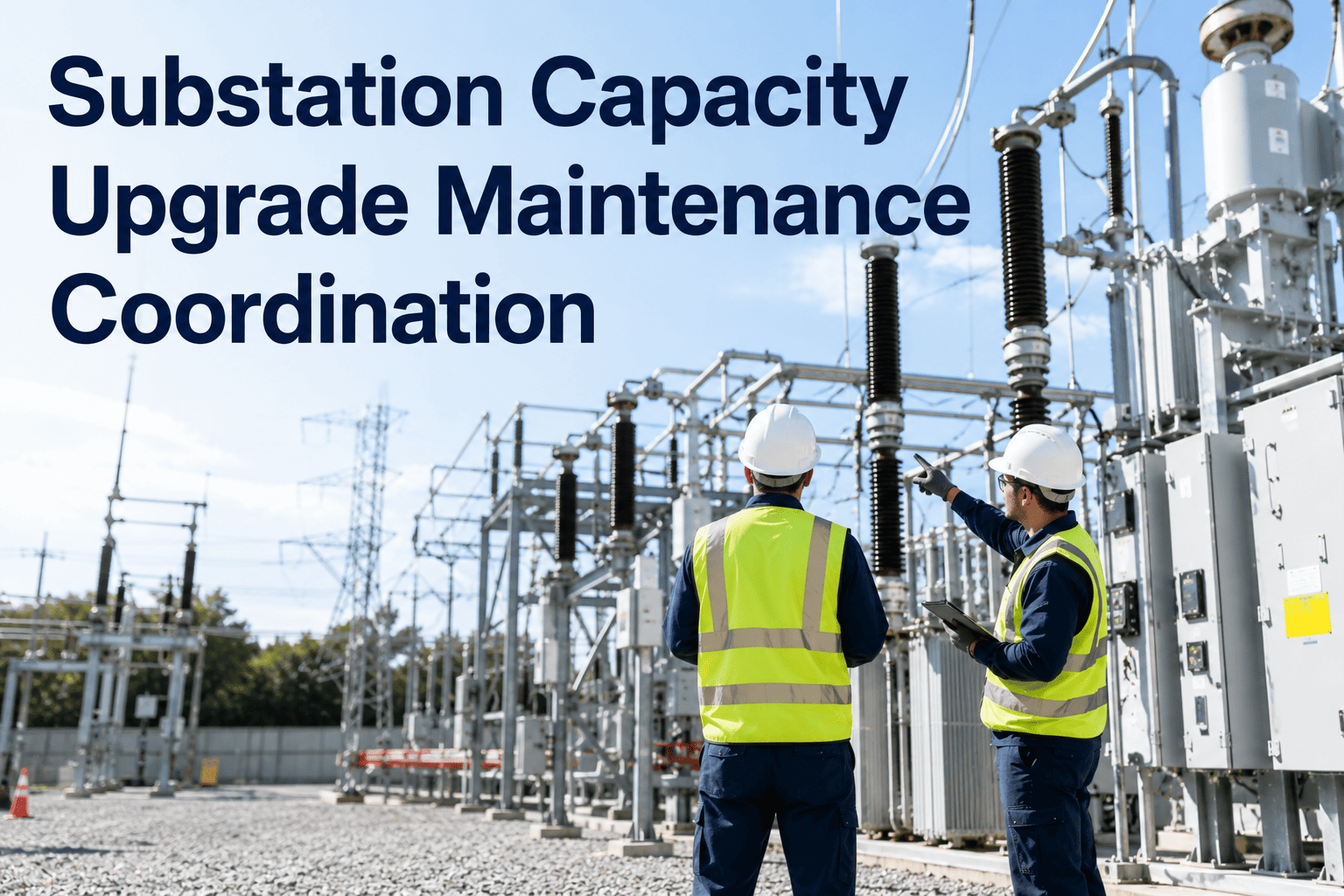
A substation capacity upgrade is not a maintenance task — it is a multi-party coordination event where a single scheduling failure can delay grid modernisation timelines by weeks, expose the utility to NERC reliability standard violations, or strand engineering crews waiting for parts that were not tracked. The convergence of aging grid infrastructure, accelerating DER interconnection queues, and rising load growth from EV and data centre demand has pushed substation upgrade programmes to the top of every transmission and distribution capital plan. Yet the coordination layer — the work management system that sequences transformer removal, civil works, protection relay upgrades, civil reinstatement, and commissioned testing across overlapping crews and contractors — is still managed with email, whiteboards, and spreadsheets in most utility operations teams. Oxmaint's outage planning module closes this coordination gap with a digital substation upgrade workflow that sequences work packages, tracks multi-party progress in real time, and generates the audit trail that NERC compliance requires. Sign up for Oxmaint to begin structuring your next substation upgrade coordination workflow, or book a demo to see the outage planning module configured for a substation upgrade scenario.
Substation Capacity Upgrade Maintenance Coordination
How utilities plan, sequence, assign, and track the multi-party maintenance work packages in a substation capacity upgrade — from pre-outage scope lock to commissioned energisation — using a digital outage planning and work order management platform.
The Five Phases of a Substation Capacity Upgrade — And What Can Go Wrong in Each
Work scope is defined from asset condition assessments, load forecasts, and interconnection queue requirements. Pre-outage borescope and condition inspections confirm the full scope so that mid-outage scope additions — the primary cause of schedule overruns — are eliminated before the outage window opens. All work packages are created, assigned, and sequenced in the Oxmaint outage plan.
NERC TOP/BA outage notifications are filed within the required lead times. Coordination with adjacent utilities and the reliability coordinator confirms that the planned outage window does not conflict with other outages that would reduce grid reliability below N-1 thresholds. NERC non-compliance at this stage carries fines of $1 million or more per violation per day.
Transformer removal, civil foundation upgrade, cable trench work, new transformer installation, bus bar modifications, and switchgear replacement are executed by a mix of internal crews and specialist contractors. Oxmaint sequences these work packages with dependency locking — transformer civil work cannot begin until the transformer removal work order is closed, preventing sequencing errors that delay the critical path.
Protection relay settings are updated to reflect the new transformer capacity and fault current levels. Commissioning testing verifies all protection systems before energisation. This phase is the most technically sensitive and the most frequently delayed — relay commissioning engineers are scarce and each testing window requires the bay to be fully de-energised and isolated under LOTO.
All work orders are confirmed closed, all commissioning test records are signed off, and the energisation authorisation checklist is completed before the outage is cleared and the substation is returned to service. Complete close-out documentation in Oxmaint creates the permanent maintenance and commissioning record that supports warranty claims, NERC audit responses, and future upgrade planning.
Stop Coordinating Substation Upgrades by Email. Start Running Them as a Structured Digital Work Programme.
Oxmaint's outage planning module gives utility project managers a sequenced work package register, dependency-locked work order execution, multi-party contractor visibility, and automated close-out checklists — all in a platform that field crews access from mobile devices without specialist training.
Substation Capacity Upgrade Coordination Checklist — Key Milestones by Phase
- Asset condition assessment completed and scope locked
- Transformer delivery confirmed and lead time tracked
- Civil contractor mobilisation plan confirmed
- Protection relay settings review completed by OEM
- NERC outage notification filed within required lead time
- Adjacent utility coordination confirmed — no N-1 conflict
- LOTO procedure prepared for all affected bay assets
- All work packages created and sequenced in Oxmaint
- LOTO confirmed complete before any crew mobilises to site
- Work package completion status updated in real time
- Contractor handover confirmed in work order — no verbal-only handovers
- Discovery items logged as separate work orders, not added to existing WOs
- Daily progress review against baseline schedule
- Commissioning engineer access confirmed after LOTO sign-off
- Test results uploaded to asset record before bay sign-off
- All work orders confirmed closed — no outstanding open items
- Commissioning test records signed and uploaded
- LOTO removal confirmed and documented
- Asset register updated with new transformer data
- Energisation authority checklist completed by authorised person
- Post-outage NERC notification filed within required window
- Lessons learned work order created for future outage planning
Substation Upgrade Coordination — Questions from Utility Project Managers
Oxmaint's outage planning module supports work order dependency configuration — where a downstream work package (such as protection relay commissioning) cannot be opened or assigned until the upstream work package (LOTO confirmation) is closed and signed off. When a commissioning engineer attempts to access the relay commissioning work order before the LOTO sign-off is complete, the system flags the dependency gap and notifies the outage coordinator. This dependency enforcement replaces the informal coordination that causes the most common and most costly substation upgrade delays — the arrival of specialist contractors before predecessor work is complete. All dependency relationships in the outage plan are visible on the project timeline dashboard, giving the outage coordinator a real-time critical path view across all active work packages. Sign up to configure your next substation upgrade as a sequenced Oxmaint outage plan.
Oxmaint's outage planning module stores the outage notification schedule, the planned outage window, the actual start and end times, and the outage reason classification — all of which are required fields for NERC TOP/BA outage reporting. When the planned outage window is entered in Oxmaint, the system generates a notification checklist that includes the regulatory lead time requirement for that outage type and flags if the notification deadline is approaching without confirmation that the filing has been completed. Post-outage, the actual duration and any extensions are automatically captured from work order close-out timestamps, producing the as-executed outage record that satisfies NERC audit requirements without manual data compilation. Book a demo to see how NERC outage notification compliance is managed in Oxmaint.
Each work package in the Oxmaint outage plan is assigned to a specific crew — internal or contractor — and each contractor crew accesses their work orders through the Oxmaint mobile app with a role-scoped view that shows only the work packages assigned to that contractor, along with the predecessor dependency status. When an internal crew completes a hand-off work package, the contractor crew receives an immediate mobile notification that their work package is ready to begin — eliminating the phone and email coordination that creates hours-long mobilisation delays. All contractor work completion, including checklist sign-offs and photos, is logged in Oxmaint with the contractor identity and timestamp, giving the utility project manager a full audit trail of contractor performance across the outage duration.
Oxmaint includes a parts and procurement tracking function within the work order that can be used to log transformer delivery commitments, track confirmed delivery dates against planned outage windows, and generate alerts when delivery schedule slippage threatens the planned outage start date. For major capital items with 14 to 52-week lead times — power transformers, large switchgear assemblies, and specialty protection relay hardware — Oxmaint creates a procurement tracking work item in the pre-outage phase that flags the outage coordinator if the delivery confirmation has not been received within the required window before the planned outage date. This gives utilities several weeks of advance warning of transformer delivery risk — rather than discovering the supply chain failure when the outage window is already open.
When the outage is closed in Oxmaint, the platform compares the planned versus actual duration for every work package and generates a variance report that identifies which work packages ran over schedule, which ran under, and which triggered dependency delays. This as-executed versus planned comparison is stored as part of the outage record and forms the basis for a lessons learned work item that is automatically created in the Oxmaint planning library. On the next substation upgrade of the same type, the outage template incorporates the duration actuals from prior upgrades — so planning estimates become progressively more accurate as the utility builds an organisational record of real execution data rather than relying on OEM schedule estimates alone. Sign up to start building your utility's outage execution knowledge base.
Every Day Your Substation Upgrade Runs Over Schedule Is a Day Your Grid Modernisation Programme Falls Behind
Oxmaint's outage planning module gives utility project managers sequenced work packages, dependency-enforced execution, multi-contractor real-time visibility, and automated NERC compliance documentation — so your next substation upgrade runs to schedule, on budget, and with a complete audit trail from scope lock to energisation.