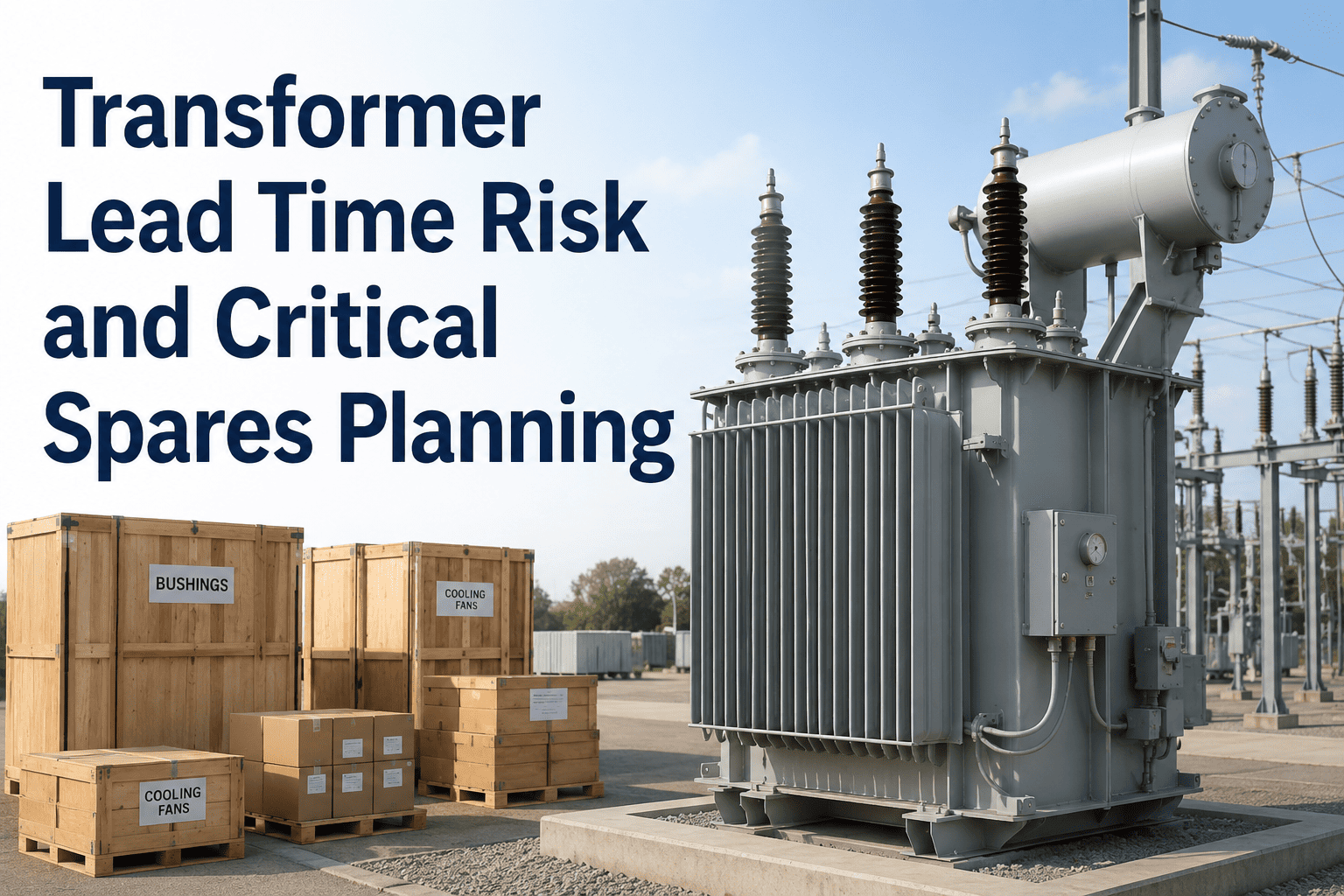
The transformer supply chain has become one of the most consequential bottlenecks in power plant asset management, and the numbers are no longer projections — they are operational reality. Large power transformers now carry average lead times of 128 weeks, with generator step-up units running to 144 weeks, and specialized high-voltage units stretching beyond 200 weeks in many markets. Prices have risen 77% since 2019. A utility or IPP that orders a failed transformer after the failure event will wait two and a half years for a replacement while paying full outage costs throughout. The only rational response to this market reality is a CMMS-driven transformer replacement planning process that identifies units approaching end-of-life years before failure occurs, initiates procurement far ahead of the failure window, and tracks every long-lead item as a strategic supply chain asset. If your transformer replacement decisions are still driven by visible failure symptoms rather than trending asset health data, start a free Oxmaint trial and begin building the replacement intelligence your procurement team needs now.
Transformer Supply Chain Guide — 2026
Transformer Replacement Planning When Lead Times Stretch to Years
How power plants use CMMS-driven asset health tracking, remaining useful life analysis, and inventory management to survive a market where lead times exceed two years.
Current Transformer Lead Time Reality
Distribution
52–80 wks
Power Transformer
128 wks avg
Generator Step-Up
144 wks avg
Large / Custom
200+ wks
Old Model (Reactive)
Wait for DGA alert or visible failure symptom
Issue emergency replacement order
Accept 2+ year delivery timeline
Pay emergency procurement premium (2–4x)
Carry full outage costs for 128+ weeks
Discover the replacement doesn't match plant specs
CMMS-Driven Model (Predictive)
Trend oil quality, thermal, and DGA data continuously
Identify units in a 3–5 year replacement window
Initiate procurement 30–36 months before predicted failure
Negotiate at standard pricing with selected suppliers
Plan replacement during a scheduled outage window
Replacement arrives before the failure does
01
Remaining Useful Life (RUL) Estimation
The IEEE Std C57.91 thermal aging model relates winding temperature to insulation degradation rate. CMMS integrates temperature history with load data to calculate cumulative thermal aging and estimate remaining insulation life — the primary determinant of transformer end-of-life. Units projecting less than 5 years of remaining life at current load levels automatically generate a replacement planning work order flag for engineering review.
02
Dissolved Gas Analysis Trend Severity Index
A single DGA sample showing elevated acetylene may be an anomaly. A DGA trend showing consistent increase in ethylene, carbon monoxide, and hydrogen across 6 quarters is a failure progression. CMMS calculates a trend severity index from sequential DGA results and projects the timeline to action levels — giving procurement a decision point months before the transformer reaches a refusal-to-operate condition.
03
Load Growth Projection vs. Rated Capacity
Transformers running at 85–95% of rated capacity face significantly accelerated aging compared to design-load operation. CMMS tracks actual load history and integrates plant capacity expansion plans to project when a transformer will be persistently overloaded. A unit that currently operates at 78% utilization but is serving a load area growing at 6% annually has a definable date when replacement becomes operationally necessary — independent of failure risk.
04
Maintenance Cost Escalation Curve
Aging transformers require progressively more intensive maintenance — more frequent oil treatments, bushing replacements, gasket renewals, and on-load tap changer refurbishments. CMMS tracks cumulative maintenance cost per asset and calculates the annual maintenance cost as a percentage of replacement value. When this ratio exceeds 8–12%, replacement economics typically favor procurement over continued maintenance — a quantitative trigger that's visible only in CMMS data.
05
Parts Obsolescence and Spare Availability
Transformers older than 25–30 years increasingly rely on spare parts from manufacturers who have discontinued production or exited the market. When CMMS spare parts records show zero inventory and no procurement source for a critical component — bushing type, tap changer mechanism, surge arrester — replacement planning must begin regardless of the thermal aging or DGA status. Parts obsolescence is an often-overlooked replacement trigger that CMMS inventory data surfaces automatically.
Transformer Inventory Management
Start the Replacement Clock 3 Years Before You Need To
Oxmaint CMMS tracks RUL trending, DGA severity, maintenance cost escalation, and parts obsolescence across your entire transformer fleet — surfacing replacement candidates years ahead of the failure window, so procurement has time to work at normal lead times and negotiated pricing.
36–48 Months Before
Flag and Classify
CMMS identifies transformer unit crossing RUL threshold or DGA severity index. Engineering reviews and classifies: Replace at next outage window, Replace on failure, or Extend with remediation plan. Units classified for replacement enter the procurement pipeline.
30–36 Months Before
Specification Development
CMMS asset record provides the complete technical specification basis: rated capacity, voltage ratio, impedance, cooling class, tap range, bushing configuration, and physical dimensions. Procurement uses CMMS data to issue RFQs to multiple manufacturers simultaneously — no specification development delay.
24–30 Months Before
Order Placement and Delivery Tracking
Purchase order placed at standard commercial terms. CMMS creates a linked spare transformer inventory record with expected delivery date and milestone tracking. Factory acceptance test dates, shipping schedule, and site delivery confirmation are tracked as sub-tasks within the CMMS procurement workflow.
6–12 Months Before
Outage Window Alignment
With the replacement unit confirmed in delivery, CMMS outage planning module aligns the installation with the next scheduled maintenance outage — civil preparation, crane access, oil handling, and commissioning all scheduled as dependent work orders within the outage package.
At Replacement
Execution and Asset Record Transfer
Installation work order completed in CMMS. New transformer asset record created with factory test certificates, nameplate data, installation date, and initial oil sample results attached. Old unit's full maintenance history is archived — creating the continuous asset lifecycle record that supports future replacement planning for the new unit.
How long does a large power transformer take to procure in 2025–2026?
Standard power transformers are averaging 128 weeks (nearly 2.5 years) from order to delivery as of 2025–2026, with generator step-up units at 144 weeks and large custom units exceeding 200 weeks in many cases. Prices have risen approximately 77% since 2019. Planning replacement procurement 30–36 months before the need window is the minimum safe lead time. Oxmaint's RUL tracking ensures your replacement flags appear within that planning window.
What CMMS data is most important for transformer replacement decision-making?
The most actionable decision inputs are: DGA trend over 4–6 sequential samples (not individual readings), cumulative thermal aging calculated from winding temperature history, maintenance cost as a percentage of replacement value trending over 3+ years, and spare parts availability for the unit's critical components. Any one of these individually can justify a replacement flag; all four trending unfavorably simultaneously makes replacement planning urgent. Book a demo to see how Oxmaint surfaces these signals automatically.
Should we hold a spare transformer in inventory given current lead times?
For transformers that are critical single points of failure and whose replacement would cause extended generation outages, holding a spare unit or participating in a regional spare-sharing consortium is increasingly justified by the current market. CMMS tracks the spare transformer as an inventory asset with a linked maintenance schedule to prevent storage degradation — the spare itself requires oil sampling, heating, and periodic inspection to remain serviceable.
How does transformer age alone compare to condition-based data for replacement decisions?
Age alone is a poor replacement trigger — well-maintained transformers regularly operate reliably for 40–50 years, while poorly maintained units can fail at 15 years. Condition-based data from CMMS (DGA trends, thermal history, oil quality, maintenance cost escalation) is far more predictive than age. However, age does become relevant as a parts obsolescence risk factor after approximately 30 years, when spare components begin disappearing from manufacturer catalogs.
How does Oxmaint CMMS support transformer procurement specification development?
Oxmaint stores the complete technical asset record for every transformer — nameplate data, voltage ratio, impedance, tap range, cooling class, bushing configuration, and physical dimensions — alongside test certificates and maintenance history. When a replacement flag is triggered, procurement can pull the full specification directly from the CMMS asset record with no engineering reconstruction required. This alone reduces specification development time from weeks to hours. Start a free trial to build your transformer asset registry.
Inventory and Supply Chain CMMS
128-Week Lead Times Are Not a Supply Chain Problem. They Are a Planning Problem.
Oxmaint gives your reliability team the RUL tracking, DGA trending, maintenance cost analysis, and procurement pipeline visibility to identify replacement candidates years before the failure window — so your transformers arrive before they are needed, not after they fail.