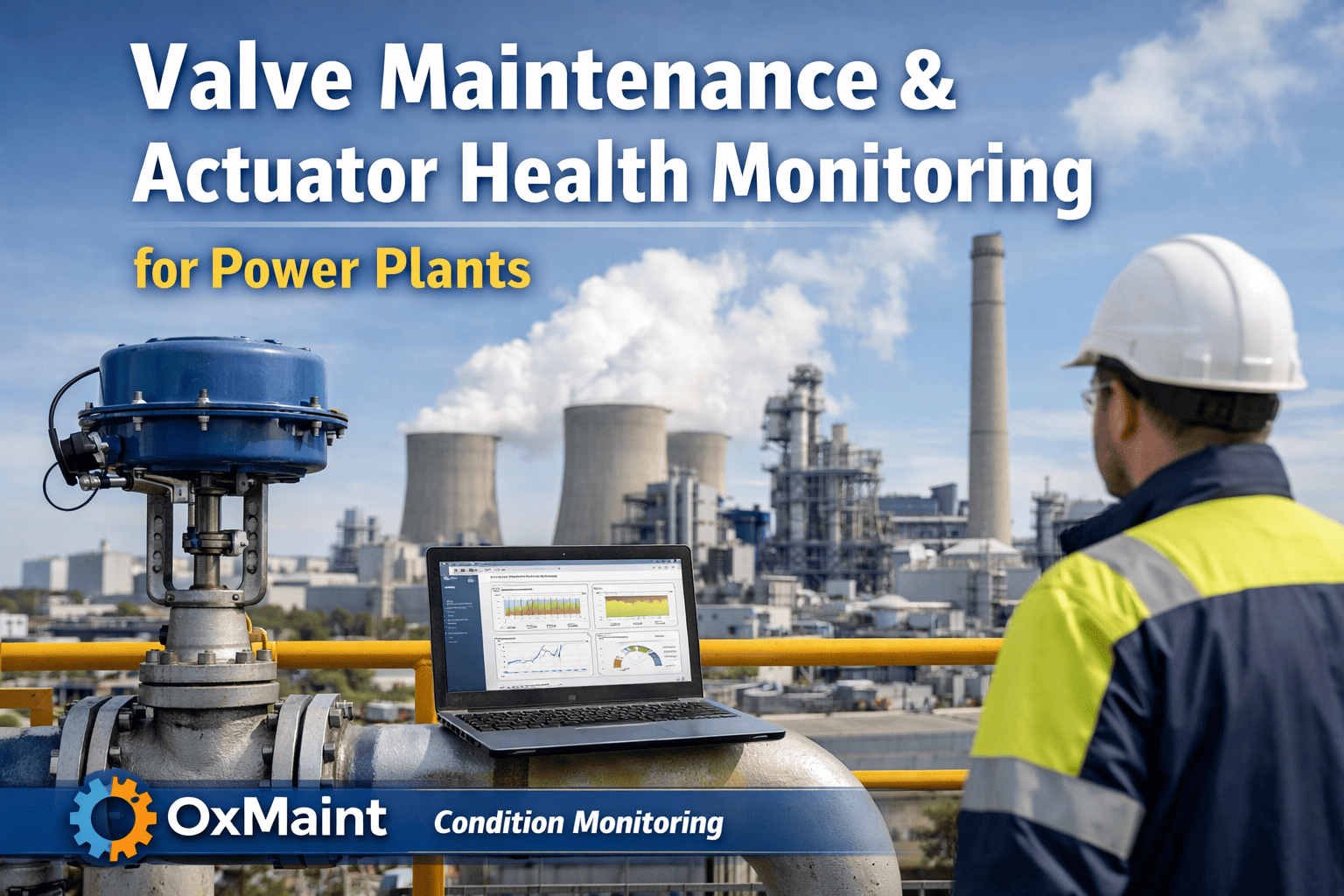
Valve actuators in process plants accumulate thousands of operating cycles before anyone checks their condition. By the time a technician discovers a seized actuator or a burned-out motor, the production line is already down, emergency repairs are underway, and the cost has multiplied tenfold. Runtime-based maintenance flips that equation—tracking actual operating hours, cycle counts, and torque loads so your team services actuators precisely when they need it, not on arbitrary calendar schedules. Sign up for Oxmaint and start tracking valve actuator runtime data from day one across your entire facility.
67%
Of actuator failures occur before scheduled PM dates
$18K
Average cost per unplanned valve actuator failure event
3.2x
Longer actuator lifespan with runtime-based servicing
42%
Reduction in spare parts inventory with usage tracking
Most facilities still service valve actuators on fixed 6-month or 12-month intervals regardless of how heavily each actuator has been used. A cooling water isolation valve that cycles twice a day receives the same maintenance attention as a batch reactor feed valve cycling 200 times per shift. The result is chronic over-maintenance on low-duty actuators and dangerous under-maintenance on high-duty ones. Runtime-based maintenance eliminates this mismatch by triggering service events based on actual operational data—cycle counts, cumulative torque, motor run-hours, and stem travel distance. Plants that switch to this model consistently see fewer surprise failures and lower total maintenance spend. Book a demo to see runtime-triggered work orders in action inside the Oxmaint CMMS platform.
Key Insight
73% of actuator motor burnouts
are directly linked to excessive cycle accumulation between service intervals. Facilities using runtime thresholds instead of calendar dates catch degradation an average of 6 weeks earlier—before torque spikes damage gearboxes and valve seats.
Critical Runtime Parameters for Valve Actuator Health
Effective runtime-based maintenance depends on tracking the right operational parameters. Each data point tells a different story about actuator condition, and together they form a complete health profile that no calendar schedule can replicate.
Actuator Health Core
CYC
Cycle Count Tracking
Total open-close cycles accumulate mechanical wear on gears, seals, and stem packing. Each actuator type has a manufacturer-rated cycle life—typically 10,000 to 60,000 cycles. Runtime tracking compares current count against rated life to schedule lubrication, packing replacement, and gearbox inspections at the right intervals.
+ Gear tooth wear before torque spikes
+ Packing degradation before external leaks
TRQ
Torque Profile Monitoring
Cumulative torque load reveals how hard an actuator works over time. Rising torque trends indicate valve seat wear, stem corrosion, or process buildup that increases operating resistance. Tracking torque against cycle count creates a degradation curve unique to each actuator-valve combination.
Electric actuator motors have finite winding insulation life that degrades with heat exposure over operating hours. Tracking cumulative run-hours alongside motor temperature data predicts insulation breakdown and bearing wear. This prevents catastrophic motor failures that strand valves in mid-position.
+ Winding insulation degradation before burnout
+ Motor bearing wear before seizure
STV
Stem Travel Distance
Total linear or rotary travel distance accumulates wear on stem threads, thrust bearings, and guide bushings. Actuators on modulating service log far more travel distance than on-off valves despite similar cycle counts. Tracking travel separately ensures modulating actuators get appropriately frequent attention.
+ Thrust bearing wear before positioning errors
+ Thread damage before stem binding
ENV
Environmental Exposure Hours
Actuators in corrosive, high-humidity, or extreme temperature environments degrade faster than those in controlled settings. Tracking cumulative exposure hours alongside ambient condition data adjusts maintenance thresholds to account for accelerated degradation from harsh operating environments.
+ Enclosure seal failure before moisture ingress
+ Corrosion progression before structural compromise
Track every actuator parameter in one dashboard. Oxmaint captures cycle counts, torque profiles, run-hours, and environmental data—then auto-generates work orders when thresholds are reached.
Different actuator technologies wear at different rates and require distinct runtime thresholds. The table below provides baseline service intervals that your Oxmaint CMMS can automatically enforce based on real-time runtime data from each unit.
Actuator Type
Lubrication Interval
Packing / Seal Service
Gearbox Inspection
Full Overhaul
Multi-Turn Electric
Every 5,000 cycles
Every 10,000 cycles
Every 20,000 cycles
Every 50,000 cycles
Quarter-Turn Electric
Every 10,000 cycles
Every 25,000 cycles
Every 40,000 cycles
Every 80,000 cycles
Pneumatic Diaphragm
Every 2,000 run-hours
Every 4,000 run-hours
N/A
Every 8,000 run-hours
Pneumatic Piston
Every 15,000 cycles
Every 30,000 cycles
N/A
Every 60,000 cycles
Hydraulic Linear
Every 1,500 run-hours
Every 3,000 run-hours
Every 5,000 run-hours
Every 10,000 run-hours
Electro-Hydraulic
Every 3,000 run-hours
Every 6,000 run-hours
Every 8,000 run-hours
Every 15,000 run-hours
Calendar vs. Runtime Maintenance: Side-by-Side Comparison
The operational difference between calendar-based and runtime-based valve actuator maintenance is measurable across every performance metric that matters to plant reliability engineers and maintenance managers.
Calendar-Based Maintenance
− Fixed 6-month or annual intervals regardless of usage
− No visibility into actual actuator health between PMs
− Technician time allocated by schedule, not by need
Runtime-Based Maintenance
+ Service triggered by cycle count, torque, and run-hours
+ Each actuator maintained according to its actual duty
+ High-duty units flagged early, preventing failures
+ Parts ordered based on predicted consumption data
+ Continuous health scoring between maintenance events
+ Technician allocation optimized by actual equipment need
Implementing Runtime-Based Actuator Maintenance: Step by Step
Transitioning from calendar schedules to runtime-based valve actuator maintenance is a structured process. Here is the proven implementation path that facilities follow to get measurable results within 90 days.
1
Week 1-2
Actuator Census and Criticality Ranking
Inventory every valve actuator by type, manufacturer, service class, and process criticality. Assign criticality tiers (A/B/C) based on production impact, safety function, and replacement lead time. This census becomes your asset register in the CMMS. Create your free Oxmaint account and build your actuator asset register in minutes using mobile barcode scanning.
2
Week 3-4
Install Runtime Data Collection Points
Deploy cycle counters, run-hour meters, and torque monitoring on Tier-A actuators first. Connect smart actuators with built-in diagnostics directly to the CMMS via fieldbus or wireless gateway. For legacy actuators, install bolt-on IoT cycle counters that report wirelessly to your maintenance dashboard.
3
Week 5-6
Configure Runtime Thresholds in CMMS
Set cycle-based, hour-based, and torque-based maintenance triggers for each actuator type using manufacturer recommendations and plant operating history. Oxmaint auto-generates work orders when any threshold is reached, assigning them to the right technician with the correct procedure and spare parts list attached.
4
Week 7-10
Baseline and Calibrate
Run the system in parallel with existing calendar schedules for 4 weeks. Compare runtime-triggered alerts against scheduled PMs to validate threshold accuracy. Adjust thresholds based on actual plant conditions, process variability, and technician feedback from field inspections.
5
Week 11-12
Go Live and Expand
Retire calendar-based PM schedules for Tier-A actuators and operate fully on runtime triggers. Document early results—reduced work orders, fewer emergency calls, parts savings—then expand to Tier-B and Tier-C actuators using the validated threshold model.
Ready to eliminate guesswork from actuator maintenance? Oxmaint configures runtime thresholds for every actuator type in your plant and auto-generates work orders the moment service is actually needed.
CMMS Features That Power Runtime-Based Actuator Programs
A capable CMMS is the backbone of any runtime-based maintenance program. Here are the specific platform capabilities that make actuator runtime tracking operationally practical at scale.
Multi-Parameter Threshold Triggers
Set independent maintenance triggers for cycles, run-hours, torque deviation, and environmental exposure on every actuator. Work orders fire automatically when any parameter crosses its threshold—no manual checking required.
Auto Work OrdersCustom Thresholds
Real-Time Runtime Dashboards
Live dashboards display current runtime metrics for every actuator alongside percentage-to-next-service indicators. Maintenance planners see at a glance which actuators are approaching thresholds and can coordinate service windows accordingly.
Live MonitoringHealth Scoring
Digital Maintenance Procedures
Attach actuator-specific service procedures, torque specs, lubrication charts, and safety lockout requirements directly to each work order. Technicians access step-by-step instructions on mobile devices at the valve location.
Mobile AccessProcedure Library
Spare Parts Forecasting
Runtime data predicts when specific actuator components will need replacement. The CMMS forecasts parts demand based on fleet-wide runtime consumption rates, triggering purchase orders before stock-outs cause maintenance delays.
Inventory SyncAuto Reorder
Actuator Failure Modes Detected by Runtime Monitoring
Runtime-based monitoring catches specific failure modes at their earliest stages—long before they progress to equipment damage or process upset. Each parameter tracked by your Oxmaint CMMS maps directly to actionable failure detection.
Mechanical Wear
Gear tooth erosion — detected by rising torque per cycle over time
Stem thread damage — detected by travel distance deviation from baseline
Thrust bearing fatigue — detected by cumulative axial load calculations
Electrical Degradation
Motor insulation breakdown — detected by run-hour accumulation plus temperature
Contactor pitting — detected by start-stop cycle count thresholds
Wiring fatigue — detected by cumulative vibration exposure hours
Seal and Packing Failures
Stem packing wear — detected by cycle count against packing material ratings
O-ring degradation — detected by environmental exposure hours and temperature
Enclosure seal failure — detected by humidity exposure duration thresholds
Process-Related Damage
Valve seat erosion — detected by progressive torque increase per thousand cycles
Scaling and buildup — detected by stroke time elongation tracking
Corrosion progression — detected by environmental hour thresholds with chemistry data
We had 14 unplanned actuator failures in Q1 before switching to runtime-based maintenance through Oxmaint. In the two quarters since, we have had exactly one—and it was on an actuator we had not yet migrated to the new system. The data does not lie: runtime tracking works.
Stop Guessing When Your Valve Actuators Need Service
Oxmaint tracks every cycle, every run-hour, and every torque reading across your entire actuator fleet. When maintenance is actually needed, the system generates the work order, attaches the procedure, reserves the parts, and assigns the technician—automatically.
What runtime data do I need to start tracking for valve actuators?
At minimum, track cycle counts and motor run-hours for electric actuators, and cycle counts plus air supply hours for pneumatic actuators. Torque trending and environmental exposure tracking add deeper insight but can be phased in after initial deployment. Sign up for Oxmaint to configure runtime parameters for every actuator type in your plant within minutes.
Can runtime-based maintenance work on older actuators without built-in diagnostics?
Yes. Bolt-on IoT cycle counters and wireless vibration sensors retrofit onto legacy actuators without any modification to the actuator itself. These devices transmit runtime data directly to your CMMS, bringing decades-old actuators into the runtime-based maintenance program alongside newer smart units.
How does a CMMS handle actuators with different runtime thresholds?
Oxmaint allows you to define unique threshold profiles for each actuator type, manufacturer model, and service class. A multi-turn electric actuator on a critical isolation valve will have different cycle-based triggers than a quarter-turn pneumatic on a utility bypass. Book a demo to see how threshold profiles are configured and managed at scale across hundreds of actuators.
What happens when multiple runtime thresholds trigger at the same time?
The CMMS consolidates overlapping triggers into a single comprehensive work order. If cycle count, torque deviation, and run-hours all indicate service is needed, the work order includes all applicable maintenance tasks so the technician addresses everything in one visit—eliminating redundant trips to the same valve.
How quickly can we transition from calendar to runtime-based actuator maintenance?
Most facilities complete the transition for critical actuators within 12 weeks using the phased approach outlined above. The CMMS setup itself takes days, not weeks. The majority of implementation time is spent on sensor installation and threshold calibration against your specific operating conditions.