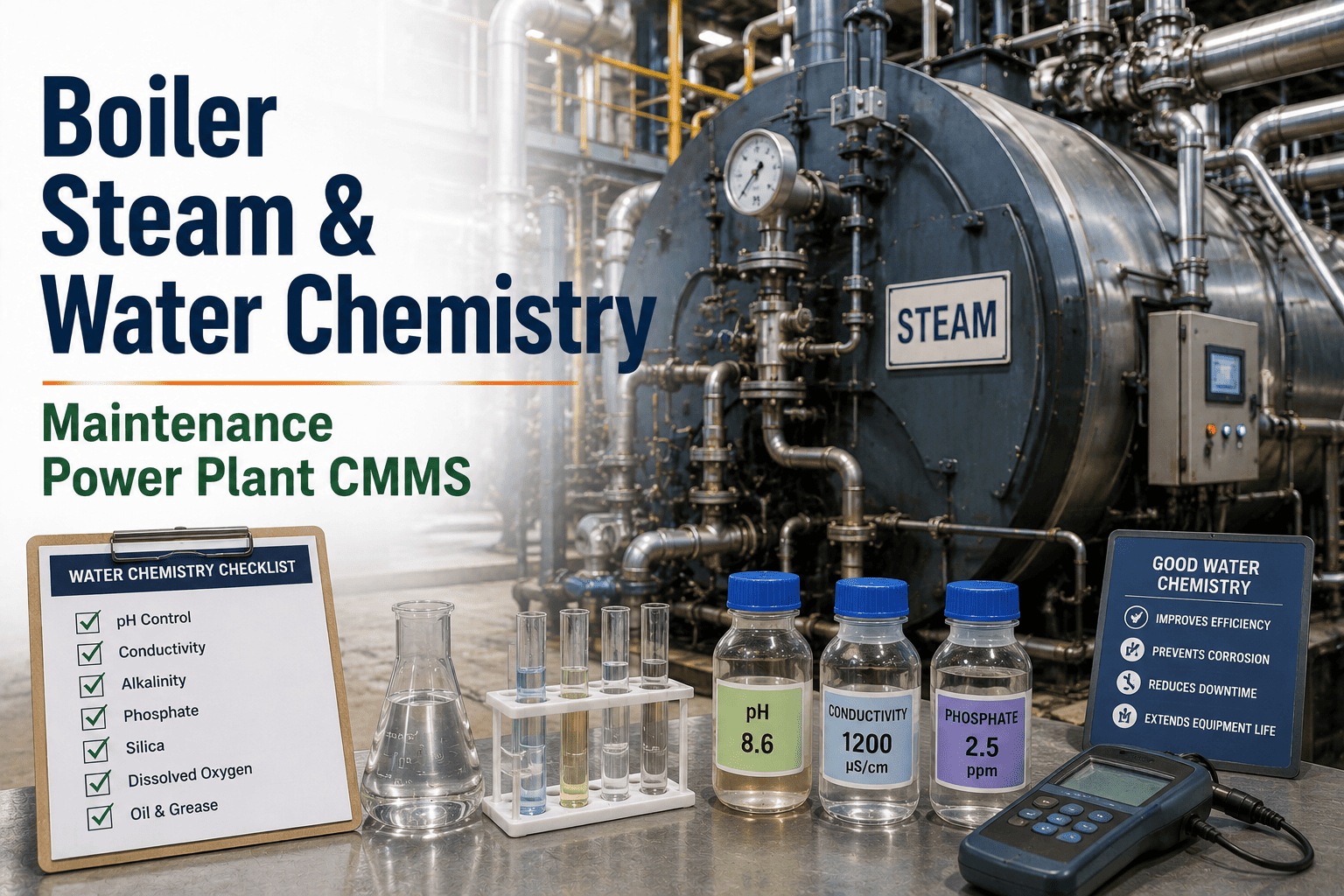
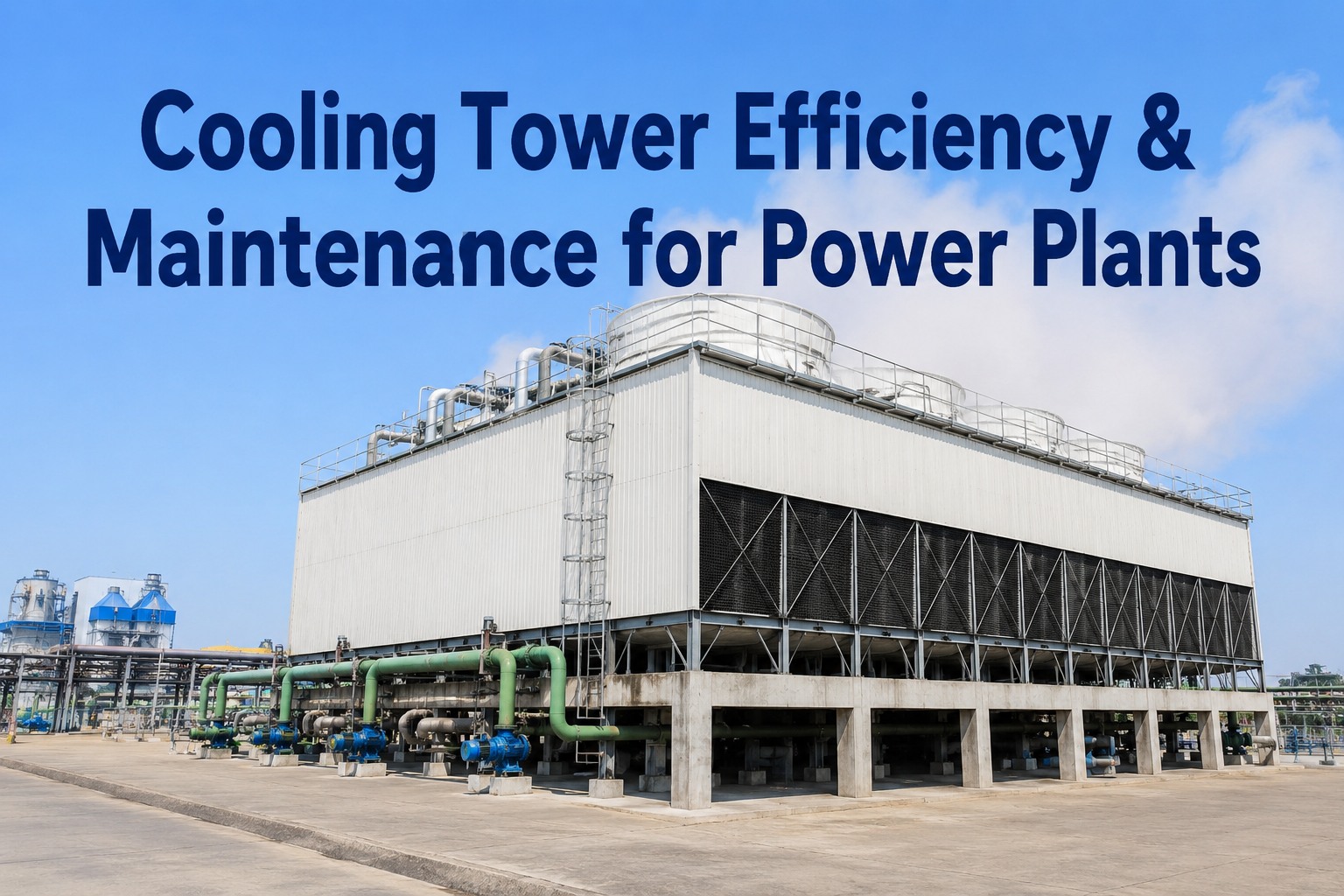
Water chemistry failures are silent — they build slowly inside boiler tubes, heat exchangers, and cooling towers before surfacing as unplanned shutdowns, accelerated corrosion, or costly equipment replacements. Power plant engineers managing feedwater quality, boiler scaling, and steam purity deal with a narrow margin for error: a 1 mm scale deposit on a boiler tube surface can increase fuel consumption by up to 7%, and untreated corrosion can cut component lifespan in half. This checklist maps every critical water chemistry control point — from feedwater treatment to cooling tower blowdown — so your team catches imbalances before they cascade into plant-wide failures. For teams ready to move beyond paper logs, OxMaint's digital maintenance platform turns every chemistry check into a timestamped, audit-ready record with automatic work order generation when parameters drift out of range.
Power Plant Operations · Water Treatment · Maintenance Checklist
Water Chemistry Problems in Power Plants
Corrosion, scaling, and steam contamination cost power plants millions annually — yet most failures trace back to missed chemistry checks. This guide covers every critical control point your maintenance team must verify.
7%
Fuel loss per 1 mm scale deposit on boiler tubes
40%
Of boiler failures linked to poor water chemistry
2×
Faster component wear from unchecked corrosion
$2M+
Average unplanned shutdown cost from chemistry failures
Core Problems
The 5 Water Chemistry Problems Costing Your Plant the Most
Each problem below represents a documented failure mode with measurable financial and operational consequences. Understanding the root cause is the first step — catching it early through structured monitoring is the fix.
01
Boiler Scale Deposits
Calcium and magnesium hardness in feedwater precipitates onto heat transfer surfaces under high temperature. Scale acts as insulation, forcing higher metal temperatures and increasing fuel consumption. Severe build-up causes tube overheating and rupture.
Trigger: Feedwater hardness > 0.1 ppm, pH drift below 8.5
02
Oxygen Pitting Corrosion
Dissolved oxygen in feedwater attacks boiler metal surfaces, creating deep pits that weaken tube walls. Even trace concentrations (above 7 ppb) in high-pressure systems accelerate metal loss faster than any other corrosion mechanism.
Trigger: DO > 7 ppb in HP feedwater, deaerator malfunction
03
Steam Purity Contamination
Boiler water carryover deposits silica and sodium salts on turbine blades and superheater tubes, causing blade erosion, efficiency loss, and deposit-induced cracking. Steam purity violations are among the costliest chemistry failures to reverse.
Trigger: Steam sodium > 10 ppb, silica carryover > 20 ppb
04
Cooling Tower Bio-fouling
Inadequate biocide dosing allows microbial colonies — including Legionella — to establish in cooling water systems. Biofilm reduces heat exchanger efficiency by 10–15% and poses serious regulatory and health risks requiring immediate remediation.
Trigger: Biocide residual below spec, pH drift, high turbidity
05
Acid/Caustic Concentration Swings
pH swings outside the 8.5–9.5 operating window in boiler water drive either acidic corrosion (low pH) or caustic stress corrosion cracking (high pH). Both failure modes are irreversible once metal damage begins and require full tube replacement.
Trigger: pH below 8.5 or above 10.5, conductivity spikes
Failure Chain
How Water Chemistry Failures Cascade
1
Chemistry Drift
pH, dissolved oxygen, or hardness moves outside specification — often undetected without regular sampling
→
2
Surface Attack
Scale forms or corrosion begins on heat transfer surfaces, turbine blades, or condensate lines
→
3
Efficiency Loss
Insulating scale drives up fuel costs; corrosion pitting thins metal walls and stresses components
→
4
Forced Outage
Tube failure, turbine damage, or regulatory violation triggers emergency shutdown — average cost exceeds $2M
Zone 01 — Feedwater
Feedwater Quality Control Checklist
Feedwater is the starting point of every chemistry problem downstream. Any contaminant entering the boiler with feedwater will concentrate with each evaporation cycle. These checks must run every shift for high-pressure units.
Dissolved Gas Control
Dissolved oxygen measured at deaerator outlet — maintain below 7 ppb for high-pressure boilers, below 20 ppb for LP units
Record: DO sampling log · Frequency: Every shift · Role: Water Treatment Chemist
Deaerator operating pressure and steam flow verified — low steam supply reduces oxygen scrubbing efficiency immediately
Record: Deaerator operating log · Frequency: Every shift · Role: Boiler Operator
Carbon dioxide concentration checked in condensate return — CO₂ drives condensate corrosion in return lines and feed heaters
Record: Condensate chemistry log · Frequency: Daily · Role: Water Treatment Chemist
Hardness & Contamination
Total hardness tested at demineraliser outlet — zero hardness target; any breakthrough above 0.1 ppm triggers immediate investigation
Record: DM plant log · Frequency: Every shift · Role: Water Treatment Chemist
Feedwater pH maintained between 8.8 and 9.2 — verify chemical dosing pumps for ammonia or morpholine are operating correctly
Record: pH dosing log · Frequency: Every shift · Role: Boiler Operator
Silica in feedwater below 0.02 ppm — silica carryover to steam turbines causes blade deposits and efficiency degradation
Record: Silica analysis log · Frequency: Daily · Role: Laboratory Analyst
Iron and copper content verified — iron above 10 ppb or copper above 2 ppb indicates active corrosion somewhere in the pre-boiler circuit
Record: Metal ion log · Frequency: Daily · Role: Laboratory Analyst
Zone 02 — Boiler Water
Boiler Water Chemistry Checklist
Boiler water chemistry operates within tighter tolerances than feedwater because concentration effects are extreme. A minor contamination in feedwater becomes a major contaminant after 50 cycles of concentration inside the drum.
pH & Alkalinity Control
Boiler water pH maintained between 9.0 and 10.5 depending on drum pressure — low pH drives acid attack; high pH causes caustic gouging
Record: Boiler water log · Frequency: Every shift · Role: Boiler Operator
Phosphate residual confirmed within treatment programme target — phosphate sludge conditioning prevents scale adhesion to drum surfaces
Record: Chemical dosing log · Frequency: Every shift · Role: Water Treatment Chemist
Conductivity & Blowdown
Specific conductivity monitored and continuous blowdown rate adjusted to maintain TDS within drum design limits
Record: Blowdown control log · Frequency: Every shift · Role: Boiler Operator
Bottom blowdown executed on schedule — removes accumulated sludge from drum bottom; log duration and valve condition
Record: Blowdown schedule log · Frequency: Per schedule · Role: Boiler Operator
Chloride content checked — chloride above 1 ppm in drum water accelerates stress corrosion cracking in austenitic steel components
Record: Chloride analysis log · Frequency: Daily · Role: Laboratory Analyst
Replace manual chemistry logs with digital records that auto-escalate when parameters drift — no missed checks, no paper rekeying.
Zone 03 — Steam & Condensate
Steam Purity & Condensate Return Checklist
Steam Quality Monitoring
Steam sodium content verified below 10 ppb — sodium carryover is the primary indicator of boiler water priming or foaming
Record: Steam purity log · Frequency: Daily · Role: Laboratory Analyst
Steam silica monitored at turbine inlet — silica above 20 ppb deposits on blades and stationary nozzles, requiring outage cleaning
Record: Silica monitoring log · Frequency: Daily · Role: Laboratory Analyst
Steam drum level stable — erratic levels or foam evidence in sight glass indicates treatment imbalance causing priming
Record: Drum level log · Frequency: Every shift · Role: Boiler Operator
Condensate Quality
Condensate conductivity measured before return — any spike above baseline indicates contamination from heat exchanger leaks or process ingress
Record: Condensate return log · Frequency: Every shift · Role: Water Treatment Chemist
Condensate polisher resin beds checked — exhausted or fouled resin fails to remove copper and iron corrosion products before boiler re-entry
Record: Polisher performance log · Frequency: Per regeneration cycle · Role: Water Treatment Chemist
Zone 04 — Cooling Systems
Cooling Tower & Heat Exchanger Checklist
Biological Control
Biocide residual confirmed within programme specification — alternating oxidising and non-oxidising biocides prevents resistance development
Record: Biocide dosing log · Frequency: Per dose event · Role: Water Treatment Chemist
Legionella risk assessment current — cooling towers require documented Legionella control under HSG274 (UK) or ASHRAE 188 (US)
Record: Legionella control log · Frequency: Monthly microbiological test · Role: EHS Officer
Scale & Corrosion Inhibition
Cycles of concentration (COC) maintained within target range — blowdown valve set point adjusted to control TDS and prevent scale nucleation
Record: COC calculation log · Frequency: Daily · Role: Water Treatment Chemist
Corrosion inhibitor dosage confirmed — phosphonate or azole-based inhibitors maintain passive oxide films on carbon steel and copper alloy surfaces
Record: Inhibitor dosing log · Frequency: Per dose event · Role: Water Treatment Chemist
Corrosion coupon weight loss measured — monthly coupon data provides the only direct evidence of actual metal loss rates in the system
Record: Coupon analysis report · Frequency: Monthly · Role: Corrosion Engineer
Reference Table
Critical Water Chemistry Parameters — Quick Reference
| Parameter |
Location |
Target Range |
Action Limit |
Consequence if Missed |
| Dissolved Oxygen |
Feedwater (HP) |
< 7 ppb |
> 10 ppb |
Oxygen pitting corrosion |
| pH |
Feedwater |
8.8 – 9.2 |
< 8.5 or > 9.5 |
Acid or alkaline corrosion |
| pH |
Boiler drum |
9.0 – 10.5 |
< 9.0 or > 10.8 |
Scale or caustic gouging |
| Total Hardness |
Feedwater |
Zero (0 ppm) |
> 0.1 ppm |
Boiler scale deposits |
| Silica |
Steam (turbine inlet) |
< 20 ppb |
> 20 ppb |
Turbine blade deposits |
| Sodium |
Steam |
< 10 ppb |
> 10 ppb |
Boiler water carryover |
| Chloride |
Boiler drum |
< 1 ppm |
> 1 ppm |
Stress corrosion cracking |
| Cycles of Concentration |
Cooling tower |
3 – 5 (site specific) |
> 6 or < 2 |
Scale or Legionella risk |
Performance KPIs
Water Chemistry KPIs Every Plant Should Track Weekly
Chemistry Check Compliance Rate
100%
All scheduled sample points completed vs planned — the single most important leading indicator of chemistry risk
Out-of-Spec Incidents per Month
< 2
Parameters breaching action limits — each event requires root cause analysis and corrective action within 24 hours
Corrective Action Closure Time
< 24 hr
Time from out-of-spec detection to documented corrective action — delays compound chemistry damage exponentially
Boiler Tube Inspection Finding Rate
0 repeat
Same corrosion or scale finding in two consecutive outage inspections signals a systemic chemistry control failure
FAQs
Frequently Asked Questions
What causes boiler scaling and how quickly does it affect performance?
Boiler scaling is caused by calcium and magnesium hardness salts precipitating onto heat transfer surfaces as water evaporates. Performance impact is immediate — a 1 mm deposit increases fuel consumption by approximately 7%, and deposits above 3 mm create a serious tube overheating and failure risk. Weekly hardness monitoring at the demineraliser outlet and correct blowdown frequency are the primary prevention controls.
Track every chemistry check on OxMaint to catch hardness breakthrough before scale forms.
How often should cooling tower water chemistry be tested?
pH, conductivity, and biocide residual should be tested daily on operating cooling towers. Microbiological counts including Legionella risk samples require monthly laboratory analysis at minimum, or more frequently if recent changes in temperature, load, or system integrity have occurred.
Book a demo to see how OxMaint schedules and logs every cooling tower test automatically.
What are the most common causes of steam purity violations?
Steam purity violations most commonly result from boiler water foaming (caused by high TDS, contamination, or incorrect chemical dosing), sudden load swings causing drum water level surges, and damaged drum internals such as separators or demisters. Monitoring steam sodium and silica daily is the fastest way to detect carryover before turbine blade deposits accumulate.
What is the difference between oxygen pitting and acid corrosion in boilers?
Oxygen pitting creates deep, localised craters on boiler metal surfaces and occurs whenever dissolved oxygen exceeds specification — even briefly. Acid corrosion is a general thinning of metal surfaces caused by pH dropping below 8.5, typically from CO₂ ingress or chemical dosing failures. Both are detectable through iron concentration monitoring in feedwater samples.
How does OxMaint help with water chemistry compliance in power plants?
OxMaint lets your team complete every chemistry check on a mobile device, attaches readings to the work record, and automatically raises a work order when a parameter breaches its action limit. Every entry is timestamped and linked to a named technician, making audit preparation fast and eliminating the rekeying of paper logs.
Start for free and have your first digital chemistry round running today.
Stop Water Chemistry Problems Before They Become Shutdowns
OxMaint gives power plant teams digital chemistry checklists, automatic out-of-spec alerts, and compliance-ready records — all from a mobile device, no paper required.