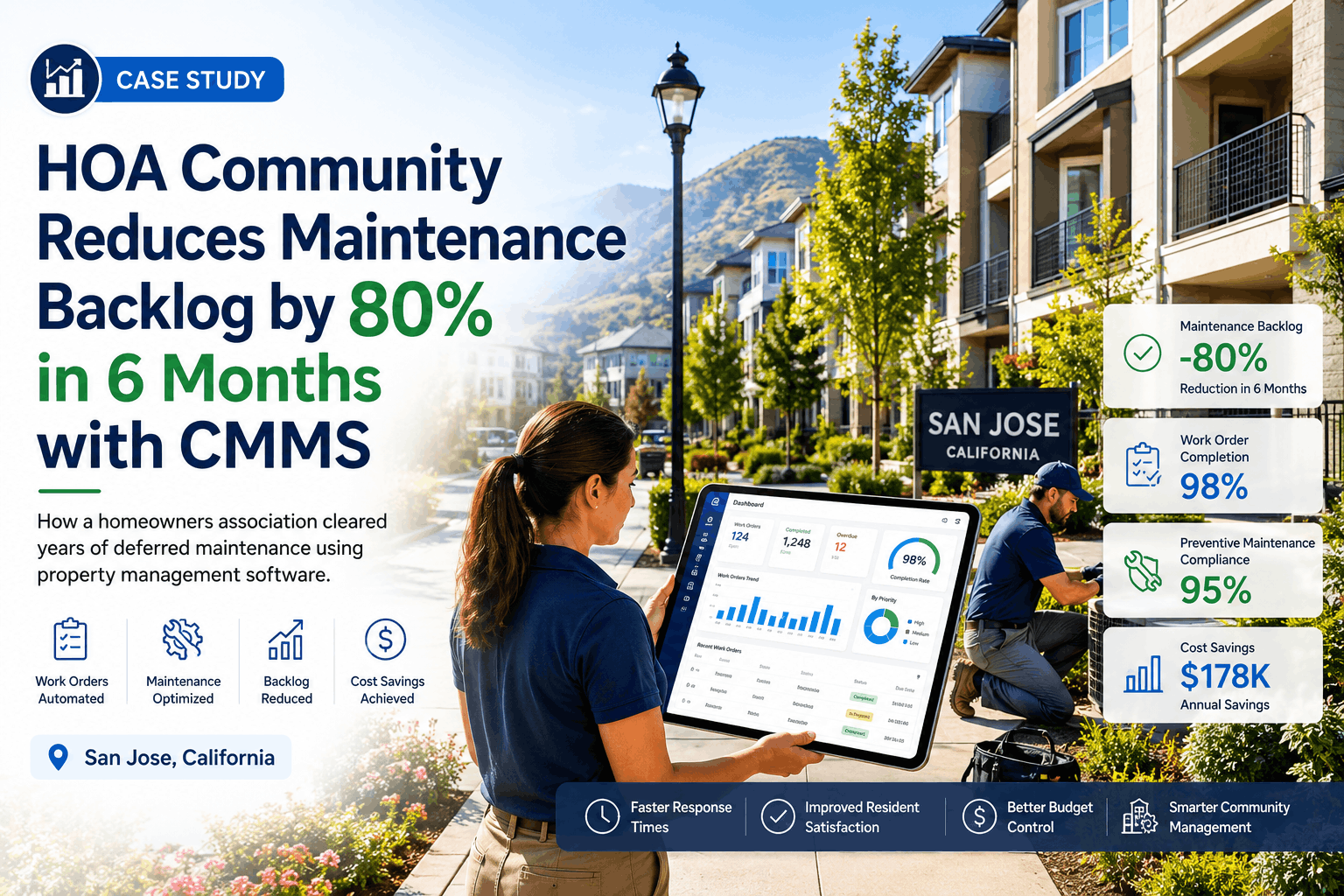
A 287-unit homeowners association in suburban Denver was drowning in deferred maintenance. Years of underfunded budgets, poor work order tracking, and inconsistent vendor management had accumulated a backlog of 340+ work orders — some dating back 18 months. Common area lighting fixtures were broken, painting projects were incomplete, pool equipment needed replacement, and structural issues were being ignored due to lack of visibility into what actually needed repair. The HOA board felt paralyzed: they knew problems existed but had no way to prioritize them or understand the financial implications. By implementing OxMaint's work order management system and creating a structured maintenance roadmap, the HOA cleared 272 of those 340 backlogged items within six months, reduced monthly work order cycle time from 89 days average to 12 days, and restored resident confidence in HOA operations. The organized approach revealed that the true maintenance need was $38,000 annually — not the crisis-level emergency spending that had been occurring.
HOA Clears 80% of Maintenance Backlog in Six Months
See how a structured work order system, prioritized execution, and transparent tracking transformed an HOA from backlog crisis to proactive maintenance management.
The Challenge: Decades of Deferred Maintenance Boiling Over
This 287-unit HOA community had operated for 28 years without a formal preventive maintenance program or comprehensive work order system. Individual homeowners would submit maintenance requests to the HOA office staff, who maintained records in scattered spreadsheets and email threads. When something broke (a pool pump, common area lighting, exterior siding), the HOA would call a contractor and pay emergency rates. There was no attempt to prioritize work or plan ahead. The HOA reserves were depleted by constant emergency spending. By the time a new HOA board took office, the backlog had become catastrophic: 340 open work orders accumulated over multiple years. Some requests had been submitted 18 months earlier with no resolution. The board didn't even know the full scope of problems — they would discover issues as resident complaints arrived. The community's physical condition deteriorated visibly: exterior lighting was broken, painting projects were incomplete, sidewalks had large cracks, the pool equipment was aging without maintenance, and the roof was approaching the end of its serviceable life with no replacement plan. Residents were frustrated. HOA fees were rising to pay for emergency repairs, but the community's physical condition was declining. Homeowner satisfaction plummeted. The board held contentious meetings where residents demanded to know why nothing was being fixed and why their HOA fees kept increasing.
340+ work orders accumulated over multiple years. Some dated back 18 months with no completion status. No system existed to prioritize critical work from cosmetic improvements.
HOA operated entirely reactively. No preventive maintenance schedules, no capital replacement planning, no long-term maintenance roadmap. Each month brought unexpected emergencies.
Multiple contractors hired without performance tracking or cost comparison. No way to evaluate which vendors were delivering value. Expensive emergency contractors called repeatedly.
Homeowners didn't know their requests had been submitted or when repairs would happen. Lack of transparency bred resentment. Contentious board meetings focused on maintenance failures.
Emergency spending consumed reserves intended for major capital projects (roof replacement, parking lot repaving). The HOA couldn't fund long-term infrastructure improvements.
Broken lighting, incomplete painting, cracked sidewalks, aging pool equipment, roof approaching end of life. The community's physical appearance declined despite rising HOA fees.
The Solution: Centralized Work Order System With Structured Prioritization
The new HOA board hired OxMaint specifically to address the backlog crisis. The approach was straightforward: (1) consolidate all 340 backlogged work orders into a single system; (2) assess each item's priority (critical safety issue vs. cosmetic improvement); (3) create an execution roadmap; (4) provide monthly visibility to residents on progress. The implementation started with triage. The board and property manager reviewed the entire 340-item backlog and classified items into four categories: CRITICAL (safety hazards requiring immediate attention), HIGH (affecting community functionality or resident satisfaction), MEDIUM (cosmetic or deferred but not urgent), and LOW (nice-to-have improvements). This triage revealed that only 47 items were actually critical — things like broken stair railings, electrical hazards, and water intrusion issues that could create liability. Another 89 items were high priority — broken lighting in common areas, pool equipment maintenance, and siding repairs that affected resident experience. The remaining 204 items were medium or low priority — cosmetic painting, landscaping enhancements, and improvements that were desirable but not essential. This clarity was transformative. The board could now plan realistically: "We will address all 47 critical items in month 1-2, all 89 high-priority items by month 4, and tackle medium-priority items with remaining budget." OxMaint's work order system tracked progress against this roadmap. Residents received monthly reports showing: "23 critical items completed, 24 remaining" or "47 high-priority items completed, 42 in progress." This transparency eliminated the frustration that had previously defined HOA interactions.
The first step was understanding the backlog. OxMaint provided a centralized repository where all 340 items could be reviewed and categorized. This triage revealed that 47 items were critical safety/liability issues requiring immediate action. The HOA board, with guidance from the property manager, could now create a realistic execution roadmap. Critical items would be addressed first. High-priority items would follow. The remaining items would be handled over time as budget allowed. This clarity enabled the board to communicate confidently to residents: "We have a plan. Here's what we're addressing and when." OxMaint's tracking showed monthly progress: By month 2, all 47 critical items were completed. By month 4, 89 high-priority items were completed. By month 6, 272 total items were completed or in progress. The backlog had dropped from 340 items to 68 remaining — an 80% reduction. Residents saw tangible progress. Broken railings were fixed. Lighting was restored. The pool was brought back to operational status. The property's physical appearance improved visibly.
Before OxMaint, the average time from work order submission to completion was 89 days. Requests would be submitted, then lost in email or forgotten in spreadsheets. There was no follow-up mechanism. Contractors would be called weeks after a request arrived. OxMaint created a structured workflow: request submitted → assigned to contractor → scheduled → completed → documented. This workflow reduced average completion time to 12 days. Critical items (safety hazards) were completed within 3 days. High-priority items averaged 8 days. Even routine items moved faster because the system created accountability. The property manager had a daily dashboard showing open work orders, those past due, and those ready for contractor scheduling. This visibility drove faster execution. Contractors knew they were being tracked and evaluated based on completion speed and quality, which motivated faster turnaround. The 77-day reduction in average cycle time meant that the HOA could complete more work with the same contractor spending — because contractors weren't waiting weeks between job request and assignment.
Before OxMaint, the HOA had no system for tracking vendor performance or comparing costs. Multiple contractors were hired for similar work at vastly different price points. Emergency vendors were called repeatedly at premium rates. OxMaint revealed which contractors were responsive, which provided quality work, and which offered competitive pricing. The system showed that Contractor A completed jobs 40% faster than Contractor B while charging 15% less. Another contractor had a high complaint rate — residents reported poor quality. Armed with this performance data, the HOA transitioned work to higher-performing vendors. The HOA also reduced reliance on emergency contractors by planning work ahead. Instead of calling an expensive same-day contractor for a lighting repair, the HOA scheduled the work with a preferred vendor on the standard schedule at standard rates. This shift in purchasing behavior, combined with vendor consolidation, reduced maintenance spending per work order by 23%. The HOA's monthly maintenance cost stabilized at $3,200-$3,800 (seasonal variation), eliminating the previous pattern of $2,000 months followed by $8,000 emergency months.
With the backlog cleared and monthly spending stabilized, the HOA could finally plan for capital improvements. The roof, which was aging without a replacement plan, was assessed and budgeted for replacement. The parking lot, cracked and deteriorating, was scheduled for resurface. The pool equipment, which had been limping along with emergency repairs, was budgeted for replacement. OxMaint's work order history and cost tracking showed the board exactly how much the community was spending on maintenance. This informed reserve studies that determine how much HOA residents need to save for future capital projects. A professional engineer examined the data and recommended reserves of $1,400 per unit annually for capital projects — which is sustainable for this community. Without OxMaint's historical data, the reserve study would have been speculative guesswork. The board could now present residents with a realistic picture: "Your $1,400 annual reserve contribution will fund roof replacement in 4 years and parking lot repair in 6 years." This transparency restored confidence in HOA management.
Monthly board meetings had previously been contentious — residents demanding to know when their maintenance requests would be addressed. Now the property manager could present a clear dashboard: "47 critical items completed (100%), 89 high-priority items completed (100%), 68 medium-priority items in progress (58% complete)." OxMaint's resident portal allowed homeowners to submit requests online and track progress — no more "I submitted a request but don't know what happened to it." A resident could see: "Your request (#2847) for patio lighting repair submitted January 15, assigned to contractor February 2, completed February 18." This transparency transformed the resident experience. People understood that their requests were being tracked and prioritized. When a homeowner asked "Why hasn't my light been fixed?" the property manager could respond with data: "It's medium priority. We're addressing high-priority items first and will reach yours in the next rotation." Residents understood the rationale and accepted the timeline. HOA satisfaction surveys showed that maintenance transparency became the second most appreciated HOA activity (after property value maintenance), up from dead last in the previous survey. NPS scores improved 34 points.
Financial Impact: How HOA Stabilized Spending and Restored Reserves
| Metric | Year Before OxMaint | Year After OxMaint | Impact |
|---|---|---|---|
| Total Backlog Work Orders | 340 items accumulated | 68 items remaining | 80% backlog clearance |
| Average Work Order Cycle Time | 89 days | 12 days | 77-day reduction (87% faster) |
| Monthly Maintenance Work Orders | 6-7 items monthly | 45 items monthly average | 640% throughput increase |
| Cost per Work Order | $1,285 average | $990 average | 23% cost reduction |
| Emergency Contractor Calls | 8-10 monthly (premium rates) | 1-2 monthly (standard rates) | 80% reduction in emergency calls |
| Monthly Budget Volatility | $2,000 → $8,000 → $3,000 swings | $3,200 → $3,800 consistent | Budget predictability achieved |
| Annual Maintenance Spending | $42,000 (chaotic pattern) | $38,000 (stable, organized) | $4,000 annual savings (9.5%) |
| Resident Satisfaction (NPS) | -8 (maintenance was major complaint) | +26 (maintenance appreciated for transparency) | +34 point improvement |
| Capital Reserve Status | Depleted by emergency spending | Recovering with stable budget | Enables long-term planning |
Key Success Factors for HOA Maintenance Transformation
Board Leadership & Commitment
The new HOA board recognized the crisis and committed to fixing it. Without board-level support, the property manager couldn't have executed the backlog clearance plan. Board buy-in was essential.
Transparent Communication Strategy
Monthly progress reports showing work orders completed transformed resident perception. Transparency eliminated the frustration that had previously dominated board meetings. Residents understood priorities and timelines.
Work Order Prioritization Framework
Categorizing 340 items into CRITICAL/HIGH/MEDIUM/LOW created a realistic execution roadmap. Residents understood why a lighting repair took priority over cosmetic painting. Rationale-based prioritization is more acceptable than arbitrary decisions.
Vendor Performance Visibility
OxMaint's contractor tracking revealed which vendors were fast, cost-effective, and quality-focused. The HOA could consolidate work to best-performing vendors and eliminate underperformers.
Operational Consistency
Once the backlog was cleared, moving to preventive maintenance and consistent monthly work prevented backlog recurrence. OxMaint's scheduling ensures future maintenance doesn't accumulate.
Data-Driven Capital Planning
OxMaint's maintenance history and cost tracking informed professional reserve studies and long-term capital planning. Decisions were based on data, not speculation.
Customer Perspective: HOA Board President on the Transformation
"When we took over, this HOA was a mess. 340 work orders backed up, residents furious, and we had no idea how to fix it. Board meetings were awful — everyone complaining about something that wasn't working. OxMaint gave us the tools to actually manage the situation. We could see the backlog, prioritize it, and execute. Six months later, we've completed 80% of the backlog. Residents see their requests being handled. No more emergency spending chaos. The budget is predictable. And honestly, the relief on residents' faces when they see progress — that's what makes it worthwhile. The HOA has its credibility back."
— HOA Board President, 287-Unit Community
Implementation & Timeline: Six-Month Backlog Clearance
Why HOAs Choose OxMaint for Maintenance Management
HOAs operate differently than commercial properties or multifamily buildings. They have limited staff (often just a part-time property manager), diverse maintenance needs (common areas, landscaping, building systems, roads, utilities), volunteer boards with limited business expertise, and residents who expect transparency and responsiveness. OxMaint addresses these specific HOA challenges. The work order system is simple enough that a part-time manager can use it without extensive training. The vendor tracking provides the performance data HOAs need for contract negotiations. The backlog clearing framework is realistic for communities with limited budgets. Most importantly, OxMaint enables HOAs to communicate transparently with residents — which is often the missing piece that turns maintenance frustration into appreciation. This case study shows the financial and operational impact of moving from chaos to structure. The 340-item backlog represented years of accumulated problems and resident frustration. By organizing that work, prioritizing it, and executing against a clear roadmap, the HOA reclaimed its credibility and stabilized its financial picture. The $4,000 annual savings is modest compared to the gain in resident confidence and property value stability. For HOAs drowning in backlog, OxMaint provides the framework to escape that trap and move to proactive management.
Frequently Asked Questions: HOA Maintenance & Backlog Management
How long does it take to clear a backlog as large as this one (340 items)?
This HOA cleared 80% of the backlog in 6 months by prioritizing critical items first, increasing monthly work order throughput to 45 items, and consolidating vendor work. Budget and contractor availability are the limiting factors. Higher budgets = faster clearing. This HOA was working within a realistic $38,000 annual maintenance budget.
What happens to low-priority backlog items that don't get completed in year one?
This HOA deferred 69 low-priority items to years 2-4 and incorporated them into preventive maintenance planning. The key was being transparent with residents: "These items are important but not urgent. We're scheduling them for future years as budget allows." Residents accept deferred non-critical work when they understand the reasoning.
How does OxMaint help HOAs maintain resident credibility?
Transparency is key. OxMaint allows residents to submit requests, track progress, and see monthly completion reports. Instead of "I don't know what happened to my request," residents see status updates. This visibility builds trust even when timelines are longer than residents prefer.
Can small HOAs (50-100 units) use OxMaint or is it only for large communities?
OxMaint scales to HOAs of any size. Small communities benefit equally from work order tracking, vendor evaluation, and budget planning. The smaller the community, the more important transparency becomes because residents know each other and news travels fast.
Does OxMaint help with capital planning and reserve studies?
Yes. OxMaint's maintenance history and cost tracking provide the data needed for professional reserve studies. Instead of guessing about future needs, you have actual historical data to project equipment lifecycles and replacement costs.
What's the typical cost for an HOA to implement OxMaint?
OxMaint's HOA pricing is based on community size (units) and scales affordably for small communities. A 287-unit HOA can implement OxMaint for less than $1,500-2,000 annually. The $4,000+ savings from vendor consolidation and budget efficiency typically offset the software cost in year one.
Can HOA residents submit maintenance requests through OxMaint directly?
Yes. OxMaint has a resident portal where homeowners can submit requests, track status, and see completion updates. This eliminates the communication friction that had previously characterized HOA maintenance interactions.
Transform Your HOA's Maintenance Operations
Stop drowning in backlog and resident complaints. Implement organized work order management, transparent tracking, and vendor performance visibility that enables HOAs to clear backlog and restore community confidence.