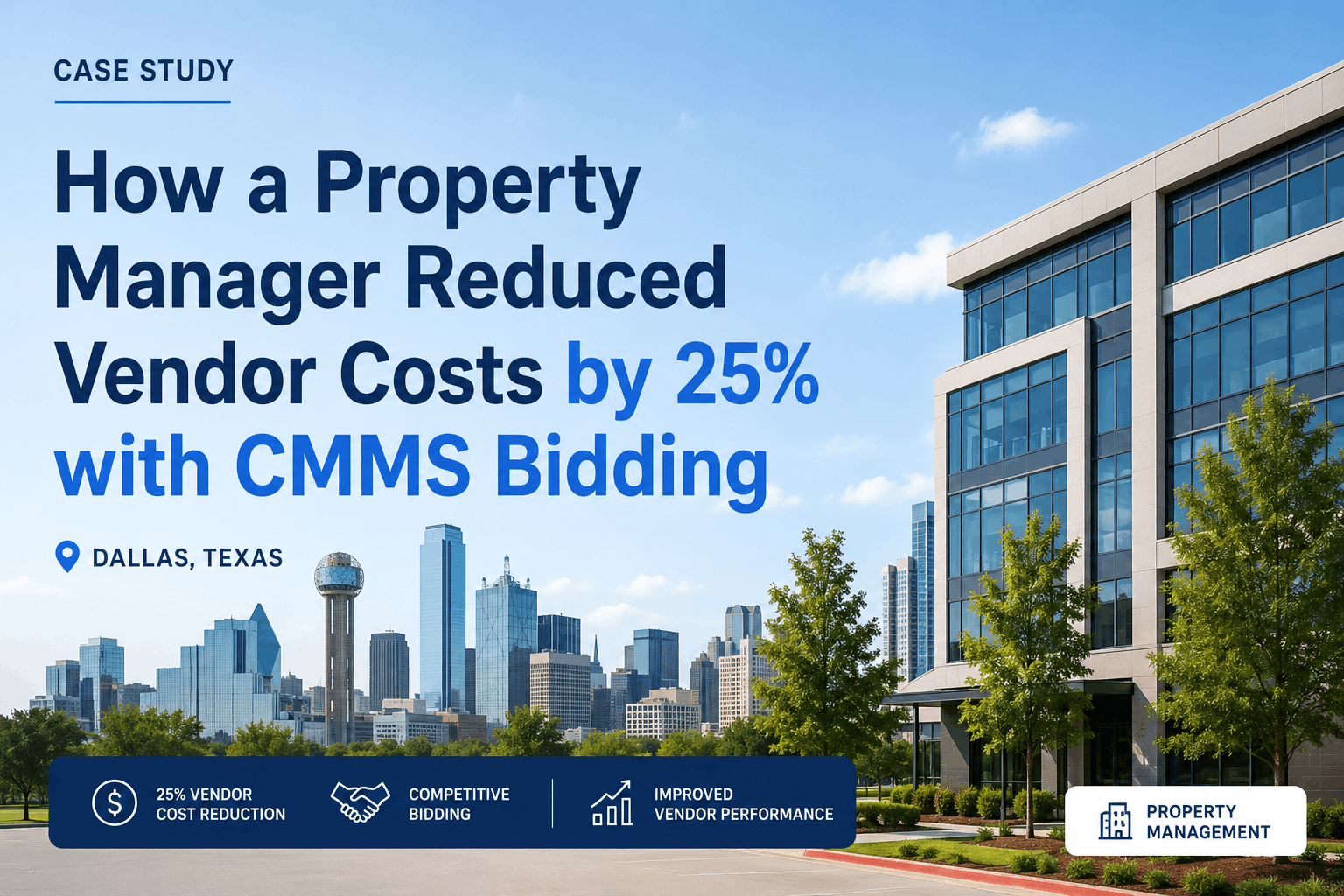
A mixed-use property development group managing 18 commercial and residential assets across three metro regions had a vendor ecosystem growing faster than the team could control. Fourteen active contractors. No centralized tracking. No performance benchmarks. Work orders routed through email threads that nobody archived. Emergency escalations handled by whoever answered the phone. The result: duplicate dispatches, missed SLAs, and a 2.9-star average on contractor response quality from internal operations audits. In 11 months, the development group restructured its entire vendor management model using OxMaint — and produced results that changed how the ownership group now plans every future acquisition. Book a free demo to see how OxMaint can streamline your vendor operations.
Client Background
The client is a privately held mixed-use property development group operating across three metropolitan markets. Their portfolio spans Class A commercial office space, ground-floor retail, and mid-rise residential units — a combination that demands highly specialized, trade-specific vendor relationships for HVAC, electrical, plumbing, elevator servicing, landscaping, and tenant improvement construction. At the time of OxMaint deployment, the group managed 14 active vendor relationships with no centralized contract repository, no performance tracking, and no shared work order system across their regional property managers.
The Challenges
Before implementing a structured vendor management system, the development group faced a compounding set of operational problems. Each issue fed the next, creating a cycle the team could not break without external intervention.
The Solution: OxMaint Vendor Management Module
Following a structured evaluation of three CMMS platforms, the development group selected OxMaint for its integrated vendor management architecture, mobile-first design, and ability to consolidate multi-property operations without requiring a separate software layer or custom integration work. The platform's vendor module was configured to serve all 18 properties and 14 active vendor relationships from a single dashboard accessible by all regional managers and the central facilities team.
All 14 vendor profiles consolidated with contact hierarchy, service scope, trade certifications, insurance expiry dates, and contract terms — visible in real time to all regional managers across all three metro regions.
Every work order dispatched with defined response and completion SLAs. Automated escalation alerts trigger if a vendor misses a response window — before a property manager has to follow up manually.
Response time, on-time completion rate, rework frequency, and invoice accuracy tracked per vendor per quarter. Scorecard data feeds directly into contract renewal reviews with full audit trail.
Insurance, licensing, and bonding documents stored and monitored with automated expiry alerts at 60 and 14 days. No vendor dispatched without active compliance documentation on record.
Every vendor invoice linked to a documented work order with scope confirmation, technician arrival timestamps, and completion sign-off — eliminating unverifiable billing disputes entirely.
Regional property managers see vendor availability and active assignments across all 18 properties before dispatching — ending duplicate assignments and cross-regional scheduling conflicts.
Execution & Deployment Timeline
The entire deployment was completed in 28 days by the existing 8-person operations team alongside their normal daily responsibilities. No consultants. No downtime. No new hires.
All 14 vendor profiles created with service scope, coverage zones, SLA commitments, certification documents, and emergency contact hierarchies. Contracts digitized and mapped to OxMaint vendor records — the first complete vendor registry the group had ever maintained.
Trade-specific dispatch rules configured per property. SLA windows defined by request type: emergency (2-hour response), urgent (4-hour response), routine (next business day). Auto-escalation thresholds set for each tier with notification routing to regional managers.
Vendor performance scorecard metrics finalized with input from regional managers. Invoice reconciliation workflow activated — all new invoices required matching work order references before approval routing to finance.
All 8 operations team members trained in under 4 hours on mobile and desktop platforms. Vendor communication sent to all 14 contractors with new dispatch, response, and documentation expectations. Full go-live on day 28. Within 60 days, 91% SLA compliance across all active vendors.
Results After 11 Months
Same vendor roster. Same internal team. Same portfolio. One system produced measurably different outcomes across every tracked dimension of vendor operations.
Why It Worked
SLA enforcement changed vendor behavior. When vendors understood that response windows were tracked, timestamped, and tied to quarterly performance reviews, response times dropped within the first 60 days of deployment. The change was not cultural — it was structural. Accountability embedded in the system produced results that internal follow-up never could.
Scorecard data transformed contract negotiations. For the first time, the ownership group entered vendor contract renewals with documented performance histories — not impressions. Two vendors whose response rates and rework frequencies were masked by the informal prior system were identified and replaced in Q2. Their replacements were selected using the same scorecard framework applied as a pre-qualification filter.
Compliance risk was eliminated at the system level. Automated certification tracking removed human dependency from a legally critical process. The ownership group's legal team formally reduced the risk classification of vendor operations in their annual portfolio review — a first for the development group in its history. Book a session to see how compliance tracking applies to your vendor roster.
Invoice reconciliation became a 10-minute process. With every work order timestamped, scoped, and signed off, the finance team could verify or dispute any vendor invoice against documented records in under 10 minutes. Payment cycles shortened significantly, improving key vendor relationships and reducing the informal price premium vendors had been applying to offset their own collection delays.
Cross-property visibility compounded over time. Regional managers who previously had no view into sister properties' vendor workloads could now see active assignments across all 18 assets before dispatching. The result: no more duplicate assignments, no more over-reliance on a single preferred vendor, and better load distribution that reduced burnout on high-performing contractors.
Key Takeaways
At 43% dispatch error rates and $224K in contested invoices, this group was not managing vendors. It was absorbing the cost of not managing them. The shift to structured vendor operations is not a refinement; it is a fundamentally different operating model.
Without a scorecard, contract renewals are decided on familiarity, not performance. The two vendors replaced in Q2 had been retained for years — not because they were performing well, but because their underperformance had never been documented.
When insurance expiry lives in an inbox, it will eventually be missed. Automated alerts at defined intervals are not a convenience — they are the only reliable protection against a dispatch liability that no property manager can consistently catch manually.
A 28-day deployment with no consultants and no new hires means savings begin accumulating in the first quarter. Portfolio groups that delay CMMS adoption because they expect a months-long implementation are operating on an outdated assumption.
The 8-person operations team did not change. Their skills did not change. The system they worked within changed — and that produced a 52% response time improvement, an 86% dispatch error reduction, and $187,000 in recovered annual spend.
Common Questions
How long did the vendor profile build and contract upload take?
Did existing vendors experience disruption during the transition?
Is OxMaint suitable for smaller property portfolios with fewer vendors?
Was any specialized training required for the operations team?
How quickly does the financial impact materialize?
Conclusion
The mixed-use development group in this case study did not have underperforming vendors. It had an underperforming vendor management system — or more precisely, the complete absence of one. Email threads, verbal SLA commitments, and relationship-based contract renewals are not a management strategy. They are a liability that compounds with every additional vendor relationship and every additional property in a growing portfolio.
OxMaint replaced that informal structure with a documented, data-driven, and enforceable one. In 28 days, the group moved from 14 vendors managed across disconnected inboxes to a unified platform where every dispatch was traceable, every SLA was enforced, every invoice was reconcilable, and every vendor was scored. The $187,000 in recovered annual spend was not the result of renegotiating contracts. It was the result of finally having the information needed to manage them. That is the structural advantage of CMMS-integrated vendor management — and the measurable outcome this deployment produced.