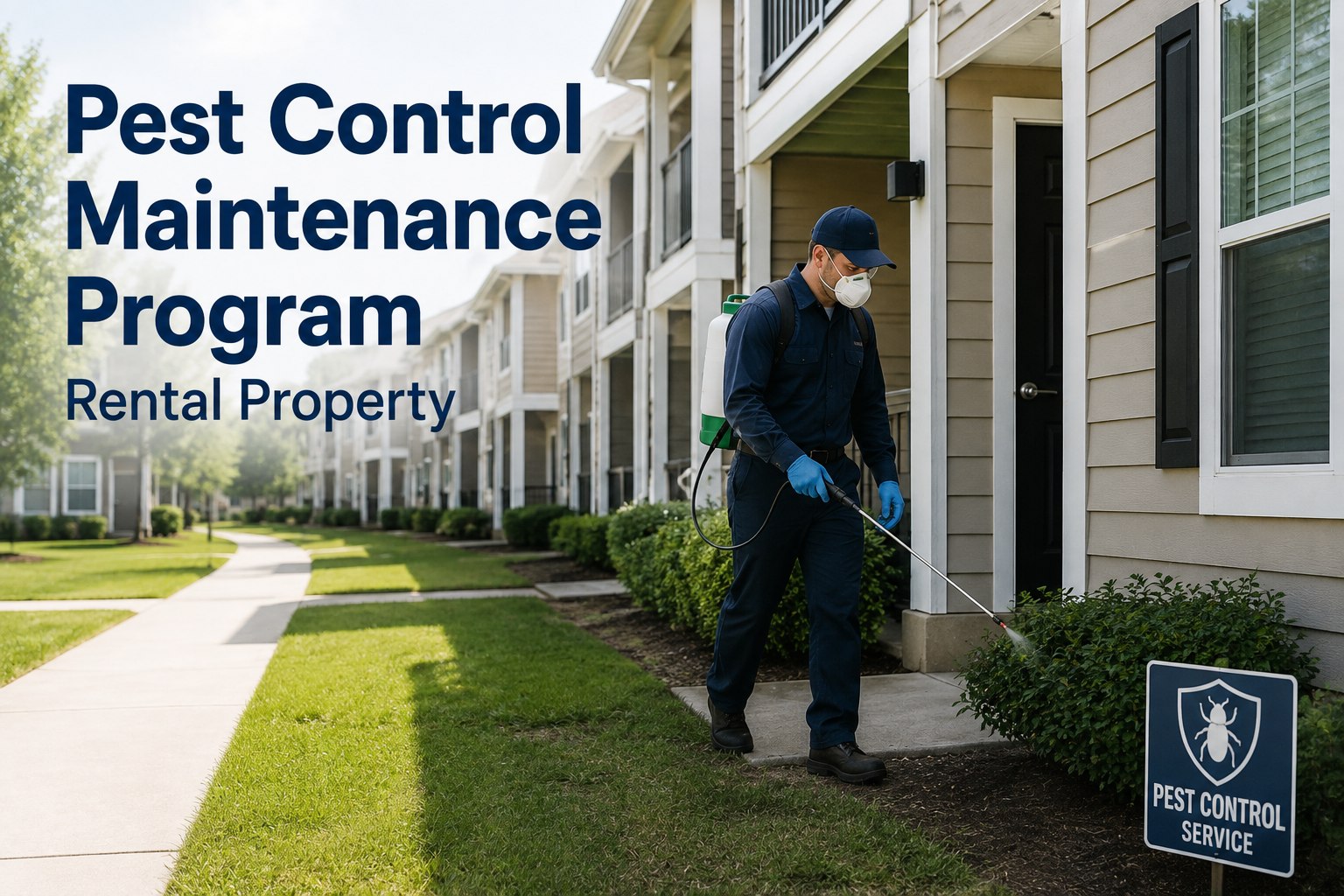
A proactive pest control maintenance program for rental and managed properties combines scheduled preventive treatments, building exclusion work, tenant education, vendor coordination, and audit-ready documentation — and it typically cuts pest complaints by 60–80% within the first year. Pest issues rank among the top three reasons tenants refuse to renew a lease, yet most property pest control is still handled reactively, one angry phone call at a time. This guide walks you through building a pest control maintenance program that protects tenant health, keeps you compliant with habitability laws, and stops small infestations from becoming five-figure remediation projects. Whether you manage a 12-unit building or a 2,000-unit multifamily portfolio, the framework below scales — and a CMMS like OxMaint makes the scheduling, vendor tracking, and documentation nearly automatic. If you want to see it running on your properties, Start Free Trial and set up your first recurring treatment schedule in under an hour.
What does a reactive pest problem really cost your rental property?
One untreated cockroach issue in a single unit can spread to 8–12 neighboring units within 90 days. Between emergency exterminator call-outs ($300–$800 per visit), unit turnover, rent concessions, and potential habitability claims, a single escalation routinely costs $4,000–$12,000 — while a preventive pest control schedule for the same property runs $40–$90 per unit per year.
Why reactive rental pest control is quietly draining your NOI
Properties that treat pest control as a complaint-response task spend 3–5x more per resolved issue than properties running a preventive pest control maintenance program. Here is where the money actually goes.
The math is not subtle. A 120-unit apartment community spending $7,200 per year on a quarterly preventive program avoids, on average, 2–3 escalated infestations annually — each of which would cost more than the entire program. Add the renewal-rate impact (industry surveys consistently show pest sightings in the top three non-renewal drivers) and property pest prevention becomes one of the highest-ROI line items in your maintenance budget.
How to build a pest control maintenance program: the 5 core components
Every effective pest control program for rental properties stands on the same five pillars. Skip one, and the others weaken — exclusion without treatment leaves existing populations in place; treatment without documentation leaves you legally exposed.
Scheduled Preventive Treatments
Quarterly perimeter and common-area treatments are the industry baseline; high-risk properties (ground-floor units, food-service adjacency, older construction) move to monthly or bi-monthly. Treatments should rotate active ingredients to prevent resistance and cover roaches, ants, rodents, and seasonal invaders.
Exclusion & Building Envelope Work
A mouse fits through a 6mm gap; a rat through 12mm. Sealing penetrations, door sweeps, weep holes, utility chases, and foundation cracks removes the entry points that treatments alone can't address. Budget exclusion as a maintenance task, not a one-time project — buildings shift and new gaps open every season.
Tenant Education & Reporting
Tenants are your early-warning network. Move-in packets should cover food storage, waste handling, and — critically — a no-penalty, easy reporting channel for sightings. Properties that make reporting frictionless catch infestations 4–6 weeks earlier than those where tenants fear blame or fees.
Vendor Coordination & SLAs
Your pest control vendor contract should specify response times (24–48 hours for active sightings), treatment scope, re-treatment guarantees, and per-unit reporting. Managing this through a CMMS turns every visit into a tracked work order with photos, findings, and follow-ups attached.
Documentation & Legal Protection
Implied warranty of habitability laws in nearly every US state make pest control the landlord's responsibility in multifamily housing. Time-stamped treatment logs, inspection reports, and response records are your defense if a dispute escalates to a rent-withholding claim or housing-authority complaint.
A pest control schedule for properties: what to do each season
Pest pressure is seasonal — your schedule should be too. This 12-month framework covers the treatment, exclusion, and inspection cadence that keeps multifamily and rental properties ahead of infestations year-round.
Mar – May
Perimeter reset & ant/swarm season prep
Apply exterior barrier treatments as soil warms. Inspect and re-seal foundation cracks opened by freeze-thaw cycles. Service rodent bait stations before spring breeding. Check door sweeps and weatherstripping damaged over winter. This is the single highest-leverage treatment window of the year.
Jun – Aug
Peak activity: monthly touchpoints
Roach, ant, fly, and wasp pressure peaks. Move high-risk units to monthly service. Inspect trash rooms, chutes, and dumpster pads weekly — sanitation failures here drive 70%+ of summer complaints. Audit tenant reporting channels and respond to every sighting within 48 hours.
Sep – Nov
Rodent exclusion blitz
Rodents begin seeking winter harborage as temperatures drop — this is your exclusion window. Seal utility penetrations, install door sweeps, screen vents, and refresh bait stations before the first frost. Treat for overwintering invaders (stink bugs, cluster flies, boxelder bugs) on south and west exposures.
Dec – Feb
Interior focus, audits & planning
Shift to interior inspections: rodent activity in basements, utility rooms, and drop ceilings. Review the year's complaint data to identify chronic units and buildings. Renegotiate vendor contracts, refresh tenant education materials, and build next year's pest control maintenance schedule in your CMMS.
Stop chasing pest complaints. Start preventing them.
See how OxMaint schedules recurring treatments, tracks vendor work orders, and builds your audit trail automatically — book a 30-minute walkthrough tailored to your portfolio.
Pest control for property management: reactive calls vs. a preventive program
The difference between complaint-driven pest control and a managed program shows up in your budget, your renewal rate, and your legal exposure. Here is the side-by-side.
| Factor | Reactive (Complaint-Driven) | Preventive Program (CMMS-Managed) |
|---|---|---|
| Cost per resolved issue | $300–$800 per emergency call-out, plus spread to adjacent units | $40–$90 per unit per year, all-inclusive contract |
| Detection timing | After tenants see pests — often 4–8 weeks into an infestation | At scheduled inspections, before populations establish |
| Tenant impact | Visible infestations, complaints, negative reviews, non-renewals | Rare sightings; tenants see a professional program in place |
| Legal position | Weak — no records of diligence if a habitability claim is filed | Strong — time-stamped treatment logs and response records |
| Staff workload | Firefighting: calls, vendor chasing, apology tours | Automated scheduling; exceptions flagged, not discovered |
| Annual cost (120 units) | $15K–$35K in treatments, turnover, and concessions | $5K–$11K program cost, with measurably fewer escalations |
What a pest control program looks like on a real 120-unit property
A 120-unit garden-style apartment community in the Southeast was averaging 9–11 pest complaints per month and losing an estimated 6 renewals per year to pest-related dissatisfaction. Here is what changed in year one.
Before: reactive
- 9–11 complaints/month, handled as individual emergency calls
- $28,400 annual spend on call-outs, one bed bug remediation, and two unit turnovers
- No treatment records — exposed on a habitability dispute
- Vendor visits untracked; no idea which units were actually serviced
After: 12 months on a program
- Quarterly preventive treatments + monthly service for 18 high-risk units
- Fall exclusion blitz: 340 linear feet of sealing, 46 door sweeps
- Complaints dropped to 2–3 per month by month 9
- Total program cost $8,900 — a $19,500 year-one swing, before renewal savings
Every work order, vendor visit, photo, and follow-up lived in one system. When a tenant claimed we'd ignored a roach issue, we pulled a complete service history in ninety seconds. The dispute ended there.
Run your entire pest control maintenance program in OxMaint
Spreadsheets and calendar reminders break down the moment you manage more than a handful of units. OxMaint's CMMS turns your pest prevention program into scheduled, tracked, documented work — automatically.
Recurring Preventive Schedules
Set quarterly, monthly, or seasonal treatment plans once — OxMaint auto-generates work orders for every building and unit, so no service window is ever missed. Properties report 95%+ on-time completion versus ~60% with manual tracking.
Vendor Work Order Tracking
Assign treatments to your pest control vendor with SLAs attached. Every visit closes with photos, findings, and chemical logs — giving you a complete, time-stamped audit trail for habitability compliance without a single spreadsheet.
Tenant Complaint Intake
Convert every pest sighting into a tracked work order in seconds, with automatic prioritization and 48-hour response workflows. Faster, documented responses are the single biggest driver of pest-related renewal improvement.
Pest Analytics by Building & Unit
Dashboards show complaint hotspots, treatment costs per door, and vendor response times across your portfolio. Identify chronic units, justify exclusion capital projects with data, and prove program ROI to ownership in one report.
The documentation that protects you when a pest issue escalates
In nearly every US state, the implied warranty of habitability places pest control responsibility on the landlord in multifamily housing. When a dispute reaches a housing authority or courtroom, the side with records wins. Your documentation stack needs four elements.
Treatment Logs
Date, unit, areas treated, products used (with EPA registration numbers), and technician for every service visit. Retain for a minimum of 3 years — longer where your state's statute of limitations requires.
Complaint & Response Records
Every tenant report with a time-stamp, your response time, actions taken, and resolution. A documented 48-hour response defeats most "landlord negligence" claims on its own.
Inspection Reports
Scheduled inspection findings with photos — especially for exclusion work, common areas, and trash rooms. These prove ongoing diligence, not just reaction to complaints.
Vendor Contracts & Licenses
Current pest control operator licenses, insurance certificates, and contract scope. If a vendor's lapse contributed to an issue, you need to show you contracted with a qualified, insured provider.
OxMaint stores all four against the relevant asset, unit, or work order — searchable in seconds. When legal counsel or a housing inspector asks for your pest control records, you export a complete history instead of digging through filing cabinets and email threads.
Pest control for rental properties: frequently asked questions
Who is responsible for pest control in a rental property — landlord or tenant?
In multifamily housing, the landlord is almost always responsible: the implied warranty of habitability in nearly every US state requires pest-free premises. Single-family rentals may shift responsibility to tenants after move-in via the lease, but landlords remain responsible for pre-existing infestations and structural entry points. When in doubt, treat — disputes cost more than treatments.
How often should a rental property be treated for pests?
Quarterly preventive treatment is the industry baseline for apartment pest control. High-risk units — ground floor, near trash rooms, older construction, food-service adjacency — should be on monthly or bi-monthly service. Rodent bait stations need monthly checks year-round, and exclusion inspections should happen at least twice a year, with a major push each fall.
How much does a pest control program cost for an apartment complex?
Contracted preventive programs typically run $40–$90 per unit per year, so a 120-unit property should budget $5,000–$11,000 annually. That compares to $300–$800 per emergency call-out and $4,000–$12,000 per escalated infestation. You can model your exact program cost and track vendor spend per door inside OxMaint before you sign a contract.
What is the most effective way to prevent pests in rental units?
Exclusion plus sanitation beats treatment alone. Seal gaps over 6mm, maintain door sweeps, screen vents, and keep trash rooms and dumpster pads clean — sanitation failures drive the majority of summer complaints. Layer scheduled perimeter treatments on top, and make tenant sighting-reporting easy and penalty-free so you catch issues weeks earlier.
Can a tenant withhold rent over a pest problem?
Yes — in most states, tenants can withhold rent, repair-and-deduct, or break a lease if a pest infestation makes the unit uninhabitable and the landlord fails to act within a reasonable time. Your defense is documentation: time-stamped treatment logs and response records showing diligent, prompt action. Book a demo to see how OxMaint builds that audit trail automatically with every work order.
Build your pest control maintenance program in OxMaint today
Recurring treatment schedules, vendor work orders, tenant complaint intake, and audit-ready documentation — all in one platform your team can learn in an afternoon.