In 2023, a 2.4-million-tonne integrated flat steel producer in Central Europe was generating an off-grade rate of 4.8% across its BOF-continuous casting-hot strip mill route. The quality team knew the problem was real. Monthly cost reports showed off-grade losses averaging €5.7 million per year. What they did not know was why — and more precisely, which combination of upstream variables was reliably predictive of a non-conforming heat. The spectrometer results, tap temperatures, scrap charge weights, and alloy addition sequences were all logged. None of it was connected into a system that could surface patterns across the 40,000 heats produced annually. Sign in to OxMaint to connect your steel plant's process and quality data to the AI prediction engine that identified the patterns this plant had been generating for three years without seeing. Book a demo to see how OxMaint's Quality Intelligence Hub works on steel production data at scale.
From 4.8% Off-Grade to 1.3% in 14 Months: How OxMaint AI Quality Prediction Delivered €4.2M in Annual Quality Cost Reduction
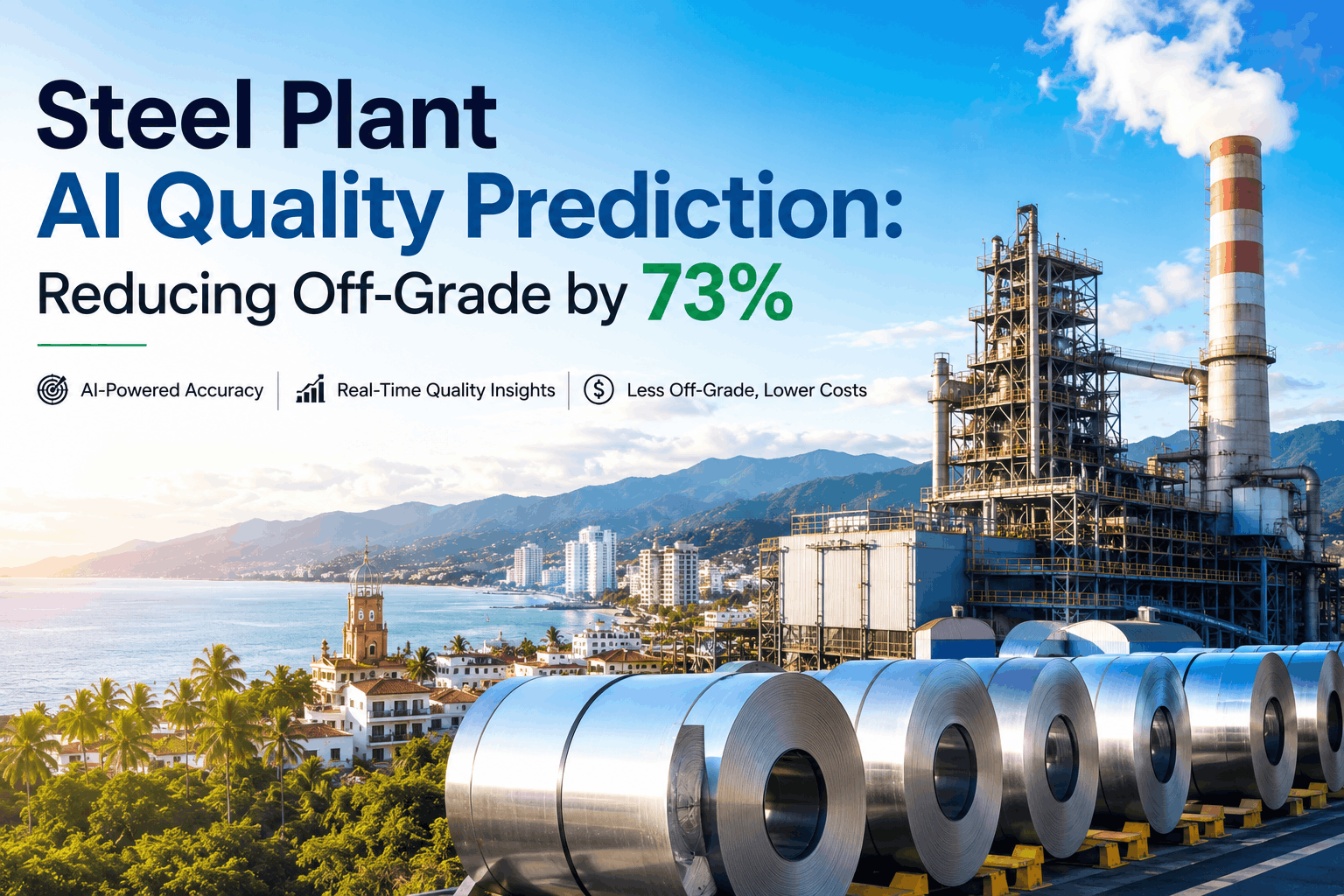
A 2.4-million-tonne flat steel producer deployed OxMaint's Quality Intelligence Hub across its BOF steelmaking and hot rolling route. AI-driven chemical composition prediction, multi-variable SPC enhancement, and real-time grade compliance scoring eliminated 73% of off-grade production and reduced quality-related customer complaints by 81% within the first year of full deployment.
The plant operated a twin-vessel BOF shop feeding a four-strand continuous casting machine producing slabs for a five-stand tandem hot strip mill. The product mix included structural steels (S235–S460), high-strength low-alloy grades for automotive, and API line pipe grades. Total annual output: 2.4 million tonnes, of which approximately 115,000 tonnes were being classified as off-grade — either downgraded to lower-value specifications, reprocessed through scarfing and reconditioning, or, in the most severe cases, charged back as scrap.
The quality team had implemented SPC across twelve critical process parameters and tracked Cpk monthly. Average Cpk across dimensional parameters was 1.18 — technically capable but below the 1.33 minimum required for automotive grade customers. The off-grade rate had remained stable at 4.7–4.9% for three years, suggesting the problem was structural rather than episodic. Book a demo to see how OxMaint's analysis identifies structural quality problems in historical heat data.
The deployment followed a four-phase structure designed to deliver measurable quality improvements at each phase before proceeding to the next — ensuring the quality team saw value at every stage rather than waiting for a full-system implementation before seeing results. Sign in to OxMaint to begin Phase 1 data connection for your steelmaking route.
OxMaint connected to the plant's OES spectrometer system, Level 2 BOF process data, continuous casting machine records, and laboratory information management system (LIMS). Historical heat records for the previous 24 months — 78,400 individual heat records — were loaded into the Quality Intelligence Hub. Initial pattern analysis identified 14 candidate variable combinations with statistically significant correlation to non-conforming outcomes. The quality team reviewed and validated 9 of these as operationally meaningful.
OxMaint trained grade-specific prediction models for the 12 highest-volume grade families — using the 9 validated variable interactions as primary input features alongside 22 additional process variables identified through automated feature selection. Models ran in parallel with existing SPC for 8 weeks — generating predictions on every heat while the quality team verified prediction accuracy against actual outcomes without acting on the predictions. Model accuracy at end of parallel run: 87.3% for identifying heats that would subsequently be classified as off-grade. Book a demo to see AI model training on steel plant data.
The AI model went live — generating pre-tap alerts for at-risk heats in real time, with specific corrective action recommendations for each alert. The primary corrective action for the most common off-grade mechanism was a tap temperature adjustment of 12–18°C on heats with specific scrap charge compositions. Secondary interventions addressed manganese addition timing on heats flagged for segregation risk. In the first full month of live deployment, the off-grade rate dropped from 4.8% to 3.1%. By month 8, it had fallen to 1.7%. Sign in to OxMaint to activate live prediction and corrective action alerts for your plant.
As the model accumulated six months of live production data with corrective action feedback, prediction accuracy improved further — reaching 91.4% by month 12. The continuous learning loop, where metallurgist corrective action decisions and their outcomes were fed back into the model, enabled the AI to refine its corrective action recommendations beyond the initial intervention library. By month 14, off-grade rate had stabilised at 1.3% — 73% below the pre-deployment level. The quality team's manual review workload decreased from 18 hours per week to 4 hours per week as the AI handled the first-pass heat qualification across the full production volume. Book a demo to see the continuous learning model improvement cycle.
The data below reflects measured plant performance in the 12-month period before AI deployment versus the 12-month period following full Phase 4 completion. All figures are drawn from the plant's quality management records and OxMaint's Quality Intelligence Hub analytics. Sign in to OxMaint to configure performance tracking dashboards for your plant's quality metrics.
| Month | Phase | Key Activity | Off-Grade Rate | Change vs Baseline |
|---|---|---|---|---|
| Pre-deployment | Baseline | Manual SPC — 12 parameters, monthly Cpk review | 4.8% | — |
| Month 1–2 | Phase 1 | Data connection, 24-month historical load, pattern analysis | 4.7% | –0.1% (model not live) |
| Month 3–4 | Phase 2 | Parallel run — predictions generated but not acted on | 4.8% | ±0 (parallel only) |
| Month 5 | Phase 3 | AI model live — pre-tap alerts active | 3.1% | –35% vs baseline |
| Month 6 | Phase 3 | Corrective action protocols refined with metallurgist team | 2.4% | –50% vs baseline |
| Month 8 | Phase 3 | Secondary interaction patterns addressed — Mn addition timing | 1.7% | –65% vs baseline |
| Month 10 | Phase 4 | Continuous learning active — model training on live outcomes | 1.5% | –69% vs baseline |
| Month 12 | Phase 4 | 91.4% prediction accuracy reached — model fully mature | 1.4% | –71% vs baseline |
| Month 14+ | Sustained | Stable operation — no further process parameter changes | 1.3% | –73% vs baseline |
OxMaint's AI analysed 78,400 historical heats across 31 process variables and identified 9 statistically significant variable interaction patterns — each one a specific combination of process conditions that reliably predicted a non-conforming outcome. None of these interactions were visible in the plant's existing SPC system, because each individual variable remained within its own SPC control limits. The multi-variable interaction space is invisible to Shewhart control charts and can only be detected by a machine learning model trained on the full variable space. This analysis, which took 48 hours in OxMaint's Quality Intelligence Hub, would have required months of manual statistical work by a dedicated data science team. Sign in to OxMaint to run multi-variable pattern analysis on your plant's historical heat data.
The critical timing advantage of OxMaint's quality prediction is that alerts are generated before the heat is tapped — while the metallurgist still has time to adjust the tap temperature target, modify the alloy addition sequence, or redirect the heat to a different order specification. This is fundamentally different from post-spectrometer alert systems that notify the quality team of a non-conformance after the heat has already been cast and cannot be economically reworked. The pre-tap window is typically 8–15 minutes in a BOF operation — sufficient time for a trained metallurgist to evaluate the alert and implement the recommended corrective action. Book a demo to see pre-tap alert timing in OxMaint's Quality Intelligence Hub.
OxMaint's quality prediction system does not replace metallurgist judgement — it augments it. When a pre-tap alert is generated, the metallurgist receives the alert with the contributing variable breakdown and the recommended corrective action. They can accept the recommendation, modify it based on operational context, or override it with a documented reason. Every decision and its outcome is fed back into the model's training data, improving prediction accuracy through the continuous learning loop. This human-in-the-loop design was critical to securing metallurgist team adoption — the AI was positioned as a tool that augmented their expertise rather than attempted to automate their decisions. Sign in to OxMaint to configure the metallurgist corrective action workflow for your plant.
Before OxMaint, the quality team spent 18 hours per week compiling quality performance reports from four separate data systems. After deployment, OxMaint's Quality Intelligence Hub generated daily, weekly, and monthly quality reports automatically — first-pass yield by grade, off-grade rate by shift and converter, AI model accuracy metrics, corrective action closure rates, and customer complaint trends — in 12 minutes of management review time rather than 18 hours of compilation. The quality manager used the reclaimed time to lead three grade development projects that had been repeatedly deferred due to capacity constraints. Book a demo to see OxMaint's automated quality intelligence reporting for steel plant management teams.
We had been tracking 4.8% off-grade for three consecutive years. We knew it was structural. We had run every manual analysis we could think of. The problem was that none of our analysis tools — including SPC — could look at 30 process variables simultaneously and identify which specific combinations were generating non-conformances. That is exactly what OxMaint's AI did in 48 hours with two years of our own historical data. The first corrective action we implemented — a 14°C tap temperature adjustment on heats with a specific scrap charge profile — was something our team would never have identified on its own, because the individual readings were all within specification. The model saw what the individual control charts could not. Within five months we were at 1.7% off-grade and our automotive customers had stopped escalating quality concerns.
Frequently Asked Questions About This Case Study
73% off-grade reduction. €4.2M annual saving. 14 months. No process parameter changes. The patterns were already in the data — OxMaint found them.
AI-driven heat prediction. Pre-tap corrective action alerts. Multi-variable SPC enhancement. Grade compliance real-time scoring. Automated quality reporting. Continuous learning model improvement.