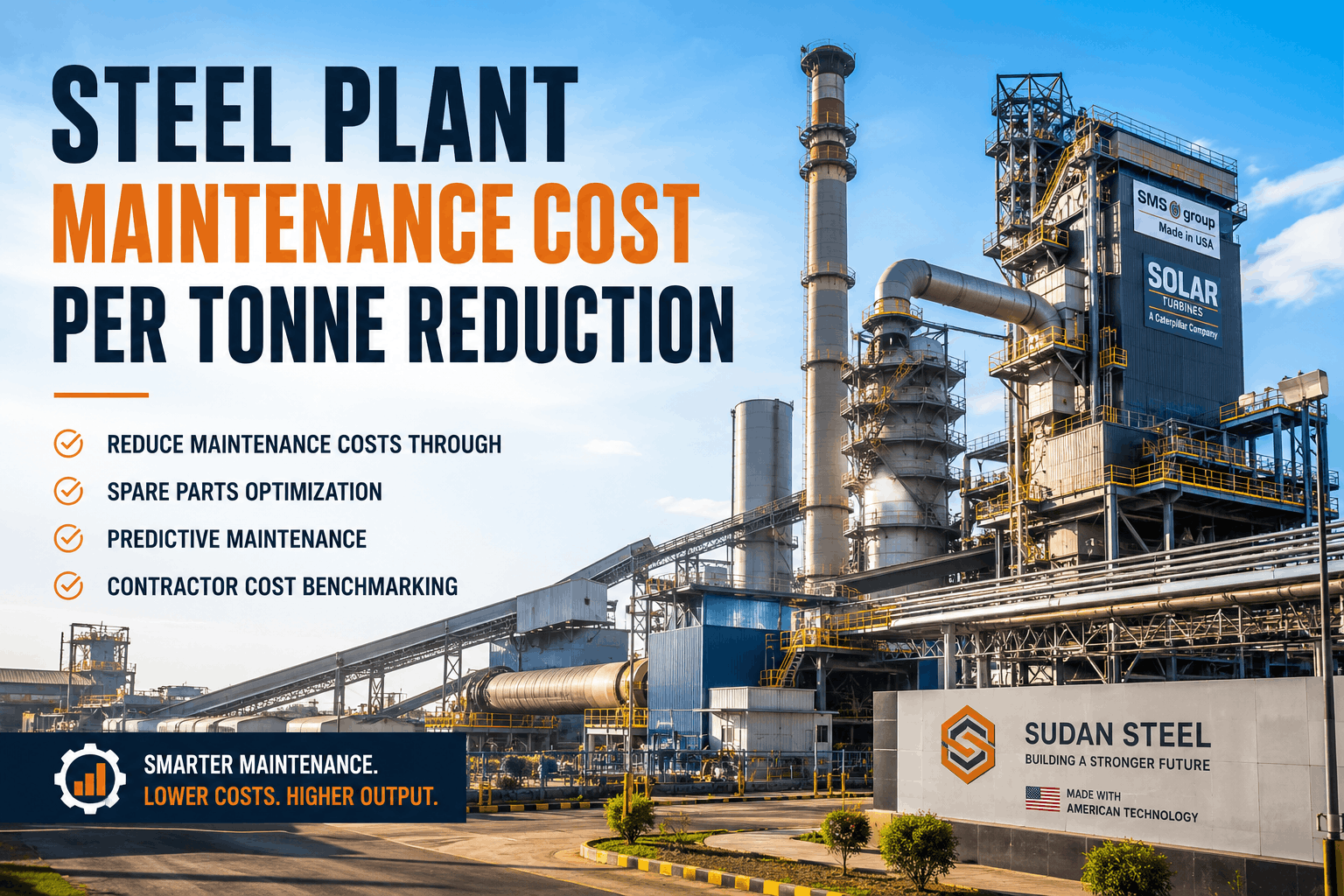
Your CMMS already contains the data that reveals your maintenance cost reduction opportunities — the problem is that 82% of steel plant managers never analyze it for cost-saving patterns. Every work order your maintenance team has completed, every emergency repair they have logged, every part they have replaced over the past 24 months contains cost drivers that repeat with statistical regularity across equipment types, failure modes, and seasonal cycles. A 2024 industry analysis found that steel plants implementing systematic cost reduction strategies reduced maintenance spend by 15-25% while improving reliability — not by cutting essential maintenance, but by eliminating waste and optimizing resource allocation. The equipment that costs $12,000 per year to maintain is not a fixed cost — it is a pattern sitting in your CMMS right now, invisible because nobody has built the cost analysis that surfaces it. Oxmaint's cost analytics module turns your maintenance history into a cost reduction engine — automatically identifying high-cost assets, flagging inefficient work orders, and generating optimization opportunities before budgets are exceeded. The data is already yours, and the analysis that reduces your next maintenance budget takes minutes to configure, not months. If your steel plant is still managing maintenance costs through spreadsheet budgeting instead of data-driven optimization, start a free trial or book a demo to see how Oxmaint surfaces cost reduction opportunities from your existing data.
Steel Plant Maintenance Cost Reduction Strategies
Proven strategies to reduce steel plant maintenance costs — from cost-per-ton optimization to emergency repair reduction, inventory optimization, and asset life extension.
You Already Have the Cost Data — You Just Need the Analysis
Every work order in your CMMS contains cost data — labor hours, parts consumed, vendor invoices, and downtime impact. Oxmaint does not require new systems or cost consultants — it analyzes the maintenance cost data you have already been collecting and surfaces the reduction opportunities that drive budget improvement. Steel plant leaders ready to reduce maintenance costs can start a free trial or book a demo to see how cost analysis works on your plant's actual data.
The Maintenance Cost Challenge in Steel Plants
Steel plants face uniquely challenging maintenance cost dynamics. Continuous operation demands high equipment availability, extreme conditions accelerate wear, and production losses from downtime carry costs far beyond the maintenance budget. Most steel plants spend $3-5 per ton of steel produced on maintenance, with significant variation between high-performing and low-performing operations.
The maintenance cost challenge is compounded by reactive maintenance cultures. Steel plants operating at 70%+ reactive maintenance spend 2-3x more on emergency repairs than planned work. The hidden costs of reactive maintenance — expedited parts, overtime labor, production losses, and accelerated asset wear — often exceed the visible maintenance budget by 40-60%.
Eight Proven Maintenance Cost Reduction Strategies for Steel Plants
The eight strategies below have been validated in steel plant operations globally. Each strategy addresses a different cost driver and delivers measurable savings through systematic implementation .
Cost Reduction Strategies 4-8 — Vendor, Training, Energy, Data, and Life Extension
The remaining strategies address vendor costs, workforce efficiency, energy consumption, data-driven decisions, and asset life extension — each delivering measurable savings when systematically implemented .
Consolidate vendors to leverage volume pricing; implement performance-based contracts; track SLA compliance; review and renegotiate contracts annually. Emergency contractor premiums often exceed standard rates by 30-100% .
Cross-train technicians to reduce reliance on specialized contractors; implement shift optimization; reduce overtime through better scheduling; invest in skill development to improve first-time repair rates.
Maintain HVAC and mechanical systems for optimal efficiency; clean heat exchangers and cooling towers; maintain compressed air systems for efficiency; reduce energy waste from poorly maintained equipment.
Identify high-cost assets and failure patterns through CMMS analytics; optimize PM frequencies based on failure data; track maintenance cost-per-ton trends; identify cost drivers and improvement opportunities.
Implement predictive maintenance to extend asset life; schedule overhauls before catastrophic failure; invest in condition monitoring to optimize replacement timing; track asset health and prioritize capital investment.
Maintenance Cost Analysis — Finding the Hidden Opportunities
The first step in cost reduction is understanding where your maintenance budget is actually going. The analysis framework below identifies the data points and metrics that reveal cost reduction opportunities .
| Cost Category | Analysis Method | Red Flags | Opportunity |
|---|---|---|---|
| Emergency Repairs | Track frequency, cost, and root causes by asset type | Same asset type failing >3x/year; >30% of total spend on emergencies | Preventive maintenance on high-failure assets; root cause analysis |
| Labor & Overtime | Analyze work order hours vs. estimated hours; track overtime patterns | Overtime >15% of labor budget; work orders consistently over-estimate | Shift scheduling optimization; technician skills development |
| Parts & Inventory | Track parts consumption and cost by asset; identify high-cost parts | Parts inventory turns <2/year; >30% of parts inventory is obsolete | Consolidate parts; implement VMI; reduce emergency parts procurement |
| Vendor Services | Track vendor spend, SLA compliance, and cost per job | Single vendor >50% of spend; vendor rates increasing >5% annually | Competitive bidding; vendor consolidation; performance-based contracts |
Implementing Cost Reduction — A 12-Month Roadmap
Implementing maintenance cost reduction strategies requires a structured approach that builds momentum through early wins and scales to comprehensive transformation .
Analyze 24 months of CMMS data to establish cost baseline across all categories. Identify top 10 high-cost assets and top 10 failure patterns. Implement quick wins: consolidate vendor contracts, reduce emergency parts procurement, and implement targeted preventive maintenance on high-cost assets.
Implement predictive maintenance program on critical assets. Rebalance preventive vs. reactive maintenance ratio (target 60%+ planned work). Optimize inventory and implement vendor-managed inventory for high-volume parts. Implement technician cross-training program.
Track cost per ton trends and adjust strategies based on results. Optimize PM frequencies based on failure data. Extend asset life through condition-based maintenance. Establish continuous improvement process and cost reduction reporting.
ROI of Maintenance Cost Reduction
Steel plants implementing systematic cost reduction strategies achieve 15-25% reduction in total maintenance spend while improving reliability
Predictive maintenance and proactive strategies eliminate 40-60% of emergency repairs
Emergency repairs cost 2-3x more than planned work — shifting to planned maintenance delivers significant savings
Cost reduction initiatives typically pay for themselves within 6-12 months through reduced emergency spend and improved efficiency
Frequently Asked Questions
What are the biggest maintenance cost drivers in steel plants?+
How can I reduce emergency repairs in my steel plant?+
How much can a steel plant save from maintenance cost reduction?+
Your Next Maintenance Budget Savings Are Already in Your Data — Find Them Before Your Next Budget Review
Every work order, emergency repair, and parts purchase your steel plant has ever recorded contains a piece of the pattern that reveals cost reduction opportunities. Oxmaint's cost analytics module analyzes your maintenance spend data against industry benchmarks, identifies cost drivers automatically, and generates the optimization opportunities that reduce your budget. No cost consultants. No complex models. Import your data, identify your cost drivers, and start reducing maintenance spend in your first 30 days.