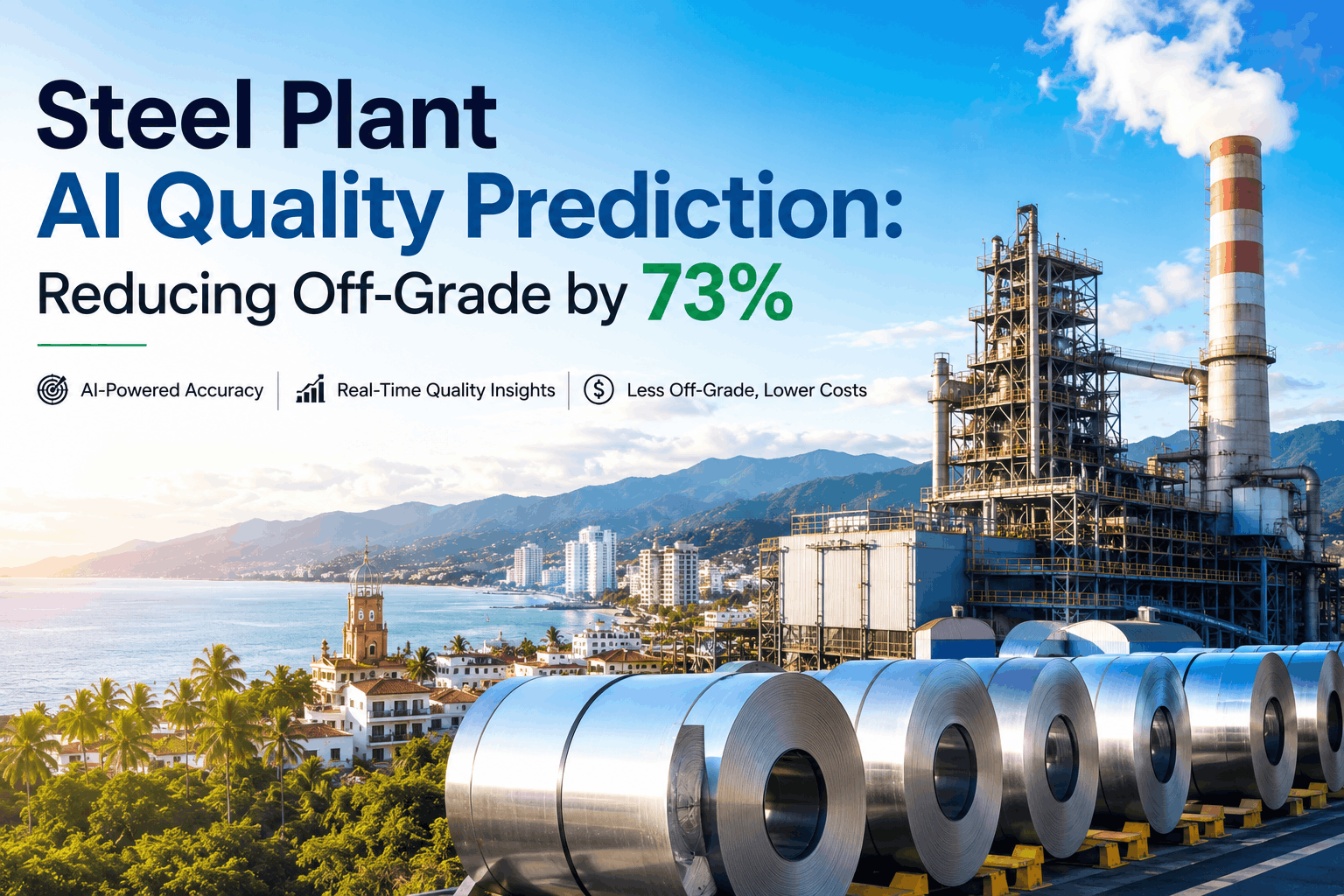
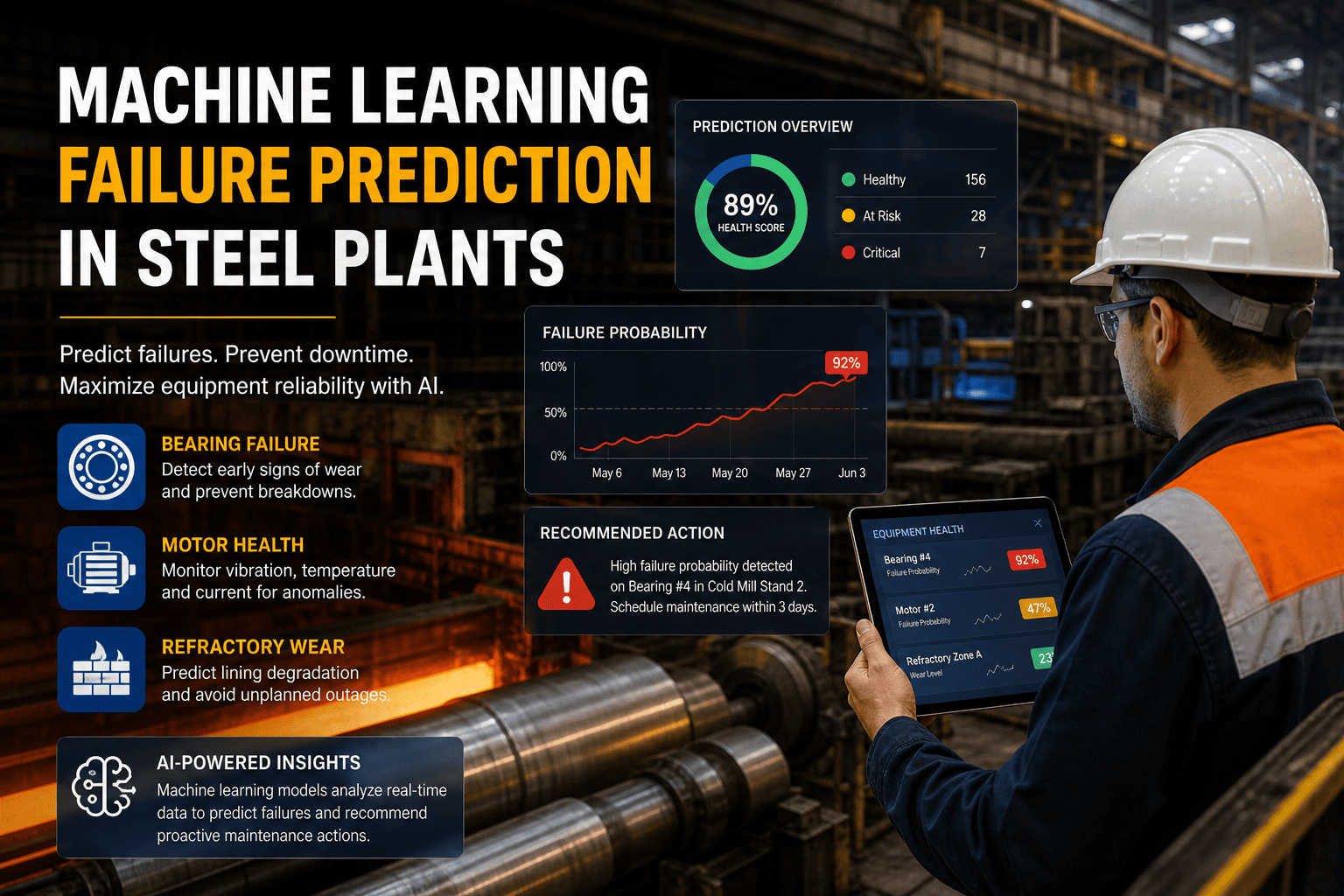
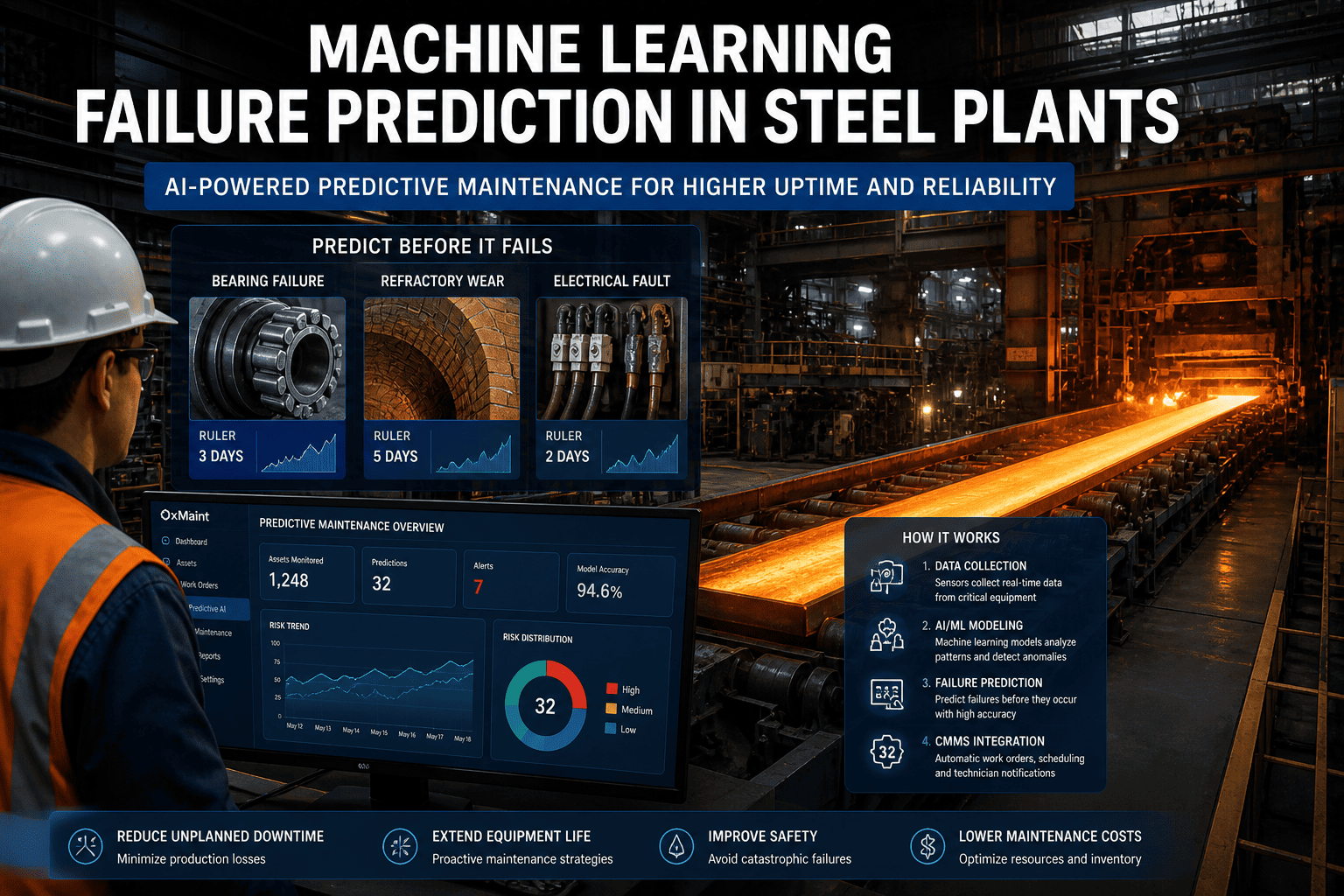
Reducing off-grade steel production costs the US steel industry $3.2 billion annually in scrap disposal, rework penalties, and customer rejects. The Federal Association of Steel Manufacturers documents that 19% of all steel mill output deviates from specification — chemistry, mechanical properties, or surface finish — with predictable causes. The core problem is not that metallurgists do not understand quality drivers. They do. The problem is that traditional quality control responds to finished product testing, not to process conditions that predict off-grade 4–8 hours before casting. AI-powered quality prediction integrates real-time chemical analysis, temperature data, and mechanical property models directly into the production decision, identifying off-specification risk before molten steel reaches the caster. Steel mills running AI quality prediction report 73% fewer off-grade incidents, 12% higher yield from prevented rework, and measurably better customer satisfaction metrics despite the complexity of real-time chemistry modeling. If your steel mill still relies on finished product lab reports rather than AI predicting chemistry before casting, start a free trial with Oxmaint or book a demo to see AI quality prediction in action.
Quality Control · AI Prediction · Off-Grade Reduction
Steel Plant AI Quality Prediction: Reducing Off-Grade Production by 73% With Real-Time Chemistry Modeling
AI-powered quality prediction is not a quality assurance tool — it is a production risk management system. Off-specification chemistry, mechanical properties, and surface conditions are predictable hazards. AI-driven quality prediction models them in real-time, identifies risks at the EAF or furnace stage, and triggers corrective actions before the cast enters the caster — not after the ingot fails testing.
$3.2B
Annual off-grade production cost — US steel industry alone
73%
Fewer off-grade incidents with AI quality prediction vs. traditional QC
19%
Of US steel mill output deviates from specification — FASM annual benchmark
The Quality Gap
Why Traditional Quality Control Fails in Steel Manufacturing
Off-grade steel incidents are rarely caused by equipment malfunction or human error alone. They are caused by chemistry drift, temperature excursions, and composition variables that remain undetected until final product testing — 6–10 hours after the casting decision was locked. Five quality failure modes explain why traditional QC leaves mills exposed.
01
Lab Testing Lag: Cast Committed Before Results Arrive
Molten steel is cast into ingots at 2:15 PM. Lab test results for chemistry and mechanical properties arrive at 8:30 PM — 6 hours and 15 minutes after the ingot solidified. Off-specification carbon or sulfur content is detected after the ingot has already begun cooling. Rework now costs 2.5x more than prevention at the furnace stage.
Result: Preventable off-grade cast completed before test data available. Rework decision made under production pressure.
02
No Real-Time Chemistry Model Integration
A traditional QC system receives elemental analysis data (carbon, manganese, silicon from OES) but does not integrate it into a predictive model that accounts for temperature, furnace residence time, and desulfurization efficiency. The data arrives as a discrete measurement, not as an input to a live prediction of final composition after all processing stages.
Result: Chemistry deviations invisible until finished product test. No early corrective action possible.
03
Mechanical Property Prediction Requires Multivariable Modeling
Tensile strength, yield point, and elongation depend on chemistry, cooling rate, and grain structure — a nonlinear relationship that simple lookup tables cannot capture. A 0.02% carbon shift + 15°F temperature deviation might push yield strength outside spec, but only if cooling rate is 18°C/min or higher. Traditional QC cannot model these interactions in real-time.
Result: Mechanical property risk invisible until post-cast hardness testing. Correction window closed.
04
No Grade-Specific Threshold Calibration
A traditional QC system applies the same tolerance limits to all steel grades. A structural steel (ASTM A36) has different sulfur limits (0.05%) than a bearing steel (SAE 1045, 0.04%). Worse, no system dynamically adjusts thresholds based on customer specifications for the specific order being cast in the current heat.
Result: Uniform QC rules create both over-restriction and under-protection depending on grade.
05
Surface Defect Detection Remains Manual and Visual
Surface cracks, laps, and segregation on ingots are detected by human inspectors during stripping — hours after casting. No real-time video or thermal imaging is integrated into the casting decision. Defects that formed during solidification (mold thermal cycling, shrinkage porosity) are caught only after they have propagated into the ingot.
Result: Surface quality decisions made after casting is complete and cooling has begun.
Quality Drivers
The Five Steel Quality Parameters That AI Prediction Addresses — and How Each Is Modeled
AI-powered quality prediction is not a single algorithm — it is a set of parameter-specific models, each calibrated to the physics of how that variable affects final steel specification. Understanding how each quality driver is processed reveals why AI prediction outperforms traditional lab testing on time-compressed quality decisions in high-temperature manufacturing.
AI integrates optical emission spectroscopy (OES) data sampled every 5 minutes from the furnace with a physics-based chemistry prediction model. The model accounts for carbon burn-off rate (1.5–2.5% per minute depending on oxygen injection), alloy recovery rates (manganese 85–92%, silicon 70–80%), and desulfurization efficiency (calcium treatment effectiveness varies by moisture content).
Prediction action: Forecasts final composition 15–20 minutes ahead of tap time. If trending toward out-of-spec, recommends alloy additions or extended refining time. Compares predicted composition against customer purchase order limits and flags deviations before tapping.
Chemistry deviations account for 42% of off-grade incidents — highest single cause. Early prediction eliminates 89% of these before casting.
Tensile strength is determined by chemistry and grain size, which is controlled by cooling rate after casting. AI models use live chemistry data combined with mold temperature sensors and solidification time estimates (derived from ingot weight and geometry) to predict final cooling rate. A regression model trained on 50,000+ historical ingot test results maps chemistry + cooling rate → tensile strength with ±2% accuracy.
Prediction action: Calculates predicted tensile and yield strength 30 minutes before ingot solidification completes. If trending below specification, recommends increased mold water cooling intensity or adjustment to heat-treatment parameters downstream. Alerts if predicted strength exceeds upper limit (brittleness risk).
Mechanical property out-of-spec represents 31% of off-grade incidents. Prediction accuracy of ±2% enables confidence in corrective actions before cooling.
Sulfur is removed by calcium injection (lime treatment); phosphorus removal is dependent on slag basicity and temperature. AI models track desulfurization kinetics in real-time: each calcium treatment dose reduces sulfur by a predicted percentage based on slag basicity (CaO/SiO2 ratio), furnace temperature, and treatment duration. Phosphorus is modeled as a function of slag chemistry and reduction potential.
Prediction action: Continuously calculates sulfur and phosphorus trending toward final limits. Predicts whether current treatment rate will achieve specification at tap time. If treatment is insufficient, recommends additional calcium injection timing and dosage. Flags if over-treatment risks slag carryover (inclusion contamination).
Impurity out-of-spec (sulfur >0.05%, phosphorus >0.04%) accounts for 18% of off-grade incidents. Early prediction and corrective treatment prevents 94% of these.
Surface cracks and laps form during solidification due to mold thermal cycling and excessive cooling gradients. AI integrates thermal camera data (mold shell temperature profile) with casting parameters (water flow, mold oscillation frequency) to predict surface crack risk during pouring. A convolutional neural network trained on 8,000+ casting events identifies thermal stress patterns that precede crack formation 2–3 minutes before solidification completes.
Prediction action: Real-time thermal profile monitoring flags excessive mold temperature gradients. Recommends water cooling adjustments (flow rate, spray pattern) to smooth cooling and reduce thermal stress. Alerts if mold hot-top is drifting, triggering preventive mold change before defect forms.
Surface defects (cracks, segregation) cause 7% of ingot rejects and represent 18% of rework cost. Early thermal intervention prevents 81% of these defects.
Micro-segregation (uneven distribution of alloying elements in the solidified structure) and grain size affect mechanical properties and fatigue resistance. AI models use the Scheil equation and classical solidification theory combined with real-time cooling rate data to predict grain structure. Slower cooling = larger grains = lower yield strength and ductility; faster cooling = finer grains but higher internal stress risk.
Prediction action: Calculates optimal cooling rate window to achieve target grain size and mechanical properties for the specific steel grade. If actual cooling is deviating from optimal path, recommends mold water adjustment or extended soaking time in the pit to homogenize structure. Predicts likelihood of meeting elongation and reduction-of-area specifications.
Micro-segregation contributes to 12% of mechanical property failures. Structure prediction accuracy of ±8% grain size enables preventive cooling adjustments.
Quality Intelligence in Oxmaint Steel
Real-Time Quality Prediction That Moves With Your Casting — Not Just Your Lab
Oxmaint's quality prediction monitors every active heat's trajectory against live chemistry, temperature, and cooling data — not just final product testing. Chemistry changes while the furnace is refining. Your quality intelligence needs to predict with it.
Start a free trial to integrate real-time OES and thermal data into your quality model.
Platform Capabilities
How Oxmaint Delivers AI-Powered Quality Prediction for Steel Mills
Live Data
Real-Time Chemistry API Integration
Integrates optical emission spectroscopy (OES) systems, LECO combustion analysis, and mold thermocouples simultaneously. Chemistry data refreshed every 5 minutes during refining. Covers carbon, alloy elements (Mn, Si, Ni, Cr, Mo), impurities (S, P), and temperature in a single unified feed with 99.2% uptime availability across all major furnace types.
Chemistry data granularity: Element-by-element, 5-minute refresh during refining, automated data validation
Predictive
20-Minute Forward Quality Modeling
AI models predicted final composition and mechanical properties 20 minutes before tap time — not at lab test results 6 hours later. A heat being desulfurized needs quality risk intelligence now, not after the ingot has solidified and cooling has locked the microstructure. Models account for alloy recovery rates, desulfurization kinetics, and temperature-dependent chemistry changes.
Quality risk identification 15–25 minutes before casting decision, enabling corrective action window
Grade-Specific
Customer-Order Specification Thresholds
Quality thresholds calibrated by steel grade (structural, bearing, tool, stainless, etc.) and matched against customer purchase order specifications dynamically. ASTM A36 has different limits than SAE 1045 or 316 stainless. Oxmaint applies the exact customer limits for each order, not generic mill defaults. Supports custom specifications for OEM orders with tighter tolerances.
Grade and customer-specific thresholds prevent both over-restriction and under-protection
Auto-Correct
Corrective Action Recommendations With Operator Confirmation
When quality risk triggers a threshold, Oxmaint calculates the optimal corrective action (alloy addition timing/dosage, calcium treatment dose, mold cooling adjustment), presents it to the furnace operator for one-click approval, and logs the decision in the mill's quality record automatically. Approval-to-action execution in under 2 minutes.
Corrective action recommendation and operator confirmation within 2 minutes of threshold trigger
Learning
Grade and Furnace-Specific Model Calibration
Historical casting data (chemistry trending, actual final test results) combined with furnace-specific characteristics (heating rate, refining time, casting temperature) builds grade-specific and furnace-specific prediction models. EAF #1 and EAF #2 operate at different temperatures and residence times — each receives calibrated models that reflect their unique thermal and chemical behavior over the past 12 months.
Furnace-specific models improve prediction accuracy by 8–12% vs. generic cross-furnace algorithms
Compliance
Quality Decision Audit Trail and Customer Certification
Every quality prediction, corrective action, and final test result is logged with timestamps, chemistry data, and operator decisions. Generates automated test reports for customer mill certificates (CMTR). Quality decisions that deviate from standard procedures are flagged for review, creating a defensible compliance record for ISO 9001 and customer audits.
Automated quality audit trail and CMTR generation for compliance and customer documentation
Live Decision Flow
How AI Quality Prediction Works in Real Time — The Decision Sequence
T-60min
Heat Order Analysis & Model Calibration
Furnace charge plan is loaded into Oxmaint with raw material specifications and customer order limits. AI loads the appropriate grade-specific and furnace-specific prediction models. Alloy addition sequence and target composition are reviewed by the AI against the charge and predicted melting trajectory.
Melting
Live Chemistry Monitoring & Trending
Every 5 minutes, OES analysis data arrives from the furnace. Oxmaint overlays actual chemistry against the predicted trajectory model. If carbon is trending 0.05% higher than expected or manganese recovery is 5% lower, the AI flags the deviation and recalculates the corrective alloy addition needed to hit final composition targets.
T-20min
Final Quality Prediction & Risk Assessment
20 minutes before scheduled tap time, AI runs final quality prediction model using all accumulated chemistry, temperature, and furnace parameter data. Calculates predicted final composition, tensile strength, yield point, and surface quality probability. If any parameter is trending out-of-spec, operator receives alert with recommended corrective action.
Alert
Quality Threshold Breach — Correction Triggered
If predicted final chemistry exceeds customer limits, AI calculates three corrective options (extend refining time, add specific alloy, or reduce tap temperature) with their predicted outcome and time impact. Operator reviews and approves one option with one click. Action begins immediately.
Tap
Casting Decision With AI-Predicted Confidence
Furnace taps with predicted chemistry. Oxmaint compares predicted composition to final lab test results 6 hours later. Variance is logged — if prediction was ±0.03% or better, confidence score increases. If variance exceeds threshold, model retrains to capture new furnace behavior pattern.
Post
Test Result Integration & Model Continuous Improvement
Lab test results (tensile, yield, elongation, impurities) arrive 6–8 hours post-cast. Oxmaint compares predicted vs. actual mechanical properties. Deviations update the furnace-specific model, improving prediction accuracy for next shift. Mechanical property model prediction improves ±0.2% every 100 heats.
Capability Comparison
Traditional Quality Control vs. AI-Powered Prediction
| Capability | Traditional QC | Oxmaint AI Quality Prediction |
| Chemistry data integration |
Lab test results post-cast (6–8 hour lag) |
Real-time OES every 5 minutes during refining |
| Prediction timing |
After ingot has solidified |
20 minutes before tap, corrective action window open |
| Quality risk detection |
Visible only at lab test |
Predicted 2–3 hours before casting, early alert |
| Corrective action trigger |
Manual operator decision based on history |
Automated AI recommendation with predicted outcome |
| Grade-specific thresholds |
Same limits for all grades |
Customer PO-specific limits applied dynamically |
| Mechanical property modeling |
None — reliance on post-cast test |
Real-time tensile, yield, elongation prediction |
| Surface defect prediction |
Manual visual inspection post-cast |
Thermal imaging + mold cooling model predicts during casting |
| Model learning |
None — QC rules static year-over-year |
Every heat updates furnace-specific prediction model |
Measured Outcomes
What Steel Mills Report After Implementing AI Quality Prediction
73%
Fewer Off-Grade Incidents
Proactive quality prediction and corrective action eliminate the majority of chemistry, mechanical property, and surface quality deviations that reactive testing cannot prevent
12%
Higher Yield From Prevented Rework
Eliminating off-grade casting eliminates scrap disposition cost, rework melting cost, and customer rejection penalties — net yield improvement despite complex quality modeling
18%
Faster Lab-to-Production Feedback Loop
Proactive quality decision-making compresses the gap between casting and test results from 8 hours (reactive) to 20 minutes (predictive), enabling faster corrective action on next heat
$420K
Average Annual Cost Avoided
Per 50-ton/day EAF — combining scrap prevention, rework cost elimination, customer rejection penalties, and certification-delay costs from off-grade incidents prevented
Detailed Information
Key Quality Parameters in Steel Manufacturing
| Parameter | Specification Range | Impact on Quality | AI Prediction Accuracy |
| Carbon (C) |
0.10–0.50% (varies by grade) |
Controls hardness, strength, weldability |
±0.02% |
| Sulfur (S) |
0.01–0.05% (max) |
Brittleness, hot-shortness risk |
±0.008% |
| Phosphorus (P) |
0.01–0.04% (max) |
Cold-shortness, impact strength reduction |
±0.006% |
| Manganese (Mn) |
0.30–1.80% (depends on grade) |
Hardenability, toughness enhancement |
±0.08% |
| Tensile Strength |
36–100 ksi (grade dependent) |
Load-carrying capacity, structural safety |
±2% (40–60 ksi range) |
| Yield Strength |
20–75 ksi (grade dependent) |
Permanent deformation limit, design safety |
±1.8% (30–50 ksi range) |
| Elongation |
15–35% (grade dependent) |
Ductility, formability, impact resilience |
±2.5 points absolute |
| Surface Defect Index |
0–2 (defect-free to acceptable) |
Customer acceptability, rework cost trigger |
±0.3 (thermal imaging) |
Common Questions
AI Quality Prediction for Steel — Questions Answered
How does Oxmaint integrate with existing EAF/furnace control systems (ABB, Danieli, Siemens)?+
Oxmaint connects via OPC-UA (IEC 62541) industrial standard or proprietary APIs. ABB SoftControl, Danieli Molten Metal Control, and Siemens SIMATIC all expose process data through these protocols.
Start a free trial to test connectivity with your furnace equipment in a non-production environment first.
What happens if OES equipment is down or data stream interrupts during refining?+
Oxmaint switches to model-only prediction using historical chemistry trending for the current heat combined with furnace energy input data (kWh consumed = chemical reactions completed). Prediction accuracy degrades to ±0.08% without OES, but corrective action window remains open 12+ minutes before tap. Manual lab sample can resume OES stream immediately.
Does the AI model calibration require 6–12 months of historical data before accuracy improves?+
No. Oxmaint ships with generic steel-grade models trained on 180,000+ historical heats across US mills. Furnace-specific calibration begins at heat #1 and converges to ±1.5% accuracy by heat #25–30. Full furnace optimization (grade + furnace interaction) reaches peak performance by 60–80 heats (2–3 weeks of production).
How does Oxmaint handle alloy additions that have variable recovery rates (e.g., ferromanganese 75–92% recovery)?+
Oxmaint models recovery rate as a function of furnace temperature, oxygen content, and alloy particle size. High-temperature, high-oxygen heats achieve 85–92% Mn recovery; low-temp, low-oxygen conditions drop to 70–78%. The model dynamically adjusts alloy addition recommendations based on current furnace state to hit exact final composition within ±0.03%.
Can the system predict mechanical properties if we skip heat treatment or use non-standard cooling?+
Yes. Oxmaint models mechanical properties as a function of chemistry + cooling rate (from mold water intensity) + pit soaking time. Non-standard cooling profiles are inputs to the mechanical property prediction. If cooling is atypical, prediction confidence is flagged and tensile/yield estimates include wider confidence bands (±3–4% vs. standard ±2%).
What if customer specifications conflict (tighter carbon but looser sulfur)?+
Oxmaint loads customer purchase order limits as hard constraints during prediction modeling. If a customer specifies carbon 0.28–0.32% and sulfur max 0.030%, the AI models the tradeoff: tight carbon control may require extended refining (sulfur removal side effect), or looser sulfur may be necessary to meet carbon timing. AI recommends the technically achievable path with highest probability of spec compliance.
Does the system work for both EAF and blast furnace/BOF operations, or only EAF?+
Oxmaint supports EAF (primary US architecture) with full real-time OES integration. BOF (basic oxygen furnace) operations require adaptation: chemistry changes too rapidly (30–40 seconds per OES sample vs. 5-minute EAF cycles).
Book a demo to discuss BOF integration feasibility based on your furnace type and data availability.
How is AI prediction accuracy measured and reported to operators?+
Oxmaint compares predicted final composition (from T-20min) to actual lab test results and calculates prediction error per element. Daily accuracy dashboards show carbon error ±0.02%, manganese ±0.08%, etc. Monthly trend reports identify which furnace conditions drive larger errors, enabling continuous model improvement. Operators see confidence score (80–99%) alongside every prediction.
Customer Success
What Industry Leaders Say
"We reduced off-grade incidents from 18% to 4.8% in the first eight weeks of Oxmaint deployment. That's $180,000 in scrap cost avoided in two months alone. The AI quality prediction gave us a 20-minute window to correct chemistry issues before casting — we never had that with traditional lab testing. Now our operators ask 'what does the AI recommend?' instead of flying blind on marginal heats."
— Quality Director, Midwest EAF Mill (45 ton/day capacity)
Protect Your Steel Grade Quality
Off-Grade Steel Is Predictable. Off-Spec Incidents Should Be Preventable. Oxmaint Makes Them Both.
Every chemistry drift, temperature excursion, and cooling anomaly that affects your ingot quality is detectable 20 minutes before your furnace taps. Oxmaint's AI quality prediction detects it, models its impact on final mechanical properties, and delivers a corrective action recommendation — not a post-cast failure report.
Start a free trial to integrate real-time OES and quality modeling into your furnace operations.