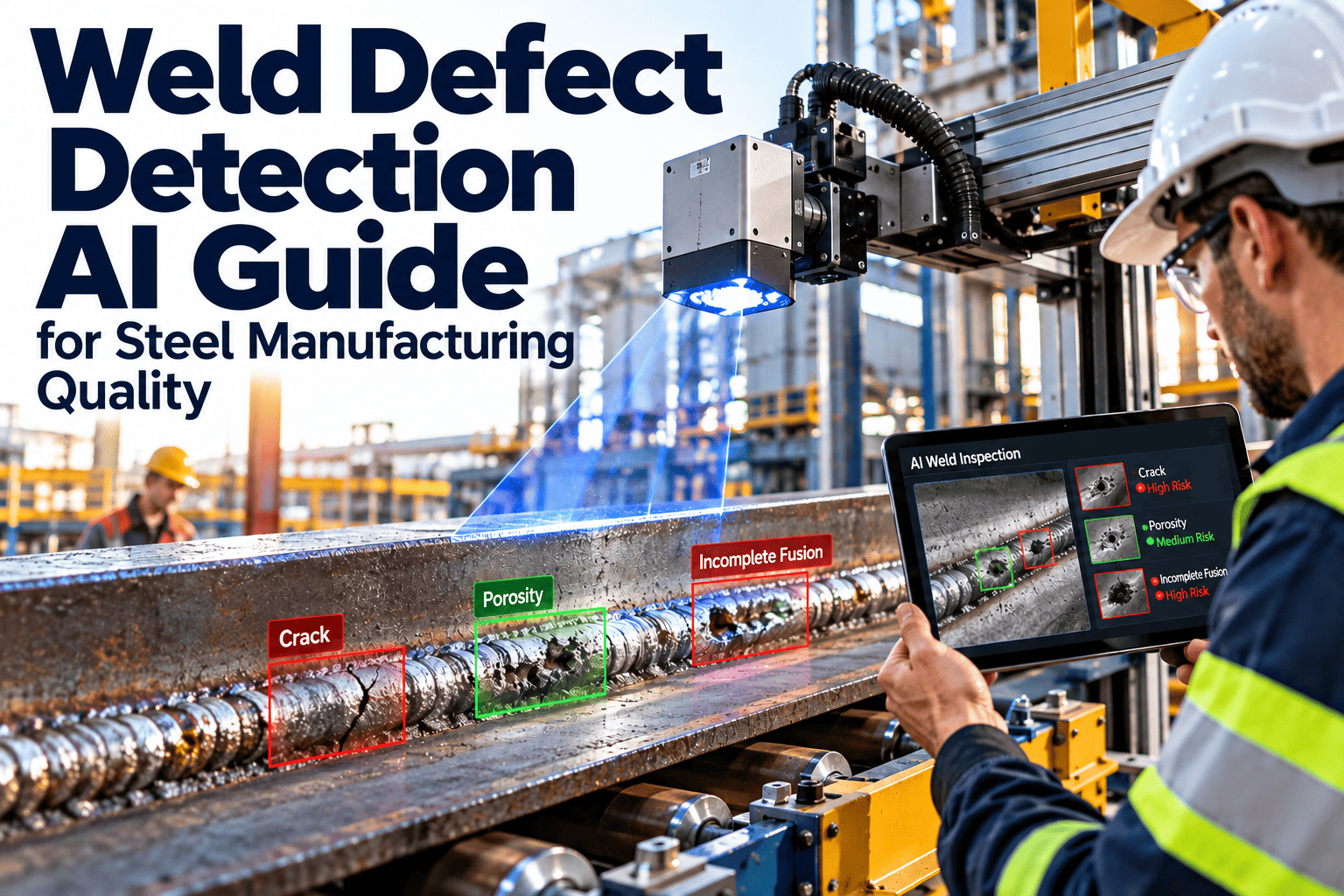
Weld defects cost manufacturers billions annually in rework, warranty claims, and catastrophic failures. Manual inspection catches only 80% of defects under optimal conditions, while fatigue and inconsistency push real-world detection rates even lower. The AI-based visual inspection market for welds reached USD 1.62 billion in 2024 and is projected to grow at 13.8% CAGR through 2033, driven by manufacturers demanding better quality assurance. AI vision systems now achieve 97-99% detection accuracy, inspecting 150 weld seams in just 40 seconds. Schedule a consultation to explore how AI weld inspection can transform quality control at your facility.
Why AI-Powered Weld Inspection
Manufacturing plants face mounting pressure from quality standards, safety regulations, and customer expectations. Manual inspection methods miss the subtle defects and patterns that AI systems catch consistently, leaving significant quality gaps and compliance risks.
The Case for AI-Powered Weld Inspection
97-99%
Detection accuracy achieved by AI vision systems—versus 80% with manual inspection under optimal conditions
0.3 sec
Per weld inspection time—enabling 100% inspection coverage instead of sample-based checking
94%
Reduction in downstream failures when AI inspection catches defects before assembly
4-8 mo
Typical ROI payback period through reduced scrap, fewer warranty claims, and eliminated rework
Ready to eliminate weld defects before they reach assembly? Join leading manufacturers using AI inspection to achieve near-zero defect rates.
AI vision systems identify defects that compromise structural integrity and product safety—from surface-level porosity to subsurface cracks that manual inspectors consistently miss under production pressure.
Defect Types & Impact on Weld Integrity
Each defect type requires specific detection algorithms trained on thousands of weld images
Porosity
Reduces strength by 30-50%
Cracks
Risk of complete failure
Lack of Fusion
Joint separation under load
Incomplete Penetration
Weak joint connection
Slag Inclusion
Stress concentration points
Undercut
Groove weakness at edges
How AI Vision Weld Inspection Works
AI vision systems combine high-resolution cameras with deep learning algorithms trained on thousands of weld images. The system captures every weld, processes images in milliseconds, and classifies defects by type and severity—enabling real-time quality control that adapts to changing production conditions.
AI Weld Inspection PipelineFrom image capture to automated action
01
Multi-Angle Capture
High-resolution cameras positioned at multiple angles capture detailed images of every weld. Lighting systems optimize contrast to reveal surface defects invisible to the naked eye.
02
Deep Learning Analysis
Neural networks trained on millions of weld images process each capture in milliseconds. Convolutional layers detect patterns matching known defect signatures with 97-99% accuracy.
03
Defect Classification
AI classifies each detected anomaly by defect type (porosity, crack, undercut, etc.) and severity level. Classification drives appropriate response—from alerts to automatic rejection.
04
Automated Response
Based on defect severity, the system triggers appropriate action—operator alerts, automatic part rejection, or automated work order creation in OXmaint for equipment calibration when defect patterns indicate welding machine issues.
Manual vs AI Weld Inspection
Understanding the capabilities difference between traditional visual inspection and AI-powered systems reveals why quality-critical manufacturers are transitioning to intelligent defect detection.
Inspection Approach Comparison
Manual Inspection
❌
80% detection accuracy under optimal conditions
2-5 minutes per weld inspection time
Inconsistent results across shifts and inspectors
Surface-only defect visibility
Sample-based inspection coverage
20%+defects missed on average
AI Vision Inspection
✔️
97-99% detection accuracy consistently
0.3 seconds per weld inspection time
100% consistency 24/7 without fatigue
Surface + subsurface defect detection
100% inspection coverage on every weld
<3%escape rate with AI systems
See AI weld inspection accuracy in a live demo. Our specialists will show you defect detection on actual weld samples from your industry.
Different industries have distinct welding requirements, defect tolerances, and production volumes. AI inspection systems adapt to each sector's unique quality standards and regulatory requirements.
100% inspection coverage on critical pipeline welds
Shipbuilding
Submerged arc, MIG, manual arc
Undercut, porosity, lack of fusion
30% faster inspection, miles of weld seams covered
Heavy Equipment
MIG, FCAW, robotic welding
Structural cracks, incomplete penetration
25% reduction in warranty claims from weld failures
Pressure Vessels
TIG, SMAW, SAW
All defect types (ASME compliance)
Automated documentation for regulatory compliance
AI models are trained on industry-specific weld types and defect signatures to optimize detection for each manufacturing sector.
ROI: The Business Case for AI Weld Inspection
AI weld inspection investments deliver returns through multiple value streams—reduced scrap, fewer warranty claims, faster throughput, and eliminated rework cycles. The financial impact compounds as quality improvements cascade through the entire production process.
Documented Manufacturing BenefitsBased on deployment data across automotive, aerospace, and heavy industry sectors
94%
Reduction in downstream failures
30%
Less rework required
15%
Faster manufacturing time
70%
Reduction in inspection labor
Calculate your potential savings. Create a free OXmaint account and our team will help model the ROI for your specific welding operations.
AI weld inspection generates valuable data beyond pass/fail decisions. When defect patterns indicate equipment issues—worn tips, misaligned fixtures, or degrading welding parameters—OXmaint's CMMS platform automatically generates maintenance work orders, ensuring every quality signal triggers appropriate corrective action.
From Detection to Resolution
1
Defect Detected
AI vision identifies anomaly pattern indicating equipment issue
2
Work Order Created
OXmaint auto-generates maintenance task with defect evidence
3
Team Notified
Mobile alerts sent to maintenance technicians with priority
4
Issue Resolved
Complete audit trail from defect to corrective action
Implementation Approach
Successful AI weld inspection deployment requires careful planning across camera placement, lighting design, AI model training, and system integration. A phased approach delivers quick wins while building toward comprehensive coverage.
Typical Deployment Roadmap
Week 1-2
Assessment & Design
Weld process analysisCamera placement designDefect classification planning
Week 3-4
Hardware Setup
Camera installationLighting optimizationNetwork connectivity
Week 5-6
AI Model Training
Sample collection & labelingModel training & validationThreshold calibration
Week 7+
Production & Optimization
Full production deploymentContinuous model improvementAdditional line rollout
Manual inspection was our bottleneck—we could only sample 10% of welds. With AI vision, we inspect 100% in less time than our previous sample-based approach. Defect escapes dropped from 3% to under 0.1%, and warranty claims from weld failures are nearly eliminated.
— Quality Director, Automotive Tier 1 Supplier
Transform Weld Quality with AI Vision
OXmaint connects AI weld inspection systems to your maintenance workflow—converting detected defects into automated work orders, tracking equipment calibration, and building complete quality documentation. See how AI-powered inspection catches what manual methods miss.
AI vision systems inspect all common welding types including MIG, TIG, resistance spot welding, laser welding, and arc welding. Each welding process produces different defect signatures, and AI models can be trained to detect defects specific to your welding methods and materials. Schedule a consultation to discuss inspection requirements for your specific weld types.
Can AI detect subsurface defects?
Surface-level AI vision detects visible defects with high accuracy. For subsurface detection, AI systems integrate with X-ray radiography or ultrasonic testing to analyze internal weld structure. AI-powered X-ray analysis achieves up to 99.8% accuracy on defect classification, making subsurface inspection practical at production speeds.
How long does implementation take?
Basic implementations can be operational within 4-8 weeks. The system requires initial training on your specific weld types and acceptable quality standards. Pre-trained models accelerate deployment, with fine-tuning for your exact materials and defect modes improving accuracy over time.
Does AI inspection replace human inspectors?
AI inspection augments human expertise rather than replacing it. Inspectors shift from repetitive visual checks to higher-value work like root cause analysis, process optimization, and handling complex edge cases. Many manufacturers redeploy inspection staff to quality engineering roles where their experience is more valuable.
How does AI inspection integrate with our existing systems?
AI inspection platforms integrate with MES, SCADA, and CMMS systems through standard industrial protocols. OXmaint's maintenance platform provides direct integration to convert inspection results into maintenance actions—automatically generating work orders when defect patterns indicate equipment issues.