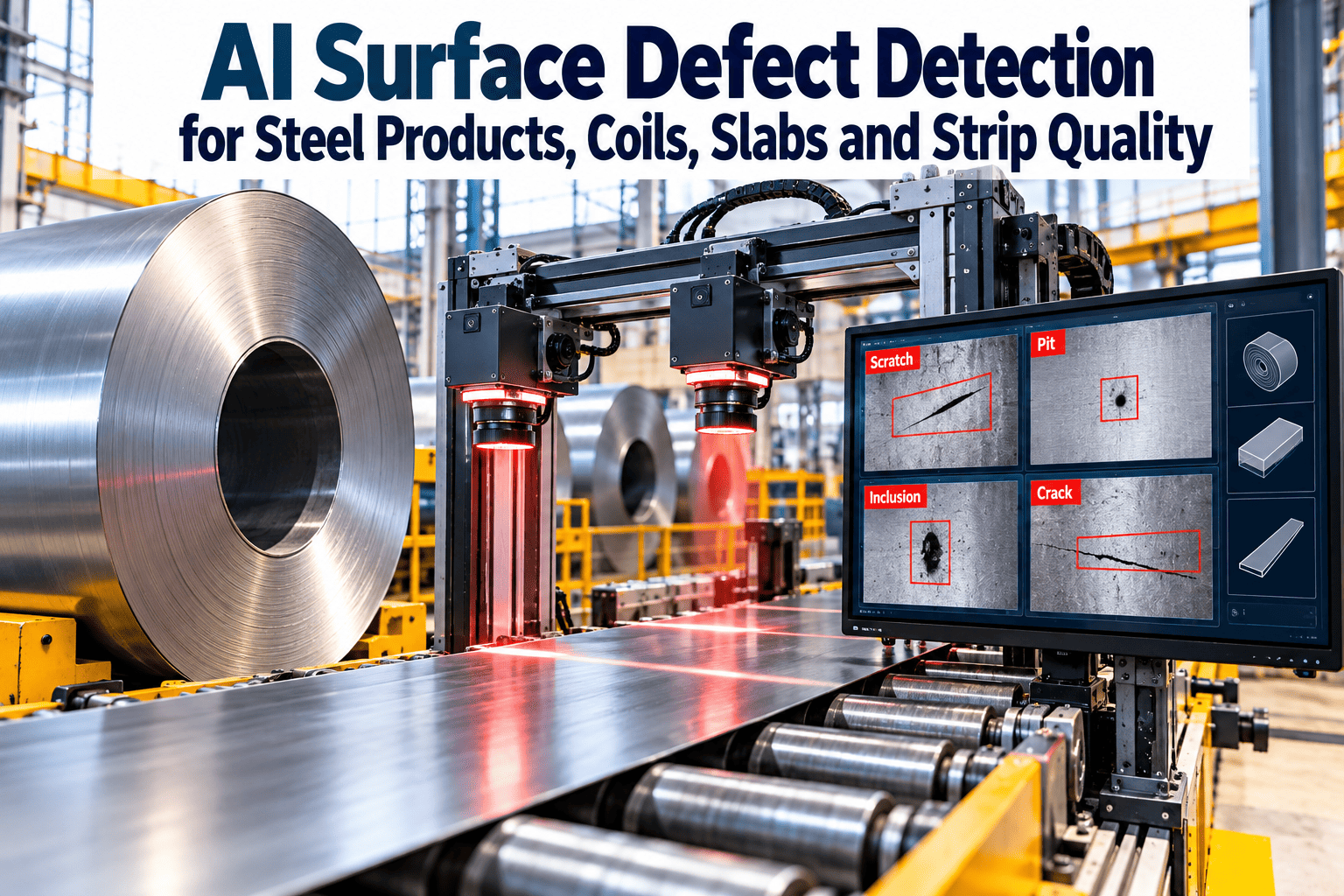
Cold rolling mills process steel at speeds exceeding 1,500 meters per minute—yet a single undetected surface defect can trigger $85,000 in customer rejections and halt production for hours. Traditional inspection methods catch only 65-75% of defects at these speeds, leaving steel manufacturers vulnerable to quality escapes that damage reputation and profitability. AI-powered vision inspection transforms cold rolling quality control, detecting scratches, pits, roll marks, and edge defects with 99.2% accuracy in milliseconds. Schedule a consultation to explore how AI vision systems can transform quality control at your cold rolling facility.
Why AI Vision for Cold Rolling Mills
Steel manufacturers face mounting pressure from automotive and appliance customers demanding zero-defect surfaces, while production speeds continue to increase. Manual inspection and traditional AOI systems miss the subtle defect patterns that cause customer rejections, leaving significant quality risks unaddressed.
The Case for AI-Powered Vision Inspection
$1.8M
Average annual savings per cold rolling line through AI-driven defect detection and false positive elimination
15ms
Detection speed—classifying defects by type, severity, and location at full production speed
92%
Reduction in false positives—from 18% with legacy AOI to under 2% with AI vision systems
99.2%
Defect detection accuracy at full line speed—up from 78% with traditional automated inspection
Ready to eliminate quality escapes in your cold rolling operation? Join leading steel manufacturers using AI vision to reduce customer rejections and meet quality targets.
Modern AI vision platforms combine high-speed line scan cameras, edge computing, and deep learning algorithms trained on millions of steel surface images to deliver real-time defect detection across your entire cold rolling operation.
Real-Time Inspection ProcessFrom image capture to automated response in milliseconds
01
High-Speed Image Capture
16K line scan cameras image both top and bottom surfaces simultaneously at speeds up to 2,000 m/min. Microsecond exposure times ensure sharp images regardless of line speed, with specialized lighting revealing surface defects invisible to standard cameras.
02
AI Analysis Engine
Neural networks trained on 5+ million defect images classify each anomaly by type, size, and severity. Deep learning models detect subtle patterns—early roll wear signatures, tension variations, lubricant breakdown—that rule-based systems miss entirely.
03
Quality Decision
Automatic pass/fail determination with complete defect mapping per coil. Quality grades assigned based on customer specifications, with full traceability from detection to disposition for every surface anomaly identified.
04
CMMS Integration
Direct connection to maintenance systems enables automated work order generation when defects indicate equipment issues. Sign up for Oxmaint to centralize vision inspection data with maintenance workflows across multiple rolling lines.
Defect Detection Capabilities
AI vision systems detect, classify, and map the full spectrum of cold rolling surface defects—from critical roll marks requiring immediate line stoppage to subtle oil stains affecting downstream coating processes.
Cold Rolling Defect Classification
Roll Marks
Periodic surface patterns from damaged work rolls detected within seconds of occurrence. AI correlates pattern spacing to specific roll positions, enabling targeted roll changes before defects propagate.
Scratches
Linear abrasions from foreign particles or guide misalignment classified by depth, length, and orientation. Machine learning distinguishes process scratches from handling damage for accurate root cause analysis.
Pitting & Inclusions
Surface depressions from scale inclusions or lubricant breakdown mapped by density and distribution. AI identifies clustering patterns indicating upstream process issues before quality limits are exceeded.
Edge Defects
Cracks, waves, and damage at strip edges from excessive tension or improper reduction ratios. Real-time edge monitoring enables automatic tension adjustment before defects require edge trimming.
See AI vision detecting defects at production speed. Book a demo and we'll show you real-time inspection for your specific steel grades.
Understanding the capabilities difference between traditional inspection methods and AI vision reveals why leading steel manufacturers are transitioning to intelligent quality control systems.
Inspection Method Comparison
Traditional AOI
✗
78-85% defect detection rate
15-25% false positive rate
Requires constant threshold tuning
Struggles with new defect types
Limited root cause correlation
15-25%of defects escape detection
AI Vision System
✓
99.2% defect detection accuracy
Less than 2% false positive rate
Self-learning algorithms adapt automatically
Detects novel defect patterns
Automatic CMMS work order generation
<1%defect escape rate achieved
ROI of AI Vision Inspection
AI vision investments deliver returns through eliminated customer rejections, reduced scrap from false positives, prevented unplanned downtime, and improved labor efficiency. The financial impact compounds across multiple value streams.
Documented Performance ImprovementsBased on cold rolling mill implementations across multiple facilities
99%
Defect detection accuracy
92%
False positive reduction
70%
Reduction in customer rejections
60%
Faster root cause identification
Transform Cold Rolling Quality Control with AI Vision
Oxmaint connects AI vision systems across your entire operation—centralizing defect data, quality metrics, and maintenance workflows while each inspection point delivers real-time intelligence at production speed.
AI vision systems install during scheduled maintenance windows without extended shutdowns. A phased approach delivers quick wins while building toward comprehensive quality control across all rolling lines.
Typical 60-Day Deployment
Week 1-2
Site Assessment
Line speed and width analysisCamera positioning designNetwork infrastructure review
Week 3-4
Installation
Hardware mounting and calibrationCMMS integration setupBaseline data collection
Week 5-6
AI Training
Model training on your gradesDefect classification tuningParallel validation testing
Week 7-8
Go-Live
Full production operationPerformance monitoringContinuous improvement setup
Start your AI vision journey today. Get a detailed project plan customized for your cold rolling facility's specific requirements.
AI vision platforms integrate with existing plant systems to enable automated quality response and comprehensive data analysis across operational, quality, and maintenance domains.
System Integration Points
System
Integration Type
Data Exchange
Level 2 Automation
Real-time bidirectional
Line speed, tension, roll data, automatic parameter adjustment triggers
Maintenance work orders for roll changes, equipment health correlation
MES Systems
Continuous feed
Production tracking, yield calculations, defect-to-batch correlation
Deploy AI Vision for Quality Excellence
Your legacy inspection system can't detect a work roll developing wear patterns or distinguish process defects from handling damage. Oxmaint helps you deploy AI vision that monitors every meter of strip surface, identifies defects in milliseconds, and triggers maintenance actions automatically—transforming quality control from sampling-based inspection to continuous assurance.
Can AI vision handle line speeds above 1,500 m/min?
Yes. AI vision systems operate at speeds up to 2,000 m/min using 16K line scan cameras with microsecond exposure times. The system maintains 99%+ detection accuracy regardless of line speed, making it suitable for the fastest cold rolling mills in operation. Book a demo to discuss your specific line speed requirements.
What training does the AI need for different steel grades?
AI models come pre-trained on millions of steel surface images covering common grades. For specialty products, the system requires 2-4 weeks of baseline data collection to optimize detection thresholds. The AI continuously learns from operator feedback, improving accuracy over time without manual reprogramming.
How quickly can we see ROI from AI vision inspection?
Most cold rolling mills achieve positive ROI within 6-12 months. Facilities processing 300,000+ tons annually typically recover implementation costs through reduced customer rejections, eliminated false-positive scrap, and prevented quality escapes. Sign up for a free account to explore ROI calculations for your operation.
How does the system integrate with existing quality management software?
Oxmaint provides standard APIs for integration with major quality management systems, Level 2 automation, and MES platforms. The system exports defect data, coil quality reports, and trend analysis in standard formats. Full CMMS integration enables automatic work order generation when defects indicate equipment issues.