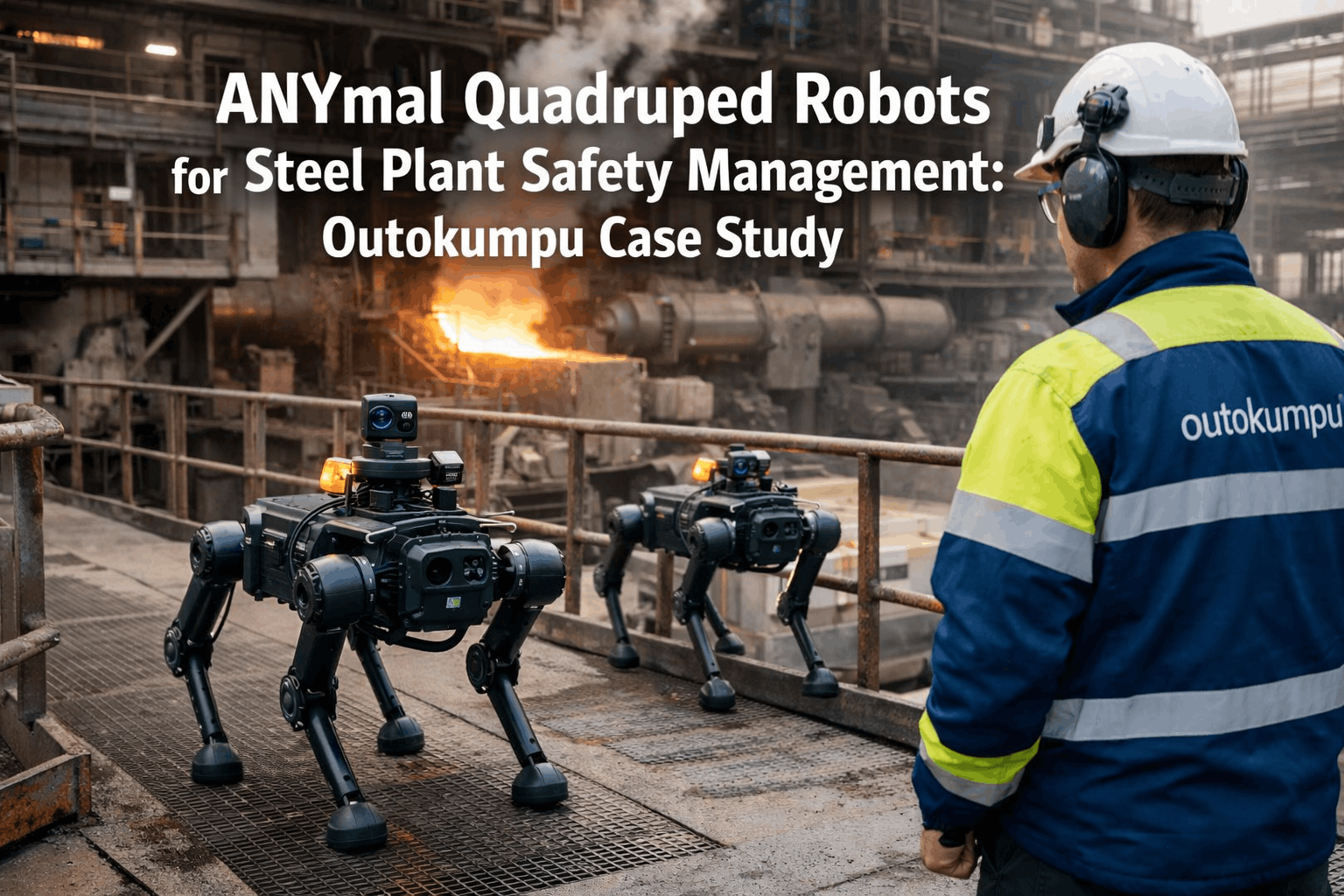
In March 2024, an Outokumpu stainless steel plant in Tornio, Finland experienced what safety managers dread most: a hydrogen leak in the cold rolling mill went undetected for 47 minutes because the area was classified as a confined space requiring full lockout-tagout procedures before human entry. By the time inspectors arrived, the leak had escalated to a plant-wide evacuation. Six weeks later, Outokumpu deployed an ANYmal quadruped robot from ANYbotics to continuously patrol that same zone — detecting gas anomalies in under 90 seconds with zero human exposure. The evacuation never happened again.
In 2026, autonomous safety patrols powered by quadruped robots are redefining how steel plants manage hazard detection, regulatory compliance, and worker protection. ANYmal — purpose-built for industrial environments with IP67 ingress protection and ATEX Zone 2 certification — is uniquely suited for the corrosive, high-temperature, and confined-space challenges of stainless steel production. This guide unpacks Outokumpu's deployment, the technical architecture behind ANYmal's safety patrols, and how a CMMS transforms robotic hazard data into enforceable safety actions. Steel plants ready to eliminate human exposure to their most dangerous zones can start their free trial today.
2026 Steel Safety Intelligence
Why Steel Plants Are Deploying Walking Robots
43%
of fatal steel industry incidents occur during routine inspection or maintenance tasks in hazardous zones that robots could patrol autonomously
$4.2M
average total cost of a single serious safety incident in steel manufacturing, including OSHA penalties, legal fees, production loss, and reputational damage
78%
of gas leak incidents in steel plants are detected faster by autonomous robotic patrols than by fixed-point gas detection systems alone
Outokumpu operates some of the world's largest stainless steel production facilities, where workers navigate environments filled with hexavalent chromium dust, hydrogen gas lines, pickling acid fumes, and molten metal splash zones daily. Traditional safety management relies on scheduled human walkthroughs, fixed gas detectors with limited coverage, and post-incident investigation. ANYmal replaces the most dangerous of these walkthroughs with continuous, sensor-rich autonomous patrols that detect hazards before they become incidents — and feeds every finding directly into the plant's CMMS for immediate corrective action.
ANYmal's Technical Edge in Steel Environments
Not all quadruped robots are equal in steel plant deployments. ANYmal was engineered from the ground up for industrial hazardous environments, unlike consumer-origin platforms adapted for industry. Understanding ANYmal's technical specifications explains why Outokumpu selected it over competing platforms for their safety-critical application.
Patrol Duration
2+ Hours Autonomous
Hot-swappable battery; returns to dock automatically
Ingress Protection
IP67 Certified
Dust-tight; survives immersion in water; resists pickling fumes
Explosion Safety
ATEX Zone 2 / IECEx
Certified for areas with occasional flammable gas presence
Sensor Payload
7-Sensor Fusion Suite
Thermal IR, RGB, LIDAR, ultrasonic, gas (multi-gas), acoustic, vibration
Navigation
Visual-Inertial SLAM
GPS-free; handles stairs, gratings, cable trays, and wet floors
Thermal Tolerance
-20°C to +50°C Base
Extended with heat shields for proximity patrols near furnaces and ladles
The ATEX Zone 2 certification is the decisive differentiator for steel plants. Areas around hydrogen storage, coke oven gas lines, and pickling baths contain intermittent flammable atmospheres. Deploying a non-ATEX-certified robot in these zones creates a new ignition source — the opposite of the safety improvement intended. ANYmal's intrinsically safe design allows it to patrol areas where even standard electrical equipment is prohibited, covering safety blind spots that no other inspection method can reach.
Outokumpu Deployment: The Safety Patrol Architecture
Outokumpu's Tornio works is one of the largest integrated stainless steel facilities in Europe, producing over 1.6 million tonnes annually. The plant's safety team designed ANYmal's patrol routes to cover their six highest-risk zones — areas where human inspectors historically spent the most time in hazardous conditions and where fixed sensors provided insufficient coverage.
Scheduled Patrol Trigger
CMMS dispatches ANYmal on shift-based schedules (every 4 hours) or on-demand after alarm events. Robot undocks from charging station and begins pre-mapped route through cold rolling mill, pickling line, and hydrogen storage area.
Multi-Hazard Scanning
At each waypoint, ANYmal performs a 360° sensor sweep: thermal imaging for overheating equipment, multi-gas detection (H₂, CO, H₂S, LEL), acoustic analysis for pressurized leak signatures, and visual inspection of safety equipment (guards, signage, spill containment).
Edge AI Anomaly Classification
Onboard AI compares readings against baseline profiles for each zone. Anomalies are classified by severity: informational (trending up), warning (approaching threshold), and critical (immediate action required). Critical alerts push to control room in real-time.
CMMS Safety Work Order
Oxmaint receives the anomaly package via API and auto-generates a safety work order with hazard type, severity classification, sensor evidence (images, gas readings, audio clip), GPS location, and recommended corrective action based on the plant's safety procedures.
What makes this architecture transformative is the shift from reactive to continuous safety monitoring. Before ANYmal, Outokumpu's safety inspectors conducted walkthroughs of these six zones once per shift — an 8-hour gap where hazards could develop undetected. With ANYmal patrolling every 4 hours and providing real-time critical alerts between patrols, the maximum detection gap dropped from 8 hours to under 2 minutes for critical hazards. This is the difference between a near-miss report and a catastrophic incident.
Before & After: Outokumpu's Safety Transformation
The measurable impact of ANYmal's deployment at Outokumpu's Tornio facility provides a clear benchmark for any steel plant evaluating robotic safety patrols. The comparison below reflects 12 months of operational data from Outokumpu's EHS and maintenance teams.
✗
Human-Only Patrols
Safety walks limited to 1× per 8-hour shift per zone
Inspectors require full PPE: SCBA, acid suits, fall protection
Gas detection via handheld 4-gas meter (single-point readings)
Hazard reports filed on paper at end of shift
Confined spaces require 2-person buddy system + attendant
Night shift patrols frequently abbreviated due to fatigue
No thermal trending data — spot checks only
Gaps in Coverage, High Exposure
✓
ANYmal + CMMS Integrated
Autonomous patrols every 4 hours, 24/7/365 coverage
Zero human entry required for routine hazard monitoring
Continuous multi-gas mapping across entire patrol route
Hazard alerts and work orders generated in real-time via CMMS
Confined space monitoring without entry permits or buddy teams
Identical patrol quality on every shift, including nights and weekends
Thermal baseline trending detects equipment degradation over weeks
Continuous, Consistent, Zero-Exposure
Outokumpu's EHS director noted that the most unexpected benefit was not hazard detection speed — which was anticipated — but the consistency of patrol quality. Human inspectors, despite excellent training, naturally vary in thoroughness based on fatigue, weather, shift timing, and workload pressure. ANYmal performs an identical 147-point inspection at every waypoint, on every patrol, without exception. This consistency transformed their safety data from anecdotal observations into statistically reliable trend analysis that satisfied both internal auditors and EU regulatory bodies.
67%
Reduction in Recordable Safety Incidents
TRIR dropped from 2.4 to 0.8 across monitored zones
94%
Hazard Detection Within 2 Minutes
Critical gas leaks and thermal anomalies flagged in real-time
100%
EU SEVESO III Compliance
Automated patrol logs satisfy major hazard site documentation
3,200+
Human-Hours Removed from Hazardous Zones
Inspectors redeployed to root cause analysis and safety engineering
Six Hazardous Zones Where ANYmal Replaces Human Entry
Steel plants contain distinct hazard zones that each present unique dangers to human inspectors. ANYmal's sensor suite and ATEX certification allow it to operate across all six of these critical areas — something no single human inspector can do without multiple PPE changeovers, permits, and buddy-system requirements.
01
Hydrogen Storage & Distribution
Hazards: H₂ leak, explosion risk, confined space. ANYmal's LEL sensors and acoustic leak detection identify micro-leaks at valve flanges before reaching explosive concentrations.
02
Pickling & Acid Regeneration
Hazards: HF/HNO₃ fumes, acid splash, corrosion. IP67-rated ANYmal resists acid mist while thermal cameras spot failing containment seals and overheating acid tanks.
03
Cold Rolling Mill Basements
Hazards: Confined space, hydraulic oil mist, poor ventilation. ANYmal navigates below rolling stands to check for hydraulic leaks, coolant line failures, and electrical faults.
04
Melt Shop & AOD Converter Area
Hazards: Extreme heat, metal splash, CO gas. Thermal imaging tracks refractory wear on converter shells and ladle exteriors from safe patrol distances.
05
Coke Oven Gas Lines
Hazards: CO, H₂S, flammable gas mixture. ATEX Zone 2 certification is mandatory here. ANYmal's multi-gas sensor array maps concentration gradients along pipe runs.
06
Slag Processing & Cooling Yards
Hazards: Steam explosions, uneven terrain, airborne particulates. ANYmal's legged locomotion handles rubble and wet surfaces where wheeled robots fail.
The Financial Case: Safety ROI at Scale
Safety investments in steel plants have historically been justified on moral and regulatory grounds. ANYmal's deployment at Outokumpu added a third justification: direct financial return. When hazards are detected faster, incidents avoided, and compliance automated, the cost savings are measurable and substantial.
Human-Only Safety Program
Recordable Incident Costs (avg 3/yr)$1.5M - $4M
Confined Space Entry Program$300K - $500K/yr
Regulatory Fines & Audit Remediation$100K - $800K/yr
Production Loss from Safety Shutdowns$500K - $2M/yr
Annual Safety Cost Exposure: $2.4M - $7.3M
VS
ANYmal + Oxmaint CMMS
ANYmal Robot (Lease + Payloads)$200K - $350K/yr
CMMS Safety Module$25K - $60K/yr
Incident Reduction (67% fewer)Saves $1M - $2.7M
Automated Compliance DocumentationAudit-Ready 24/7
Net Safety Savings: $1.5M - $5M+
Insurance carriers are the silent accelerant behind robotic safety adoption in steel. Major industrial insurers including FM Global and Zurich now offer premium reductions of 10-20% for plants that demonstrate autonomous hazard monitoring with documented patrol logs and CMMS-integrated response workflows. For a plant paying $3M+ annually in industrial insurance premiums, this reduction alone can cover half the cost of an ANYmal deployment.
Turn Robotic Safety Patrols Into Enforceable Actions
Stop letting hazard data die in patrol reports. Oxmaint connects to ANYmal's inspection API to auto-generate safety work orders, track corrective action completion, and deliver audit-ready compliance logs — all without manual data entry.
Phased Deployment: From Pilot Zone to Plant-Wide Coverage
Outokumpu's experience confirmed that successful robotic safety programs start with a single high-value zone and expand based on demonstrated results. Attempting plant-wide deployment on Day 1 overwhelms the safety team with data and creates resistance from operators unfamiliar with the technology. The phased model below reflects Outokumpu's actual rollout timeline.
Pilot Zone Validation (Weeks 1-6)
Single High-Risk ZoneRoute Mapping & BaselineOperator FamiliarizationCMMS API Connection
Multi-Zone Expansion (Weeks 7-14)
3-4 Additional Patrol RoutesShift-Based SchedulingAnomaly Threshold TuningSafety Team Training
Plant-Wide Predictive Safety (Weeks 15-24)
All 6 Critical Zones ActiveAI Trend Prediction LiveRegulatory Reporting AutomatedMulti-Robot Fleet Option
A critical lesson from Outokumpu's Phase 1 was the importance of involving frontline operators early. Initial resistance — "the robot is here to replace us" — transformed into advocacy once operators saw that ANYmal eliminated the tasks they disliked most (entering acid fume zones, confined space entries in cold rolling basements) while their expertise became more valued in the data interpretation and corrective action planning roles. Plants that skip this change management step face adoption friction that delays the entire program.
Cross-Functional Impact of Robotic Safety Data
ANYmal's safety patrol data serves far more stakeholders than the EHS department alone. When integrated through a CMMS, every patrol generates intelligence that informs maintenance planning, production scheduling, capital investment, and regulatory reporting. The plant operates with a single source of truth for asset condition and workplace safety.
EHS / Safety
Maintenance & Reliability
Production / Operations
Process Engineering
Regulatory / Compliance
Capital Planning
Insurance / Risk
Plant Management
Predictive Equipment Failure Alerts
Thermal and vibration data from safety patrols doubles as condition monitoring for maintenance. A single ANYmal patrol detects both safety hazards and early-stage equipment failures, eliminating duplicate inspection programs.
Automated SEVESO / PSM Documentation
Every patrol generates timestamped, sensor-verified logs that satisfy EU SEVESO III major hazard reporting and OSHA PSM requirements — eliminating months of manual documentation effort before regulatory audits.
Insurance Premium Optimization
Risk managers use ANYmal patrol history to demonstrate continuous hazard monitoring to insurers. Documented robotic safety programs have secured 10-20% premium reductions at major steel plants.
Unify safety, maintenance, and compliance data in one platformGet Started →
Outokumpu's deployment proved that the boundary between "safety inspection" and "condition monitoring" is artificial. A thermal hot spot on a hydraulic line is simultaneously a fire hazard (EHS concern) and a maintenance defect (reliability concern). By routing all ANYmal data through a single CMMS, both departments act on the same finding simultaneously — eliminating the organizational silos that allow hazards to persist between departmental handoffs. Book a Demo.
Bring Autonomous Safety to Your Steel Plant
Join forward-thinking steelmakers like Outokumpu using Oxmaint to transform robotic patrol data into zero-exposure safety programs. Eliminate confined space entries, automate compliance, and protect your most valuable asset — your people.
Frequently Asked Questions
What makes ANYmal different from Boston Dynamics' Spot for steel plant safety?
The primary differentiator is ANYmal's native ATEX Zone 2 / IECEx certification and IP67 rating, which are built into the robot's core design rather than added as aftermarket modifications. This means ANYmal can legally operate in potentially explosive atmospheres (near hydrogen lines, coke oven gas systems, and solvent storage) without creating a new ignition source. Spot requires custom thermal shielding and is not ATEX-certified, limiting its deployment to non-explosive hazardous zones like blast furnace casthouses. For plants with significant flammable gas exposure, ANYmal is the safer regulatory choice.
How does ANYmal's data integrate with our existing CMMS?
ANYmal transmits patrol data through ANYbotics' cloud platform (ANYmal Fleet), which exposes a REST API for CMMS integration. A CMMS like Oxmaint connects to this API to receive patrol completion reports, anomaly classifications, sensor data packages (thermal images, gas readings, acoustic signatures), and GPS-tagged waypoint results. When an anomaly exceeds configured thresholds, the CMMS automatically generates a prioritized safety work order with all supporting evidence attached. No manual data entry, no email routing, no delays.
Can ANYmal handle the physical environment of a steel plant floor?
Yes. ANYmal's quadruped locomotion was specifically designed for unstructured industrial terrain. It navigates metal gratings, wet floors, cable trays, stairs (up to 25° incline), debris, and uneven surfaces that would immobilize wheeled or tracked robots. At Outokumpu, ANYmal routinely traverses cold rolling mill basements with oil-coated floors, slag processing yards with rubble, and elevated platforms with narrow walkways. The robot's dynamic balance system recovers from stumbles and external disturbances without falling — a critical capability in active production environments.
What is the typical payback period for an ANYmal safety deployment?
Most steel plants achieve payback within **8 to 14 months**. The primary value drivers are: avoided safety incidents ($1.5M–$4M per recordable incident), eliminated confined space entry program costs ($300K–$500K/yr), insurance premium reductions (10-20%), and automated regulatory compliance documentation. Plants with high OSHA/SEVESO compliance burdens often see the fastest payback because the automated patrol logs eliminate hundreds of hours of manual documentation work annually.
Will the robot replace our safety inspectors?
No — and Outokumpu's experience proves this definitively. ANYmal replaces the most dangerous, repetitive, and physically demanding aspects of safety inspection (entering confined spaces, walking through acid fume zones, conducting overnight patrols). Safety professionals are redeployed to higher-value activities: analyzing robotic data trends, conducting root cause investigations, designing engineering controls, and managing the corrective action process through the CMMS. Their domain expertise becomes more impactful because they now have continuous, sensor-quality data instead of intermittent visual observations.