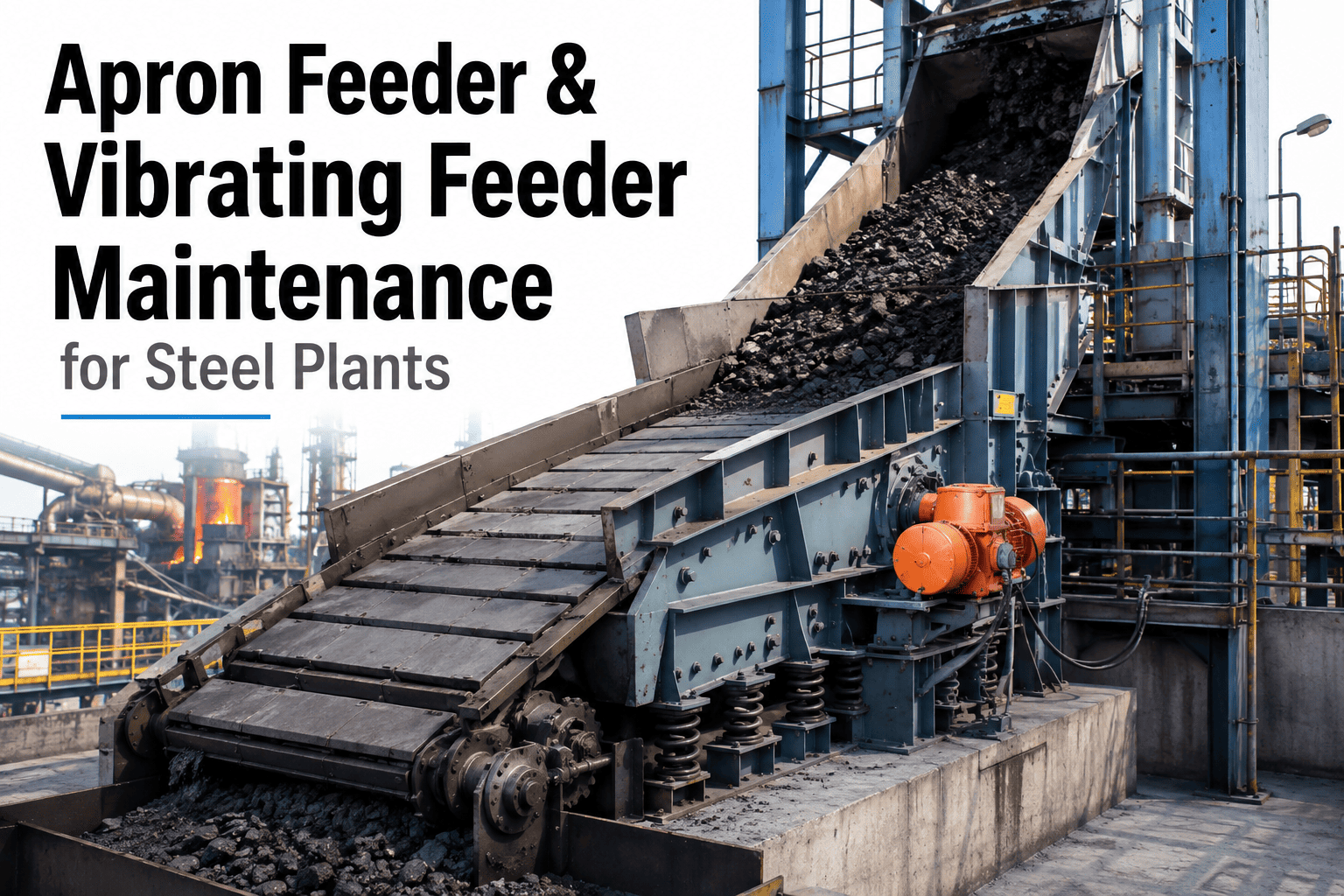
Apron feeder and vibrating feeder maintenance at steel plants is the thin line between steady throughput and a frozen material handling circuit — when a feeder stops, the blast furnace, mill, or ship-loader downstream stops with it. This guide covers pan inspection, drive chain PM, vibrating motor maintenance, sprocket wear tracking, and spring integrity checks, plus how a CMMS-driven feeder program keeps material moving. Plants that digitize feeder PM with OxMaint typically cut unplanned feeder downtime 30–50% and recover thousands of tons of lost throughput per year — you can Start Free Trial or book a demo to see it on your assets.
FEEDER RELIABILITY GUIDE
Is one feeder failure quietly costing your plant $8,500 per hour?
Apron feeders and vibrating feeders sit at the pinch points of every steel plant material handling circuit — and their failures back up entire process trains. A structured PM program protects throughput, chain life, and motor bearings. OxMaint digitizes every inspection, work order, and wear reading so you catch failures weeks before they stop the line.
APRON FEEDER PM
Apron feeder maintenance checklist for steel plants
A typical heavy-duty apron feeder in a steel plant handles 600–2,000 tph of hot sinter, ore, or scrap under shock-loading conditions. Chain stretch beyond 1.5–2% of original pitch is the single most common precursor to catastrophic failure — and it is measurable with a simple gauge at every weekly round. Build these checks into a tiered CMMS schedule so nothing depends on a clipboard.
- Inspect pan surface for cracks, warped skirts, and missing bolts
- Listen for chain skipping, sprocket tooth hammering, or gearbox whine
- Verify drip lubrication flow to chain pins and rollers
- Check for material build-up under pans and around tail take-up
- Measure chain stretch against a marked reference pitch — flag at 1.5%
- Inspect sprocket tooth profile for hooking and asymmetric wear
- Torque hold-down bolts and check take-up tension travel
- Sample gearbox oil for metal particulate and water content
- Ultrasonic-thickness scan of pan floor and skirt liners — log readings
- Inspect discharge chute and impact zone for liners below 40% remain
- Check main shaft alignment and bearing-housing bolt torque
- Review trend charts of motor amps, vibration, and chain elongation
WORKED EXAMPLE
A 1,200 tph apron feeder at an integrated steel plant was running to failure on a reactive schedule, averaging 3 unplanned stops per quarter at $8,500/hr over 6 hours each — roughly $612K/yr in lost throughput. After moving feeder PM into OxMaint with weekly chain-stretch logging, monthly UT wear readings, and condition-based lubrication triggers, the team caught a sprocket-hooking trend 9 weeks before failure and scheduled the change-out during a planned outage. Result: zero unplanned feeder stops for 11 months, $204K in downtime avoided in year one, and a 3-week sprocket lead-time absorbed without crisis.
VIBRATING FEEDER PM
Vibrating feeder maintenance: motor, spring & deck care
Vibrating feeders in steel plants handle hot, abrasive, and irregular loads — and their failure modes are different from apron feeders. The two highest-risk components are the unbalanced-motor bearings (which run at 960–1,500 RPM under continuous vibration) and the suspension springs or rubber mounts (which settle, crack, and shift the feeder's natural frequency). A 15% loss in spring rate can shift resonance and amplify body stress by 40%.
| Component | Failure mode | Inspection method & frequency | Action threshold |
|---|---|---|---|
| Unbalanced motor bearings | Inner-race spalling, lubrication breakdown | Vibration analysis (velocity, mm/s) — monthly; grease top-up per OEM hours | Velocity > 7.1 mm/s RMS or temperature > 80°C |
| Coil springs / rubber mounts | Fatigue cracking, settlement, frequency shift | Visual + free-height measurement — monthly; UV dye — quarterly | Free height < 90% of OEM spec or visible crack |
| Deck liners & wear bars | Abrasive wear, tearing, bolt shear | UT thickness scan — monthly; visual after upset events | Remaining thickness < 40% of nominal |
| Motor mounting bolts | Loosening from vibration, thread fatigue | Torque check with calibrated wrench — weekly | Torque below 85% of OEM specified value |
| Drive shaft & eccentric weights | Shaft misalignment, weight slippage | Laser alignment — quarterly; scribe-mark check — monthly | Angular misalignment > 0.05 mm/mm or shifted scribe mark |
APRON vs VIBRATING FEEDER
Apron feeder vs vibrating feeder: which PM program is right for your circuit?
Steel plants run both feeder types because they solve different material-handling problems — and their PM programs differ just as sharply. Apron feeders are heavy-duty drag-chain machines built for abrasive, hot, and lumpy loads; vibrating feeders are lighter, higher-frequency machines best suited for controlled volumetric feed of smaller material. Confusing the two maintenance strategies wastes labor and misses the real failure modes.
Built for shock loads & abrasive sinter
- Primary risk: chain stretch, sprocket hooking, pan cracking
- PM focus: chain elongation measurement, lubrication, liner UT scans
- Inspection cadence: daily walk-down, weekly chain PM, monthly structural audit
- Lubrication: continuous drip or automatic grease on chain pins
- Typical MTBF target: 8,000–12,000 operating hours
Stop losing throughput to feeder failures you predicted too late
OxMaint turns your feeder PM from a paper checklist into a condition-based program that catches chain stretch, bearing spalling, and liner wear weeks before they stop the line. Book a 30-minute demo and we'll map it to your feeders.
CMMS FOR FEEDER MAINTENANCE
How OxMaint digitizes feeder maintenance for steel plants
Most steel plants still run feeder PM on spreadsheets and clipboards — which means readings are lost, triggers are missed, and the first sign of trouble is a breakdown. OxMaint replaces that with an AI-powered CMMS that schedules, captures, and analyzes every feeder inspection and work order so your team moves from reactive firefighting to condition-based maintenance.
Automated PM scheduling
Auto-generate daily, weekly, and monthly feeder work orders based on runtime hours or calendar triggers. Eliminate missed inspections and paper checklists — technicians get mobile work orders with step-by-step checklists, photo capture, and digital sign-off.
Outcome: 95%+ PM compliance, zero paper, full audit trail
Condition-based triggers
Log chain-stretch readings, UT liner thickness, and vibration data directly into OxMaint. The AI engine flags trends that cross threshold — like a sprocket wear curve accelerating — and auto-creates a corrective work order before failure.
Outcome: catch 80%+ of feeder failures before they cause unplanned downtime
Asset & spare-parts tracking
Track every feeder as a hierarchical asset — motor, gearbox, chain, sprockets, springs, liners — with full maintenance history. Link spare parts to each asset so the right chain section or spring set is reserved before a planned outage begins.
Outcome: cut outage feeder-change time by 25–40%, eliminate stock-out delays
Maintenance analytics & MTBF
OxMaint dashboards show MTBF, MTTR, PM compliance, and downtime cost per feeder in real time. Identify your worst-acting feeder, see whether PM or design changes are needed, and prove reliability gains to management with hard numbers.
Outcome: cut unplanned feeder downtime 30–50%, prove ROI in one quarterly review
"We moved three apron feeders and six vibrating feeders onto OxMaint and within four months our unplanned feeder stops dropped from 11 to 3 per quarter. The chain-stretch trending alone paid for the platform by catching one sprocket failure before it wrecked the chain."
— Reliability Manager, mid-size integrated steel plant (1,800 employees, 4,200 assets)
FAQ
Feeder maintenance in steel plants — frequently asked questions
How often should apron feeders be inspected in a steel plant?
Apron feeders in steel plants should receive a daily visual walk-down, a weekly chain-stretch and drive PM check, and a monthly structural and wear audit including UT thickness scanning of pan liners. High-duty feeders handling hot sinter or abrasive ore may need chain measurement twice weekly. Scheduling these in a CMMS like OxMaint ensures inspections are never missed and readings are trended over time.
What is the most common cause of apron feeder failure?
Chain stretch beyond 1.5–2% of original pitch is the most common precursor to catastrophic apron feeder failure, followed closely by sprocket tooth hooking and pan cracking from shock loading. When chain elongation goes unmeasured, the chain rides high on the sprocket, skips teeth, and can derail or snap — taking the entire material train down. Weekly measurement with a reference gauge catches this weeks before failure.
How do you maintain a vibrating feeder motor?
Vibrating feeder motors require monthly vibration analysis (velocity in mm/s RMS), grease top-up per OEM running-hours, and weekly torque checks on mounting bolts. Bearing temperature should stay below 80°C and vibration velocity below 7.1 mm/s RMS — exceeding either triggers a corrective work order. You can automate these thresholds and auto-generate work orders in OxMaint, or Book a Demo to see the workflow live.
When should feeder wear liners be replaced?
Feeder wear liners — whether pan floor plates on an apron feeder or deck liners on a vibrating feeder — should be replaced when remaining thickness drops below 40% of nominal, or when any through-thickness crack or torn section is found. Monthly UT thickness scanning logged in a CMMS gives you a wear-rate curve so you can predict replacement dates and order plate stock before the outage begins.
Can a CMMS reduce feeder downtime in steel plants?
Yes — a CMMS reduces feeder downtime by 30–50% by automating PM scheduling, trending condition data (chain stretch, vibration, liner thickness), and triggering corrective work orders before failures occur. Plants using OxMaint typically recover 2–4 unplanned feeder stops per quarter, each worth $6,000–$12,000 per hour in lost throughput. The payback period is usually under 4 months for a plant with 10+ feeders.
See OxMaint on your feeders — book a 30-min demo
We'll load your feeder asset hierarchy, map your PM checklists, and show you the dashboards your reliability team has been missing. Or start free and explore the platform yourself — no credit card needed.
Free 14-day trial · No credit card