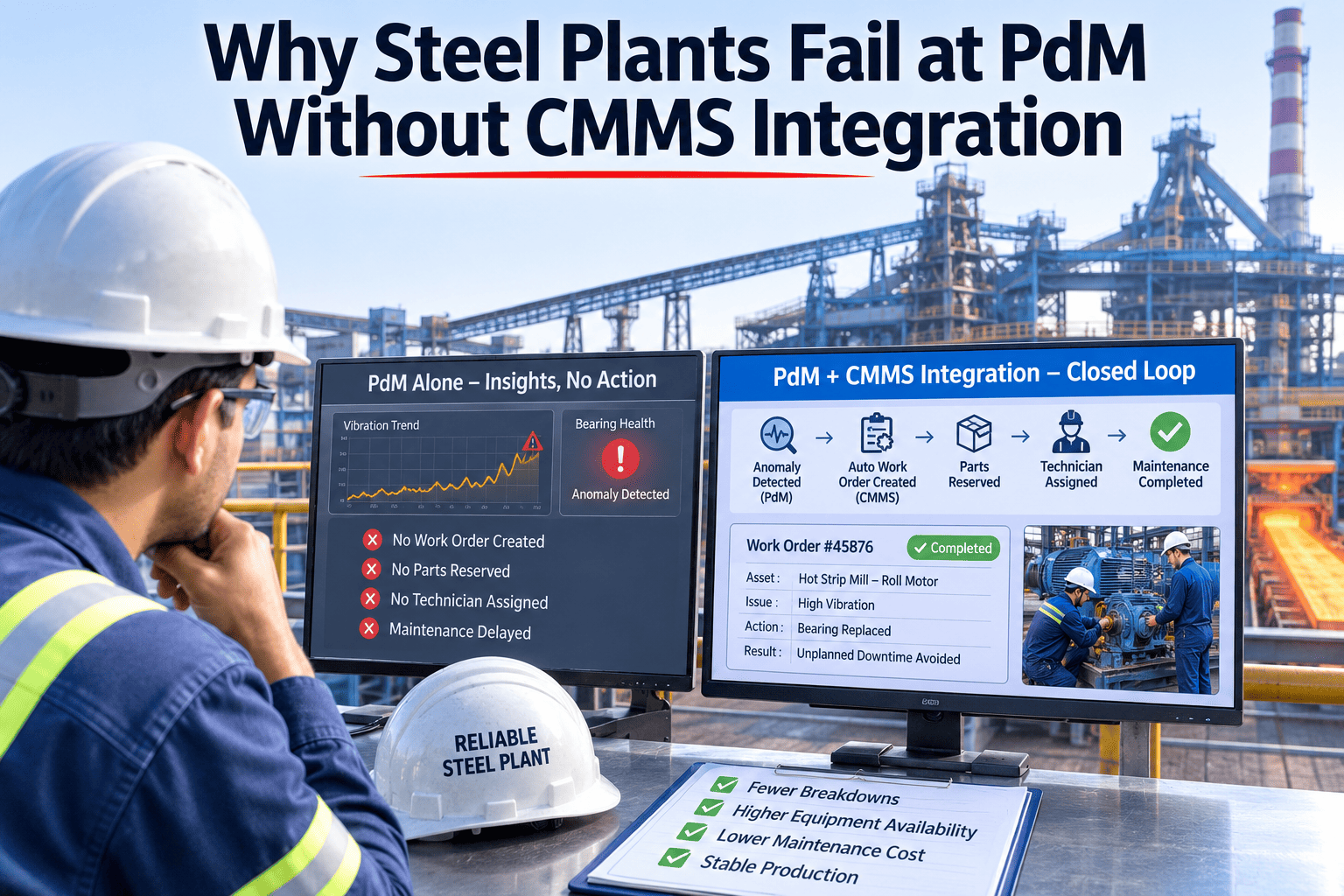
Most steel plants don't fail at predictive maintenance because their sensors are bad. They fail because a vibration spike on a rolling mill motor has nowhere to go — no work order, no technician assignment, no parts reservation, just a dashboard nobody opens after the third week. Plants buy sensors, build dashboards, celebrate a pilot, then watch the whole program quietly die within a year because the condition data was never wired into the maintenance workflow that actually runs the plant floor. The fix isn't a smarter model or another point solution; it's connecting live equipment signals to the CMMS that technicians already use every shift. Start a free trial to see an integrated PdM-CMMS workflow in action, or book a demo to map it against your current stack.
PdM Reality Check · CMMS Integration · Steel Operations
Why Predictive Maintenance Programs Quietly Die in Steel Plants
Sensors don't fail. Models don't fail. What fails is the handoff — the moment a condition alert needs to become a scheduled, planned, parts-ready work order and instead becomes another browser tab nobody opens.
68%
of steel plant PdM pilots are abandoned or left unused within 18 months of sensor installation
4.7x
more alerts are generated than work orders created when condition monitoring runs outside the CMMS
$620K
average annual spend on sensors and dashboards that never translate into a completed maintenance action
11 days
typical delay between a detected anomaly and any recorded maintenance response without workflow integration
83%
of steel maintenance leaders say their biggest predictive maintenance obstacle isn't data quality or sensor accuracy — it's that alerts land in a separate system technicians never check during a shift. A platform that writes conditions straight into the CMMS closes this gap without adding another screen to monitor.
The Real Root Cause: Sensors Without a Workflow
Plants rarely fail at PdM because the physics is wrong. A bearing that's overheating shows up in the data every time. What breaks down is everything after detection. The alert reaches a dashboard maintained by a reliability engineer, not the planner who schedules work, not the storeroom that stocks the part, and not the technician walking the floor. By the time someone notices the flag, the equipment has either already failed or the window for planned, low-cost intervention has closed. Steel plants running condition monitoring as a bolt-on tool — separate from the CMMS — end up with two parallel realities: one where sensors say a failure is coming, and another where maintenance is still scheduled exactly as it was five years ago. OxMaint closes this by writing every condition score, threshold breach, and degradation trend directly into the same CMMS record technicians already open, so there's only one system of truth to act on.
Disconnected Alert Queues
Vibration and thermal alerts sit in a monitoring vendor's portal that maintenance planners rarely log into, so urgent signals age out unseen
No Automatic Work Order Trigger
A threshold breach should generate a work order automatically; without integration it generates an email that gets buried in an inbox
Parts Not Reserved in Advance
Even when a technician sees the alert, the required spare part hasn't been reserved, turning a planned job back into an emergency one
No Feedback Loop to the Model
Without CMMS work history feeding back into the model, prediction accuracy stalls and technicians stop trusting the alerts entirely
Alarm Fatigue: The Silent Killer of PdM Adoption
Alarm fatigue sets in fast when condition monitoring exists outside the maintenance system. A rolling mill with hundreds of monitored points can generate dozens of threshold notifications a day, and if none of them arrive with context, priority, or a clear next action, technicians learn to ignore all of them — including the ones that matter. This is the single biggest reason PdM software gets shelved within a year of purchase. The table below shows how the same alert volume behaves with and without CMMS-integrated triage.
One Record, Not Two Systems
Condition scores, work orders, and repair history live on the same asset record so nothing gets lost between detection and action
Automatic Work Order Generation
A threshold breach creates a prioritized work order with the right craft, parts, and safety permits attached automatically
Parts Reserved Before the Job Starts
Inventory is checked and reserved the moment an alert fires, so planned interventions don't turn into emergency scrambles
Model Accuracy That Improves With Use
Completed work orders feed real outcomes back into the prediction engine, sharpening accuracy month over month
Your sensors aren't the problem. The gap between detection and action is.
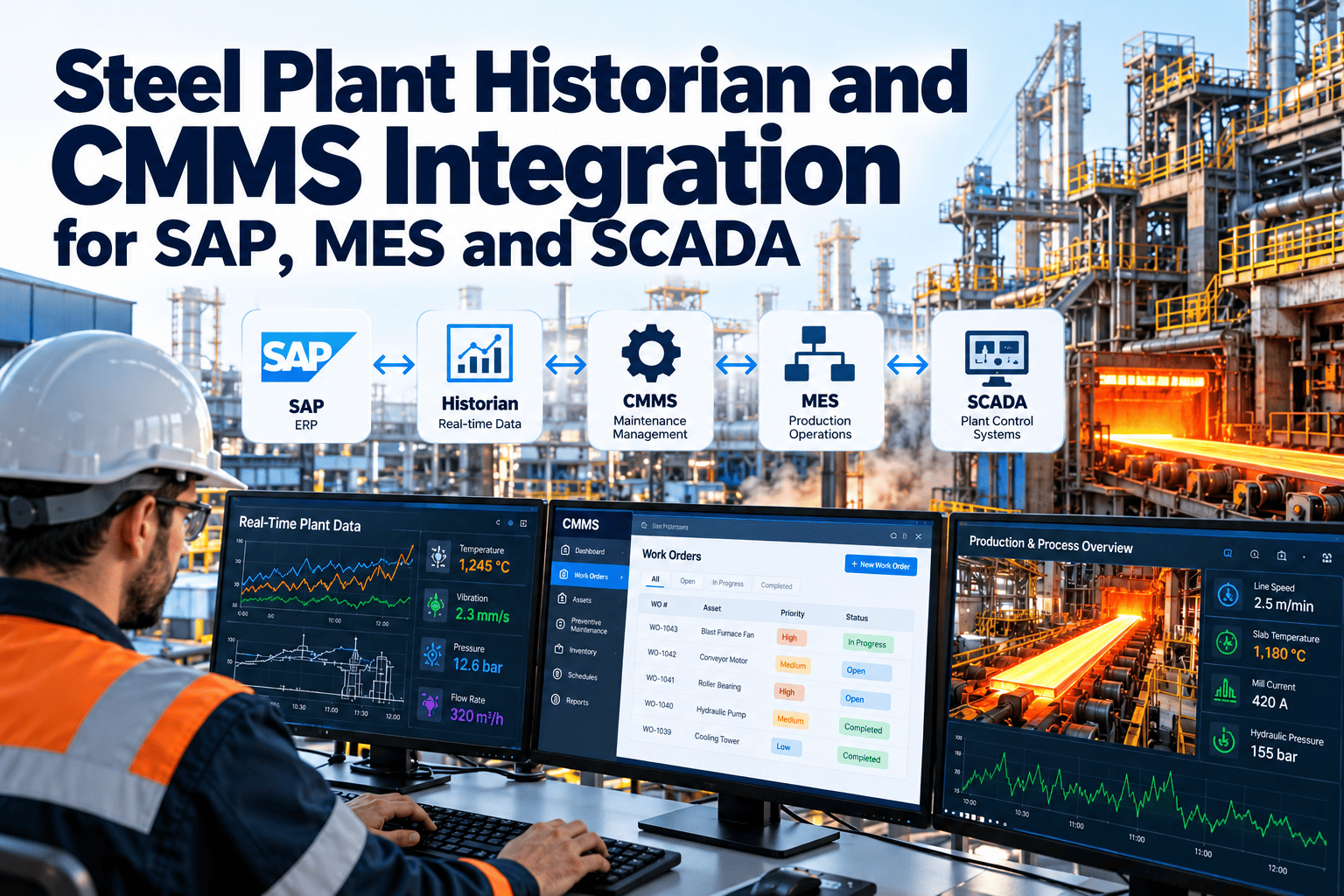
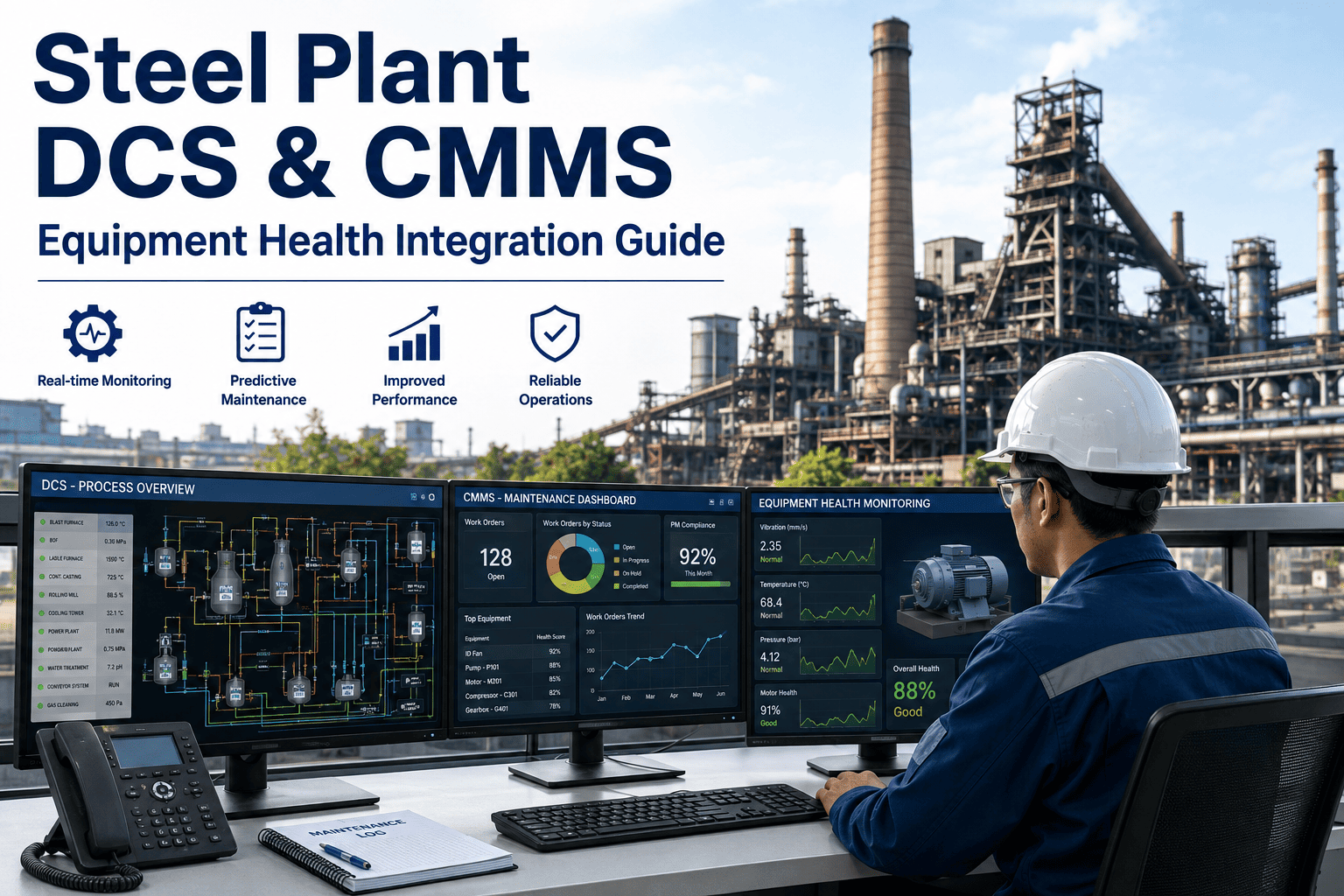
OxMaint connects condition monitoring, CMMS work orders, and spare parts inventory into one workflow, so every alert has somewhere to go. See it running against your own asset list before you commit to anything.
A Practical Framework for Fixing a Stalled PdM Program
Plants that recover a stalled predictive maintenance program don't start by buying more sensors — they start by auditing the handoff points between detection and execution. The framework below is the sequence most steel facilities follow when rebuilding trust in their PdM investment.
01
Audit Alert-to-Action Conversion
Measure what percentage of alerts in the last 90 days actually became a completed work order — most plants are shocked by how low this number is
02
Consolidate Into One System
Retire standalone monitoring dashboards in favor of a CMMS that ingests sensor data natively, removing the extra login technicians skip
03
Automate the Work Order Trigger
Configure threshold breaches to auto-generate prioritized work orders with craft, safety, and parts requirements pre-filled
04
Close the Loop With Outcomes
Feed completed repair data back into the model so predictions keep improving instead of decaying after the first year
We had three years of vibration data sitting in a portal nobody but our reliability engineer ever opened. Once we routed alerts straight into work orders with parts attached, our planned maintenance ratio jumped from 41% to 79% in under a year — and the technicians stopped treating the sensors as background noise.
— Maintenance Manager, Flat Products Mill, Ohio, USA
Frequently Asked Questions
Why do PdM sensors get installed but never actually change maintenance behavior?
Because the data stops at a dashboard instead of becoming a scheduled work order. Without a direct link into the CMMS, alerts require a manual step someone eventually skips.
Can we integrate condition monitoring into a CMMS we already use?
Yes.
OxMaint connects to existing CMMS platforms and can also run as the primary system, syncing asset records, work orders, and sensor data in one place.
How much sensor coverage do we need before integration is worthwhile?
Even partial coverage on critical assets like mill drives, furnace fans, and casting equipment shows measurable gains once alerts flow into scheduled work rather than a separate dashboard.
What causes technicians to stop trusting predictive alerts?
Repeated false positives or alerts with no clear next step train technicians to ignore the system entirely. Prioritized, work-order-linked alerts rebuild that trust quickly.
How long does it take to see the alert-to-work-order conversion rate improve?
Most plants see measurable improvement within 60-90 days of switching to an integrated workflow. You can
book a demo to see the setup timeline for your facility.
Stop Buying Sensors for a Dashboard No One Opens
Every alert that never becomes a work order is a failure waiting to happen on schedule instead of by surprise. OxMaint connects condition monitoring straight into your maintenance workflow so predictive data actually gets acted on.
.png)
.png)