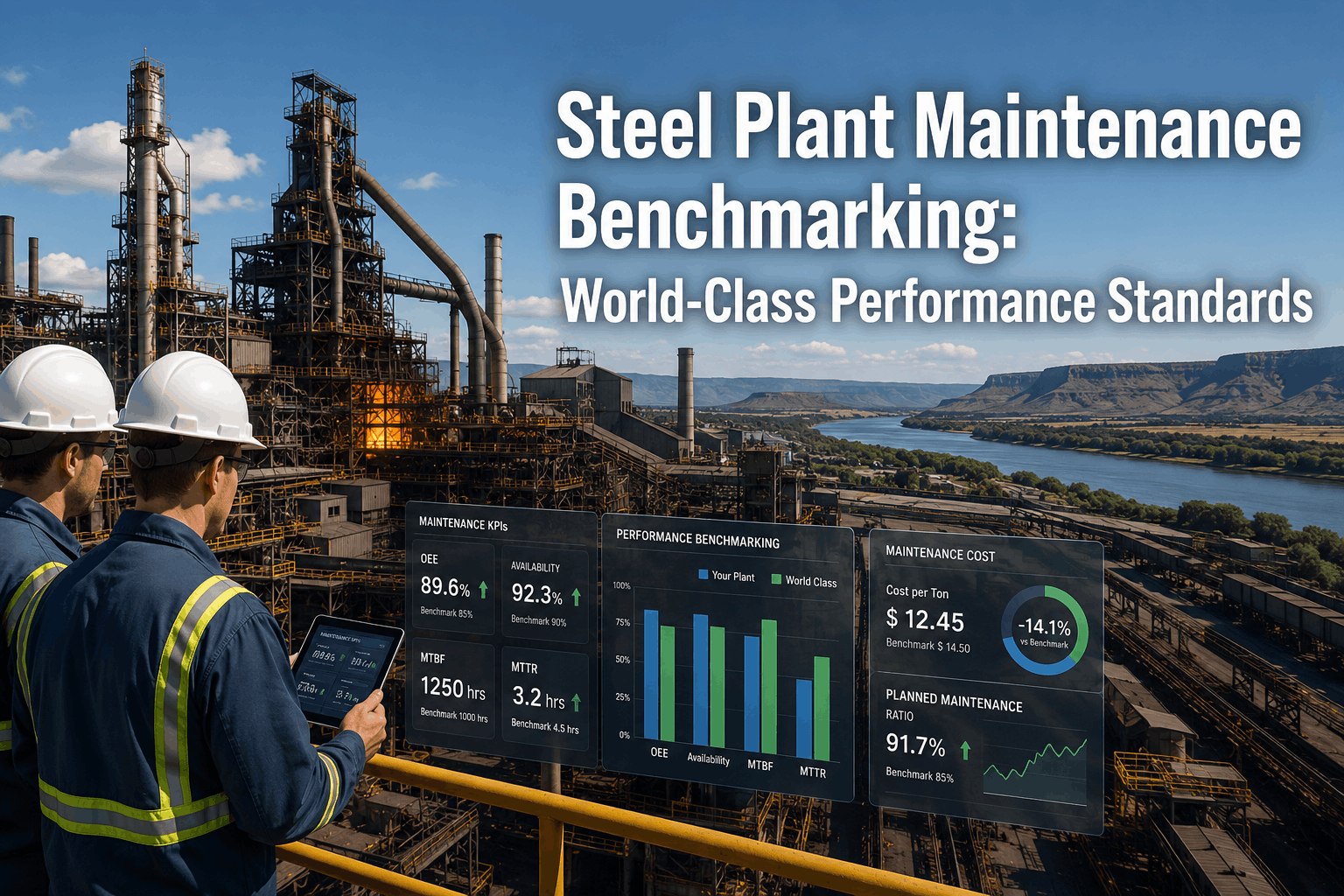
Benchmarking Steel Plant Maintenance Costs: Global Industry Data
By James smith on March 17, 2026
When a steel plant's maintenance budget comes up for review, the question every operations director faces is the same: is this number too high, too low, or competitive? Without verified external benchmarks, the answer is always a guess — and a guess made with $40M to $120M at stake. Global steel plant maintenance costs range from $15 per tonne at world-class operations to $45 per tonne or more at facilities running reactive-dominant strategies. The difference is not equipment age or geography. It is maintenance program maturity, data quality, and the discipline to act on what the data shows. Sign up for Oxmaint to benchmark your facility's maintenance spending against global industry data within your analytics dashboard.
This article presents the global benchmarking data as it stands across integrated flat-rolled, long products, and specialty steel operations — covering cost per tonne, maintenance-to-replacement-value ratios, planned versus unplanned ratios, and the specific gaps that separate average performers from world-class facilities. The data draws from World Steel Association reports, McKinsey manufacturing benchmarking studies, the Association for Iron and Steel Technology, and Oxmaint's implementation dataset across steel operations on four continents. Book a benchmarking session to receive a facility-specific cost position analysis against this dataset.
$15–$45
Per tonne maintenance cost range across global steel operations — world-class vs. reactive-dominant
2–8%
Maintenance spend as a share of Replacement Asset Value — industry benchmark for cost efficiency
3×
Higher total cost per repair event at reactive facilities vs. world-class planned maintenance programs
Global Cost Per Tonne Benchmarks by Facility Type
Maintenance cost per tonne is the most widely used cross-facility benchmark in steel because it normalizes for production volume — making a comparison between a 1 MTPA specialty mill and a 5 MTPA integrated producer meaningful. The ranges below reflect current global data segmented by facility type and maintenance program maturity tier. Facilities in the bottom quartile consistently share four characteristics: reactive-dominant strategy, low PM compliance, fragmented data across multiple disconnected systems, and limited visibility into total downtime cost. Sign in to Oxmaint to track your own cost-per-tonne trend and position it against this benchmark range.
Maintenance Cost Per Tonne — Global Range by Facility Type2024 Industry Data
Integrated Flat-Rolled
World Class
Average
Lagging
$15$22$30$38$45+
$15–$45 / t
Long Products (Bar / Wire)
World Class
Average
Lagging
$18$26$33$40$50+
$18–$50 / t
Specialty / Alloy Steel
World Class
Average
Lagging
$24$35$46$58$70+
$24–$70 / t
Mini-Mill (EAF)
World Class
Average
Lagging
$12$20$28$35$42+
$12–$42 / t
World Class (top quartile)Industry Average (second/third quartile)Lagging (bottom quartile)
World-Class Performance Indicators Across Six KPIs
Cost per tonne is a single dimension of maintenance performance. The six gauges below show what world-class looks like across the indicators that drive it — from planned maintenance ratio to PM compliance to wrench time. Facilities that benchmark poorly on these underlying metrics will always end up in the lagging cost-per-tonne band regardless of budget size, because the structural inefficiencies that inflate cost are embedded in the operating model, not the budget line. Understanding which indicators are pulling your cost position into the lagging band is the starting point for any credible cost reduction program.
World-Class Target Benchmarks — Global Steel OperationsKPI targets shared by top-quartile facilities in McKinsey and AIST studies
90%+
Planned Maintenance Ratio
Share of all maintenance work that is planned vs. reactive — industry average sits at 60–65%
92%
PM Compliance Rate
Percentage of scheduled PMs completed on time — average facilities run 58–68% compliance
55%+
Wrench Time
Productive repair time as a share of technician shift — industry average is 24–28%
2–3%
Maintenance / RAV Ratio
Annual maintenance spend as a share of Replacement Asset Value — reactive plants run 6–8%
85%+
Overall Equipment Effectiveness
Availability × Performance × Quality — industry average in steel sits at 72–76%
<4 hrs
Mean Time to Repair (MTTR)
Average duration from failure detection to asset restoration — lagging facilities average 11–18 hours
Know where your facility sits on every one of these six benchmarks. Oxmaint's analytics dashboard calculates your planned ratio, PM compliance, OEE, and MTTR against global steel industry benchmarks in real time — so your next budget review starts with data, not estimates.
What Separates Top Quartile from Bottom Quartile: The Five Gaps
McKinsey's Steel Operations Benchmarking Study identifies five measurable operational gaps that explain virtually all of the cost-per-tonne difference between world-class and lagging facilities. None of them are primarily about capital investment — they are about data discipline, planning process, and the feedback loop between maintenance performance and financial outcomes. Facilities that close all five gaps consistently move from the bottom quartile to the top within 18–36 months of deploying a modern CMMS with analytics capabilities.
Gap 1$8–$12 / tonne cost gap
Planned vs. Reactive Maintenance Ratio
Bottom-quartile steel facilities run 35–45% planned maintenance, meaning more than half of all work orders are reactive — generated by failures already in progress. Top-quartile facilities run 88–92% planned. The cost difference is structural: reactive repairs cost 3–5× more per event than the same work performed as a planned PM, and they occur mid-campaign when the cost of downtime is highest. Closing this gap alone typically reduces total maintenance spend by 20–28% for a facility moving from bottom to top quartile. Sign in to Oxmaint to track your planned ratio and set a compliance target that closes this gap within 12 months.
World-class facilities attribute 95%+ of all maintenance spend to specific assets with full cost-category breakdown — labor, parts, contractor, downtime consequence. Bottom-quartile facilities attribute less than 50%, meaning cost management decisions are made with incomplete data. You cannot optimize what you cannot see. Facilities that deploy full cost attribution through a CMMS consistently identify 15–22% of maintenance spend as misdirected — allocated to low-criticality assets while high-consequence equipment runs under-maintained. Full attribution is a prerequisite for intelligent budget allocation.
Industry studies consistently show that maintenance technicians in average facilities spend only 24–28% of their shift on actual repair work. The remainder is travel, parts retrieval, waiting for approvals, and administrative tasks. World-class facilities achieve 52–58% wrench time through digital work orders, mobile access to parts and documentation, intelligent scheduling, and pre-kitted jobs. At a 200-technician steel plant, moving from 26% to 55% wrench time is the equivalent of adding 116 technicians without a single hire — representing $9–$14M in recovered labor value annually. Book a demo to see how Oxmaint's mobile work order system drives wrench time improvement.
Industry Average: 24–28%World Class: 52–58%
0%Wrench Time Target100%
Gap 4$3–$5 / tonne cost gap
Spare Parts Inventory Optimization
Over-stocked parts rooms and under-stocked critical items are two symptoms of the same data problem: no reliable link between parts consumption history and asset maintenance schedules. Top-quartile facilities carry 20–30% less inventory value than average facilities while achieving higher parts availability for critical work — because every part is tied to the assets that use it and reordered at optimized points. The excess inventory carrying cost at average facilities typically represents $2–$5M in tied-up capital per plant, plus the cost of emergency procurement events when the wrong parts are stocked.
Contractor maintenance spend at average steel facilities runs 35–50% of total maintenance budget — often with limited scope control, no performance benchmarking, and minimal work order documentation. World-class facilities manage contractor spend against defined unit cost benchmarks, require CMMS work order creation for all contractor activities, and use completion data to identify contractor tasks suitable for insourcing. Facilities that implement this governance framework typically reduce contractor spend by 18–25% within 18 months through a combination of scope clarity, performance management, and targeted insourcing.
Regional Benchmark Comparison: Where Global Operations Stand
Maintenance cost benchmarks vary by region due to labor cost differences, energy price structures, and average fleet age. The following comparison presents maintenance cost per tonne and key efficiency metrics across the major steel-producing regions, based on World Steel Association operational data and regional industry benchmarking studies. Understanding your regional peer group is important — comparing a Southeast Asian mini-mill to a European integrated producer on raw cost per tonne misses the structural differences that explain much of the variation.
Steel Plant Maintenance Benchmarks by Region
World Steel Association Data
Region
Cost/Tonne (Avg)
Top Quartile
Planned Ratio
OEE (Avg)
Position
Japan / South Korea
$18–$24
$14–$17
82–88%
83–87%
Leading
Germany / Netherlands
$22–$30
$17–$22
78–86%
80–85%
Leading
North America
$24–$36
$18–$24
68–78%
74–80%
Average
China (State-Owned)
$20–$32
$16–$22
65–75%
72–78%
Average
India
$28–$42
$20–$28
55–68%
70–76%
Developing
CIS / Eastern Europe
$30–$45
$22–$32
48–62%
64–72%
Lagging
Latin America
$26–$40
$19–$26
58–70%
68–74%
Average
Source: World Steel Association Operational Benchmarking, McKinsey Steel Operations Study, AIST Maintenance Benchmarking. Cost figures normalized to USD, 2023–2024.
Swipe horizontally to view all columns on smaller screens
Find your regional peer group and measure your gap against the top quartile. Oxmaint's benchmarking module positions your facility against region- and facility-type-specific benchmarks — showing exactly which KPIs are inflating your cost per tonne relative to world-class peers.
Moved from $31/t to $12/t over 24 months by implementing Oxmaint's planned maintenance program, raising PM compliance from 58% to 94%, and cutting reactive event frequency by 71%.
North American Mini-Mill
58%
Wrench Time Achieved
Raised wrench time from 24% to 58% in 14 months using Oxmaint mobile work orders and pre-kitted job packages. Equivalent labor productivity gain: 136 technician-hours per day without additional headcount.
Asian Specialty Steel Operation
$4.2M
Annual Parts Cost Saving
Inventory optimization through Oxmaint's parts-to-asset linkage reduced carrying cost by 28% and eliminated $2.8M in emergency procurement spend in the first year of deployment.
Frequently Asked Questions
QWhat is a good maintenance cost per tonne benchmark for an integrated flat-rolled steel plant?
World-class integrated flat-rolled facilities achieve $15–$18 per tonne in total maintenance cost. The global average for this facility type runs $26–$32 per tonne. Facilities above $38 per tonne are typically in the bottom quartile, characterized by reactive-dominant maintenance programs, PM compliance below 65%, and limited cost attribution data. The path from average to world class runs through planned maintenance ratio improvement, PM compliance enforcement, and full cost attribution — not budget cutting. Sign up for Oxmaint to start tracking your cost per tonne against these benchmarks automatically.
QWhat is the Maintenance / RAV ratio and what is the target for steel plants?
The Maintenance to Replacement Asset Value (RAV) ratio expresses annual maintenance spend as a percentage of what it would cost to replace all plant assets at current prices. World-class steel facilities run a Maintenance/RAV ratio of 2–3%, meaning they spend $2–$3 for every $100 of asset value per year. Industry average sits at 4–5%. Reactive-dominant facilities often exceed 6–8% because emergency repairs, early equipment replacement from deferred maintenance, and unplanned downtime costs inflate total spend well above what a well-run PM program requires. Book a demo to calculate your facility's Maintenance/RAV ratio in Oxmaint.
QHow do Japanese and Korean steel plants consistently achieve lower maintenance cost per tonne than other regions?
The cost advantage of Japanese and Korean steel operations in maintenance benchmarking traces primarily to three structural factors: very high planned maintenance ratios (82–88% planned vs. 60–65% industry average), systematic total productive maintenance (TPM) programs that engage production operators in first-line equipment care, and decades of kaizen-driven continuous improvement in maintenance processes. The labor cost differential with North America and Europe is partly offset by these efficiency advantages — labor productivity in Japanese maintenance teams is 35–40% higher than the industry average on a wrench-time basis. CMMS adoption in leading Japanese facilities is nearly universal, with maintenance data feeding directly into production scheduling.
QHow long does it realistically take to move from average to top-quartile maintenance cost performance?
Based on Oxmaint's implementation data across steel and heavy manufacturing facilities, the typical trajectory from average to top-quartile performance is 18–30 months. The first 90 days produce immediate gains in PM compliance and cost visibility as digital work orders replace paper-based tracking. Months 3–12 produce the planned ratio improvement as the maintenance backlog clears and the PM schedule becomes the dominant work source. Months 12–30 deliver the full cost-per-tonne reduction as the compounding effect of higher equipment reliability, lower emergency repair frequency, and optimized contractor spend works through the operating cost structure. Start your benchmarking journey in Oxmaint to establish your baseline and set quarterly improvement targets.
QCan Oxmaint produce a facility-specific benchmarking report comparing our metrics to global steel industry data?
Yes. Oxmaint's analytics dashboard includes a benchmarking module that calculates your planned maintenance ratio, PM compliance, wrench time (where digital work orders are in use), OEE contribution, MTTR, and cost per tonne, then positions each metric against the facility-type and regional peer group benchmarks in this article. The report updates in real time as your operational data accumulates and is shareable with finance and executive leadership as a single PDF export. Book a benchmarking demo to see the report format for your facility type.
Find Out Where Your Maintenance Costs Stand Against Global Benchmarks
Oxmaint's analytics dashboard positions your facility's cost per tonne, planned ratio, PM compliance, and OEE against world-class steel industry benchmarks — giving your leadership team the data needed to close the gap to top quartile performance.