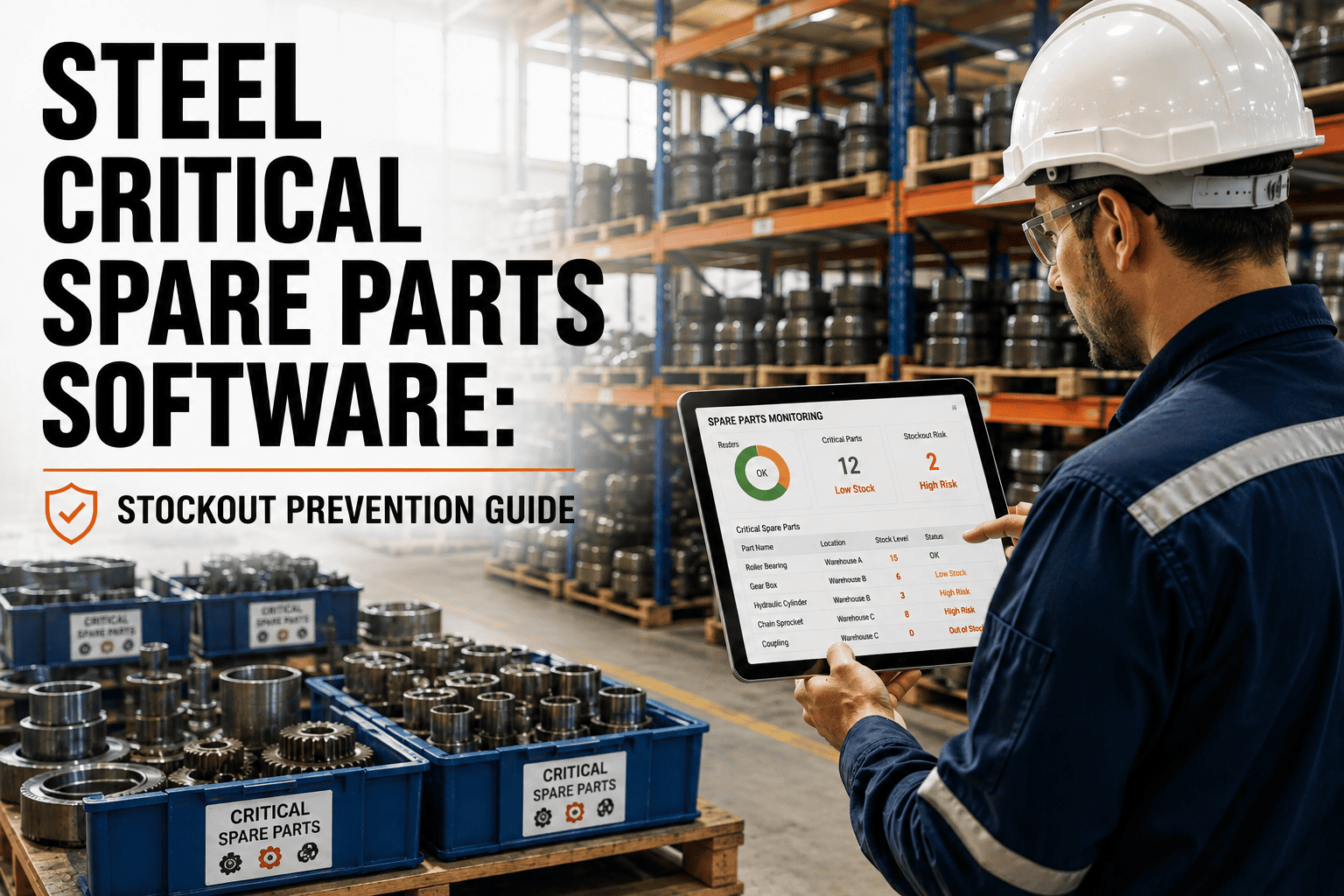
A steel plant shutdown that runs three days over schedule because a critical spare was not stocked does not just cost the price of the part — it costs the price of three days of lost production on a blast furnace, a rolling mill, or a continuous caster, where downtime losses routinely exceed $200,000 per day. Spare parts criticality analysis and shutdown forecasting are the two disciplines that prevent that outcome: knowing in advance which components are likely to fail, how long they take to source, and what the production consequence of a stockout would be. OxMaint's inventory management platform integrates work order history, asset risk scoring, lead time data, and production impact weighting into a single spare parts criticality engine — so every shutdown begins with the right parts on the shelf, not with an emergency purchase order sent to a supplier four continents away.
Case Study · Shutdown Planning · Inventory Management
Spare Parts Criticality and Shutdown Forecasting for Steel Plants
Criticality Scoring · Lead Time Tracking · Stockout Prevention · Shutdown Spares Forecasting · Production Impact Analysis
Criticality Dashboard · Shutdown T-60 Days
EAF Electrode Arm Clamp
Crit: A1
Stock: 0 · Lead: 14 wk
BF Tuyere Set (×20)
Crit: A1
Stock: 8 · Min: 20
Caster Mold Copper Plates
Crit: A2
Stock: 4 · Adequate
Rolling Mill Work Roll
Crit: A1
ETA: 18 wk · Order NOW
$200k+
Daily production loss from unplanned blast furnace or caster downtime — the cost of one stockout event
68%
Of shutdown overruns in steel are caused by parts not available at the start of the maintenance window
18 wk
Lead time for critical rolling mill work rolls — ordering must begin before the shutdown is even scheduled
T-90
Minimum advance window OxMaint uses to flag criticality gaps before shutdown — 90 days prior to outage
The OxMaint Spare Parts Criticality Framework for Steel
A1
Production-Critical · Long Lead
Parts whose absence stops production immediately — EAF electrodes, BF tuyeres, caster mold components, rolling mill rolls. Lead times typically 8–22 weeks. OxMaint triggers procurement at T-120 days minimum.
Action: Always-on stock · Reorder at minimum quantity · OxMaint auto-PO trigger
A2
Production-Critical · Available
Parts that stop production but are available within 2–4 weeks from distributor. Hydraulic cylinders, gearbox assemblies, conveyor drive units. Stock level managed by OxMaint min/max with work order consumption tracking.
Action: Min/max stock policy · Work order consumption tracked · Lead time monitored
B
Process-Impacting · Moderate Lead
Parts that degrade process quality or safety compliance if unavailable but do not immediately stop production. Instrumentation, valve actuators, conveyor belting sections. Stock based on OxMaint failure frequency analysis.
Action: Consumption-based reorder · Failure rate analysis · Quarterly review
C
Maintainability · Short Lead
Standard components available locally within 24–48 hours. Bearings, belts, filters, seals, fasteners. Managed on economic order quantity with OxMaint stock visibility — no emergency procurement risk.
Action: EOQ stock policy · Local supplier · Technician self-service issue
Shutdown Spares Forecasting — The OxMaint T-Minus Process
T-120
Criticality Gap Analysis
OxMaint cross-references shutdown scope (from planned work orders) against current stock levels and supplier lead times. All A1 parts with lead time exceeding 12 weeks flagged for immediate procurement. Procurement manager receives gap report automatically.
T-90
Work Order to BOM Linkage
All planned shutdown work orders are linked to their parts bill of materials in OxMaint. Each part requirement is checked against stock — generating a consolidated shutdown spares requisition with supplier, lead time, and cost for each line item.
T-60
Procurement Confirmation
All long-lead items confirmed on order with expected delivery dates logged in OxMaint. Delivery tracking linked to shutdown schedule — any slip in delivery date automatically flags a risk to the maintenance planner and procurement team.
T-30
Pre-Staging and Kitting
OxMaint generates kitting lists by work order — each technician's task has a pre-staged kit of parts reserved in the warehouse. Reduces shutdown walk time and prevents parts being drawn for the wrong job at the height of activity.
T-0
Shutdown Execution — Full Visibility
Every part issued during the shutdown is logged against its work order in real time via OxMaint mobile. Actual consumption vs forecast is visible to the shutdown manager — enabling rapid reorder decisions if a job scope expands and additional parts are needed.
Case Result — Integrated Steel Plant, 2.4 Mtpa
| Metric |
Before OxMaint |
After OxMaint |
Improvement |
| Shutdown overrun (days) |
3.8 days avg |
0.4 days avg |
89% reduction |
| Emergency procurement events |
14 per shutdown |
2 per shutdown |
86% reduction |
| A1 parts stockout incidents |
6 per year |
0 per year |
100% eliminated |
| Inventory carrying cost |
$4.2M overstock |
$2.8M optimised |
33% reduction |
| Shutdown production loss recovery |
$1.8M avg overrun cost |
$180k avg overrun cost |
$1.62M saved/shutdown |
Your Next Shutdown Begins Today — With the Right Parts on the Shelf.
OxMaint's criticality engine analyses your work order history, lead times, and production risk to build a shutdown spares forecast that eliminates stockouts before they can delay your outage window.
"
In integrated steel, a shutdown is not a maintenance event — it is a production event with a fixed window, a fixed crew, and a fixed cost per hour of overrun. The single biggest controllable variable in shutdown performance is spare parts availability, and the single biggest reason parts are not available is that no one systematically linked the planned work order scope to the parts BOM with enough lead time to procure long-lead items. I have seen blast furnace shutdowns delayed by the absence of a tuyere set that had an 18-week lead time and was ordered 6 weeks before the outage. That is not a procurement failure — it is a planning system failure. OxMaint's T-120 criticality workflow closes that gap structurally. By the time the shutdown work order list is finalised, every A1 part is already on order, and every delivery date is tracked against the shutdown schedule. That is the operating standard that turns a consistently overrunning shutdown programme into a reliable one.
Rajiv Nair, CMRP, PE
Head of Maintenance and Reliability · Integrated Steel Producer, South Asia · 27 Years Steel Plant Maintenance, Shutdown Planning, and Inventory Optimisation · Certified Maintenance and Reliability Professional (SMRP) · Professional Engineer · Specialist in blast furnace shutdown management, critical spares strategy, and CMMS-integrated inventory planning for 2–5 Mtpa integrated steel operations
Frequently Asked Questions
How does OxMaint assign criticality ratings to spare parts in a steel plant?
OxMaint's criticality scoring engine evaluates each part against four weighted dimensions: production impact if the part is unavailable (does the plant stop, slow, or continue at reduced quality?), mean time between failure of the associated asset (how frequently is the part consumed?), supplier lead time (can it be sourced in days or months?), and substitutability (is there an interchangeable alternative available locally?). Each dimension is scored and weighted according to the facility's production priorities — a tuyere set at a blast furnace scores differently from the same part at a steel finishing plant. The resulting A1/A2/B/C rating drives the stocking policy, reorder point, and procurement trigger timeline automatically within OxMaint.
Start a free trial and run a criticality analysis on your spare parts register.
Can OxMaint generate a consolidated shutdown spares requisition automatically from planned work orders?
Yes — OxMaint links each planned shutdown work order to its parts bill of materials at the planning stage. When the shutdown scope is locked, OxMaint aggregates all part requirements across every work order into a single consolidated spares requisition — line items include part number, description, quantity required, current stock on hand, net requirement, preferred supplier, lead time, unit cost, and total cost. The requisition is generated as a PDF or CSV export and can be sent directly to the procurement team or uploaded to the ERP system for purchase order creation. For any part where the required quantity exceeds current stock and the lead time exceeds the remaining time before shutdown, OxMaint flags the item as a critical procurement risk with a recommended order date.
Book a demo to see OxMaint's shutdown spares requisition in action.
How does OxMaint track actual parts consumption during a shutdown against the forecast?
During shutdown execution, every part issued from the warehouse is logged against the relevant work order in OxMaint via mobile app or warehouse terminal — creating a real-time view of actual consumption versus the pre-shutdown forecast for each item. When a job scope expands during the shutdown and additional parts are needed beyond the kitted quantity, the technician raises a parts request in OxMaint that triggers an immediate stock check and, if the item is not available, a fast-track procurement notification to the shutdown manager. At shutdown close, OxMaint automatically generates a variance report showing forecast vs actual consumption by work order — feeding directly into post-shutdown review and improving the accuracy of the next shutdown's criticality forecast.
Explore OxMaint's shutdown parts tracking with a free trial.
OxMaint · Spare Parts Criticality · Steel Plant Shutdown
No More Shutdown Overruns Because the Wrong Part Was Missing.
OxMaint's criticality engine forecasts every part your next shutdown needs — 120 days in advance, linked to work orders, tracked to delivery, and kitted for execution. Shutdowns that finish on time start with OxMaint.