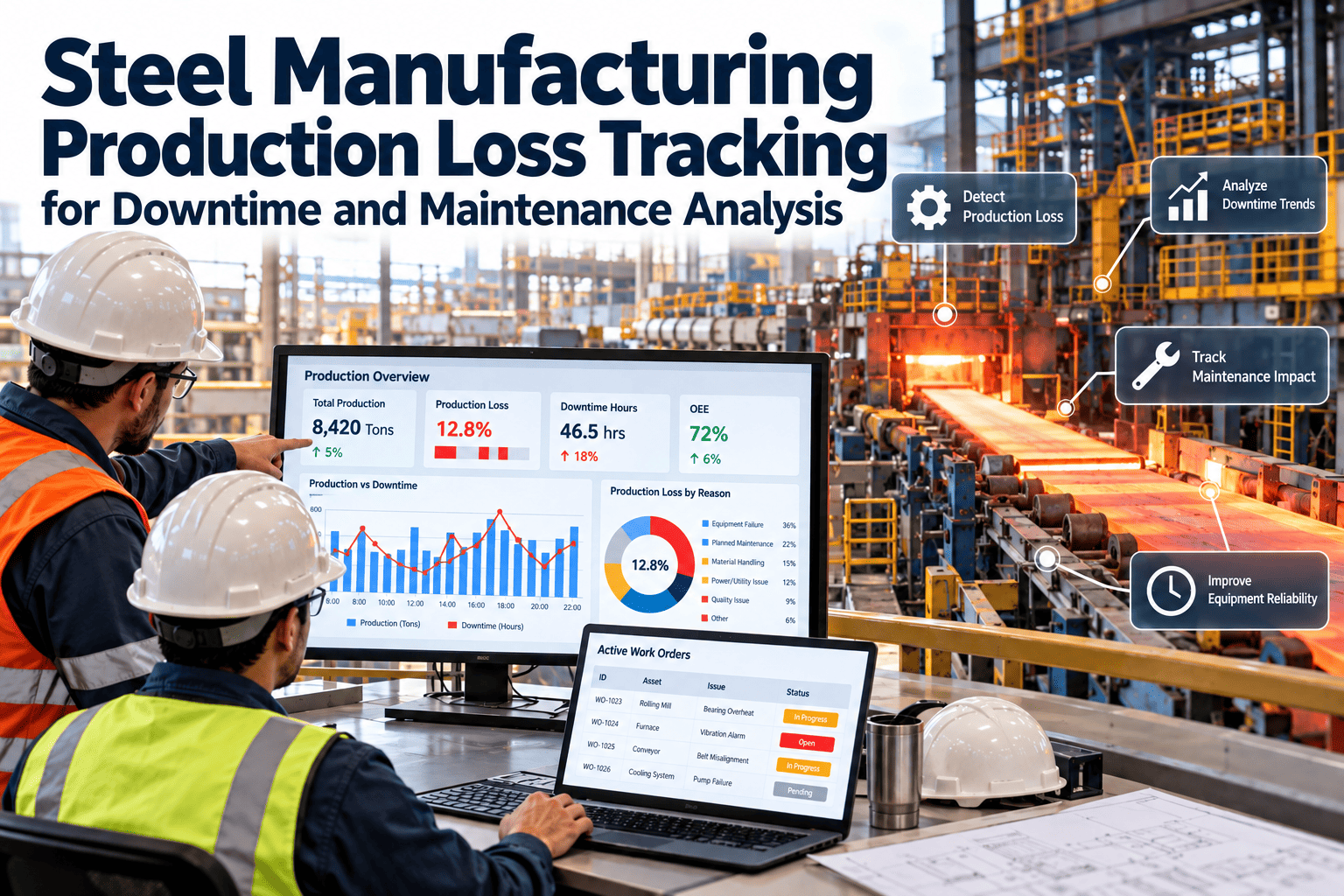
A steel plant shutdown that costs $4.2 million in planned maintenance can easily become a $9 million event — not because the maintenance scope changed, but because the costs that surround it were never properly accounted for: the lost production tonnage, the contractor overtime triggered by a delayed crane, the emergency airfreight on a part that was not stocked, the re-heat energy wasted when the caster sat idle for 18 hours beyond the planned window. Shutdown cost analysis is not an accounting exercise performed after the outage — it is a planning discipline that shapes every decision made in the 90 days before the first isolation lock-out. OxMaint's analytics and reporting platform gives steel plant maintenance leaders a structured shutdown cost model — tracking planned versus actual across every cost driver, in real time, from the first work order to the final production ramp-up.
Article · Shutdown Planning · Analytics & Reporting
Maintenance Shutdown Cost Analysis for Steel Plants
Production Loss Modelling · Labour & Contractor Tracking · Spares Cost Variance · Overrun Risk Scoring · Post-Shutdown ROI
Shutdown Cost Tracker · BF-2 Annual Outage
Labour & Contractors
$1.8M
Total Shutdown Cost: $6.7M · Planned: $5.2M · Variance: +$1.5M
42%
Of total shutdown cost in integrated steel is lost production — the largest single cost driver in every outage
$180k
Typical cost per day of blast furnace production loss — making every hour of overrun visible in financial terms
28%
Average shutdown cost overrun in steel plants without structured cost tracking — vs 6% with OxMaint analytics
Real-time
OxMaint cost dashboard updates as work orders close — actual vs planned visible to shutdown manager at all times
The Five Cost Drivers in Every Steel Plant Shutdown
01
Lost Production — The Dominant Cost
Production loss is calculated as planned shutdown duration multiplied by daily production value — but the real risk is the overrun multiplier. A blast furnace producing 4,000 tpd at $180/ton generates $720,000/day. Every unplanned day added to the outage adds that cost directly to the shutdown P&L.
OxMaint tracks planned vs actual outage duration in real time — alerting the shutdown manager when milestone delays indicate production loss risk.
02
Labour and Contractor Costs
A major steel plant shutdown typically involves 200–600 contractors alongside the in-house workforce. Labour cost overruns are caused by scope creep (additional work discovered during the outage), productivity losses from sequencing failures, and overtime triggered by delays in earlier work packages that cascade into later ones.
OxMaint's work order sequencing tracks contractor task completion rates against the shutdown schedule — identifying cascade delays before they propagate to the critical path.
03
Spare Parts and Materials
Planned spares cost can be modelled with precision if the work order BOM is well-defined before the outage. The cost that kills the budget is the emergency procurement — airfreighted parts, premium-price spot purchases, and expediting fees for components that were not identified in the pre-shutdown criticality analysis.
OxMaint logs every emergency procurement event against the work order that triggered it — providing the post-shutdown data needed to eliminate recurrence in the next outage cycle.
04
Contractor Delay Penalties
Contractor agreements for major outages often include schedule penalty clauses and resource retention costs when the outage overruns. Conversely, the plant also loses the cost of contractor mobilisation when a shutdown is extended and crew rotations add days of standby cost to the labour bill.
OxMaint contractor work order tracking creates a timestamped record of delays and causes — essential documentation for contract dispute resolution and future contractor performance evaluation.
05
Re-Heat and Utilities Waste
Every hour a steel plant sits idle after the planned restart window burns utility cost without producing revenue — re-heating refractory, maintaining ladle temperatures, running auxiliary equipment on standby. In EAF-based plants, energy cost during extended shutdowns can reach $40,000–$80,000 per day of overrun.
OxMaint's energy meter integration tracks utility consumption during the shutdown window — adding the energy cost dimension to the real-time cost dashboard for a complete overrun picture.
Shutdown Cost Model — Planned vs Actual Tracking
| Cost Category |
Planned ($) |
Actual ($) |
Variance |
Primary Driver |
| Production loss (planned downtime) |
$2,880,000 |
$3,240,000 |
+$360,000 |
1.5 day overrun — crane delay |
| In-house labour (shutdown roster) |
$480,000 |
$512,000 |
+$32,000 |
Overtime — refractory rework |
| Contractor labour |
$1,200,000 |
$1,380,000 |
+$180,000 |
Retention day × 3 — overrun |
| Planned spare parts (BOM) |
$880,000 |
$920,000 |
+$40,000 |
Scope addition — tuyere reline |
| Emergency procurement |
$0 |
$180,000 |
+$180,000 |
Unplanned airfreight × 4 items |
| Utilities / energy (overrun) |
$0 |
$112,000 |
+$112,000 |
1.5 day standby energy cost |
| Total Shutdown Cost |
$5,440,000 |
$6,344,000 |
+$904,000 (+16.6%) |
Avoidable with OxMaint analytics |
Know Your Shutdown Cost — Before the First Work Order Opens.
OxMaint gives steel plant maintenance leaders a real-time cost dashboard for every shutdown — planned vs actual, by category, by work order, and by day — so overruns are caught in hours, not discovered in the post-shutdown debrief.
"
Every major steel plant shutdown I have reviewed in the last twenty years has had the same pattern: the planned cost is rigorous, the actual cost is worse, and the variance analysis happens three weeks after the plant has restarted. By the time someone understands why the shutdown cost $900,000 more than planned, the contractors have demobilised, the part-level consumption records are incomplete, and the lessons that should feed the next shutdown plan have been diluted by time and memory. OxMaint changes that timeline by making the cost model live — every work order closure updates the actual cost, every emergency procurement is logged in real time, and the shutdown manager can see the cost trajectory building before it becomes unrecoverable. That real-time visibility is what allows course corrections: mobilising additional resources before the critical path slips, escalating the emergency part situation before the airfreight becomes unavoidable, resequencing the work pack before the crane window is missed. Post-shutdown cost analysis is valuable; real-time cost tracking is transformational.
Viktor Sobczak, MBA, CMRP
Director of Maintenance and Capital Projects · Central European Integrated Steel Group · 30 Years Steel Plant Shutdown Management, Cost Control, and Contractor Performance · Certified Maintenance and Reliability Professional (SMRP) · Specialist in blast furnace and caster major outage planning, shutdown cost modelling, and CMMS-integrated contractor management for operations producing 3–8 Mtpa
Frequently Asked Questions
How does OxMaint calculate production loss cost in real time during a shutdown?
OxMaint allows the maintenance planner to configure a production loss rate per hour or per day for each shutdown — based on the asset's planned production rate and the current market value of the product (tonnes per day times price per tonne). As the shutdown progresses, OxMaint compares the actual elapsed outage time against the planned duration milestone by milestone. When the actual time passes the planned milestone, the overrun production loss cost accumulates in the cost dashboard at the configured rate — giving the shutdown manager a live monetary value for the schedule variance that makes the urgency of recovery immediately visible. The production loss figure is broken down by planned downtime cost and overrun cost, so the analysis distinguishes the expected production sacrifice from the avoidable one.
Start a free trial and configure your shutdown cost model in OxMaint.
Can OxMaint generate a post-shutdown cost report suitable for board or CFO presentation?
Yes — OxMaint's shutdown analytics module generates a structured post-shutdown cost report automatically at shutdown close, including planned vs actual cost by category (production, labour, spares, emergency procurement, utilities), variance analysis with root cause classification for each significant overrun, work order cost breakdown showing which tasks exceeded budget and why, and a KPI summary covering outage duration, cost per maintenance hour, emergency procurement ratio, and overrun percentage. Reports export in PDF with visual charts and tables, or CSV for integration into ERP financial reporting. The report structure is designed to meet the information requirements of board-level capital expenditure review and annual maintenance budget justification processes.
Book a demo to see OxMaint's post-shutdown cost report format.
How does OxMaint track contractor delay costs and distinguish them from in-house workforce costs?
OxMaint supports separate contractor and in-house workforce cost tracking by assigning each work order to either an internal team or a named contractor company with a configured rate schedule — daily rate, hourly rate, or lump-sum contract value. As work orders progress and close, actual hours are logged against each work order by crew type. When a work order is delayed beyond the planned completion timestamp — for example, a crane contractor blocked by a sequencing dependency — OxMaint logs the delay event with a cause code and calculates the standby cost at the contractor's daily retention rate. At shutdown close, the contractor cost breakdown shows planned contract value, additional hours cost, retention days, and total cost by contractor — providing both the financial analysis and the performance data needed for contractor evaluation and next-shutdown contract negotiation.
Explore contractor cost tracking with a free OxMaint trial.
OxMaint · Steel Plant Shutdown Cost Analytics
From $5M Planned to $5M Actual. That Is What Real-Time Cost Analytics Delivers.
OxMaint tracks every shutdown cost driver in real time — production loss, labour, spares, emergency procurement, and utilities — so steel plant maintenance leaders can act on overruns while there is still time to recover them.