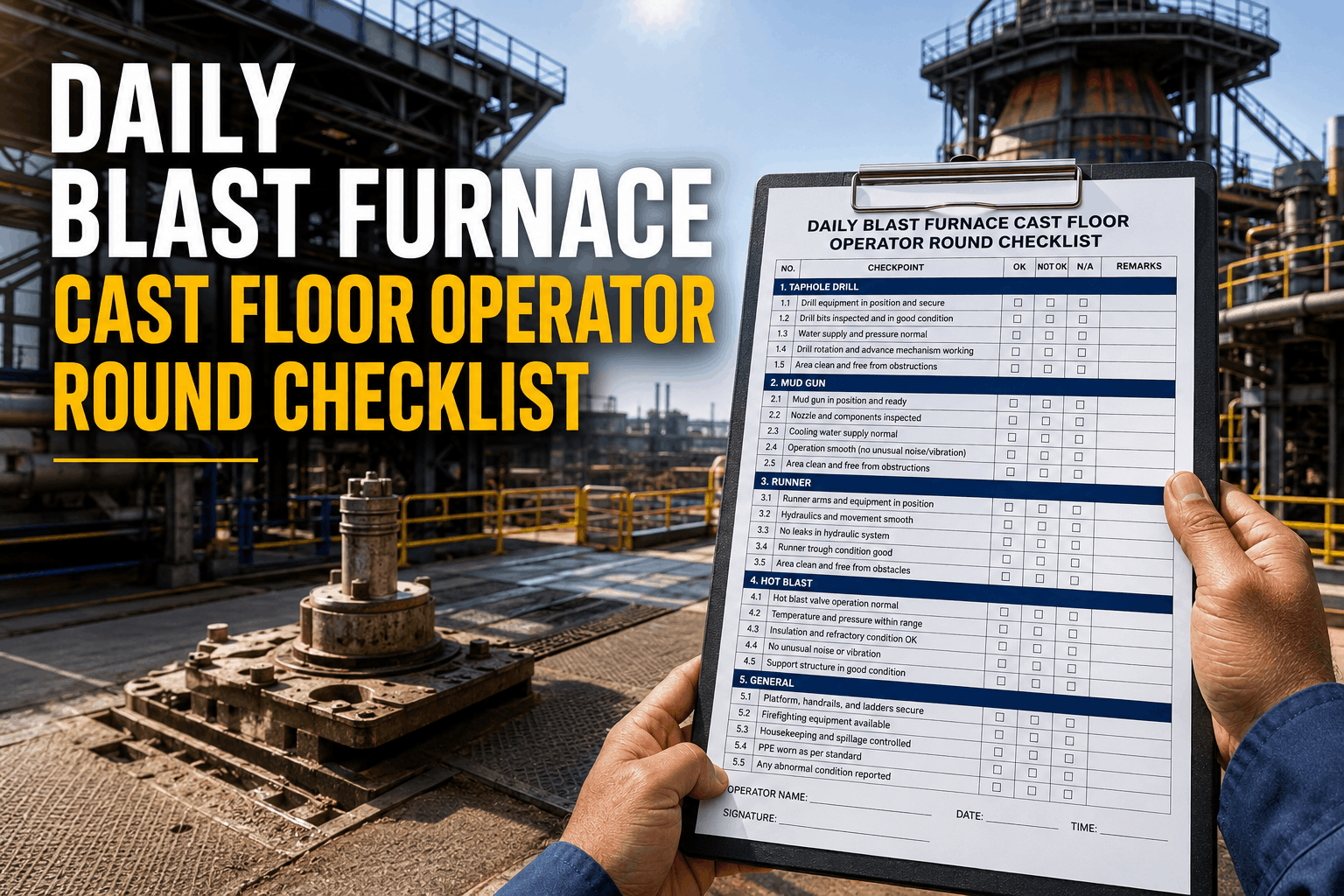
A blast furnace is one of the few pieces of industrial equipment where the consequences of a missed parameter check can escalate from a data point to a safety event within a single shift. Cooling water flow failure on a stave cooler, undetected BF gas leak at a tuyere, or burden descent arrest that goes unrecognised and untreated can each progress from anomaly to crisis in under two hours — faster than any reactive response system can compensate. The purpose of a structured daily monitoring checklist is not administrative compliance. It is the systematic collection of the early warning signals that give the furnace operator the 2–4 hour window between "something is changing" and "something has failed" in which corrective action is both possible and effective. Sign up for Oxmaint to activate this checklist as a digital daily round on any mobile device at your blast furnace.
Parameter Alert Level Key — used in all tables below
Cooling Water System — Stave Coolers, Tuyere Coolers & Shaft Cooling
Cooling water failure is the fastest path from normal operation to refractory damage in a blast furnace. A stave cooler that loses flow can reach damaging temperatures within 15–20 minutes. Cooling water monitoring is the highest-priority check on every operator round and must be completed first before moving to other checklist sections. Sign up for Oxmaint to log cooling water readings directly to your BF asset record on mobile.
Walk the cooling water manifold and check individual circuit flows and return temperatures for each stave zone, tuyere cooling ring, and shaft cooling panel. Any stave return temperature 15°C above adjacent stave baseline requires immediate investigation before proceeding.
| Parameter | Normal | Caution | Alarm Action |
|---|---|---|---|
| Inlet header pressure | 3.0–4.5 bar | <3.0 bar | Below 2.5 bar — call shift supervisor, check pump |
| Stave return ΔT over inlet | 8–15°C | 15–25°C | >25°C — reduce blast, cool-down protocol |
| Tuyere return temperature | <45°C | 45–55°C | >55°C — emergency notification, tuyere isolation |
| Cooling water pH | 7.5–9.5 | <7.5 or >9.5 | Below 7.0 or above 10.5 — water treatment emergency |
Swipe to view full parameter table
Hot Blast Parameters — Hot Blast Stoves, Blast Temperature & Volume
Hot blast parameters define the thermochemical state of every reaction zone in the furnace. Blast temperature directly controls the thermal reserve zone, coke rate, and iron production rate. Changes in blast volume or temperature that are not compensated in burden distribution will manifest as burden descent irregularities within 2–4 heats. Book a demo to see how Oxmaint logs hot blast readings against production heat records.
Read and log all hot blast parameters at the hot blast main instrument panel. Compare against the current production target. Any parameter deviation greater than 10% from target requires notification to the cast house manager before adjustment.
| Parameter | Normal Range | Caution | Alarm Trigger |
|---|---|---|---|
| Hot blast temperature | Target ±20°C | ±30°C from target | >1,250°C or <1,000°C |
| Blast volume | Target ±5% | Target −10% | >15% below target — blower/tuyere check |
| Hot blast pressure | 1.8–2.5 bar | ±0.15 bar from target | Sudden drop — tuyere damage suspected |
| Stove dome temp before blast | >1,350°C | 1,250–1,350°C | <1,200°C — delay stove change |
Swipe to view full parameter table
BF Gas System — Top Gas Pressure, Temperature & CO/CO2 Ratio
Blast furnace gas at the furnace top is 100–250 mbar above atmospheric pressure and contains 20–25% CO — a colourless, odourless gas with an IDLH of 1,200 ppm. Every BF gas system check is simultaneously a safety check and a process efficiency check. Top gas parameters are the earliest available signal of furnace operating condition changes. Sign up for Oxmaint to configure BF gas parameter alerts in your digital round template.
Walk the top gas system area wearing CO personal monitor. Verify all gas alarm detectors are active and reading non-zero (zero reading on a fixed CO detector indicates sensor failure, not clean air). Log top gas analysis from the gas analyser in the cast house control room.
Paper BF Round Logs Miss the Trend. Digital Rounds in Oxmaint Show It.
When cooling water return temperature rises 2°C per shift for three consecutive shifts, a paper log will show three separate readings that require active comparison. Oxmaint's digital round template shows the trend automatically — flagging the pattern before it reaches the alarm threshold.
Burden Descent & Stockline Monitoring
Burden descent monitoring is the primary indicator of furnace operating stability. A furnace descending at target rate, evenly distributed around the circumference, and responsive to burden material changes is a furnace in normal operation. Any deviation — slowing, arrest, or asymmetric descent — requires immediate diagnosis and response. Sign up for Oxmaint to link burden descent data to your PM schedules.
Verify burden descent rate from the stockline radar or mechanical probe readings in the control room. Cross-check with the theoretical descent rate calculated from blast volume and coke rate. Significant discrepancy between actual and theoretical descent rate indicates a burden anomaly requiring immediate investigation.
Tuyere & Tap Hole Condition — Visual Inspection
The tuyere peephole visual check is the operator's direct view into the combustion zone — the only area of the furnace interior visible during normal operation. An experienced operator can identify raceway irregularities, coke quality changes, and early burn-through conditions from tuyere flame characteristics. This check requires appropriate PPE including face shield rated for infrared exposure.
Walk the tuyere platform and inspect through each tuyere peephole glass. Use the approved peephole inspection procedure — face shield required. Check every tuyere around the full circumference. Log any tuyere showing abnormal flame or raceway condition in the digital round record immediately. Book a demo to see how Oxmaint logs tuyere position conditions with photo capture.
Safety & Emergency Systems — End-of-Round Check
The safety and emergency systems check is completed at the end of every operator round. An emergency system that is found defective at the end of a round was defective throughout that round — the sooner it is found, the sooner it is restored. Every item in this section that shows a deficiency is an immediate reporting obligation to the shift supervisor. Sign up for Oxmaint to configure automatic escalation when safety check items are flagged.
Why This Checklist Belongs in a Digital CMMS, Not a Paper Log Book
The operational content of this checklist is identical whether it is executed on paper or on a mobile device. The difference is what happens to the data after each round is completed.
We ran paper operator rounds for 18 years. The readings were always completed — our operators were diligent. The problem was that the readings sat in a log book, and no one had time to trend them. The first time we realised that Stave 14 cooling return temperature had been creeping up by 1.2°C per shift for 9 consecutive shifts was not from the log book. It was from the refractory inspection after we had to blow down for emergency stave replacement. All the information to catch it was in the log. No one had the time or the tool to see it. Oxmaint's trending showed us the pattern in week two of deployment. We have not had an unplanned stave replacement since.
Blast Furnace Daily Monitoring — Common Questions
Minimum three full rounds per 12-hour shift on a continuous production furnace — once at shift start, once mid-shift, and once before shift handover. During abnormal operating conditions (reduced blast, high burden descent variability, elevated stave temperatures), rounds should be increased to hourly or continuous patrol of critical areas until normal parameters are restored. The Oxmaint digital round template can be configured with a time-based alert that notifies the shift supervisor if a round has not been started within the required interval. Sign up for Oxmaint to configure round frequency alerts for your BF operation.
The Oxmaint digital round template classifies parameters as Normal, Caution, or Alarm in real time as the operator enters readings. A Caution reading automatically flags the item for shift supervisor notification within the round record. An Alarm reading — such as a tuyere return temperature above 55°C or a CO detector showing fault status — generates an immediate escalation notification to the shift supervisor and blast furnace engineer regardless of what stage in the round the operator has reached. The operator does not need to complete the round before the notification is sent. Book a demo to see parameter alert escalation in Oxmaint.
Yes — Oxmaint's digital round templates are fully configurable for each furnace's specific instrumentation and operating configuration. A furnace with PCI injection would add a pulverised coal flow rate section (CWS section parallel to BGS). A furnace with fewer tuyere positions would have the TYR section sized accordingly. A furnace with natural lump ore burden would have different burden descent rate targets than a pellet-burden furnace. The checklist structure — six sections covering cooling, hot blast, gas, burden, tuyere, and safety — applies to every blast furnace. The parameter values and specific check points are configured per furnace during Oxmaint setup.
When an operator completes their final round before shift handover, Oxmaint generates a shift summary report showing all readings from the shift, any items that were flagged as Caution or Alarm, any readings that showed a trend different from the previous shift, and any open corrective actions created from round findings. The incoming operator accesses this summary as part of their shift start on the same mobile device or their own device — seeing the outgoing shift's full round data before they begin their first round. This structured data handover replaces the informal verbal handover that traditionally loses nuance about gradual parameter changes. Sign up to configure the shift handover report for your BF operation.
Every Blast Furnace Round Completed on Paper Is Data That Cannot Trend. Start Logging in Oxmaint.
The difference between a paper log book and a digital round in Oxmaint is not the data collected — it is what happens to that data after the round is complete. Trending, alerting, shift comparison, and predictive pattern detection are all impossible with paper. They are all automatic with Oxmaint. Configure this six-section blast furnace daily monitoring checklist as a live digital round on every shift at your furnace.